 Norway
Deep fjords, mountains plunging into the sea, Arctic islands and a right to roam that lets everyone camp freely in nature.
Places not to miss
Geirangerfjord
A UNESCO-listed fjord with the Seven Sisters waterfalls.
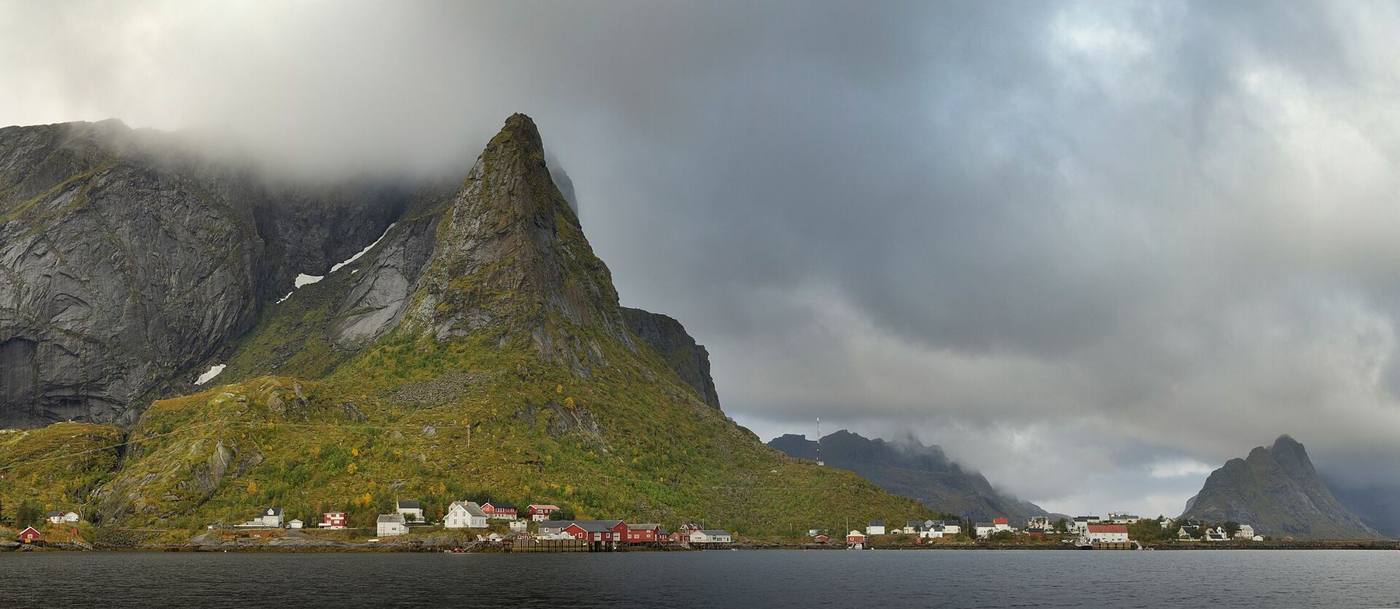
Lofoten Islands
Red fishing villages beneath sheer mountains, midnight sun.
Preikestolen
Pulpit Rock, a flat ledge 604 metres above the Lysefjord.
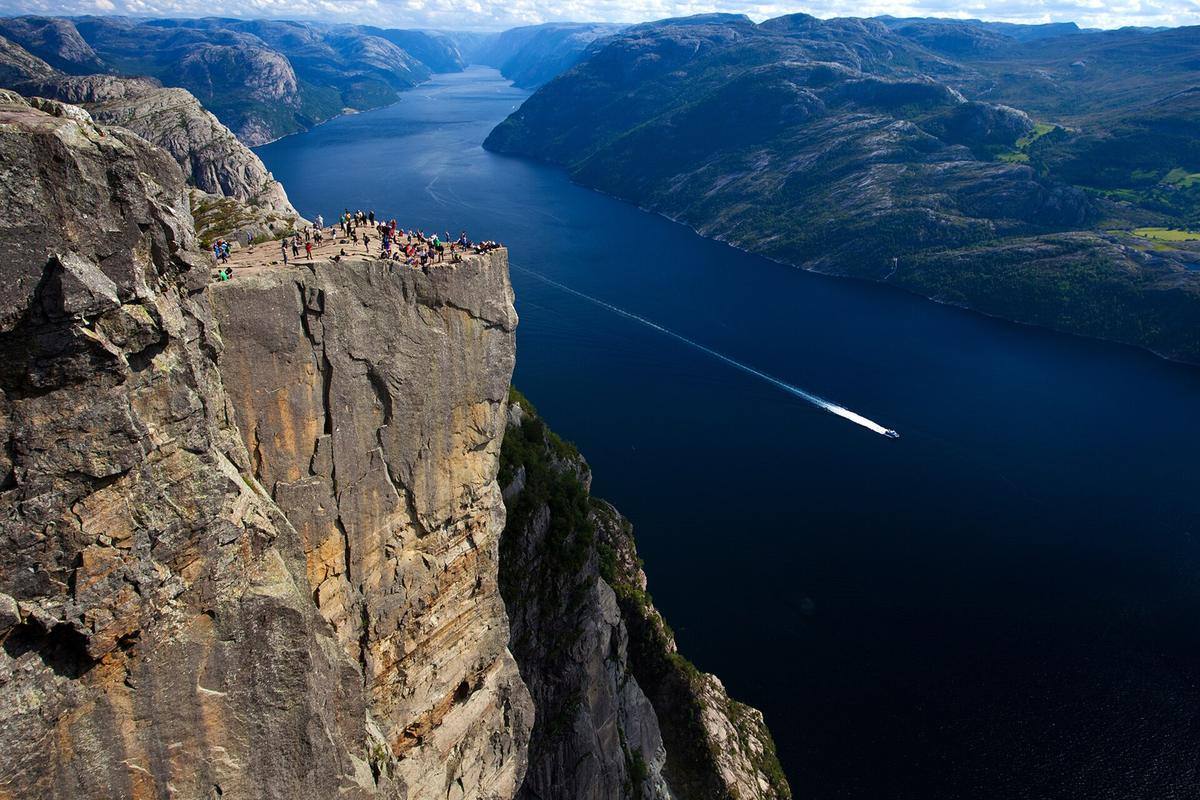
Photo: Svein-Magne Tunli, CC BY-SA 3.0 Bergen
The Hanseatic wharf of Bryggen with its colourful wooden houses.
Tromsø
Capital of the Arctic, northern lights and whales in winter.
Trolltunga
The suspended tongue of rock, a demanding hike.
Nature and wildlife
Moose, reindeer, musk oxen at Dovrefjell, orcas and humpbacks in the far north in winter, sea eagles.
Food and drink
Salmon, dried cod, brunost (brown cheese), waffles.
When to go
June-August for the fjords; September-March for the aurora.
Did you know?
Norwegians introduced salmon sushi, exporting salmon to Japan in the 1980s.
Itineraries in Norway
The fjords: Bergen to Geiranger
Bergen and Bryggen, the Sognefjord and the Flåm railway, Briksdal glacier, the Geirangerfjord and the Trollstigen road.
The Lofoten Islands
Fishing villages with red rorbu cabins, peaks plunging into the sea, white beaches and trails such as Reinebringen and Ryten.
North Cape and Finnmark
The midnight sun at North Cape, the rock carvings of Alta, Sami culture in Karasjok and fishing villages on the Barents Sea.
Tromsø and the northern lights
The Arctic capital in winter: aurora chasing by minibus, husky and reindeer sledding, and orcas in the fjords from November to January.
The Hurtigruten from Bergen to Kirkenes
Six days on the coastal ship along the whole coast, with 34 ports, the Trollfjord, Lofoten and North Cape, then three days in Kirkenes and Tromsø.
Trolltunga, Preikestolen and Kjerag
Norway's three most famous hikes: the troll's tongue above Lake Ringedalsvatnet, the pulpit above the Lysefjord and the wedged boulder of Kjerag.
Oslo and Norway in a Nutshell
Two days in Oslo between the Opera, the Munch museum and the Viking ships, then the train, boat and bus route through the fjords to Bergen.
Svalbard: polar bears and ice
A thousand kilometres from the North Pole: Longyearbyen, glaciers by boat, the Russian mining town of Barentsburg, walruses and, with luck, polar bears.
Atlantic Road, Trollstigen and Ålesund
A road loop from Ålesund: the Atlantic Road across bridges between islets, the Romsdal valley, the hairpins of Trollstigen and the Geirangerfjord.
Senja and Vesterålen
The quiet alternatives to Lofoten: the sheer mountains of Senja and sperm whale safaris from Andenes in Vesterålen.
Oslo in depth
The capital on its fjord: the Opera House roof you can walk on, the Munch Museum and the new National Museum, Vigeland Park and its sculptures, the Bygdøy peninsula with the polar ships Fram and Kon-Tiki and the open-air museum, and a floating sauna in the harbour.
Jotunheimen and the Besseggen ridge
The home of the giants: the Besseggen ridge traverse between green Lake Gjende and blue Lake Bessvatnet, the scenic Sognefjellet road, the guided ascent of Galdhøpiggen, the highest peak in Northern Europe, and the mountain lodges.
Rondane and Dovrefjell
Norway's high plateaus: the country's first national park, Rondane, with its rounded peaks and wild reindeer, then the Dovrefjell plateau with guided walks to see musk oxen, Ice Age animals, and the Snøhetta reindeer observation pavilion.
The Sørlandet south coast
The Norwegian summer by the sea: white wooden towns such as Lillesand, Grimstad and Arendal, the archipelago of smooth rocks to explore by boat or kayak, Kristiansand with its centre and beaches, and Lindesnes lighthouse, the southernmost point of mainland Norway.
Trondheim and Røros
From the city of the Viking kings to the mining town: Nidaros Cathedral, the old bridge and the colourful wharf houses on the Nidelva in Trondheim, then Røros, a UNESCO site, with the wooden houses of the copper miners, the slag heaps and the baroque church.
The Helgeland coast
The Kystriksveien coastal route south of the Arctic Circle, made of ferries and bridges: the holed mountain of Torghatten, the Seven Sisters, the Vega archipelago (UNESCO) known for eiderdown gathering, the Svartisen glacier and the Saltstraumen tidal current.
The Rallarvegen by bike
The road of the Bergen Railway builders, now the country's most famous cycle route: from the Hardangervidda plateau at Haugastøl, past lakes and snowfields even in summer, to Finse and Myrdal, then the hairpin descent down the Flåm valley to the fjord.
Telemark: the canal and the stave churches
Rural inland Norway: a cruise on the Telemark Canal through its 19th-century locks to Dalen, Heddal stave church, the largest in the country, the Rjukan hydroelectric site (UNESCO) and the cable car built to bring winter sun to the valley.
The Lyngen Alps
Pointed mountains dropping into the sea east of Tromsø: in summer, hikes to the glacial lake of Blåisvatnet and kayaking in the fjord under the midnight sun; in winter, ski touring down to the sea and northern lights far from city lights.
Bergen in depth and its mountains
The city between seven mountains: the Hanseatic houses of Bryggen (UNESCO), the fish market, the Fløyen funicular and the ridge walk to Ulriken, the KODE museums with works by Munch and Edvard Grieg's home at Troldhaugen.
Practical guide to Norway
- Documents
- EU citizens need only a valid identity card or passport. Norway is not part of the European Union but is in the Schengen area, so there are no systematic checks on flights from other Schengen countries.
- Safety
- One of the safest countries in the world. Risks are natural: fast-changing mountain weather, rockfalls on fjord roads, long tunnels, mountain roads closed from October-November to May-June. In the mountains follow the Norwegian mountain code: tell someone your route and turn back if the weather worsens. Official advice: GOV.UK.
- Getting around
- Trains link Oslo, Bergen, Trondheim and Bodø; boats and ferries ply the fjords, many of them electric; regional buses fill the gaps. In fjord country a car gives great freedom: roads have automatic tolls and many ferries are part of the road network. The coastal ship links Bergen with the north as far as Kirkenes.
- Verified costs
- We do not give a single daily figure: Norway is among Europe's most expensive countries. Certain costs in 2026: the Flåm Railway starts from 399 kroner for an adult one-way ticket, half for children aged 6 to 17 (source vy.no). Trollstigen and other mountain tourist roads are usually open from mid-May to October or November and can also close suddenly (source Visit Norway). Some tourist municipalities may apply an accommodation tax of up to 3 per cent, only if approved by the government.
Climate month by month
Average minimum and maximum temperatures in Bergen (west coast), Oslo (south-east) and Tromsø (north, beyond the Arctic Circle). The coast is mild and rainy, the interior colder in winter; in summer the sun never sets in the north.
- January
- Bergen 1 / 5 °C · Oslo -5 / 0 °C · Tromsø -5 / 0 °C
- February
- Bergen 0 / 5 °C · Oslo -5 / 1 °C · Tromsø -6 / -1 °C
- March
- Bergen 1 / 7 °C · Oslo -2 / 5 °C · Tromsø -4 / 1 °C
- April
- Bergen 4 / 11 °C · Oslo 2 / 11 °C · Tromsø -2 / 4 °C
- May
- Bergen 7 / 15 °C · Oslo 7 / 17 °C · Tromsø 3 / 9 °C
- June
- Bergen 10 / 18 °C · Oslo 11 / 20 °C · Tromsø 7 / 12 °C
- July
- Bergen 12 / 20 °C · Oslo 13 / 23 °C · Tromsø 9 / 16 °C
- August
- Bergen 12 / 19 °C · Oslo 13 / 21 °C · Tromsø 8 / 15 °C
- September
- Bergen 10 / 16 °C · Oslo 9 / 16 °C · Tromsø 5 / 11 °C
- October
- Bergen 6 / 12 °C · Oslo 4 / 10 °C · Tromsø 1 / 5 °C
- November
- Bergen 3 / 8 °C · Oslo 0 / 4 °C · Tromsø -2 / 2 °C
- December
- Bergen 1 / 5 °C · Oslo -4 / 1 °C · Tromsø -4 / 1 °C
Source: Climats et Voyages (1991-2020). Data and prices checked in November 2026.
Where to go and where not to
There are no particular warnings beyond normal precautions; before booking, always check up-to-date official travel advice, because the situation can change.