 Colombia
Places not to miss
Cartagena
The walled city.
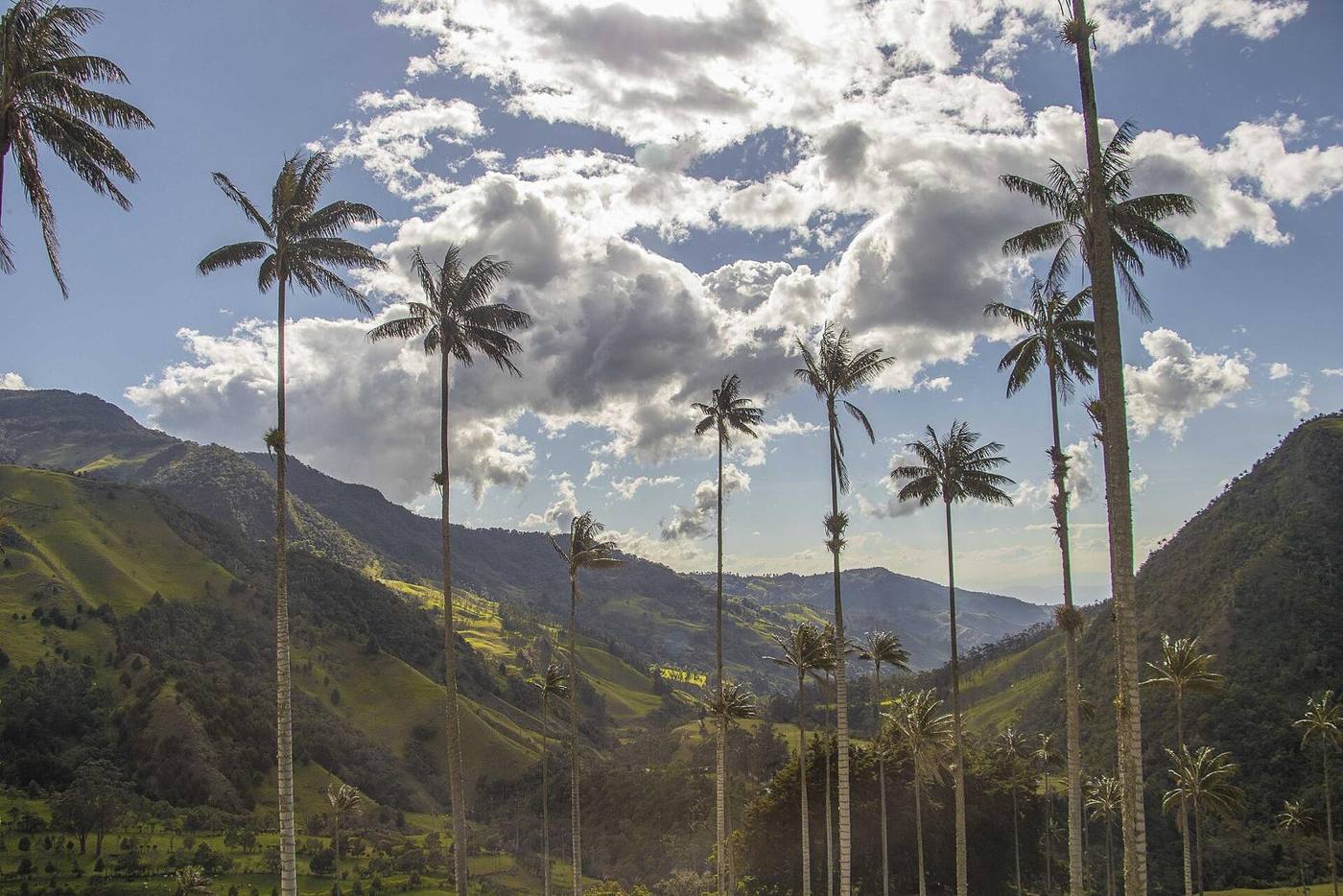
Cocora Valley
Wax palms.
Medellín
Comuna 13.
Tayrona
Beaches in the jungle.
Caño Cristales
The river of five colours.
Nature and wildlife
More bird species than any other country, pink river dolphins.
Food and drink
Bandeja paisa, arepas.
When to go
December-March and July-August.
Did you know?
It is the country with the most bird species in the world.
Itineraries in Colombia
Cartagena and the Rosario Islands
The finest walled city in the Caribbean, the Getsemaní district, San Basilio de Palenque and two days at sea in the Rosario Islands.
The coffee region and the Cocora Valley
Coffee farms between Salento and Filandia, the sixty-metre wax palms of the Cocora Valley and the Santa Rosa hot springs.
Trek to the Ciudad Perdida
Four days on foot in the Sierra Nevada de Santa Marta, fording rivers and passing Kogi villages, to the lost city of the Tayrona.
Tayrona, Minca and Palomino
The Caribbean coast below the Sierra Nevada: the jungle beaches of Tayrona park, the waterfalls and coffee of Minca, the river at Palomino.
Medellín and Guatapé
The city of eternal spring and its rebirth, Comuna 13 with its escalators and murals, then the lake and the Peñol rock at Guatapé.
Bogotá, Villa de Leyva and Zipaquirá
The Gold Museum and La Candelaria in Bogotá, the salt cathedral of Zipaquirá and the great colonial square of Villa de Leyva.
Classic Colombia
Bogotá, Medellín, the coffee region and the Caribbean between Cartagena and Tayrona park: the ideal first trip to the country.
La Guajira and Punta Gallinas
By 4x4 through the Wayuu desert to Cabo de la Vela and the dunes that drop into the sea at Punta Gallinas, the northernmost point of South America.
San Agustín and the Tatacoa Desert
The pre-Columbian stone statues of San Agustín, the gorges of the Magdalena river and starry nights in the red and grey Tatacoa Desert.
The Pacific: Nuquí and the whales
The Chocó coast, where jungle meets the beach: humpback whales with calves a few metres from the boat, waterfalls, hot springs and Afro-Colombian villages.
Bogotá in depth
The capital at 2,600 metres: the colonial Candelaria district, the Gold Museum with thousands of pre-Hispanic pieces, the Botero Museum, Monserrate sanctuary by cable car, the downtown murals, Paloquemao market with fruits you have never seen and Usaquén on a Sunday.
Mompox, the town on the river
The colonial town frozen in time on a branch of the Magdalena River, a UNESCO site: yellow-painted churches, houses with wrought-iron grilles, silver filigree workshops, the Holy Week processions and a dawn boat trip through the Ciénaga de Pijiño wetlands.
San Andrés and Providencia
Colombia's Caribbean islands, closer to Nicaragua than to Bogotá: the sea of seven colours around San Andrés, Johnny Cay and the natural aquarium, then Providencia, a quiet island of Raizal culture, with its barrier reef and McBean Lagoon marine park.
Santander: Barichara, San Gil and the Chicamocha canyon
The adventure department: Barichara, perhaps the country's most beautiful colonial village, the Camino Real on foot to Guane, rafting and the Juan Curí falls around San Gil, and the cable car over the Chicamocha canyon, one of the deepest in South America.
Caño Cristales, the river of five colours
In the Serranía de La Macarena an aquatic plant turns the riverbed red, pink and purple between yellow rocks, green water and blue sky: reached by plane and on foot with local guides, among waterfalls, pools and savannah trails.
The Amazon: Leticia and Puerto Nariño
Colombia's southern tip on the Amazon, where Colombia, Brazil and Peru meet: Monkey Island, pink river dolphins in the Tarapoto lakes, the village closed to cars of Puerto Nariño, night walks in the forest and the Tikuna communities.
Jardín and Jericó in Antioquia
The coffee towns south of Medellín: Jardín with its square of colourful balconies, the neo-Gothic basilica, the cable car up the mountain and the Retiro waterfall, then Jericó, with its painted houses, leather workshops and the Morro El Salvador viewpoint.
Tolú and the San Bernardo islands
The quiet Caribbean of the Gulf of Morrosquillo: the town of Tolú with its seafront and the mangroves of the Ciénaga de La Caimanera by canoe, the San Bernardo islands with Múcura and Tintipán, and Santa Cruz del Islote, one of the most densely populated islands in the world.
Los Nevados and the Otún lagoon
High-altitude trekking in the Central Cordillera: from the Cocora valley or Potosí you climb through cloud forest and páramo, the Andean moorland with its frailejones, to the Otún lagoon just under 4,000 metres, sleeping in mountain farms.
Barranquilla and its Carnival
One of the world's largest carnivals, UNESCO intangible heritage: four days before Ash Wednesday of parades, cumbia, marimonda and congo masks and the Battle of Flowers, then the Carnival museum, the Ventana al Mundo on the Magdalena River and the town of Puerto Colombia.
Practical guide to Colombia
- Documents
- EU citizens enter without a visa for tourism for up to 90 days with a valid passport. Before the flight, between 72 hours and one hour before departure, you must fill in the Check-MIG form online on the official Migración Colombia website: it is at no cost.
- Safety
- The United States rates Colombia level 3 for crime and terrorism, with level 4 for Arauca, Cauca except Popayán, Valle del Cauca except Cali, Norte de Santander and 10 km from the Venezuelan border. In tourist areas use app taxis, do not display valuables and never accept drinks from strangers. Official advice: GOV.UK.
- Getting around
- Between regions you fly: Bogotá, Medellín, Cartagena and Pereira are linked by short flights. Mountain roads are slow and it is best not to travel at night. In cities use app taxis.
- Verified costs
- The Check-MIG form is at no cost. We give no other figures: prices of reserves and excursions change often and we could not verify them from official sources. In the Cocora Valley and on the Rosario Islands carry cash in pesos.
Climate month by month
Average minimum and maximum temperatures in Bogotá, Cartagena and Medellín, plus rainfall in Bogotá. Near the equator temperatures change little through the year: they depend on altitude. Rain is heaviest in April and May and in October and November.
- January
- Bogotá 7 / 20 °C · Cartagena 24 / 31 °C · Medellín 18 / 28 °C · Bogotá rain 30 mm
- February
- Bogotá 8 / 20 °C · Cartagena 24 / 31 °C · Medellín 18 / 28 °C · Bogotá rain 45 mm
- March
- Bogotá 9 / 20 °C · Cartagena 25 / 31 °C · Medellín 18 / 28 °C · Bogotá rain 65 mm
- April
- Bogotá 10 / 20 °C · Cartagena 26 / 32 °C · Medellín 18 / 28 °C · Bogotá rain 100 mm
- May
- Bogotá 10 / 20 °C · Cartagena 26 / 32 °C · Medellín 18 / 28 °C · Bogotá rain 95 mm
- June
- Bogotá 9 / 19 °C · Cartagena 26 / 32 °C · Medellín 18 / 28 °C · Bogotá rain 55 mm
- July
- Bogotá 9 / 19 °C · Cartagena 26 / 32 °C · Medellín 18 / 29 °C · Bogotá rain 45 mm
- August
- Bogotá 9 / 19 °C · Cartagena 26 / 32 °C · Medellín 18 / 28 °C · Bogotá rain 45 mm
- September
- Bogotá 8 / 20 °C · Cartagena 26 / 32 °C · Medellín 18 / 28 °C · Bogotá rain 70 mm
- October
- Bogotá 8 / 20 °C · Cartagena 26 / 32 °C · Medellín 18 / 27 °C · Bogotá rain 105 mm
- November
- Bogotá 9 / 20 °C · Cartagena 25 / 31 °C · Medellín 18 / 27 °C · Bogotá rain 90 mm
- December
- Bogotá 8 / 20 °C · Cartagena 25 / 31 °C · Medellín 18 / 27 °C · Bogotá rain 50 mm
Source: Climats et Voyages (temperatures 1991-2020; for rainfall the period is not stated). Data and prices checked in November 2026.
Where to go and where not to
Avoid the areas listed above and before booking, always check up-to-date official travel advice, because the situation can change.