Nan and Phrae
Northern Thailand off the beaten track: Nan with Wat Phumin and its murals, the mountains of Doi Phu Kha and the salt village of Bo Kluea, Phrae with its teak houses and Burmese-style temples.
- Phrae
- Nan
- Doi Phu Kha
- Bo Kluea
Day by day
- Day 1
Phrae: the teak houses and Wat Phra That Cho Hae
Nan and Phrae are two provinces in northern Thailand, near the border with Laos, far from the main tourist circuits. They are lands of valleys planted with rice, forest-covered mountains, old temples with a style of their own and villages of ethnic minorities. For centuries they were small, almost independent kingdoms, linked to the Lanna kingdom of Chiang Mai and to Laos. In five days it is the right trip for those who have already seen Chiang Mai and are looking for a quieter, more authentic Thailand.
You reach Phrae by bus or car from Chiang Mai in about three or four hours, or on a flight from Bangkok. The old town is enclosed by a moat and the remains of walls, and it is famous for teak: the forests around it were once full of these precious trees, and timber companies, British ones among them, were based here.
In the morning, visit one of the town's large teak houses, such as Vongburi House, a late nineteenth-century residence with windows and balconies decorated with wood carving like lace, now a museum with furniture, photographs and family objects. Then walk through the streets of wooden houses in the old town and the small temples.
In the afternoon, leave town and go about ten kilometres to Wat Phra That Cho Hae, a hilltop temple with a large chedi, the bell-shaped tower that holds a relic, covered in gold and wrapped in golden cloth, which gives the temple its name. It is an important place of pilgrimage, especially for those born in the Year of the Tiger in the Chinese calendar.
Practical tip: in temples, cover your shoulders and knees and take off your shoes before entering the buildings.
- Day 2
The road to Nan and Wat Phumin at sunset
In the morning, before leaving, visit Phae Mueang Phi near Phrae, whose name means roughly the land of ghosts: a small park where erosion has carved pinnacles, columns and walls in red and yellow earth, like a landscape from another planet. According to local legends it was a place inhabited by spirits. An hour or two is enough to walk around it.
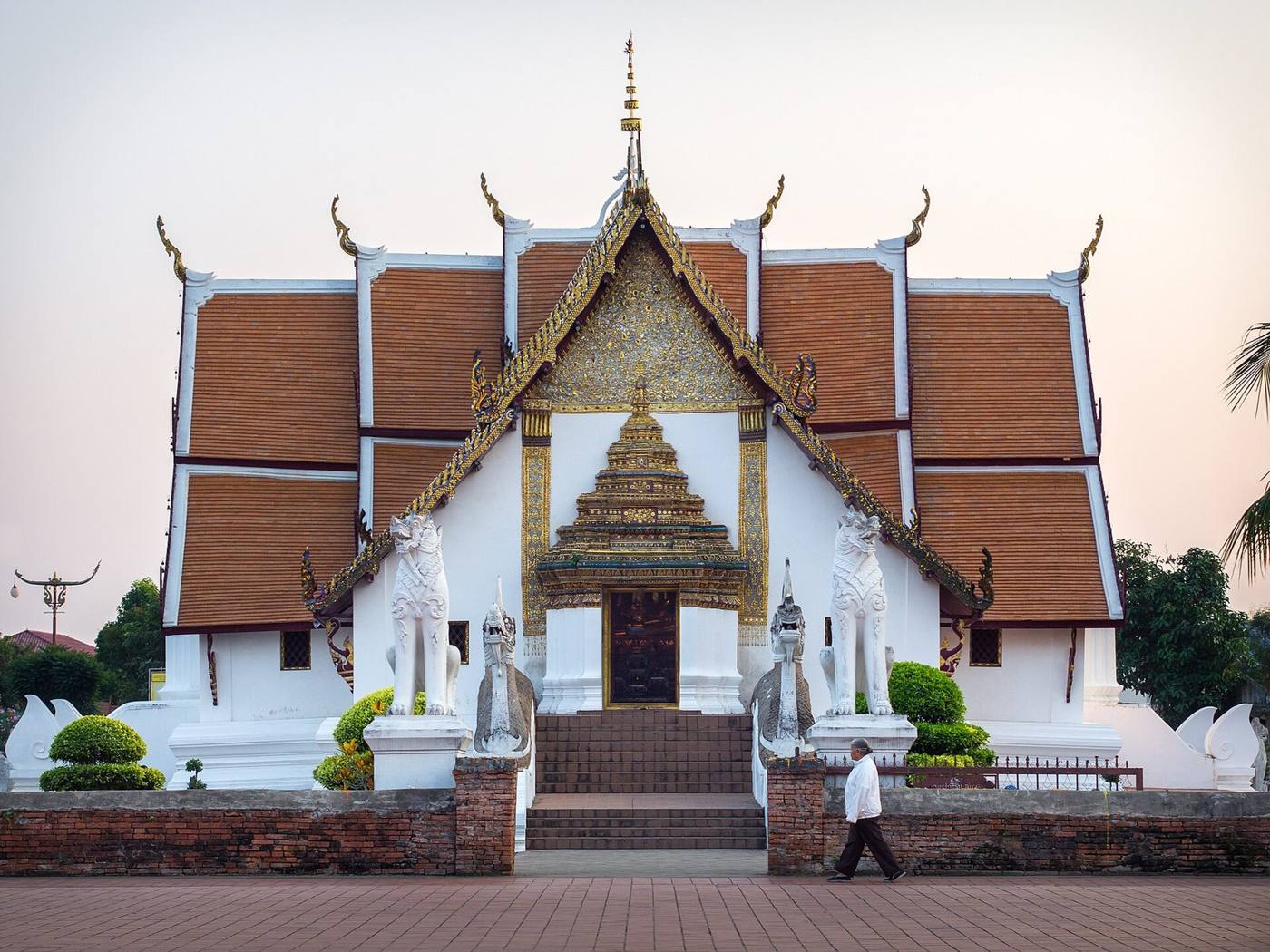
Then take the road north-east to Nan, about two and a half hours through farmed hills, rice fields and woods. Nan is a quiet town on the banks of the river of the same name, with many temples, wooden houses and a slow pace. Drop off your bags and, in the late afternoon, walk to Wat Phumin, the most famous temple in the province.
Wat Phumin has an unusual cross shape, with four staircases and four doors on its sides, each with a large seated Buddha facing a different direction. The base is held up by two large naga, the mythical serpents, which seem to pass right through the building. But the real treasure is the nineteenth-century murals inside, painted by a Tai Lue artist: they tell stories of the Buddha's previous lives, but also scenes of daily life in Nan, with farmers, foreign merchants, soldiers, women combing their hair and couples. The most famous shows a man whispering something into a woman's ear, and it has become the symbol of the town.
In the evening, next to the temple, there is often a market with northern street food, music and stalls.
Practical tip: the murals at Wat Phumin are fragile: do not use flash and do not touch the walls.
- Day 3
The Nan National Museum and Wat Phra That Chae Haeng
In the morning, visit the Nan National Museum, housed in the old palace of the town's princes, a white early twentieth-century building right opposite Wat Phumin. The museum tells the history of the small kingdom of Nan, its links with Lanna and Laos, and the lives of the province's different peoples, such as the Tai Lue, Hmong, Mien and Mlabri, with traditional clothes, silver jewellery, musical instruments and tools. Its most famous piece is a black elephant tusk, considered sacred and lucky.
Then walk along the Nan river and through the centre, among the smaller temples, such as Wat Phra That Chang Kham, with elephant statues that seem to hold up the chedi, and Wat Hua Khuang, with its northern-style wooden roof.
In the afternoon, cross the river and go a few kilometres to Wat Phra That Chae Haeng, on a hill surrounded by rice fields. You climb a staircase guarded by two large colourful naga, their scales shining in the sun. At the top is a tall golden chedi containing a relic of the Buddha, and a temple with a tiered roof that reaches almost to the ground. At sunset the light on the chedi and the view over the valley are lovely.
In the evening, if they are happening, watch the long boats practising from the riverbank: in Nan, between September and October, races are held with large rowing boats decorated with naga heads, a much loved tradition.
Practical tip: in Nan it is worth renting a bicycle or a scooter to get around the temples, which are close together but spread out.
- Day 4
Doi Phu Kha and the salt wells of Bo Kluea
Today you go up into the mountains north-east of Nan, towards the border with Laos. You need a car, preferably with a driver, because the roads are steep, narrow and full of hairpin bends.
The first stop is Doi Phu Kha National Park, about an hour and a half from town, one of the largest and best preserved mountain forests in northern Thailand. From the viewpoints along the road you see rows of forested mountains fading towards Laos, often with mist rising from the valleys in the morning. The park has waterfalls, caves and trails. In January and February the chomphu phu kha blooms, a very rare tree with clusters of pink flowers that in Thailand grows almost only here: at that time many Thais come to photograph it.
In the afternoon, go down to the village of Bo Kluea, in a narrow valley between the mountains. Here, very far from the sea, the villagers extract salt from wells of salty water that rise from underground, as they have done for centuries. The water is drawn up in buckets, then boiled in large pans over a wood fire until only the white salt remains, which is packed into bags. You can see the whole process and buy mountain salt, also used in cooking and for massages.
Around the village there are terraced rice fields and small country guesthouses: if you like, sleep here to enjoy the silence of the mountains.
Practical tip: between November and February, nights and mornings in the mountains are cold, sometimes close to freezing, so bring a jacket. In the rains, from June to October, the road may have landslides.
- Day 5
Return to Nan and the flight
On your last morning, if you slept in Bo Kluea, get up early to see the morning mist in the valley and the first activity at the salt wells. Then drive down to Nan, about two hours on mountain roads.
On the way you can stop in one of the Tai Lue villages of the province, such as Nong Bua, with its temple decorated with murals in the same style as Wat Phumin, or in a village where the women weave traditional cotton cloth on looms, with colourful patterns called nam lai, like flowing water. Buying a textile directly from the weavers is the best way to take home a genuine souvenir of the region.
Once back in Nan, if you still have some time, take a last walk around the morning market, with mountain vegetables, rice sweets and northern food, such as khao soi, a curry noodle soup with coconut milk, and sai ua, the herb sausage.
In the afternoon, go to Nan airport, small and close to the centre, for the flight back to Bangkok, just over an hour. Alternatively, you can return to Chiang Mai by bus or car in about six hours, or continue to Chiang Rai.
Practical tip: since 15 September 2026 Italian citizens can enter Thailand without a visa for tourism for up to 30 days, and before each arrival they must fill in the Thailand Digital Arrival Card, the TDAC, online within the three days before.
For those who have already seen Chiang Mai and want a quiet Thailand. Mountain roads towards Bo Kluea are steep and winding. Nan has a small airport with flights from Bangkok. Since 15 September 2026 Italians can enter without a visa for tourism for up to 30 days (previously 60), and the Thailand Digital Arrival Card (TDAC) must be completed online before every arrival.
Before you go
- Documents and visa
- Passport valid for at least six months. Since 15 September 2026 many nationalities, including most EU citizens, enter without a visa for tourism for up to 30 days. Before each entry, within the three days beforehand, the no-cost Thailand Digital Arrival Card (TDAC) must be completed online on the official website.
- Health and vaccines
- No vaccines required arriving from Europe; ask your doctor about hepatitis A and typhoid. Dengue is present: use repellent. Do not drink tap water. Health insurance recommended. Emergencies: 191 police, 1669 ambulance, 1155 tourist police.
- Money and payments
- Baht. Cards accepted in cities and hotels; markets and small places need cash. ATMs charge a flat fee for withdrawals with foreign cards.
- Power sockets
- Types A, B, C and O, 220 volts: bring a universal adapter.
- Time zone
- UTC+7, no daylight saving time.
- Safety
- A safe country for travellers. Avoid the southernmost provinces near Malaysia and the border strip with Cambodia. Beware of tuk-tuk and gem scams, and of scooter traffic. Official advice: GOV.UK.
Information checked in November 2026 for Italian and EU citizens. Rules change: always check before you travel.
Variations
In 3 days: Nan only, with Wat Phumin, the museum, Wat Phra That Chae Haeng and Bo Kluea, flying from Bangkok there and back.
In 8 days: add Chiang Mai at the start and, after Nan, continue to Chiang Rai and the Golden Triangle.
Frequently asked questions
When is the best time to go?
From November to February, with a cool, dry climate, and in January and February the blossom on Doi Phu Kha. From March to April it is hot and often hazy from agricultural fires; from June to October it rains.
Do I need a car?
In the towns a bicycle, scooter or tuk tuk is enough, but for Doi Phu Kha and Bo Kluea you need a car, preferably with a driver, because the mountain roads are steep and winding.
What documents do I need?
A valid passport. Italian citizens can enter without a visa for tourism for up to 30 days and must fill in the TDAC online before arrival.
Indicative itinerary written by World Atlas. Before booking, check timetables, seasonal openings, documents and safety.
 4 daysEasy
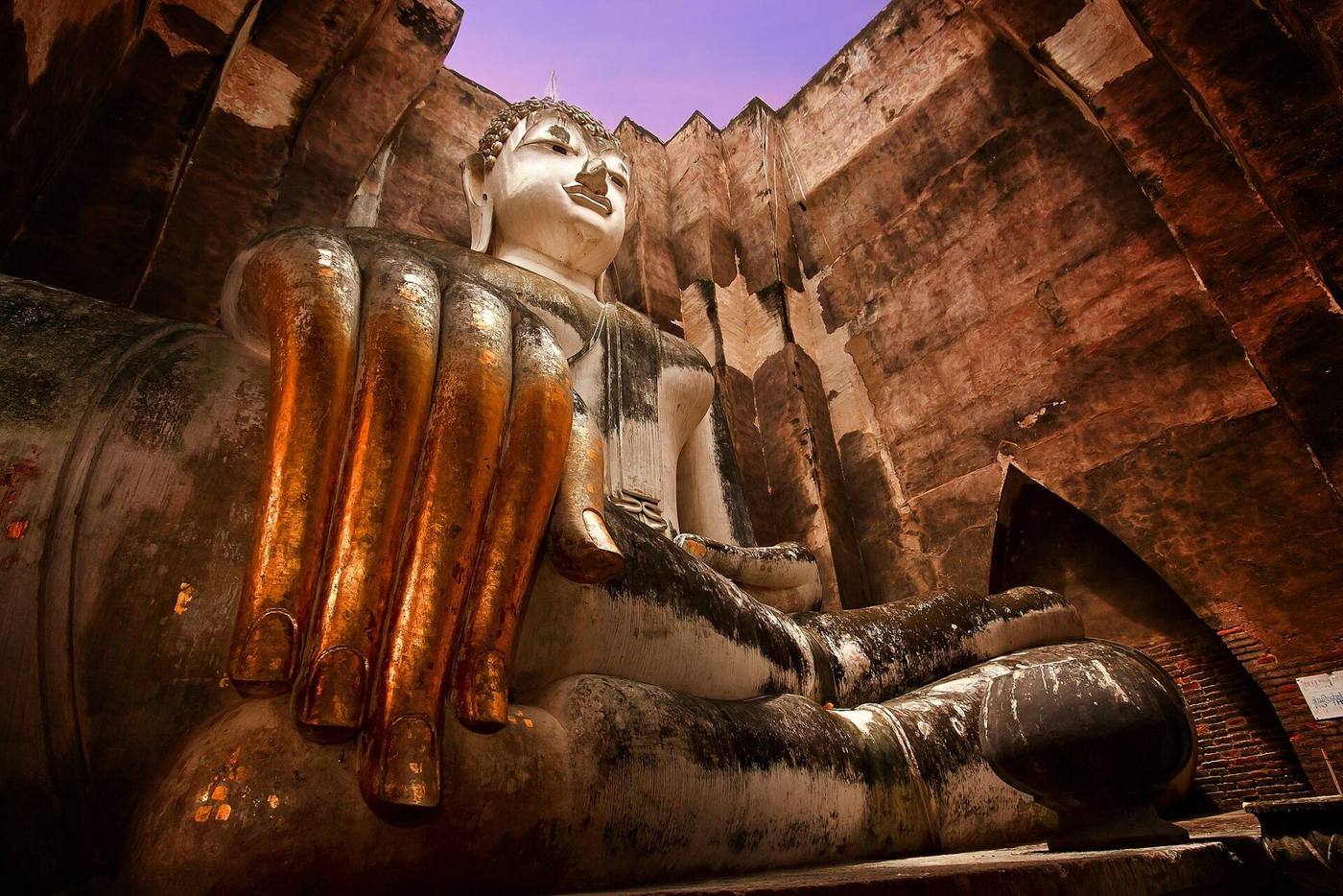
Sukhothai, Si Satchanalai and Kamphaeng Phet
The first capitals of the Thai kingdom, a UNESCO World Heritage site: the historical parks of Sukhothai, to explore by bicycle among Buddhas and lotus ponds, Si Satchanalai among the trees and Kamphaeng Phet with laterite temples in the forest.
 8 daysEasy
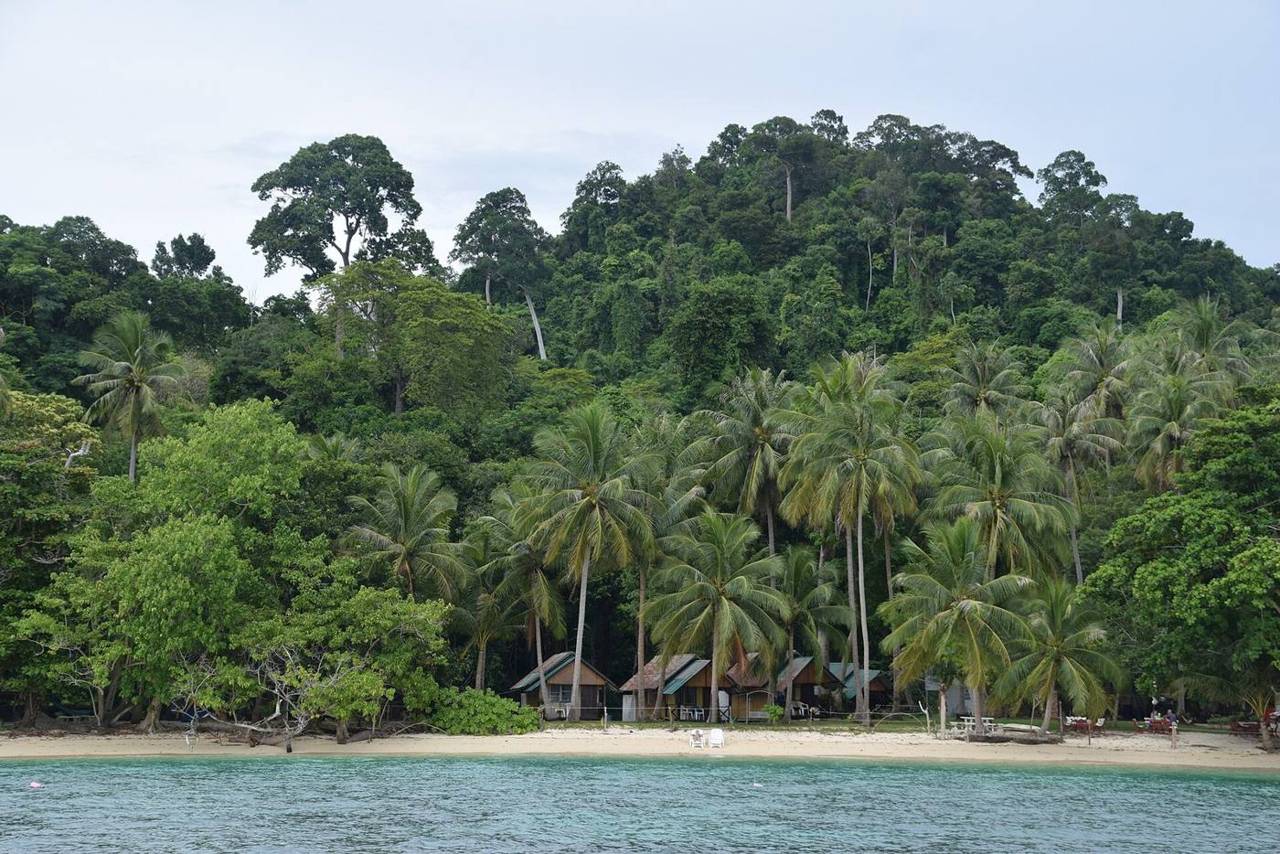
The Trang Islands and Koh Lipe
The quietest islands of the Andaman Sea: Koh Mook with the Emerald Cave reached by swimming, Koh Kradan with its white sand, Koh Libong and its dugongs, then Koh Lipe in Tarutao Marine Park with its coral reef.
 5 daysModerate
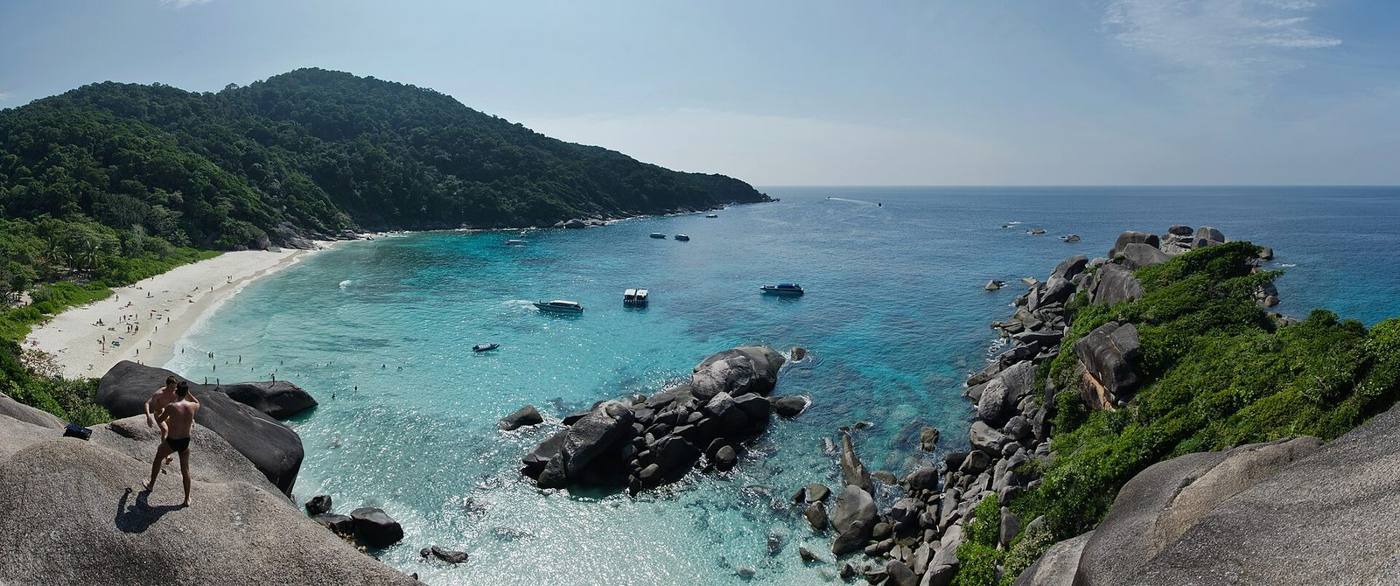
Diving the Similan Islands
A four-day liveaboard in the Similan Islands National Park and to Koh Bon and Koh Tachai: granite boulders, corals, manta rays and, with luck, whale sharks, with Richelieu Rock as the most famous dive.