Tenerife and La Gomera
Sun all year: Teide volcano, the Los Gigantes cliffs, whales and the La Gomera forest.
- Tenerife
- Teide
- Masca
- Los Gigantes
- La Gomera
Day by day
- Day 1
Arrival in Tenerife
This trip visits two of the Canary Islands, the Spanish archipelago in the Atlantic off the coast of Africa: Tenerife, the largest, with the Teide volcano, Spain's highest mountain, and La Gomera, small, green and peaceful, with one of Europe's oldest forests. You discover volcanic landscapes, laurel forests, sea cliffs, white villages and a mild climate all year round.
The Canaries are part of Spain and the Schengen area and use the euro: EU citizens only need an identity card.
You fly into Tenerife: the south airport receives most European flights, the north airport mainly flights from Spain. You need a car to explore the island.
On the first day, if you land at the south airport, you can stay around Puerto de la Cruz on the north coast, greener and more authentic, about an hour and a half away, or stay in the south, sunnier but more touristy.
In the afternoon, if you are in the north, walk around Puerto de la Cruz, a seaside town with colourful houses, a fishing harbour and a seafront with seawater pools built among volcanic rocks. Visit the botanical garden, founded in the eighteenth century to acclimatise tropical plants before taking them to Spain.
At sunset watch the sun go down over the ocean from the seafront.
In the evening have papas arrugadas, small potatoes boiled in their skins in salted water, served with mojo, red chilli or green coriander sauces.
Spend the night in Puerto de la Cruz.
Practical tip: the north of Tenerife is often cloudy, while the south is sunnier. Bring a jacket: it is cold in the mountains.
- Day 2
Teide National Park and sunset above the clouds
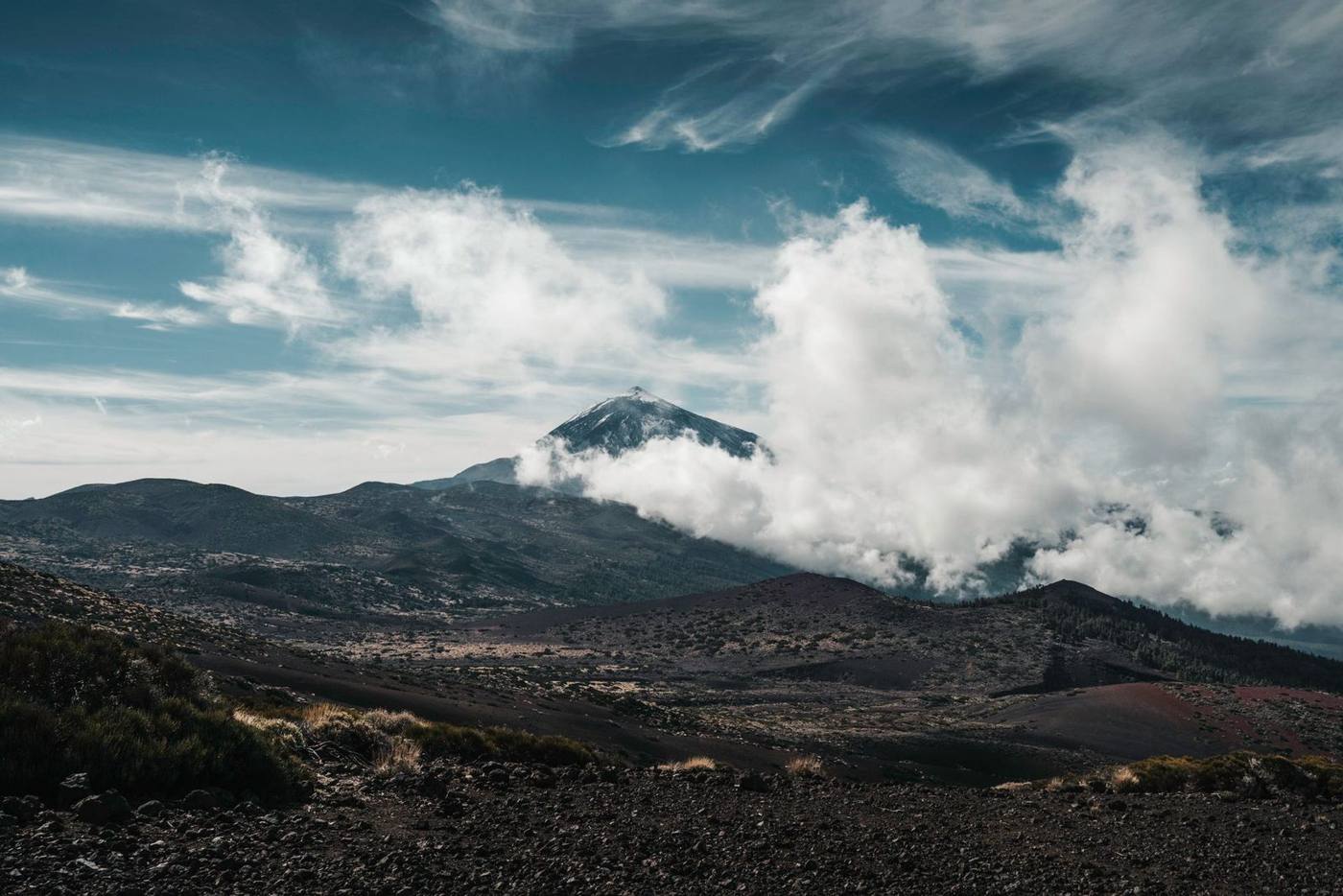
Today climb into Teide National Park, a UNESCO World Heritage Site, in the centre of the island. From Puerto de la Cruz the road climbs through Canary pine forests, passes through the sea of clouds that often covers the north of the island and arrives in another world, above 2,000 metres, under a deep blue sky.
The park is a great caldera, the crater of an ancient collapsed volcano, about seventeen kilometres wide, with lava flows of different colours, black, red, ochre and green, and strange rock formations. In the middle rises Teide, at 3,715 metres, Spain's highest mountain, considered the third highest volcano in the world measured from the ocean floor.
Stop at the Roques de García, a group of volcanic rocks shaped by erosion, including the tree shaped Roque Cinchado, with Teide behind. An easy trail of about an hour circles the rocks.
Then ride the Teide cable car up to about 3,555 metres. Short trails from the top station offer views of the other Canary Islands. Climbing to the summit crater requires a special permit.
In the afternoon stay in the park until sunset: from the viewpoints, the sun sets over the sea of clouds, with Teide's triangular shadow projected on the sky. At night, Teide's sky is among the best in the world for stargazing.
Spend the night in Puerto de la Cruz or in the park.
Practical tip: the cable car and summit permit must be booked in advance: check prices and availability. It is cold at altitude and the sun is strong. The cable car closes in wind.
- Day 3
Masca and its barranco, then Garachico
Today discover the island's wildest corner, the north west.
In the morning go to Masca, a small village of stone houses and tiled roofs built on a ridge in the Teno mountains, about an hour from Puerto de la Cruz. For centuries it was isolated and reachable only on foot; the road was built only in the 1970s. The drive is spectacular, narrow and full of hairpins, with views over gorges and sea.
From Masca starts the trail down the Masca barranco, a deep, narrow gorge between rock walls hundreds of metres high, running down to the sea. It is one of the most famous hikes in the Canaries. The descent takes about three hours, on a rocky path with sections among boulders.
In the afternoon drive down the coast to Garachico, a seaside town with an unusual history. In the sixteenth and seventeenth centuries it was the island's most important port, but in 1706 a volcanic eruption filled the harbour with lava and destroyed part of the town. Today the old centre has colonial houses, churches, convents and a small castle by the sea. On the shore, lava has formed natural pools among black rocks, called El Caletón, where you swim in calm seas.
At sunset go to Punta de Teno, the lighthouse at the island's western tip, with a view of the Los Gigantes cliffs.
Spend the night in the north of the island.
Practical tip: the Masca barranco trail is regulated: a paid booking is required and it is sometimes closed for rockfalls or maintenance. Check beforehand. Car access to Punta de Teno is restricted at certain times: check.
- Day 4
By boat at Los Gigantes with pilot whales and dolphins
Today head to the west coast, to Los Gigantes, about an hour from the north, where the Los Gigantes cliffs, the giants, drop vertically into the sea with walls up to six hundred metres high. They are among the highest cliffs in Europe.
In the morning take a boat trip from Los Gigantes harbour to see cetaceans. In the channel between Tenerife and La Gomera lives a resident population of short finned pilot whales, hundreds of them, and bottlenose dolphins. They are seen almost every time, sometimes very close to the boat. More rarely other whales and dolphins pass by. The channel is one of Europe's most important whale watching areas.
Boats also sail beneath the Los Gigantes cliffs, which look even higher from the sea, and stop in a bay for swimming or snorkelling.
In the afternoon relax on one of the area's black sand beaches, such as Los Gigantes or Playa de la Arena, or walk around the village.
At sunset sit at a seafront spot and watch the sun go down behind La Gomera, visible opposite.
In the evening have local fish, such as vieja, a Canary parrotfish, and goat's cheese with palm honey.
Spend the night in Los Gigantes or the south of the island.
Practical tip: choose boats licensed for whale watching, which respect distances and time limits. The channel can be rough: if you suffer from seasickness take something beforehand.
- Day 5
Ferry to La Gomera and Garajonay forest
Today take the ferry from Los Cristianos, in the south of Tenerife, to San Sebastián de La Gomera, the island's capital, in under an hour. You can bring your car or hire one on the island.
La Gomera is a round, mountainous island cut by deep gorges called barrancos, with terraced fields, palms and small villages. It is far less touristy than Tenerife. San Sebastián is linked to Christopher Columbus, who made his last stop here before crossing the Atlantic in 1492. In town you see the Torre del Conde and the house where, by tradition, Columbus stayed.
Then climb to the centre of the island, to Garajonay National Park, a UNESCO World Heritage Site. The park protects one of the best preserved laurisilva forests in the world, a humid forest of laurel and other evergreens, a relic of the forests that covered southern Europe millions of years ago. The forest is often wrapped in mist, and the trees are covered in moss and lichen, with an almost fairytale atmosphere.
The park has many trails. One of the finest climbs to Alto de Garajonay, the island's summit, at about 1,480 metres, with views of Teide above the clouds. Another, easy one crosses the El Cedro forest along a stream.
In the evening settle in a village on the island.
Spend the night on La Gomera.
Practical tip: check ferry times and prices and book if you take a car. The forest is cool and damp: bring a jacket.
- Day 6
Valle Gran Rey, then Anaga on Tenerife
In the morning drive down into Valle Gran Rey, La Gomera's most famous valley, on the west coast. The road descends in hairpins between rock walls, terraced fields and thousands of palms to the sea, where there are small villages and dark sand beaches. Stop at the César Manrique viewpoint, designed by the Canarian artist, overlooking the whole valley.
In the valley you may hear silbo gomero, the island's whistled language, used for centuries by shepherds to communicate across gorges, kilometres apart. It is on UNESCO's list of intangible cultural heritage and is now taught in the island's schools. Some restaurants and cultural centres hold demonstrations.
At midday return to San Sebastián and take the ferry back to Tenerife.
In the afternoon go to the Anaga massif, at Tenerife's north eastern tip, about an hour from the port. Anaga is a UNESCO biosphere reserve, with jagged mountains, ridges covered in laurisilva and small isolated villages such as Taganana and Chamorga. The ridge road offers views over both seas. The Pico del Inglés viewpoint and the path of the senses, a short forest walk, are among the best spots.
At sunset go down to Taganana or Benijo beach, with rocks rising from the sea.
Spend the night around La Laguna or Santa Cruz.
Practical tip: the roads of Anaga and Valle Gran Rey are narrow and winding. Drive slowly and check ferry times so you do not miss the return.
- Day 7
Departure
On the last day, before your flight, visit San Cristóbal de La Laguna, near the north airport, a few minutes from Santa Cruz.
La Laguna was Tenerife's first capital, founded at the end of the fifteenth century, and its old town is a UNESCO World Heritage Site. It was the first Spanish colonial town built without walls, on a grid of straight streets, which served as a model for many towns later founded in Latin America, such as Cartagena de Indias and Havana. Walk the pedestrian streets with colourful colonial houses, wooden balconies, inner patios and churches, such as the cathedral and the Concepción church with its bell tower.
La Laguna is also a lively university town, with many cafés and small shops.
If you have time, stop in Santa Cruz de Tenerife, today's capital, to see the auditorium, a modern building shaped like a white wave by the sea, and the Nuestra Señora de África market, with tropical fruit, cheeses and flowers.
Before leaving buy some souvenirs: jars of mojo, goat's cheeses, island wine, palm honey from La Gomera and crafts.
The north airport is a few minutes from La Laguna; the south airport is about an hour away.
Practical tip: check which of the two airports your flight leaves from, as they are far apart. Return the car with time to spare.
Guaranteed sunshine even in winter, with the nature of Mount Teide and the forest of La Gomera. The south of Tenerife is very touristy, so the north or the interior is a nicer base. Reaching the summit of Teide requires a no-cost permit, to be requested weeks ahead.
Before you go
- Documents and visa
- EU citizens need a valid identity card or passport. Other nationalities should check the Schengen rules.
- Health and vaccines
- No vaccines required. EU citizens should bring their EHIC; in summer the south often goes above 40 °C. Emergencies: 112.
- Money and payments
- Euro. Cards are accepted almost everywhere. Catalonia, the Balearics and some other areas charge a tourist tax per person per night.
- Power sockets
- Types C and F, 230 volts.
- Time zone
- Central European Time (UTC+1, summer UTC+2); the Canary Islands are one hour behind.
- Safety
- A safe country. In Barcelona and Madrid pickpocketing is common on the metro, on the Ramblas and in crowded places. Official advice: GOV.UK.
Information checked in November 2026 for Italian and EU citizens. Rules change: always check before you travel.
Variations
In 4 days: Tenerife with Teide, Masca and Los Gigantes.
In 10 days: add La Palma or El Hierro, the wildest of the western Canaries.
Frequently asked questions
When is the best time to go?
All year round, with a mild climate. In winter it can snow on Teide and in summer the south is hot.
Do I need a car?
Yes, to explore the islands freely. The ferries to La Gomera also carry cars.
Do I need a passport?
No, the Canaries are in Spain and the Schengen area: EU citizens only need an identity card.
Indicative itinerary written by World Atlas. Before booking, check timetables, seasonal openings, documents and safety.
 7 daysEasy
Andalusia: Seville, Córdoba and Granada
Spain's three most beautiful Moorish cities, among flamenco, patios and the Alhambra.
 10 daysEasy
Madrid, Toledo, Barcelona
Spain's two great capitals and the city of three cultures, linked by high-speed rail.
 10 daysModerate
Green Spain: Basque Country, Cantabria and Asturias
The Spain you don't expect: pintxos in San Sebastián, the Guggenheim, cliffs and the Picos de Europa.