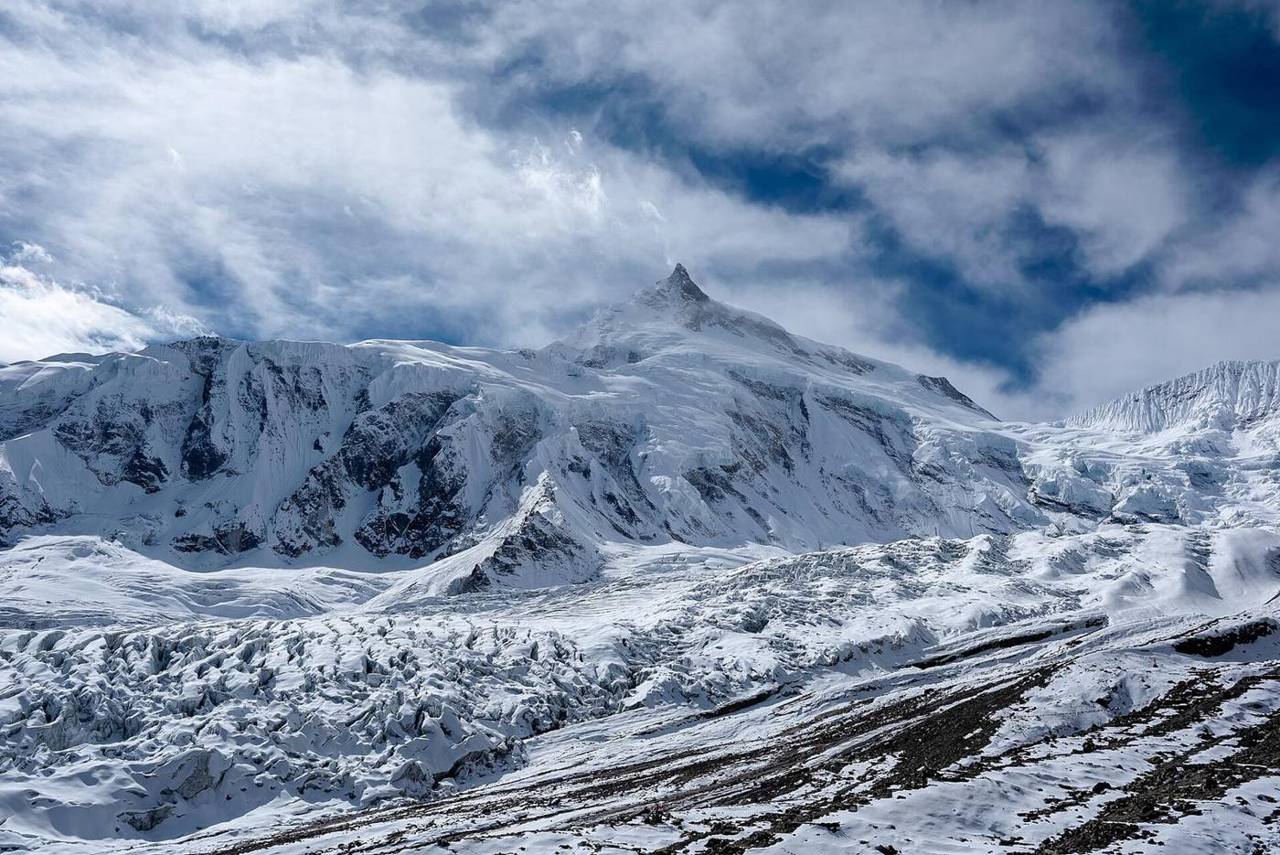
The Manaslu circuit
The wild alternative to the Annapurna circuit: the Budhi Gandaki gorge, Tibetan-culture villages and the Larkya La pass at 5,106 metres beneath the world's eighth-highest mountain.
- Kathmandu
- Soti Khola
- Jagat
- Namrung
- Samagaon
- Samdo
- Larkya La
- Bimthang
- Marsyangdi
Day by day
- Day 1
Arrival in Kathmandu
This twenty-one-day trip is the Manaslu Circuit, around the eighth highest mountain in the world, at 8,163 metres. It is a two-week trek on foot: you climb the gorge of the Budhi Gandaki river, enter the Tibetan-culture villages of the Nubri valley, cross the Larkya La at 5,106 metres and descend into the Marsyangdi valley. It is a demanding trip, for fit and experienced hikers.
Before you go: Italian citizens need a passport valid for at least six months and a tourist visa, issued on arrival at Kathmandu airport after you fill in the online form. Other nationalities should check their own rules. Demonstrations are possible: avoid them and check your government's travel advice. Manaslu is a restricted area with a special permit: you need a group of at least two foreign trekkers, with a licensed guide, and the permit is requested through a registered agency. You also need the permits for the Manaslu and Annapurna conservation areas. Check prices and rules when you book.
You land at Kathmandu airport and reach your hotel. If you have the energy, take an evening walk in the Thamel district, between gear shops, prayer flags and the traffic of rickshaws and scooters.
Sleep in Kathmandu, for two nights.
Practical tip: bring US dollars in cash for the visa, in recent notes that are not damaged, and choose insurance that covers helicopter rescue above 5,000 metres.
- Day 2
Permits and the old city
Today you prepare the trek and take a first tour of the city.
In the morning meet your guide and the agency's contact. Hand over your passport and photos for the permits, and go through the route, the stages and the plan for the spare days together. Ask who carries the big bag: usually a porter carries the main luggage and you walk with a day pack.
Check your gear: boots you have already worn in, poles, a down jacket, warm gloves, a hat, sunglasses, a head torch with spare batteries, a warm sleeping bag and a water bottle. In Thamel you can buy or hire whatever is missing.
In the afternoon go to Durbar Square, the square of the kings, a UNESCO World Heritage Site, with pagoda temples of wood and brick and the old royal palace. Some buildings were damaged by the 2015 earthquake and a few are still being restored. Check prices and times.
Then climb to Swayambhunath, the stupa on the hill west of the city, with the eyes of the Buddha painted on the tower and prayer flags all around. From the terrace you see the whole valley, and on clear days the mountains to the north.
In the evening try dal bhat, the national dish, with rice, lentil soup and vegetables: you will eat it almost every day in the mountains.
Sleep in Kathmandu.
Practical tip: withdraw cash in rupees for the whole trek, because there are no cash machines along the route and payments are made in cash.
- Day 3
The road to Soti Khola
Today you leave Kathmandu and reach the start of the trek.
Set off early by jeep or private bus. The road heads west down the Trisuli valleys, with rice terraces, villages and fruit stalls, then turns north towards Arughat, the market town at the mouth of the Budhi Gandaki valley. The journey is long, usually seven or eight hours, and the last stretch is on a narrow dirt road, dusty in the dry season and muddy after rain.
After Arughat the road follows the river to Soti Khola, a small village at about 700 metres, among tropical forest and fields. Here it is hot and humid, very different from what you will find higher up. This is the starting point of the circuit.
Settle into the lodge, take a short walk along the river and pack your bag for tomorrow. From here on the lodges are simple: small rooms, beds with blankets, shared bathrooms and a dining room with a stove.
In the evening have an early dinner with your guide and porters and ask what the next day's stage is like.
Sleep in Soti Khola.
Practical tip: if you suffer from car sickness, sit at the front and take a remedy before you leave. Keep water, snacks and a light fleece within reach.
- Day 4
From Soti Khola to Machha Khola
Today you start walking in the gorge of the Budhi Gandaki.
The trail leaves Soti Khola, crosses a suspension bridge and climbs up and down through the forest above the river, among sal trees, waterfalls and small clearings. Further on you pass rice terraces and Gurung and Magar villages, with stone houses and tin roofs, goats and children who wave.
In some stretches the trail is cut into the rock, narrow, above the rushing river. Walk carefully and always keep away from the drop side when you meet mule trains: stand against the rock face and wait for them to pass.
At midday stop for a plate of noodles or rice in one of the tea houses along the trail. The heat is strong in the middle of the day: drink often and wear a hat.
In the afternoon you reach Machha Khola, whose name means «fish river», a village on the banks of a tributary of the Budhi Gandaki. Here you can freshen up and rest your legs.
The stage usually takes six or seven hours, with many ups and downs. It is a good chance to get used to the rhythm of trekking: walk slowly and steadily, without rushing.
Sleep in Machha Khola.
Practical tip: use water purification tablets or a filter, so you can fill your bottle at the taps and cut down on plastic bottles.
- Day 5
From Machha Khola to Jagat
Today you keep climbing the gorge, which becomes narrower and deeper.
The trail passes Khorlabesi and then reaches Tatopani, a small village with a hot spring, where travellers stop to wash their face and hands. Further on you cross more suspension bridges over the river, which here runs white and noisy between the rocks.
The landscape changes little by little: fewer rice fields, more rock walls, waterfalls falling from above and bamboo groves. You pass small villages, with plots of maize and millet and wooden stables. Keep a light rain jacket handy: in this part of the gorge showers can arrive quickly, even outside the monsoon.
In the afternoon you reach Jagat, a village with stone-paved lanes, at about 1,300 metres. Here there is a checkpoint where the guide shows the conservation area permits and the special permit.
In the village walk among the stone houses and watch daily life: women spinning wool, men mending tools and children playing on the steps.
The stage usually takes six or seven hours. In the evening, in the dining room, meet the other hikers and compare plans: many do the circuit in the same direction.
Sleep in Jagat.
Practical tip: keep your permits in a waterproof pouch in your day pack, because they are checked several times along the route.
- Day 6
From Jagat to Deng
Today you enter the wildest part of the gorge.
From Jagat the trail climbs to Philim, a large Gurung village with terraced fields, a school and tidy houses. Then it continues above the river, between millet fields and pine woods, with ever wider views over the valley.
Further on you reach an important junction: to the right is the trail to the Tsum valley, another restricted area with a special permit, very isolated. You carry on to the left, towards the Nubri valley and Manaslu.
The trail passes above narrow gorges, where the river almost disappears between the rock walls, and crosses suspension bridges covered with prayer flags. The flags are the first sign of the Tibetan Buddhist world you will find in the coming days.
In the afternoon you reach Deng, a small village at about 1,800 metres, with a few houses, a lodge and fields around. The air is already cooler and the evenings are cold.
The stage usually takes six or seven hours. Your legs begin to feel the effort of the ups and downs: stretch them well in the evening and drink plenty.
Sleep in Deng.
Practical tip: charge your phone and power bank whenever you find electricity, because higher up charging often costs extra and is not always possible.
- Day 7
From Deng to Ghap
Today the valley changes character and you enter the Tibetan world.
From Deng the trail crosses the river and climbs through pine and rhododendron forest. You pass small villages where people have Tibetan features, clothes and traditions. Along the way you see the first mani walls, long walls of stones carved with the Buddhist mantra «Om mani padme hum». Always pass them on your left, going clockwise, as the faithful do.
In spring the rhododendrons are in flower and colour the forest red and pink. In autumn the fields are yellow and the air is clear.
If your guide agrees and time allows, make a detour towards Prok, a village on a terrace above the valley, with a small monastery and views of the mountains opposite.
In the afternoon you reach Ghap, a village scattered among fields and woods, with chortens, small stupa-shaped Buddhist monuments, at the entrance to the village.
The stage is shorter than the others, usually five or six hours: use the time to rest and wash a few clothes in the sun.
In the evening taste salty butter tea, which Tibetans drink to keep warm. The flavour is strong and unusual, but very nourishing.
Sleep in Ghap.
Practical tip: respect sacred places: do not climb on mani walls or chortens, and always ask before photographing people and monks.
- Day 8
From Ghap to Namrung
Today you climb through the woods to Namrung, one of the most beautiful villages on the route.
The trail crosses the river several times and climbs through a forest of pine, fir, birch and rhododendron. It is one of the loveliest and quietest stretches of the circuit: the forest is dense, the river flows below you and sometimes you see langur monkeys in the trees.
Walk slowly: today you climb several hundred metres and begin to feel the altitude. Stop often, drink and eat something every hour.
In the late morning or early afternoon you reach Namrung, at about 2,600 metres. Here the valley opens out and, with a clear sky, you see the great snowy peaks for the first time, including Himal Chuli and the Siringi range.
In the afternoon walk through the village, with houses of stone and wood, barley fields and colourful prayer flags. Visit the small museum or the monastery, if they are open, to understand the culture of the Nubri valley.
The evening is cold: put on your down jacket and sit near the stove in the dining room, where everyone warms up together.
Sleep in Namrung.
Practical tip: from here on, climb by the rules: when possible, no more than three or four hundred metres of height gain from one night to the next, and watch for the signs of altitude sickness.
- Day 9
From Namrung to Lho
Today you walk among the Tibetan villages of the Nubri valley, with Manaslu ever closer.
From Namrung the trail passes Lihi and Sho, villages of stone houses with flat roofs, barley and potato fields and courtyards with stacks of firewood. You see women working in the fields, yaks and horses grazing and painted chortens at the entrance to the villages.
The landscape opens up more and more: the valley becomes wide and green, surrounded by snowy mountains. Stop often to look: it is one of the finest stretches of the trek.
In the afternoon you reach Lho, at about 3,200 metres. From the village, with a clear sky, you see the great summit of Manaslu in front of you, white and towering.
Climb to Ribung Monastery, on the hill above the village, where monks live and young novices study. If you arrive at prayer time, sit quietly at the back of the hall and listen to the chanting and the sound of horns and drums. Leave a small offering.
At sunset stay outside to see the pink and orange light on the summit of Manaslu.
Sleep in Lho.
Practical tip: at dawn step out of the lodge for the best photo of Manaslu: in the cold of the morning the sky is almost always clearer.
- Day 10
From Lho to Samagaon
Today you reach Samagaon, the largest village in the valley, at the foot of Manaslu.
The trail climbs from Lho through the forest and then reaches Shyala, a small village on a plateau surrounded by mountains, with Manaslu, Peak 29 and Himal Chuli all around. It is one of the most impressive panoramas on the circuit: stop and take it in calmly.
From Shyala the trail is almost flat and crosses meadows and fields to Samagaon, also called Sama, at about 3,500 metres. It is a large village, with houses of stone and wood, barley and potato fields, yaks and horses. The people are of Tibetan culture and live from farming, herding and work with trekkers and expeditions.
In the afternoon walk through the village and visit the monastery on the hill, with its wall paintings and prayer wheels. Stop to chat with people, always with respect.
The stage is short, usually four or five hours, because from here the highest part begins and you need to climb slowly.
In the evening drink plenty, eat well and sleep long: tomorrow is an acclimatisation day.
Sleep in Samagaon, for two nights.
Practical tip: at this altitude nights are cold even outside the main season. Use your warm sleeping bag and keep a bottle of hot water inside it.
- Day 11
Acclimatisation and Lake Birendra
Today you stay in Samagaon to get used to the altitude. The mountain rule says: climb high by day, sleep lower.
In the morning walk to Lake Birendra, about an hour on foot from the village. It is a glacial lake, green and grey, at the foot of the Manaslu glacier. From the shore you sometimes hear the noise of seracs collapsing from the mountain. Stop on the moraine and watch the glacier coming down from the summit.
If you feel well, continue towards Pungyen Monastery, a longer climb, with very close views of Manaslu and its glaciers. Alternatively, the fittest can climb part of the way towards Manaslu base camp, a very long and steep walk: decide with your guide according to your strength and the weather.
Return to Samagaon for lunch and rest in the afternoon. Wash a few clothes, charge your batteries and check your gear for the pass.
Towards evening walk through the village: you see children coming back from the pastures with the yaks and women preparing the fire.
Your guide checks how you are: be honest if you have a headache, nausea or restless sleep.
Sleep in Samagaon.
Practical tip: during acclimatisation do not sit still all day: an uphill walk in the morning and rest in the afternoon help your body adjust.
- Day 12
From Samagaon to Samdo
Today you climb towards Samdo, the last village before the pass.
The trail leaves Samagaon and follows the Budhi Gandaki valley, which is wide and open here, among meadows, juniper bushes and mani walls. The walk is gentle and not too long, but you are above 3,500 metres: walk slowly and breathe calmly.
Along the way you see yak pastures and herders' huts. Behind you Manaslu stays in view for much of the walk.
Towards the end the trail crosses the river and climbs to Samdo, at almost 3,900 metres, a stone village on a terrace above the valley. The families of Samdo have Tibetan origins and live mainly from yak herding and trade. The Tibetan border is not far, a few days' walk away.
In the afternoon, if you feel well, take a short walk above the village to gain height and then come back down to sleep. From the hill you see the valleys leading north and the snowy mountains all around.
In the evening eat well and drink plenty. Listen to your body: it is better to stop for an extra day than to climb too fast.
Sleep in Samdo.
Practical tip: buy a pair of handmade yak wool gloves or a hat if you are missing one: you will need them on the pass.
- Day 13
From Samdo to Dharamsala
Today you reach the camp below the pass.
The trail drops a little from Samdo, crosses the river and then climbs slowly up a side valley, among moraines, screes and the remains of an old seasonal market, linked to trade with Tibet. The landscape grows ever barer: no trees, only short grass, stones and glaciers.
The stage is short, usually three or four hours, because you must climb slowly: Dharamsala, also called Larkya Phedi, lies above 4,400 metres. There is no village here, just a group of stone shelters and a few tents, cold and very basic.
In the afternoon rest and get everything ready for tomorrow. Pack your day bag: water, energy snacks, sun cream, sunglasses, head torch, down jacket, gloves and hat. Put tomorrow morning's clothes next to your sleeping bag.
If you feel well, take a short walk on the moraine above the camp to help acclimatisation.
Dinner is early and simple. Go to sleep as soon as you can: the alarm will ring before dawn.
Your guide checks how you are once more. If you have strong symptoms of altitude sickness, do not cross the pass: go down. It is the most important rule of the trek.
Sleep in Dharamsala.
Practical tip: at night put your water bottle inside your sleeping bag, so the water does not freeze and you have something to drink straight away in the morning.
- Day 14
The Larkya La pass and the descent to Bimthang
Today is the longest and hardest day of the trek: the Larkya La pass, at 5,106 metres.
You wake before dawn, usually around four. A hot breakfast, then you set off in the dark with your head torch. The trail climbs slowly along the glacier moraine, among stones and small frozen ponds. It is very cold until the sun arrives.
Walk slowly and steadily, without stopping too long so you do not get cold. The trail is not technical, but with snow it can be slippery: at certain times you need microspikes, so ask your guide.
After a few hours you reach the pass, covered in prayer flags. From here you see a crown of snowy mountains and great glaciers. Stop for photos and a cup of tea, but not for long: the wind is strong and the descent is long.
The descent to the west is steep, on gravel and sometimes on snow. Go down calmly, using your poles. Then the trail becomes gentler and reaches Bimthang, a wide valley with meadows and a group of lodges, much lower, below four thousand metres, facing the walls of Manaslu and its glaciers.
In all you walk eight to ten hours. You arrive tired but happy.
Sleep in Bimthang.
Practical tip: set off with at least two litres of water, snacks that are easy to eat with gloves on and some energy in reserve for the descent, which is often more tiring than the climb.
- Day 15
From Bimthang to Tilije
Today you descend towards the Marsyangdi valley, on the Annapurna side.
In the morning, if the sky is clear, watch sunrise on Manaslu from the west side: the mountain looks very different from the one you saw from the Nubri valley, with its walls of ice above the Bimthang glacier.
Then the trail goes down into the forest, among pines, birches and large rhododendrons. After the days spent among the screes, the green of the woods and the scent of the trees are a pleasure. Breathing becomes easier and easier, your legs are heavy but you lose height quickly.
You pass small villages and summer pastures along the Dudh Khola river. In this part of the valley the culture is more mixed, with Gurung and Tibetan villages, and life becomes more like that of the villages of the Marsyangdi valley.
In the afternoon you reach Tilije, a quiet village at about 2,300 metres, with wheat and potato fields and stone houses. Here you can have a hotter shower and sleep better thanks to the lower altitude.
In the evening celebrate the pass with your guide and porters. It is the right moment to thank them.
Sleep in Tilije.
Practical tip: when going downhill, loosen your laces a little above the ankle and tighten those over the foot, so your toes do not hit the front of the boot.
- Day 16
From Tilije to Dharapani
Today is the last walking stage of the trek.
From Tilije the trail goes down along the river among fields, woods and villages, with suspension bridges and waterfalls. At Thonje the Dudh Khola joins the Marsyangdi, the river that comes down from the Manang valley and the Annapurna Circuit.
You cross the bridge and reach Dharapani, a village on the main road of the Marsyangdi valley. Here your route meets the Annapurna Circuit: you see other hikers, jeeps and mules going up and down. The Annapurna Conservation Area checkpoint checks your permits again.
The stage is short, usually three or four hours, so you have the afternoon to yourself. Rest, wash your clothes and write your travel notes. If you have the energy, walk along the river or visit the village's small monastery.
In the evening have your last dinner in the mountains with your guide and porters. It is customary to leave a tip for the team at the end of the trek: put it in an envelope and hand it over with your thanks, in front of everyone.
Before going to sleep look at the stars and think back over the walk: in two weeks you have gone all the way around one of the highest mountains on Earth.
Sleep in Dharapani.
Practical tip: ask your guide what the usual tip for the team is, so you can prepare the right amount in cash.
- Day 17
The road to Besisahar and Kathmandu
Today you return to Kathmandu.
Early in the morning you leave Dharapani by jeep. The road goes down the Marsyangdi valley to Besisahar, a market town at the entrance to the valley. It is a narrow, winding dirt mountain road, with waterfalls, bridges and villages on the slopes. The journey takes a few hours, depending on the state of the road.
In Besisahar you change vehicles: take a car or private bus to Kathmandu, another long stretch along the Marsyangdi and Trisuli valleys, with lorry traffic on the main road.
You reach Kathmandu in the evening, tired but satisfied. Get to your hotel and enjoy your first real hot shower in many days.
In the evening go out in Thamel for dinner wherever you like: after two weeks of dal bhat it will feel like a celebration.
Alternatively, if you would rather avoid the second part of the road, from Besisahar you can go to Pokhara and take a domestic flight to Kathmandu: ask the agency and check prices and times.
Sleep in Kathmandu, for four nights.
Practical tip: do not book your long-haul flight for the days right after the trek. Mountain roads are often slow or closed by landslides, and the spare days in Kathmandu are there precisely for this.
- Day 18
Pashupatinath and Boudhanath
Today you rest and visit the two great holy places of the Kathmandu valley.
Sleep late and have a relaxed breakfast. Then take your trekking clothes to the laundry.
Around mid-morning go to Pashupatinath, the great temple of Shiva on the banks of the Bagmati river, one of the holiest sites in Hinduism. Only Hindus may enter the main temple, but from the opposite bank you see the ghats, the steps where cremations take place, and the sadhus, ascetics with painted faces. Watch in silence and with respect, without photographing families up close. Check prices and times.
In the afternoon reach Boudhanath, one of the largest stupas in the world, a UNESCO World Heritage Site. A large Tibetan community lives around it, with monasteries, shops selling incense and religious objects, and cafés with terraces. After the villages of the Nubri valley you will recognise the pilgrims' gestures, the prayer wheels and the colours of the flags.
Walk around the stupa clockwise with the faithful, then sit on a terrace for the sunset, when the butter lamps are lit around the base.
In the evening go back to your hotel calmly and rest your legs.
Sleep in Kathmandu.
Practical tip: after a long trek your body needs rest. Drink plenty, eat well and, if you like, have a leg massage.
- Day 19
Patan, the city of craftsmen
Today you visit Patan, one of the three ancient royal cities of the valley, a UNESCO World Heritage Site.
In the morning cross the Bagmati river and reach Patan's Durbar Square, one of the most beautiful in Nepal, with pagoda temples, columns topped by statues of kings and the old royal palace. Look at the stone Krishna temple, with carved scenes from the great Indian epics, and the carved wooden windows of the palaces.
Enter the Patan Museum, in the royal palace, one of the best in Asia for Hindu and Buddhist religious art. The bronze statues and ritual objects are clearly explained and help you understand everything you have seen in the temples and monasteries. Check prices and times.
Then walk through the lanes around to the Golden Temple, a small Buddhist monastery with a courtyard full of bells and golden statues. In the workshops you see craftsmen working metal and wood with ancient techniques: it is a good place to buy a small statue or a Tibetan bell.
In the afternoon rest or take a quiet stroll through the city's hidden courtyards, where children play and old people chat in the sun.
Sleep in Kathmandu.
Practical tip: in Patan have lunch around Durbar Square and stay for the afternoon: the late afternoon light on the temples is beautiful.
- Day 20
Bhaktapur
Today you visit Bhaktapur, the best preserved city in the valley, a UNESCO World Heritage Site. It is also the last spare day: if the trek ran late because of weather or the road, today you catch up without stress.
In the morning reach Bhaktapur, in the east of the valley, about an hour's drive. There is a ticket to enter the city: check prices and times.
Walk along the brick streets, among courtyards, ancient fountains and houses with carved wooden windows. Visit Durbar Square with the richly decorated Golden Gate, and Taumadhi square, with the tall, five-roofed Nyatapola temple, one of the most elegant in Nepal.
In the potters' square you see craftsmen shaping clay on the wheel and leaving the pots to dry in the sun. Taste juju dhau, the sweet, creamy yoghurt of Bhaktapur, served in clay bowls.
In the afternoon stay in the city until sunset, when the squares become quieter.
In the evening return to Kathmandu and pack your bag. If you like, buy last souvenirs in Thamel: tea, spices, wool shawls or a prayer flag.
Sleep in Kathmandu.
Practical tip: if you still have time and the sky is clear, ask the agency whether there are scenic flights over the Himalaya from Kathmandu, and check prices and times.
- Day 21
Departure
This is the last day of the trip.
If your flight leaves late, go back early in the morning to Swayambhunath or Boudhanath, when the light is soft and the faithful arrive for their prayers. Then head to Kathmandu airport, very early, because traffic and checks can be slow.
In twenty-one days you have completed the full Manaslu Circuit. You climbed the gorge of the Budhi Gandaki, with its suspension bridges, waterfalls and Gurung villages, and entered the Nubri valley, with the Tibetan-culture villages of Namrung, Lho and Samagaon, Ribung Monastery and Lake Birendra at the foot of the glacier. You crossed the Larkya La at 5,106 metres, descended to Bimthang facing the walls of Manaslu and followed the Marsyangdi valley. In Kathmandu you saw Pashupatinath, Boudhanath, Patan and Bhaktapur.
When to go: the best months are October and November, with clear skies after the monsoon, and April, with the rhododendrons in flower. March can still have snow on the pass. From June to September the monsoon brings rain, landslides and leeches in the lower part. In winter the pass is often closed by snow and many lodges higher up are shut.
Practical tip: before booking, ask the agency to confirm in writing the special permit, the licensed guide, the minimum number of participants and what happens if the pass is closed on the planned day.
Nepal's wildest teahouse trek, like Annapurna thirty years ago. You need a restricted-area permit and a mandatory guide. Pass day is long (8-10 hours) and starts before dawn: experienced hikers only. Right months: October-November and April.
Before you go
- Documents and visa
- Passport valid for at least six months from the date of entry and a tourist visa, issued on arrival at Kathmandu airport. Fill in the form online up to 15 days ahead or at the airport kiosks. According to the Department of Immigration the visa costs 30 US dollars for 15 days, 50 for 30 days and 125 for 90 days: bring US dollars in cash. Border officers may ask for health insurance with repatriation and the address of your first night.
- Health and vaccines
- No compulsory vaccines when arriving from Europe; yellow fever is needed only if you come from a risk country. In the Terai, the southern plain, there is a malaria risk: ask your doctor. Above 3,000 metres climb slowly to avoid altitude sickness. Drink only bottled or treated water. Police 100, tourist police 1144.
- Money and payments
- Nepalese rupee. Cash dominates; ATMs are found in Kathmandu, Pokhara and the towns, far fewer on the trails. Cards work in the larger hotels.
- Power sockets
- Types C, D and M, 230 volts: bring a universal adapter. Power cuts are frequent.
- Time zone
- UTC+5:45 all year.
- Safety
- After the youth protests of 8 and 9 September 2025, with at least 75 deaths and the fall of the government, the country voted on 5 March 2026; since March 2026 a new government has held a large majority. Demonstrations and strikes are still possible and can turn violent: avoid them. The United States advises increased caution. The UK warns that areas hit by the flood of 26 August 2026 in Rasuwa district may remain unstable. A licensed guide is required in national parks and protected areas. According to the UK, no Nepali airline meets international safety standards, and mountain flights are often delayed by the weather. Official advice: GOV.UK.
Information checked in November 2026 for Italian and EU citizens. Rules change: always check before you travel.
Variations
In eighteen days: fewer spare days in Kathmandu, only if you already have experience of high-altitude trekking.
In twenty-eight days: add the Tsum valley, another restricted area with a special permit, before climbing to Samagaon.
Frequently asked questions
Can you do the Manaslu Circuit independently?
No. Manaslu is a restricted area with a special permit: you need at least two foreign trekkers, a licensed guide and a permit requested through a registered agency. The rules can change: check before booking.
How hard is the Larkya La pass?
The trail is not technical, but the pass is at 5,106 metres and the crossing day lasts eight to ten hours, starting before dawn. You need good fitness and proper acclimatisation.
How much do the permits cost?
The price of the special permit changes with the season and the number of days, and the conservation area permits are added. Check prices and rules with the agency and on the website of Nepal's Department of Immigration.
Indicative itinerary written by World Atlas. Before booking, check timetables, seasonal openings, documents and safety.
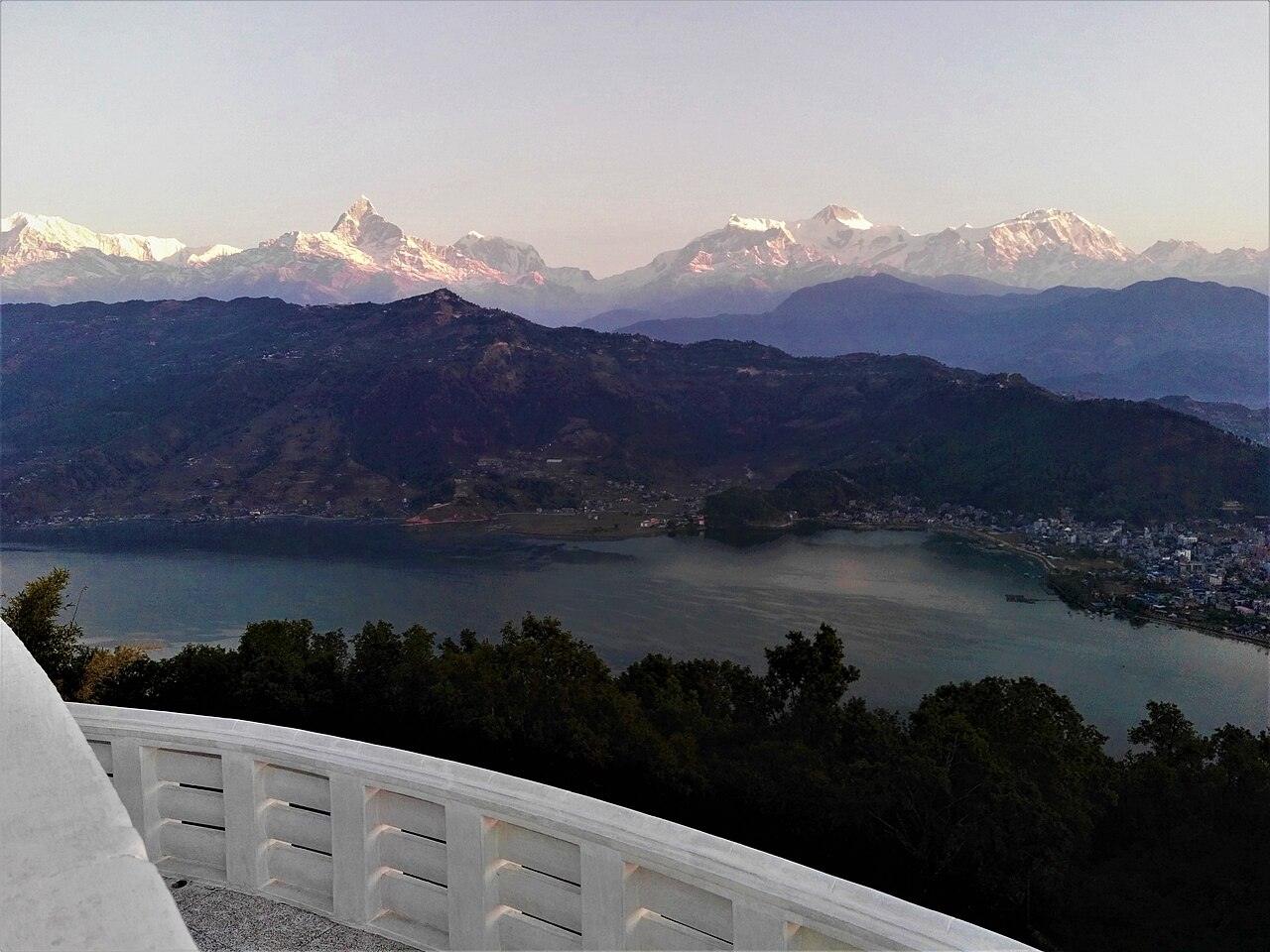 7 daysEasy
Kathmandu, Pokhara and Poon Hill
The temples of the Kathmandu Valley, the lake at Pokhara and a short trek with sunrise over the Annapurnas.
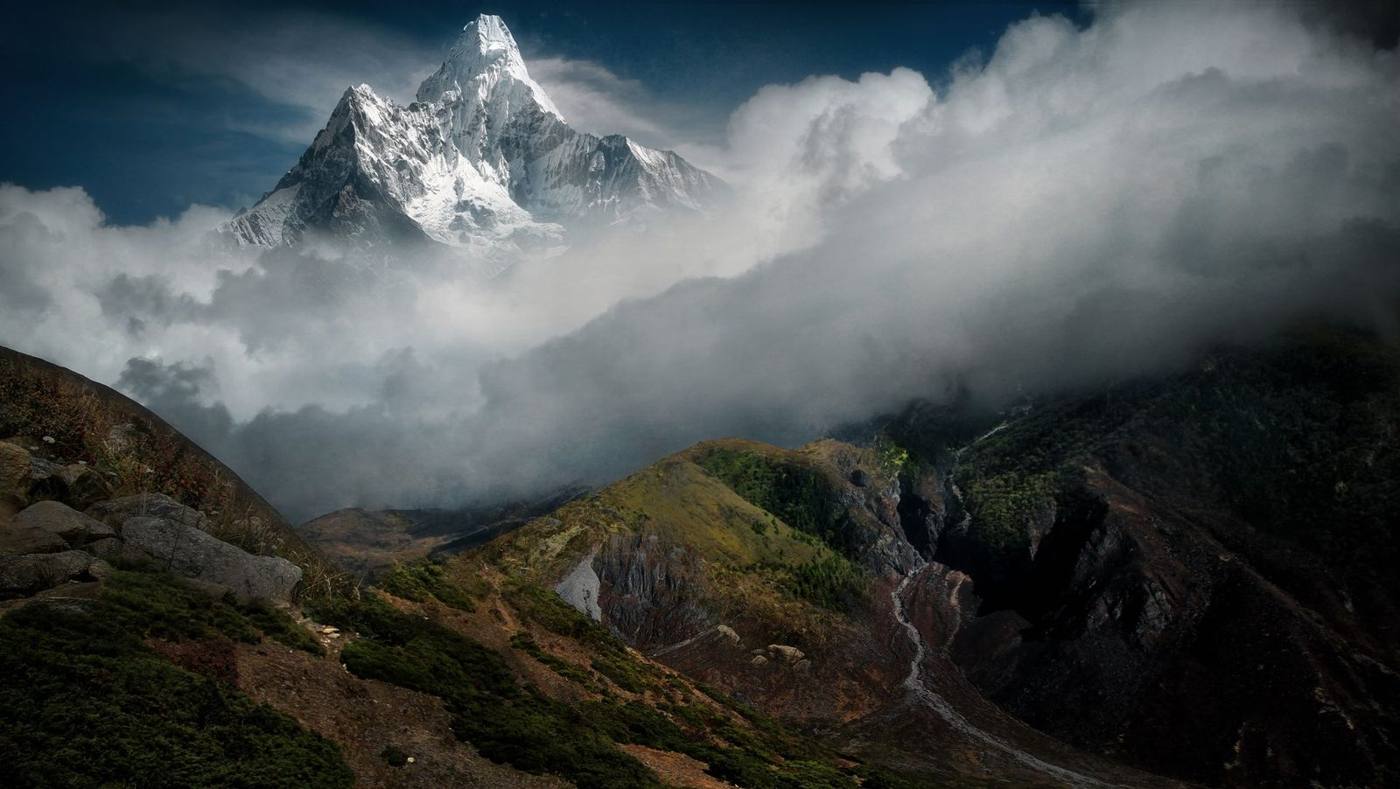 15 daysChallenging
Everest trek and Chitwan
The spectacular flight to Lukla, Sherpa villages and the Everest viewpoint of Kala Patthar, then the rhinos of Chitwan. Good fitness required.
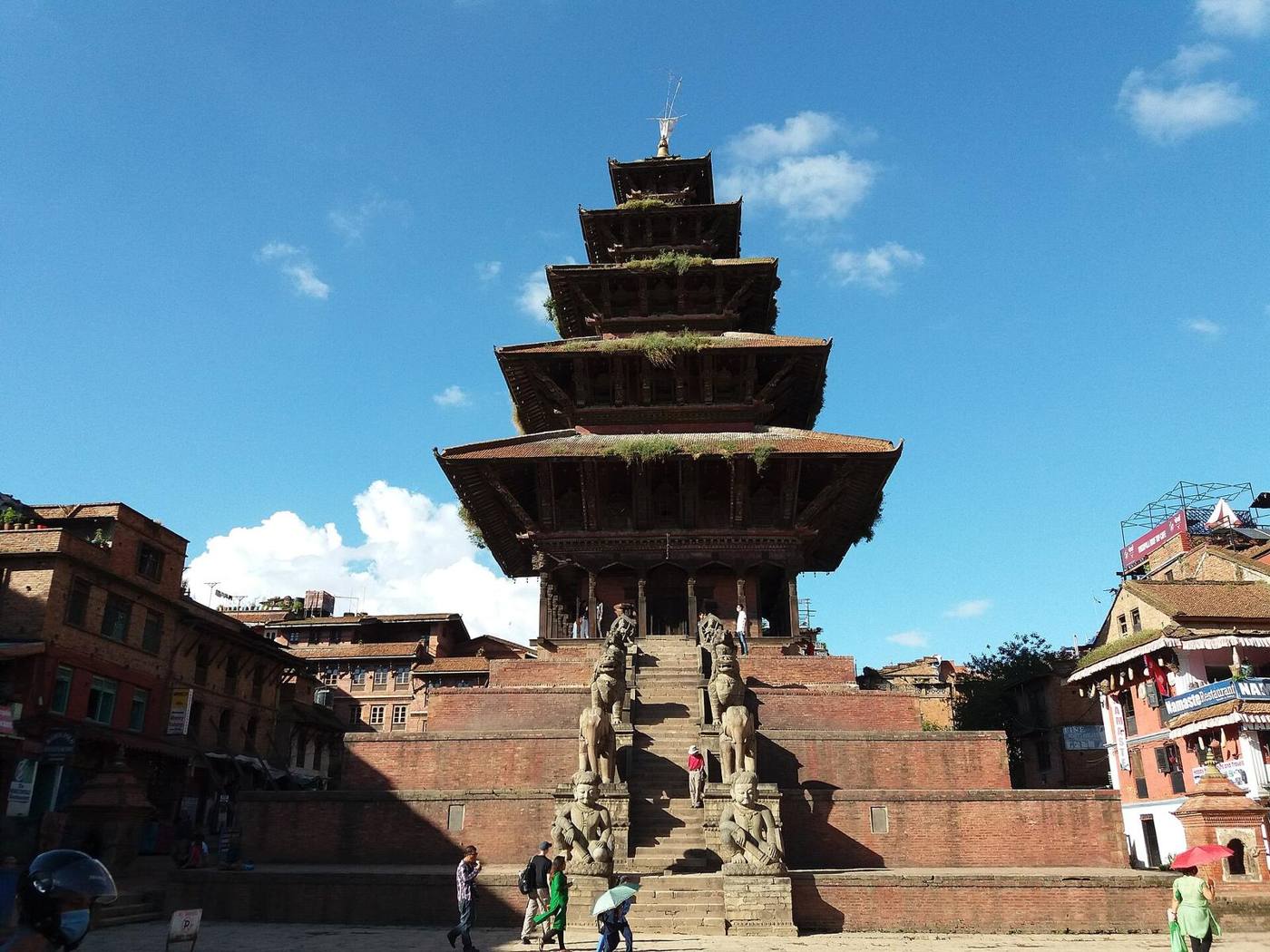 16 daysEasy
All of Nepal: the Kathmandu valley, Pokhara and Chitwan
The valley's three royal cities, a short trek with Annapurna views, rafting on the Trisuli, the rhinos of Chitwan and Lumbini, birthplace of the Buddha.