All of Nepal: the Kathmandu valley, Pokhara and Chitwan
The valley's three royal cities, a short trek with Annapurna views, rafting on the Trisuli, the rhinos of Chitwan and Lumbini, birthplace of the Buddha.
- Kathmandu
- Patan
- Bhaktapur
- Nagarkot
- Pokhara
- Trisuli
- Chitwan
- Lumbini
Day by day
- Day 1
Arrival in Kathmandu
This sixteen-day trip is the whole of Nepal without a major trek: the three royal cities of the Kathmandu Valley, sunrise over the Himalayas from Nagarkot, the lake of Pokhara and a short three-day walk through Gurung villages with views of Annapurna, then rafting on the Trisuli, the rhinos of Chitwan National Park and Lumbini, where the Buddha was born. It suits everyone, even people who have never trekked.
Before you go: Italian citizens need a passport valid for at least six months and a tourist visa, issued on arrival at Kathmandu airport after you fill in the online form. According to Nepal's Department of Immigration the visa costs 30 US dollars for 15 days, 50 for 30 days and 125 for 90 days. Other nationalities should check their own rules. Demonstrations are still possible: avoid them and check your government's travel advice before leaving. For the short trek in the Annapurna Conservation Area a licensed guide is compulsory, booked through a registered agency; in Chitwan National Park safaris are run only with authorised guides.
You land at Kathmandu airport, at about 1,400 metres, and reach your hotel. Traffic is slow: allow time.
In the late afternoon rest and, if you have the energy, take a short walk in the Thamel district, among prayer flags, tea shops and rickshaws.
In the evening try dal bhat, the national dish of rice, lentils and vegetables, which Nepalis eat twice a day.
Practical tip: bring US dollars in cash for the visa, in recent notes that are not damaged, and change some rupees at the airport for the first days.
- Day 2
Durbar Square, Swayambhunath and Thamel
Today you discover the historic centre of Kathmandu and the oldest stupa in the valley.
In the morning walk to Kathmandu Durbar Square, the heart of the royal city, a UNESCO World Heritage Site together with the rest of the valley. Here you see the Hanuman Dhoka palace, the pagoda temples with their tiered roofs and the carved beams. Near the square is the house of the Kumari, the girl worshipped as a living goddess: sometimes she appears at the window of the courtyard, but she must not be photographed. Many buildings were rebuilt after the 2015 earthquake. Check prices and times.
At midday have momos for lunch, Tibetan steamed dumplings.
In the afternoon climb to Swayambhunath, the stupa on the hill west of the city, known as the Monkey Temple. You reach it by a long staircase, between statues, small shrines and monkeys that are best left alone. From the top the Buddha's eyes painted on the tower look out over the whole valley. Walk round the stupa clockwise and spin the prayer wheels. Check prices and times.
At sunset, from the terrace of the stupa, watch the lights of the city come on.
In the evening go back to Thamel through the bazaars of Asan and Indra Chowk, where people buy spices, fabrics and offerings.
Sleep in Kathmandu.
Practical tip: do not feed the monkeys at Swayambhunath and do not carry plastic bags in your hand. They can snatch them from you and sometimes they bite.
- Day 3
Patan and Pashupatinath
Today you visit the city of craftsmen and the holiest temple in Nepal for Hindus.
In the morning go to Patan, also called Lalitpur, south of the Bagmati river and now joined to Kathmandu. At the entrance to the historic centre foreign visitors pay a fee. Check prices and times. Patan Durbar Square is perhaps the most harmonious in the valley. Here you see the Krishna temple, in stone, with columns and small towers, and the royal palace, home to the Patan Museum, one of the finest in South Asia for its bronze statues and its explanation of sacred art. Check prices and times.
Then walk to the Golden Temple, a Buddhist monastery with a courtyard full of prayer wheels and gilded roofs. In the workshops around it Newar craftsmen cast metal statues.
At midday have lunch in a courtyard in the historic centre.
In the afternoon go to Pashupatinath, the great Shiva temple on the Bagmati river. The main temple is open only to Hindus, but from the opposite bank you see the cremation ghats and the sadhus, the ascetics painted and dressed in orange. Watch respectfully: it is a place of mourning for families. Do not photograph the rites close up. Check prices and times.
At sunset, on some evenings, the priests celebrate aarti, the ceremony with lamps on the river.
Sleep in Kathmandu.
Practical tip: at Pashupatinath politely turn down people who offer to guide you without being licensed. If you want explanations, ask your agency's guide.
- Day 4
Boudhanath and Bhaktapur
Today you move from the great Tibetan stupa to the best preserved royal city in the valley.
In the morning go to Boudhanath, one of the largest stupas in the world, at the centre of Kathmandu's Tibetan community. Arrive early, when the pilgrims walk round the white dome reciting mantras and spinning the prayer wheels. Walk round clockwise yourself and step into one of the monasteries around the square to hear the monks at prayer. Check prices and times.
Then drive to Bhaktapur, about an hour away depending on traffic. At the entrance to the historic centre foreign visitors pay a fee. Check prices and times.
At midday taste juju dhau, the sweet yoghurt of Bhaktapur, served in clay bowls.
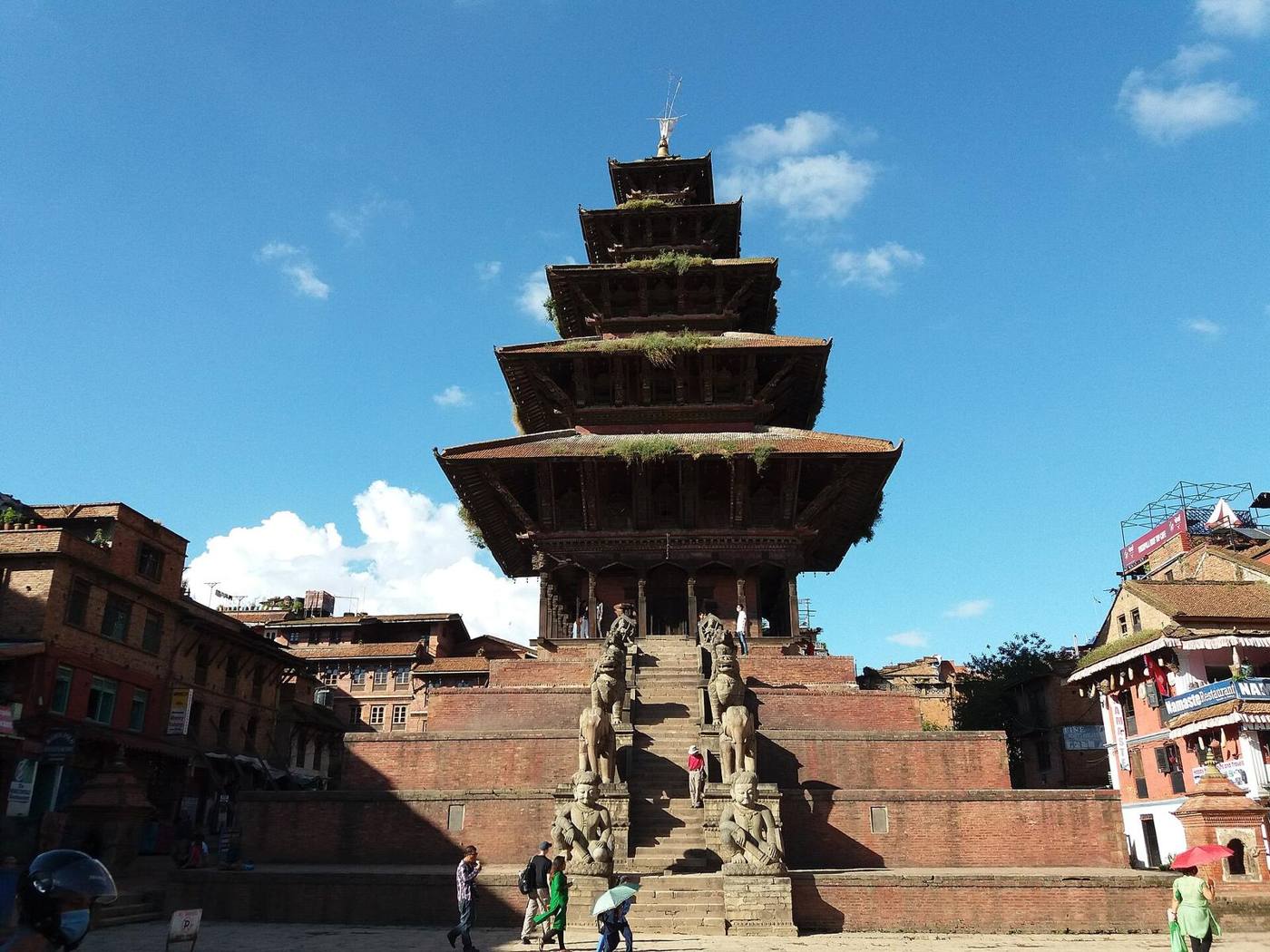
In the afternoon visit Durbar Square, with the royal palace and the Golden Gate, then Taumadhi Square with the Nyatapola temple, a five-roofed pagoda, the tallest in the valley. Continue to Pottery Square, where craftsmen shape clay on the wheel and set the pots out to dry in the sun.
In the late afternoon drive up to Nagarkot, on the eastern rim of the valley, at about 2,100 metres. The road is short but winding.
The evening is cool: bring a jacket.
Sleep in Nagarkot.
Practical tip: in Bhaktapur keep your entrance ticket. You may be asked for it several times at the different checkpoints in the historic centre.
- Day 5
Sunrise at Nagarkot and Changu Narayan
Today you see the Himalayas at dawn for the first time.
Before dawn climb onto a terrace or the viewing tower near the village. On clear days the Himalayan range lights up pink from west to east, from Langtang to the mountains towards Everest, which from here looks small and far away. Below you the valley is covered in mist. In autumn the sky is often clearer; in spring there is more haze.
In mid-morning have breakfast and then start an easy downhill walk of about three hours, through pine woods, villages and terraced fields, to Changu Narayan.
At midday have lunch in the village.
In the early afternoon visit the Changu Narayan temple, dedicated to Vishnu, one of the oldest temples in the valley and part of the UNESCO World Heritage Site. The pagoda temple is surrounded by stone statues and carvings of great value, with very ancient inscriptions. Check prices and times. Then your car takes you back to Kathmandu, in about an hour.
In the late afternoon pack a small bag for the trek: you will leave the rest at your hotel in Pokhara.
In the evening have dinner with Newar food, the traditional cooking of the valley, with fried lentil cakes, spiced meat and beaten rice.
Sleep in Kathmandu.
Practical tip: check the forecast the evening before the sunrise. If the sky is overcast, sleep longer and enjoy the walk: here the mountains are a gift of the weather.
- Day 6
The road to Pokhara
Today you cross the central hills of Nepal to the lake of Pokhara.
In the morning leave early by car. The road is about two hundred kilometres long and takes seven or eight hours, with lorry traffic and roadworks. It drops to the Trisuli river and then follows the valleys of the Trisuli and the Marsyangdi, between terraced hills, villages and suspension bridges. If you prefer to save time, you can take the domestic flight, of about half an hour. According to the British government no Nepali airline meets international safety standards: weigh up this risk.
At midday have lunch at one of the stops along the road, with dal bhat or noodles.
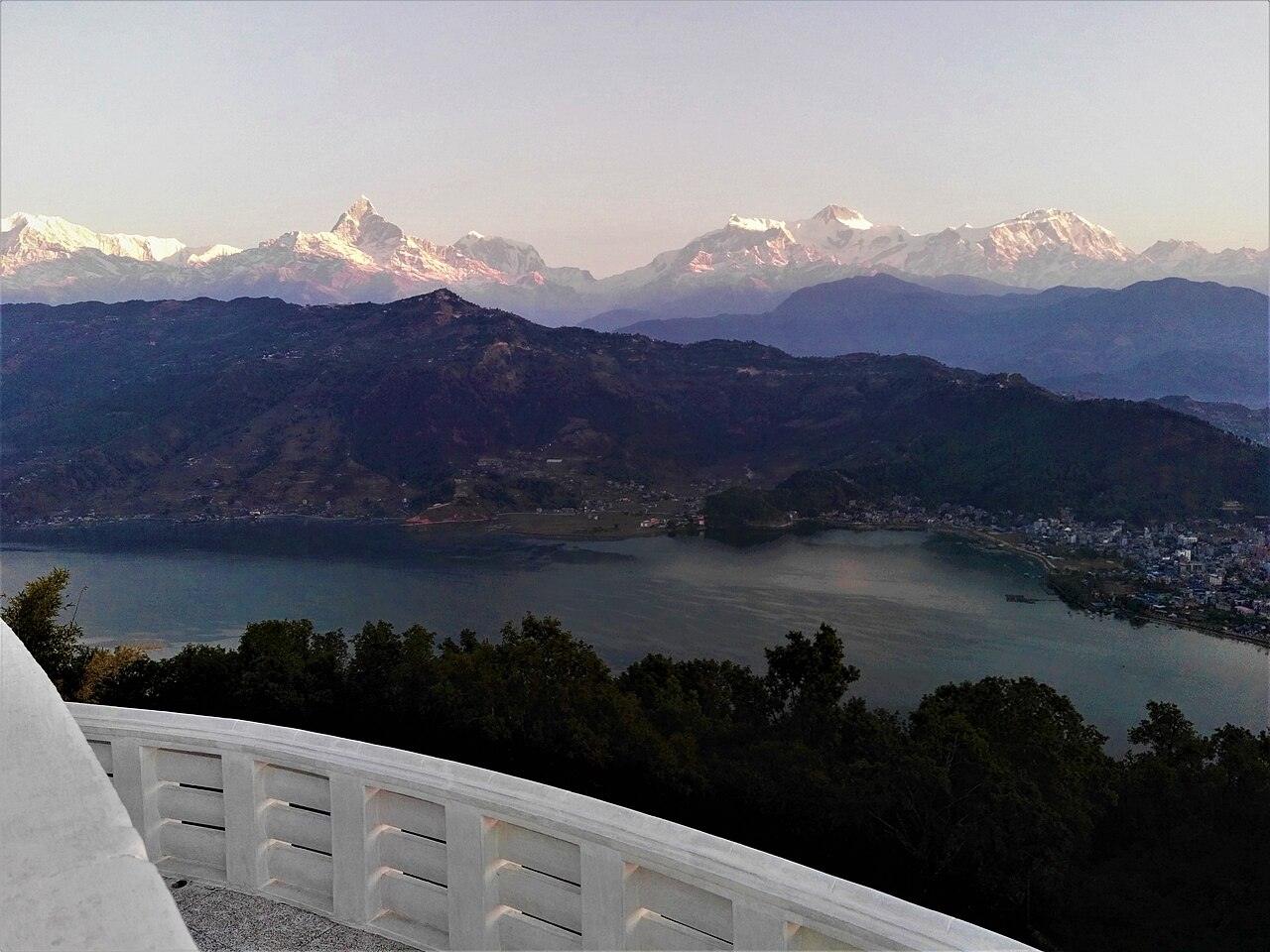
In the afternoon you reach Pokhara, at about 800 metres, on the shores of Phewa Lake. The climate is milder than in Kathmandu and the atmosphere relaxed. Above the city, on clear days, rises the pyramid of Machhapuchhare, the fishtail mountain, 6,993 metres high.
At sunset walk along the lakeside, as the colourful boats come back and the lights come on over the water.
In the evening meet your trekking guide, who has arranged the Annapurna Conservation Area permit. Check prices and times.
Sleep in Pokhara.
Practical tip: in the car sit in front if you suffer from car sickness and bring water and snacks. There are many bends and the stops do not always come when you need them.
- Day 7
Trek: Australian Camp and Dhampus
Today the short three-day trek through the hill villages begins.
In the morning drive for about an hour to Kande, the trailhead. At the checkpoint your guide shows the permit.
The trail climbs through the woods for about an hour and a half to Australian Camp, a meadow on a ridge at about 2,000 metres. From here, on clear days, you see Annapurna South, Hiunchuli and Machhapuchhare very close, with its double summit. It is one of the finest views you can reach with so little effort.
At midday have lunch on one of the terraces with a view.
In the afternoon walk along the ridge, gently downhill, to Dhampus, a village of scattered houses among terraced fields, mostly inhabited by Gurung people. You see women working in the fields, buffaloes, goats and children playing. Greet people with a «namaste», hands joined in front of your chest.
At sunset the mountains turn pink, then violet.
Sleep in Dhampus, in a small trekkers' house run by a village family.
Practical tip: bring trekking shoes you have already worn in and a small pack with water, sun cream and a jacket. Even an easy route has many stone steps, and poles help on the way down.
- Day 8
Trek: from Dhampus to Landruk
Today you walk through woods and villages to a wilder valley.
In the morning, at dawn, step outside to look at the mountains: from Dhampus the view of Annapurna is open and the morning light is the best. Then set off towards Pothana, a small settlement on the ridge.
The trail enters a forest of oak and rhododendron, damp and silent. In spring the rhododendrons, the national flower of Nepal, are covered in red blossom. Listen to the birds and, if you are lucky, you will see langurs, the grey monkeys with black faces.
At midday have lunch in Pothana or Deurali, a small pass with prayer flags.
In the afternoon go down a stepped trail, between terraced fields and waterfalls, to Landruk, at about 1,600 metres. This Gurung village looks over the valley of the Modi Khola, the river that flows down from the Annapurna Sanctuary. On the other side of the valley you see the houses of Ghandruk, tomorrow's destination.
At sunset sit on the terrace: above the valley you can still see Annapurna South, while below the river roars.
Sleep in Landruk.
Practical tip: drink plenty and always purify tap water, with tablets or a filter. Plastic bottles in the mountains become waste that is hard to dispose of.
- Day 9
Trek: Ghandruk and back to Pokhara
Today you reach the most famous Gurung village and return to the city.
In the morning walk down from Landruk to the Modi Khola river and cross it on a suspension bridge covered in prayer flags. Then climb up the other side, on a long stone staircase, to Ghandruk. It is the most demanding climb of the trek: keep a steady pace and take breaks.
In mid-morning you reach Ghandruk, at about 1,900 metres, one of the most beautiful Gurung villages in Nepal, with stone houses, paved alleys and balconies full of flowers. The Gurung are also known for the Gurkha soldiers who serve in the British and Indian armies. Visit the small museum of Gurung culture, with tools, costumes and traditional instruments. Check prices and times.
At midday have lunch with a view of Annapurna South and Machhapuchhare.
In the early afternoon take the jeep back to Pokhara, on a mountain road that is partly unpaved, in about two or three hours. Say goodbye to your guide: it is the right moment to give the tip, in rupees, in an envelope, with a word of thanks.
In the late afternoon you reach the hotel and collect your large bag.
In the evening book a leg massage and have dinner by the lake.
Sleep in Pokhara.
Practical tip: in the jeep keep a jacket within reach and something to cover your nose and mouth. On unpaved roads, in the dry season, there is a lot of dust.
- Day 10
Pokhara: Phewa Lake and the World Peace Pagoda
Today you stay in Pokhara, between the lake and the hills.
Before dawn, if the sky is clear, drive up to Sarangkot, the hill north-west of the lake, at about 1,600 metres. From here you see sunrise over the Annapurna range and Machhapuchhare and, on the best days, Dhaulagiri to the west too.
In mid-morning go back to town for breakfast and then hire a rowing boat on Phewa Lake. Reach the islet of the Tal Barahi temple, dedicated to a form of the goddess Durga, where local people bring flowers and offerings.
At midday have lunch near the lake.
In the early afternoon cross the lake by boat and walk up to the World Peace Pagoda, the white stupa on the ridge south of the lake. The climb takes less than an hour through the woods. From the top you see the lake, the city and, on clear days, the mountains.
In the late afternoon, if you have time, visit the International Mountain Museum, dedicated to Himalayan mountaineering and mountain peoples, or Davis Falls and the nearby Gupteshwor cave. Check prices and times.
In the evening go shopping on the lakeside: Nepali tea, wool scarves and Tibetan crafts.
Sleep in Pokhara.
Practical tip: the clouds usually rise in late morning, so plan the views at dawn and the visits in the afternoon. In autumn clear days are more frequent.
- Day 11
Rafting on the Trisuli
Today you run a Himalayan river in a raft and reach the southern plain.
In the morning leave Pokhara early by car heading east, along the main road that follows the Trisuli river. In about three hours you reach the starting point of the rafting.
The Trisuli is one of the most popular rivers in Nepal for rafting, with rapids of moderate difficulty, suitable for beginners too, and calm stretches where you float between rock walls, villages and suspension bridges. Before you start, the instructors explain the safety rules: how to paddle, how to hold on and what to do if you fall in. Always wear your life jacket and helmet.
The descent lasts a few hours, depending on the stretch chosen and the water level. In autumn, after the monsoon, the river is stronger; in spring it is calmer.
At midday have lunch on the bank, often a picnic prepared by the organisers.
In the afternoon get back in the car and drive down to the Terai, the southern plain, to Chitwan National Park, in about three hours. The landscape changes: rice fields, banana trees, villages of mud houses and humid heat.
In the evening you reach Sauraha, the village at the entrance to the park, on the banks of the Rapti river.
Sleep in Chitwan.
Practical tip: choose a rafting organisation with gear in good condition and experienced instructors. Put your phone and documents in a dry bag and keep a dry change of clothes in the car.
- Day 12
Chitwan: the jungle and the river
Today you explore Chitwan National Park, a UNESCO World Heritage Site and one of the richest protected areas in Asia.
Early in the morning, with the mist still on the Rapti river, climb into a dugout canoe with the authorised guides. Drift slowly down the river in silence. On the banks you see birds, such as herons, kingfishers and storks, and often mugger crocodiles in the sun. With a little luck you also see the gharial, the narrow-snouted crocodile that lives only in the rivers of South Asia.
After the canoe take a walk in the jungle with two guides. This is no ordinary outing: rhinos, wild elephants, sloth bears and tigers live in the park. Always follow the guides' instructions, walk in single file and in silence.
At midday go back to the village for lunch and rest during the hottest hours.
In the afternoon take a jeep safari in the park with the authorised guides. The Indian rhinoceros, with a single horn, is the symbol of Chitwan, and its population has grown thanks to protection. You often see it in the tall grasslands and in the pools. You will also see deer, wild boar and monkeys. The tiger is present but very hard to spot.
At sunset watch the red sun go down over the Rapti river.
Sleep in Chitwan.
Practical tip: in the park safaris are run only with authorised guides. Wear neutral colours, use mosquito repellent and never go near a rhino.
- Day 13
Chitwan: elephants and Tharu villages
Today you stay in Chitwan to get to know the animals and the people of the plain better.
In the morning, at dawn, take another outing with the authorised guides, by jeep or on foot, in the areas of tall grass. It is the best time to see animals, before the heat. Bring binoculars: the jungle is dense and many animals can be seen only from a distance.
In mid-morning visit the park's elephant breeding centre, where the elephants that work with the rangers are raised. Watch the mothers and calves without feeding the animals. Check prices and times. Elephants have been part of life on the plain for centuries, but today many travellers choose not to ride them: a safari by jeep, canoe or on foot is kinder to the animals.
At midday have lunch in the village.
In the afternoon visit a Tharu village, home to the people who have lived in the Terai for centuries, with mud and straw houses decorated by hand. You can learn about their farming, fishing and festivals. Check prices and times.
At sunset sit on the bank of the Rapti river, where local people bathe and wash their clothes, and watch the golden light on the jungle.
In the evening, in many villages, you can watch the Tharu stick dance. Check prices and times.
Sleep in Chitwan.
Practical tip: on the plain it is hot at midday even in winter, and mosquitoes can carry diseases. Talk to your doctor about recommended prevention before you leave.
- Day 14
Lumbini, where the Buddha was born
Today you reach one of the holiest places in Buddhism.
In the morning drive west across the Terai plain. The journey takes about four or five hours, between fields, villages and small market towns.
At midday you reach Lumbini and have lunch near the sacred area.
In the afternoon visit the sacred garden of Lumbini, a UNESCO World Heritage Site. According to tradition, Prince Siddhartha Gautama, who became the Buddha, was born here. Enter the Maya Devi temple, dedicated to the Buddha's mother, built over the remains of ancient temples and over the spot identified as the exact place of his birth. Next to it stands the pillar of the emperor Ashoka, who visited Lumbini in the 3rd century BC and left an inscription recording the Buddha's birth. Nearby is the sacred pond, where according to tradition Maya Devi bathed. Check prices and times.
Then walk or cycle through the monastic zone, a large park with temples built by Buddhist countries from all over the world, each in its own style: Tibetan, Thai, Chinese, Burmese, Japanese.
At sunset sit under the tree hung with prayer flags near the pond and listen to the monks and pilgrims chanting.
Sleep in Lumbini.
Practical tip: in the Maya Devi temple take off your shoes and cover your shoulders and legs. The park is very large: hire a bicycle or a rickshaw to get between the monasteries.
- Day 15
Flight to Kathmandu
Today you fly back to the capital.
Early in the morning, if you like, return to the sacred garden of Lumbini at dawn, when the pilgrims meditate under the trees and the light is softer.
Then drive to Bhairahawa airport, about half an hour from Lumbini. The flight to Kathmandu takes less than an hour, and with a clear sky you see the Himalayan range from the window. According to the British government no Nepali airline meets international safety standards: weigh up this risk. Domestic flights can be delayed by the weather.
At midday you reach Kathmandu and have lunch in the city.
In the afternoon go back to one of the places you liked most, or visit the Garden of Dreams, a historic European-style garden near Thamel, quiet and full of flowers, where you can rest away from the traffic. Check prices and times.
In the late afternoon do your last shopping in Thamel and Asan bazaar: tea, spices, wool scarves, Tibetan singing bowls and metal crafts from Patan.
In the evening have the last Nepali dinner of the trip, with momos and dal bhat.
Sleep in Kathmandu.
Practical tip: keep at least one spare day between the domestic flight and your international flight. If the flight from Bhairahawa is cancelled, the road to Kathmandu takes many hours.
- Day 16
Departure from Kathmandu
Today is the day you go home.
In the morning, if your flight is late, take a last walk at Boudhanath or Swayambhunath, to say goodbye to the Buddha's eyes looking out over the valley. Then reach the airport well in advance, because the traffic is unpredictable.
In sixteen days you have seen almost all of Nepal. In the Kathmandu Valley you walked through the three royal cities, Kathmandu, Patan and Bhaktapur, and among the great shrines of Swayambhunath, Pashupatinath and Boudhanath. From Nagarkot you saw sunrise over the Himalayas and walked down to the temple of Changu Narayan. In Pokhara you rowed on Phewa Lake and walked for three days between Dhampus, Landruk and Ghandruk, with Machhapuchhare before your eyes. Then you ran the Trisuli in a raft, looked for rhinos in Chitwan and visited Lumbini, where the Buddha was born.
When to go: the best months are October and November, with clear skies after the monsoon and the mountains well in view, and March and April, with the rhododendrons in bloom but more haze and more heat in Chitwan. December and January are cool and often clear, with morning fog on the plain. From June to September the monsoon brings rain, landslides on the roads and clouds over the mountains, and some areas of Chitwan may close.
Practical tip: keep the entrance tickets for the UNESCO sites and photos of your permits. They make a good souvenir and help you describe the trip to anyone who wants to follow you.
Complete Nepal without big treks: suitable for everyone, with excellent variety. Roads are slow (Kathmandu-Pokhara takes 7-8 hours for 200 km): an internal flight saves a day. Best months: October-November and March-April.
Before you go
- Documents and visa
- Passport valid for at least six months from the date of entry and a tourist visa, issued on arrival at Kathmandu airport. Fill in the form online up to 15 days ahead or at the airport kiosks. According to the Department of Immigration the visa costs 30 US dollars for 15 days, 50 for 30 days and 125 for 90 days: bring US dollars in cash. Border officers may ask for health insurance with repatriation and the address of your first night.
- Health and vaccines
- No compulsory vaccines when arriving from Europe; yellow fever is needed only if you come from a risk country. In the Terai, the southern plain, there is a malaria risk: ask your doctor. Above 3,000 metres climb slowly to avoid altitude sickness. Drink only bottled or treated water. Police 100, tourist police 1144.
- Money and payments
- Nepalese rupee. Cash dominates; ATMs are found in Kathmandu, Pokhara and the towns, far fewer on the trails. Cards work in the larger hotels.
- Power sockets
- Types C, D and M, 230 volts: bring a universal adapter. Power cuts are frequent.
- Time zone
- UTC+5:45 all year.
- Safety
- After the youth protests of 8 and 9 September 2025, with at least 75 deaths and the fall of the government, the country voted on 5 March 2026; since March 2026 a new government has held a large majority. Demonstrations and strikes are still possible and can turn violent: avoid them. The United States advises increased caution. The UK warns that areas hit by the flood of 26 August 2026 in Rasuwa district may remain unstable. A licensed guide is required in national parks and protected areas. According to the UK, no Nepali airline meets international safety standards, and mountain flights are often delayed by the weather. Official advice: GOV.UK.
Information checked in November 2026 for Italian and EU citizens. Rules change: always check before you travel.
Variations
Shorter version: in ten days you can do the Kathmandu Valley, Pokhara and Chitwan, without the trek and without Lumbini.
Longer version: add three or four days of trekking to Poon Hill for sunrise over Dhaulagiri and the Annapurnas.
Frequently asked questions
Do you need to be fit for this trip?
No. The trek lasts three days at low altitude, around 2,000 metres, with many steps but short stages. You only need to be used to walking a little.
How do you see the rhinos in Chitwan?
On safaris by jeep, canoe or on foot, always with authorised guides. The Indian rhinoceros is often seen in the park's grasslands and pools.
Is it better to drive or fly between Kathmandu and Pokhara?
The road is about two hundred kilometres long and takes seven or eight hours. The flight takes about half an hour and saves a day, but the British government reports that no Nepali airline meets international safety standards.
Indicative itinerary written by World Atlas. Before booking, check timetables, seasonal openings, documents and safety.
 7 daysEasy
Kathmandu, Pokhara and Poon Hill
The temples of the Kathmandu Valley, the lake at Pokhara and a short trek with sunrise over the Annapurnas.
 15 daysChallenging
Everest trek and Chitwan
The spectacular flight to Lukla, Sherpa villages and the Everest viewpoint of Kala Patthar, then the rhinos of Chitwan. Good fitness required.
 12 daysModerate
Everest View: Namche and Tengboche
The short trek in the Khumbu valley: the flight to Lukla, Namche Bazaar, Tengboche monastery and Everest before your eyes, without going too high.