Kathmandu and Pokhara at a gentle pace
Cultural Nepal without strain: the valley's four cities, temples and stupas, Pokhara on the lake and sunrise over the mountains from Sarangkot.
- Kathmandu
- Kirtipur
- Patan
- Bhaktapur
- Pokhara
- Sarangkot
Day by day
- Day 1
Arrival in Kathmandu
This eleven-day trip is cultural Nepal without the effort: the four towns of the Kathmandu Valley, Kathmandu, Kirtipur, Patan and Bhaktapur, with their temples, royal squares and great stupas, then Pokhara on the lake and sunrise over the mountains from Sarangkot. It is the right trip for anyone who does not want to trek.
Before you go: Italian citizens need a passport valid for at least six months and a tourist visa, issued on arrival at Kathmandu airport after you fill in the online form. According to Nepal's Department of Immigration the visa costs 30 US dollars for 15 days and 50 for 30 days: bring the dollars in cash. Other nationalities should check their own rules. After the protests of September 2025 the country voted on 5 March 2026 and has a new government, but demonstrations and strikes are still possible: avoid them and check your government's travel advice before leaving.
You land at Kathmandu international airport, a few kilometres from the centre. After the visa, change some money into rupees and take a prepaid taxi.
In the afternoon settle in. For the first nights you can choose Thamel, the lively and convenient travellers' district, or the quieter area near Patan.
At sunset relax in the Garden of Dreams, a restored neoclassical garden near Thamel, with fountains and pavilions. Check prices and times.
In the evening have momos, steamed dumplings, and a spiced milk tea.
Sleep in Kathmandu, for three nights.
Practical tip: buy a local SIM card at the airport or in town, with your passport: it is useful for calling taxis and using maps.
- Day 2
Durbar Square and Swayambhunath
Today you discover the historic centre of Kathmandu, a UNESCO World Heritage Site together with the rest of the valley.
Early in the morning walk south from Thamel through the old bazaars of Asan and Indra Chowk, where spices, fabrics, copper pots and bead necklaces are sold. This is where the city wakes up: worshippers bring flowers and rice to the small temples at the crossroads.
You reach Kathmandu Durbar Square, the square of the Hanuman Dhoka royal palace, with wooden pagodas, statues and courtyards. The 2015 earthquake damaged many buildings, some already rebuilt. Nearby is the house of the Kumari, the girl worshipped as a living goddess, who sometimes appears at the courtyard window. Do not photograph her. Check prices and times.
At midday have a relaxed lunch near the square, with dal bhat or noodles.
In the afternoon take a taxi or walk to Swayambhunath, the white stupa on the hill west of the city, known as the Monkey Temple. Climb the long stairway, among monkeys and statues. At the top the Buddha's eyes painted on the tower look out over the valley. Walk round the stupa clockwise and spin the prayer wheels. Check prices and times.
At sunset stay on the terrace and watch the valley and the city light up.
Sleep in Kathmandu.
Practical tip: at Swayambhunath do not carry food in your hands and keep your bag closed: the monkeys are used to people and steal anything they find.
- Day 3
Kirtipur and Patan
Today you visit two Newar towns of the valley: little Kirtipur on its hill and the great city of Patan, the city of art.
In the morning go to Kirtipur, south-west of Kathmandu, an old town on a ridge, away from the tour groups. In the 18th century it held out for a long time against the siege of Prithvi Narayan Shah, the king who unified Nepal. Walk through the brick lanes, visit the Bagh Bhairab Temple, with old weapons hung on its facade, and the Chilancho stupa. From the top of the town you see the whole valley and, on clear days, the mountains. Check times.
At midday have lunch in Kirtipur with a Newar dish, such as samay baji, the festive plate of beaten rice, spiced meat, beans and vegetables.
In the afternoon take a taxi to Patan, also called Lalitpur, the city of beauty. Patan Durbar Square is perhaps the most elegant in the valley, with the 17th-century stone Krishna Temple and the old royal palace. Inside is the Patan Museum, with a fine collection of bronze statues and sacred objects. Check prices and times.
Then visit the Golden Temple, a Buddhist monastery with a gilded roof and a courtyard full of bells, and walk past the workshops where bronze statues are cast.
At sunset sit on the steps of a temple in the square and watch the local people.
Sleep in Kathmandu.
Practical tip: in Patan it pays to stay until evening: when the groups leave, the squares return to the residents and the light on the roofs is beautiful.
- Day 4
Bhaktapur, a night in the old town
Today you move to Bhaktapur, the medieval town of the valley, and sleep there: it is one of the best moments of the trip.
In the morning leave Kathmandu by taxi, about an hour. Foreigners pay a ticket to enter the old town, which can be valid for several days if you ask. Check prices and times.
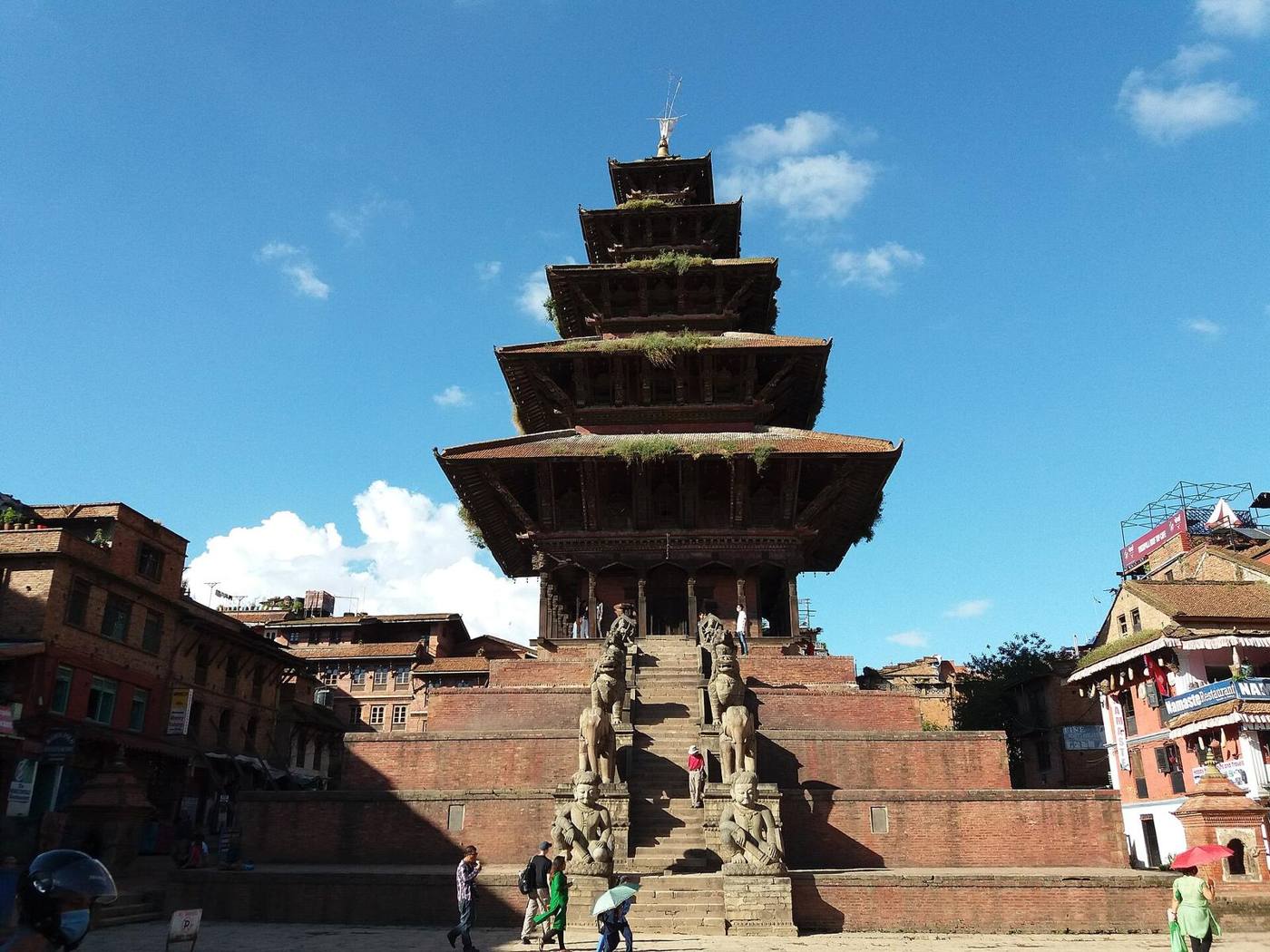
Drop your bags and start at Durbar Square, with the palace of 55 carved wooden windows and the Golden Gate, a masterpiece of gilded metal. Then walk to Taumadhi Square, with the Nyatapola Temple, a five-storey pagoda with guardian statues on its stairway.
At midday taste juju dhau, Bhaktapur's sweet yoghurt, served in a clay bowl.
In the afternoon pass through Pottery Square, where craftsmen work clay on the wheel and leave the pots to dry in the sun. Carry on to Dattatreya Square, with the old priests' houses and the Peacock Window, a carved wooden window with a peacock spreading its tail.
At sunset the day groups leave and the town changes. Women sit on the temple steps, children play in the squares, men play music in the small pavilions, and the temple bells ring for evening prayers.
In the evening have dinner on a terrace overlooking the rooftops.
Sleep in Bhaktapur.
Practical tip: get up at dawn and walk around Bhaktapur before eight: you will see the town of morning rituals, with worshippers bringing offerings to the temples.
- Day 5
Changu Narayan and Boudhanath at sunset
Today you visit the oldest temple in the valley and the great Tibetan stupa.
In the morning leave Bhaktapur and drive by taxi, just over half an hour, to Changu Narayan, a temple dedicated to Vishnu on a hill north of the town, a UNESCO World Heritage Site. It is considered the oldest temple in the valley still in use, and in the courtyard there is a 5th-century stone inscription, among the oldest in Nepal. Look at the wooden struts carved with many-armed deities and the stone statues scattered around the courtyard, some more than a thousand years old. Check prices and times.
Then stroll through the small hilltop village, with its shops and Newar houses, and enjoy the view over the farmed terraces.
At midday have lunch in Changu Narayan or along the way.
In the afternoon go to Boudhanath, one of the largest stupas in the world, at the heart of Nepal's Tibetan community. Around the great white dome are dozens of monasteries, shops selling sacred objects and tea houses. Step into one of the monasteries to hear the monks chanting. Check prices and times.
At sunset join the pilgrims walking clockwise round the stupa, spinning the prayer wheels and telling their beads, while the butter lamps are lit.
In the evening have Tibetan dishes, such as thukpa, noodle soup.
Sleep in Kathmandu.
Practical tip: for tonight's dinner choose a terrace overlooking the illuminated stupa: it is one of the finest views in Kathmandu.
- Day 6
The flight to Pokhara
Today you leave the Kathmandu Valley and reach Pokhara, the lake town.
In the morning take the domestic flight to Pokhara, about half an hour. If the sky is clear, sit on the right side of the plane: you will see the long line of snowy mountains, from Ganesh Himal to the Annapurnas. Alternatively you can travel by tourist bus, six to eight hours on a busy mountain road.
Pokhara is one of the main tourist towns in Nepal, on the shores of Phewa Lake, at the foot of the Annapurna massif. The climate is milder than in Kathmandu and the air is cleaner.
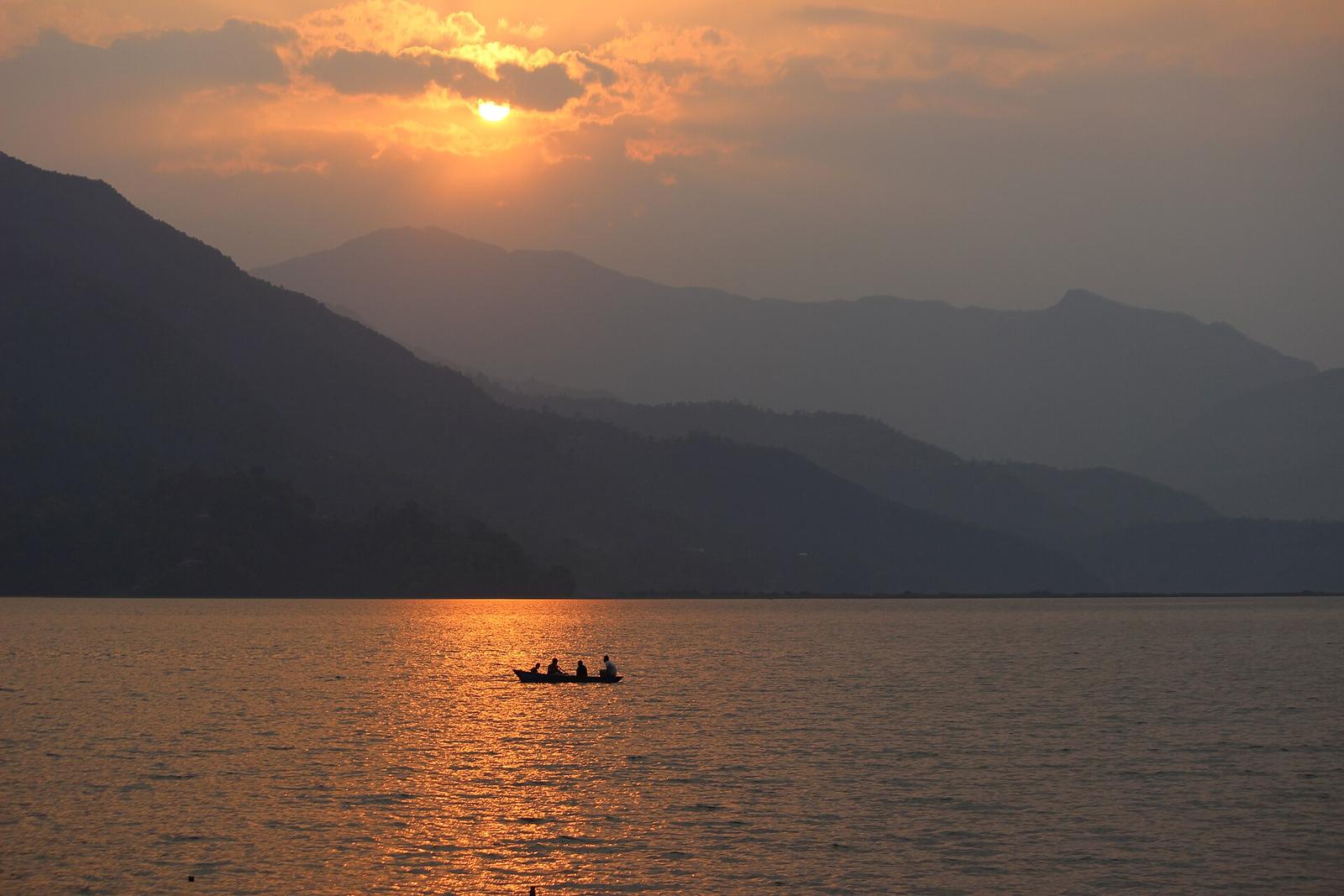
In the afternoon settle into Lakeside, the district on the waterfront, and walk along the shore with its colourful boats, cafés and stalls. On clear days Machapuchare, the fishtail mountain, is reflected in the water.
Then visit the International Mountain Museum, which tells the story of the great Himalayan expeditions, the mountain peoples and the geology of the range. Check prices and times.
At sunset sit by the lake and watch the sky change colour over the hills.
In the evening have lake fish or a Nepali thali, the tray with many small dishes.
Sleep in Pokhara, for three nights.
Practical tip: domestic flights in Nepal are often postponed for fog or cloud, and according to the British government no Nepali airline meets international safety standards: weigh up your choice and keep the day flexible.
- Day 7
Sarangkot at dawn and Phewa Lake by boat
Today you watch sunrise over the mountains and discover the lake from the water.
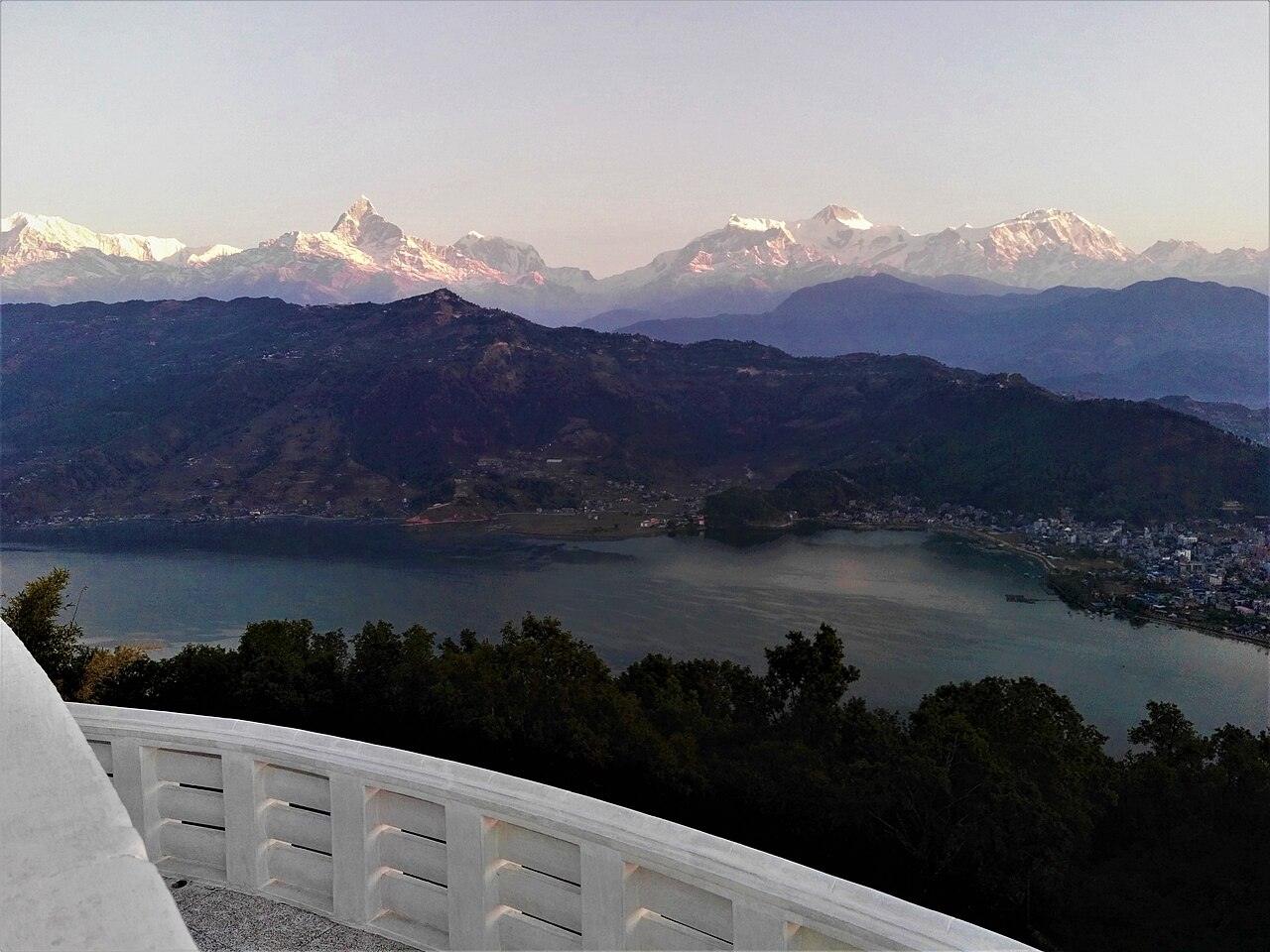
In the morning, still in the dark, take a taxi up to Sarangkot, a hill above Pokhara at about 1,600 metres. Climb the last steps to the viewpoint and wait for the sun. As it rises, the pink light touches the peaks one by one: Dhaulagiri, the Annapurnas and Machapuchare, which looks very close from here. Below you, the lake and the town are still in the mist.
Go back to Pokhara for breakfast.
In the middle of the morning hire a colourful rowing boat on Phewa Lake, with a boatman or rowing yourself. Stop at the island of the Tal Barahi Temple, a small pagoda dedicated to the goddess Barahi, where worshippers arrive by boat with offerings. Check prices and times.
At midday cross the lake to the southern shore and walk up through the woods, about an hour, to the World Peace Pagoda, a white stupa built by Japanese Buddhist monks above the lake. From the terrace you see all of Pokhara and the Annapurna range.
In the afternoon go back down to town and rest.
At sunset watch the paragliders gliding down from Sarangkot and landing near the lake.
Sleep in Pokhara.
Practical tip: for Sarangkot you leave very early, around five in autumn: bring a warm jacket, because on the hill it is cold at dawn even when the weather in Pokhara is mild.
- Day 8
The Tibetan settlement and the caves
Today you discover Pokhara's Tibetan community and the caves that open beneath the town.
In the morning visit one of the Tibetan settlements founded around Pokhara after 1959, when many Tibetans left their country and came to Nepal. The largest is north of the town, on the road to Baglung; another is to the south, near Devi's Fall. Walk among the low houses, visit the small monastery and the school, and watch the women weaving carpets by hand in the workshop. Check times.
At midday have Tibetan dishes for lunch, such as momos and thukpa.
In the afternoon go to the south of the town, where the Pardi river disappears underground in a waterfall inside a gorge, Devi's Fall. Opposite is the Gupteshwor Mahadev cave, a cave sacred to Shiva: go down the steps between damp rocks to a chamber with an altar and, further down, to a view of the waterfall from inside. Check prices and times.
If you still have time, head north to Mahendra Cave, a limestone cave with stalactites, and the nearby Bat Cave, where thousands of bats sleep hanging from the roof. Check prices and times.
In the evening return to Lakeside for a quiet dinner.
Sleep in Pokhara.
Practical tip: in the caves the ground is wet and slippery: wear shoes with a good grip and bring a small torch for the Bat Cave.
- Day 9
Back to Kathmandu
Today you leave Pokhara and return to the Kathmandu Valley.
Early in the morning, if the sky is clear, take a last look at the mountains from the lakeside: at dawn Machapuchare is often clear of cloud.
Then take the flight to Kathmandu, about half an hour, or the tourist bus, six to eight hours. By bus the road follows the Seti and Trisuli rivers through the hills, with plenty of stops in the villages along the way.
In the afternoon, once you arrive, visit Pashupatinath, the great Shiva temple on the Bagmati river, the holiest place in Nepal for Hindus. The main temple is open only to Hindus, but from the opposite bank you can see the ghats, the stone steps where cremations take place, and the sadhus, the ascetics with painted faces. Watch respectfully and do not photograph the rites close up. Check prices and times.
At sunset, on some evenings, the aarti takes place on the bank, a ceremony with lamps, chanting and bells: ask on the spot whether it is being held.
In the evening have dinner in Thamel or Patan and enjoy your last evenings in the valley.
Sleep in Kathmandu, for two nights.
Practical tip: if you choose to fly, book the morning flight: it is more likely to leave on time, before the clouds rise over the mountains. If the flight is cancelled, you still have a spare day before you leave.
- Day 10
Nepali cooking class or a day at leisure
Today is a day to shape as you like, without hurry.
In the morning you can join a Nepali cooking class. It usually starts at the market, where you learn to recognise the spices, vegetables and lentils. Then in the kitchen you make dal bhat, with lentil soup, rice, vegetable curry and pickles, and above all momos, steamed dumplings: you learn to make the dough, the filling and the folds, and then you steam them. At the end you have lunch with what you have cooked.
If you prefer a day at leisure, go back calmly to the places you liked most, or visit those you have not yet seen. You can return to Boudhanath for another walk round the stupa, spend a morning in the museums and workshops of Patan, or have a massage.
In the afternoon do your last shopping. In Thamel and Patan you will find pashmina scarves, Himalayan teas, bronze statues, prayer wheels, singing bowls and lokta paper, handmade from the bark of a shrub.
At sunset go back to Swayambhunath or sit on a terrace above the city rooftops.
In the evening have a last Nepali dinner, with traditional music if you can find it.
Sleep in Kathmandu.
Practical tip: in Thamel's shops bargain with a smile, but do not overdo it; in fixed-price shops and craft cooperatives the price is the one shown.
- Day 11
Departure
Today you leave Nepal.
In the morning, if your flight is late, take a last walk through the centre of Kathmandu, among the Asan bazaars and the small temples at the crossroads, or sit in a quiet courtyard with a cup of tea.
Then go to the airport with plenty of time: security checks can be slow and the traffic is unpredictable.
In these eleven days you have seen cultural Nepal at a gentle pace: Kathmandu Durbar Square and the Swayambhunath stupa, the ridge town of Kirtipur and the squares of Patan, a night in the medieval town of Bhaktapur, the ancient temple of Changu Narayan and the great stupa of Boudhanath, then Pokhara with Phewa Lake, sunrise from Sarangkot, the Tibetan settlements and the caves, and finally the Pashupatinath temple on the sacred river.
When to go: the best months are October and November, with the clearest skies after the monsoon and the mountains visible almost every day, and March and April, with a mild climate and the rhododendrons in flower, but with the mountains more often hazy. From October to December the sky is especially clear. From June to September the monsoon brings heavy rain and cloud over the mountains. In autumn the great festivals of Dashain and Tihar are also celebrated: check the dates, because many offices and shops close on those days.
Practical tip: in Nepal tips are appreciated by guides, drivers and waiters: keep them ready in rupees, in small notes.
Nepal for those who don't want to trek. Sleeping in Bhaktapur, once the day groups leave, is the trip's highlight. From October to December the sky is clear and the mountains are visible almost every day.
Before you go
- Documents and visa
- Passport valid for at least six months from the date of entry and a tourist visa, issued on arrival at Kathmandu airport. Fill in the form online up to 15 days ahead or at the airport kiosks. According to the Department of Immigration the visa costs 30 US dollars for 15 days, 50 for 30 days and 125 for 90 days: bring US dollars in cash. Border officers may ask for health insurance with repatriation and the address of your first night.
- Health and vaccines
- No compulsory vaccines when arriving from Europe; yellow fever is needed only if you come from a risk country. In the Terai, the southern plain, there is a malaria risk: ask your doctor. Above 3,000 metres climb slowly to avoid altitude sickness. Drink only bottled or treated water. Police 100, tourist police 1144.
- Money and payments
- Nepalese rupee. Cash dominates; ATMs are found in Kathmandu, Pokhara and the towns, far fewer on the trails. Cards work in the larger hotels.
- Power sockets
- Types C, D and M, 230 volts: bring a universal adapter. Power cuts are frequent.
- Time zone
- UTC+5:45 all year.
- Safety
- After the youth protests of 8 and 9 September 2025, with at least 75 deaths and the fall of the government, the country voted on 5 March 2026; since March 2026 a new government has held a large majority. Demonstrations and strikes are still possible and can turn violent: avoid them. The United States advises increased caution. The UK warns that areas hit by the flood of 26 August 2026 in Rasuwa district may remain unstable. A licensed guide is required in national parks and protected areas. According to the UK, no Nepali airline meets international safety standards, and mountain flights are often delayed by the weather. Official advice: GOV.UK.
Information checked in November 2026 for Italian and EU citizens. Rules change: always check before you travel.
Variations
In 7 days: Kathmandu, Patan and a night in Bhaktapur, then two days in Pokhara with sunrise from Sarangkot.
In 14 days: add three days in Chitwan National Park, on the Terai plain, with rhinos and canoe trips, before returning to Kathmandu.
Frequently asked questions
What documents do I need for Nepal?
Italian citizens need a passport valid for at least six months and a tourist visa, issued on arrival in Kathmandu. According to the Department of Immigration it costs 30 US dollars for 15 days and 50 for 30 days. Other nationalities should check their own rules.
Is this trip suitable for people who do not want to walk?
Yes. There is no trekking: you walk only in the towns, on temple stairways and on a few short paths, such as the one to the World Peace Pagoda in Pokhara, which you can avoid by taxi.
Is Nepal safe?
After the protests of September 2025 the country voted on 5 March 2026 and has a new government. The United States advises increased caution because demonstrations can turn violent: avoid them and check official travel advice before you go.
Indicative itinerary written by World Atlas. Before booking, check timetables, seasonal openings, documents and safety.
 7 daysEasy
Kathmandu, Pokhara and Poon Hill
The temples of the Kathmandu Valley, the lake at Pokhara and a short trek with sunrise over the Annapurnas.
 15 daysChallenging
Everest trek and Chitwan
The spectacular flight to Lukla, Sherpa villages and the Everest viewpoint of Kala Patthar, then the rhinos of Chitwan. Good fitness required.
 16 daysEasy
All of Nepal: the Kathmandu valley, Pokhara and Chitwan
The valley's three royal cities, a short trek with Annapurna views, rafting on the Trisuli, the rhinos of Chitwan and Lumbini, birthplace of the Buddha.