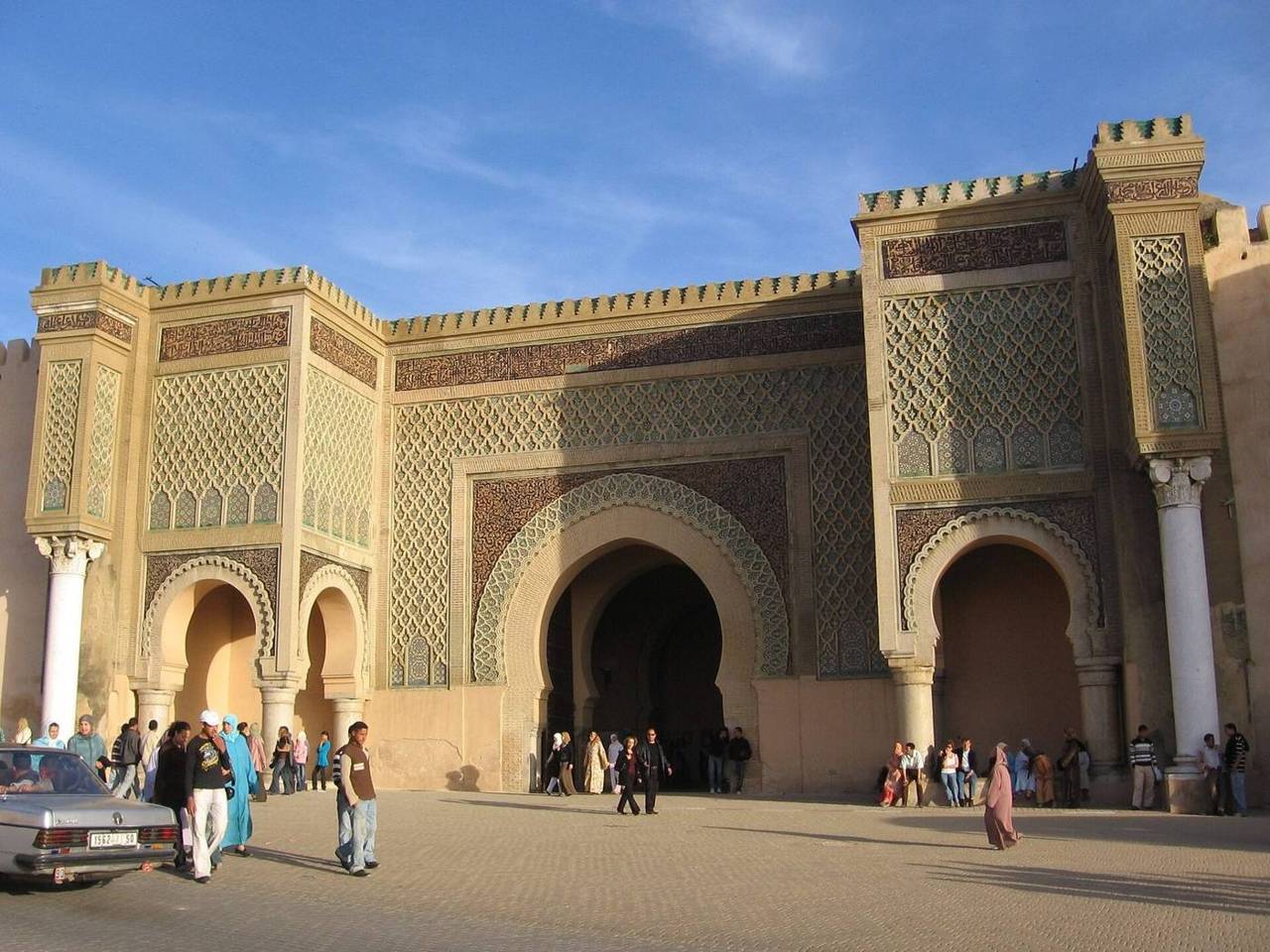
Meknes in depth and Moulay Idriss
Moulay Ismail's imperial city, a UNESCO site: the Bab Mansour gate, the granaries and stables of Heri es-Souani, the sultan's mausoleum, the medina and its souks, then the holy town of Moulay Idriss Zerhoun on its hill and the ruins of Volubilis at sunset.
- Meknes
- Moulay Idriss
- Volubilis
Day by day
- Day 1
Meknès: Bab Mansour, el-Hedim square and the medina
Meknès is one of Morocco's four imperial cities, along with Fès, Marrakech and Rabat, but it is far less visited and calmer. You get there by train from Fès in about half an hour, from Rabat in just over two hours, or by car. At the end of the seventeenth century Sultan Moulay Ismail made it his capital and filled it with walls, gates, palaces, vast granaries and stables: this is why some have called it the Versailles of Morocco. The historic city is a UNESCO World Heritage site.
In the morning start at Bab Mansour, the most beautiful monumental gate in Morocco, finished in 1732, covered in green and white ceramic mosaics, carved arches and marble columns taken from the Roman ruins of Volubilis. In front of it opens el-Hedim square, the city's great square, less chaotic than Marrakech's but just as lively, with vendors, families and storytellers, especially in the evening.
On one side of the square visit the Dar Jamaï museum, in a nineteenth-century palace with an Andalusian garden, displaying ceramics, carpets, painted woodwork and Berber jewellery.
In the afternoon enter the medina behind the square: the souks of fabrics, spices and coppersmiths, and the Bou Inania medersa, the fourteenth-century Koranic school with a courtyard of carved cedar wood, stucco and zellige tiles, where you can climb onto the roof for a view of the minarets.
In the evening return to el-Hedim square for dinner at the street food stalls: kebabs, harira, the lentil and chickpea soup, and snails in spiced broth. Practical tip: in Meknès vendors are less insistent than in Fès or Marrakech, but a polite, firm no is still the best answer.
- Day 2
Heri es-Souani, the mausoleum of Moulay Ismail and Moulay Idriss
In the morning visit the part of the imperial city built by Moulay Ismail, south of the medina. The mausoleum of the sultan, who died in 1727, is one of the few religious shrines in Morocco that non-Muslims may also enter, as far as a room from which you look at the tomb: quiet courtyards, fountains, stucco and mosaics. Dress modestly, covering shoulders and knees.
Then walk along the high rammed-earth walls, which seem endless, to Heri es-Souani, the royal granaries and stables. These are enormous halls with very high ceilings and walls several metres thick that kept the temperature cool to store grain and hay; the stables are said to have held thousands of horses, a figure perhaps exaggerated by legend. Next to them is the Agdal basin, a large reservoir that once irrigated the gardens, now a place where families come for a stroll.
After lunch leave for Moulay Idriss Zerhoun, about half an hour's drive to the north. It is a white town built on two hills around the tomb of Idriss I, founder of Morocco's first Islamic dynasty in the eighth century: it is the holiest place in the country and a pilgrimage destination, especially in summer. Non-Muslims cannot enter the shrine, but they can wander around the town.
Climb the lanes to the viewpoints at the top, where you see the white houses piled together and the green countryside of olive groves. Sleep in Moulay Idriss, very quiet in the evening, so you can be at Volubilis when it opens. Practical tip: in Moulay Idriss respect the religious character of the place, with covered clothing and discretion when taking photos.
- Day 3
Volubilis early in the morning and the journey back
Volubilis is a few kilometres from Moulay Idriss: you get there by taxi or even on foot, in about an hour through the olive groves. Go when it opens, because the site is very exposed, with no shade, and the morning light is the best for photos.
Volubilis was a Berber and then a Roman city at the south-western edge of the Empire, in the province of Mauretania Tingitana. At its height, in the second and third centuries, it had perhaps 20,000 inhabitants and lived on the trade in olive oil and grain. After the Romans left it remained inhabited for centuries; it was later abandoned and partly dismantled to build Meknès. It is a UNESCO site and the best-preserved Roman site in Morocco.
Start at the small museum by the entrance, then follow the route through the ruins: the forum, the basilica with its columns, the Capitol and above all the triumphal arch dedicated to Emperor Caracalla. The finest thing is the mosaics left in place in the floors of the great houses: the labours of Hercules, Diana bathing, Orpheus with the animals, the procession of Bacchus. Walk along the decumanus, the main street, with views over the plain and the surrounding hills dotted with olive trees.
Allow about two hours. Bring water, a hat and sunscreen, especially from May to September.
At midday return to Meknès for the train to Fès or Rabat, or continue straight to Fès, less than an hour's drive away. Practical tip: at the entrance to Volubilis there are official guides with badges; a guide helps a great deal in understanding the ruins, so agree on the price before you start.
Meknes is 40 minutes from Fez by train and much calmer. The shrine of Moulay Idriss is closed to non-Muslims, but the town can be visited and you can stay overnight. There is little shade at Volubilis: go early or at sunset. EU citizens enter without a visa for up to 90 days with a passport. The border with Algeria is closed: keep away from the border strip.
Before you go
- Documents and visa
- EU visitors need a passport valid for the whole stay; identity cards are not accepted. No visa is needed for tourist stays of up to 90 days.
- Health and vaccines
- No vaccines required. Drink bottled water and take out travel health insurance: public healthcare is limited and private clinics charge. Emergencies: 19 police, 15 ambulance.
- Money and payments
- Moroccan dirham, which cannot be exported beyond a small sum: change a little at a time and keep the receipts. Cash is needed everywhere in medinas and villages.
- Power sockets
- Types C and E, 220 volts.
- Time zone
- UTC+1 for most of the year; Morocco changes its clocks during Ramadan, so check before travelling.
- Safety
- The main risk named by governments is terrorism; avoid the 20 km strip along the closed Algerian border and the frontier areas of Western Sahara. Official advice: GOV.UK.
Information checked in November 2026 for Italian and EU citizens. Rules change: always check before you travel.
Variations
In 2 days: Meknès on day one, Moulay Idriss and Volubilis on day two, returning in the evening.
In 6 days: combine Meknès with Fès and its medina, with a trip to Sefrou and Bhalil, or with the Middle Atlas and Ifrane and Azrou.
Frequently asked questions
When is the best time to go?
In spring, from March to May, and in autumn, from September to November. In summer Volubilis is very hot; in winter the nights are cool.
Is it safe?
The United States has Morocco at level 2, meaning increased caution, mainly because of the risk of terrorism; Meknès, Moulay Idriss and Volubilis are quiet areas. Check the latest advice before you go.
Is it better to sleep in Meknès or Fès?
Meknès is calmer and cheaper; if you are short of time you can visit it as a day trip from Fès, but for Volubilis at dawn it is best to sleep in Moulay Idriss.
Indicative itinerary written by World Atlas. Before booking, check timetables, seasonal openings, documents and safety.
 4 daysEasy
Fez in depth, Sefrou and Bhalil
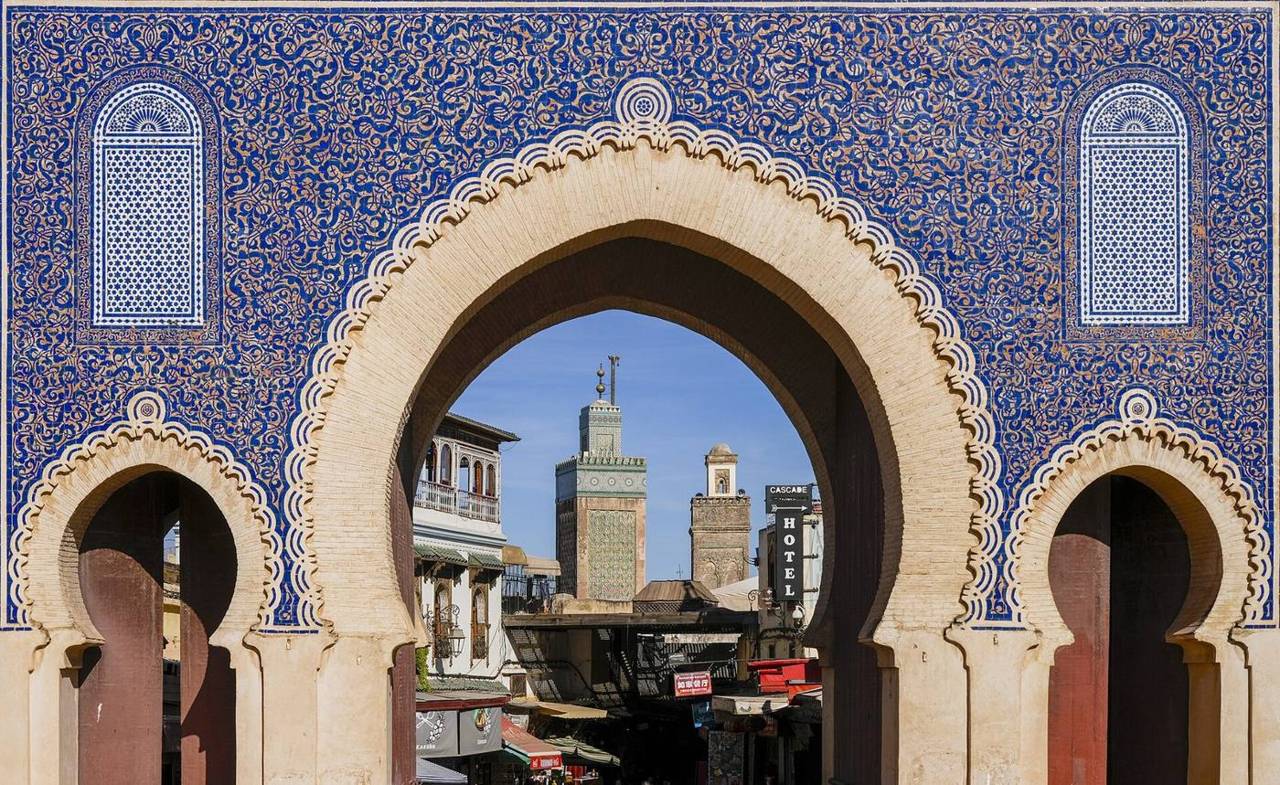
The largest medieval medina in the Maghreb, at an easy pace: the Bou Inania and Al-Attarine madrasas, the Chouara tanneries, the artisans' quarters, the Mellah of Fès el-Jdid, the view from the Marinid tombs, then Sefrou with its old Jewish quarter and the cave houses of Bhalil.
 5 daysEasy
Rabat, Casablanca, El Jadida and Oualidia
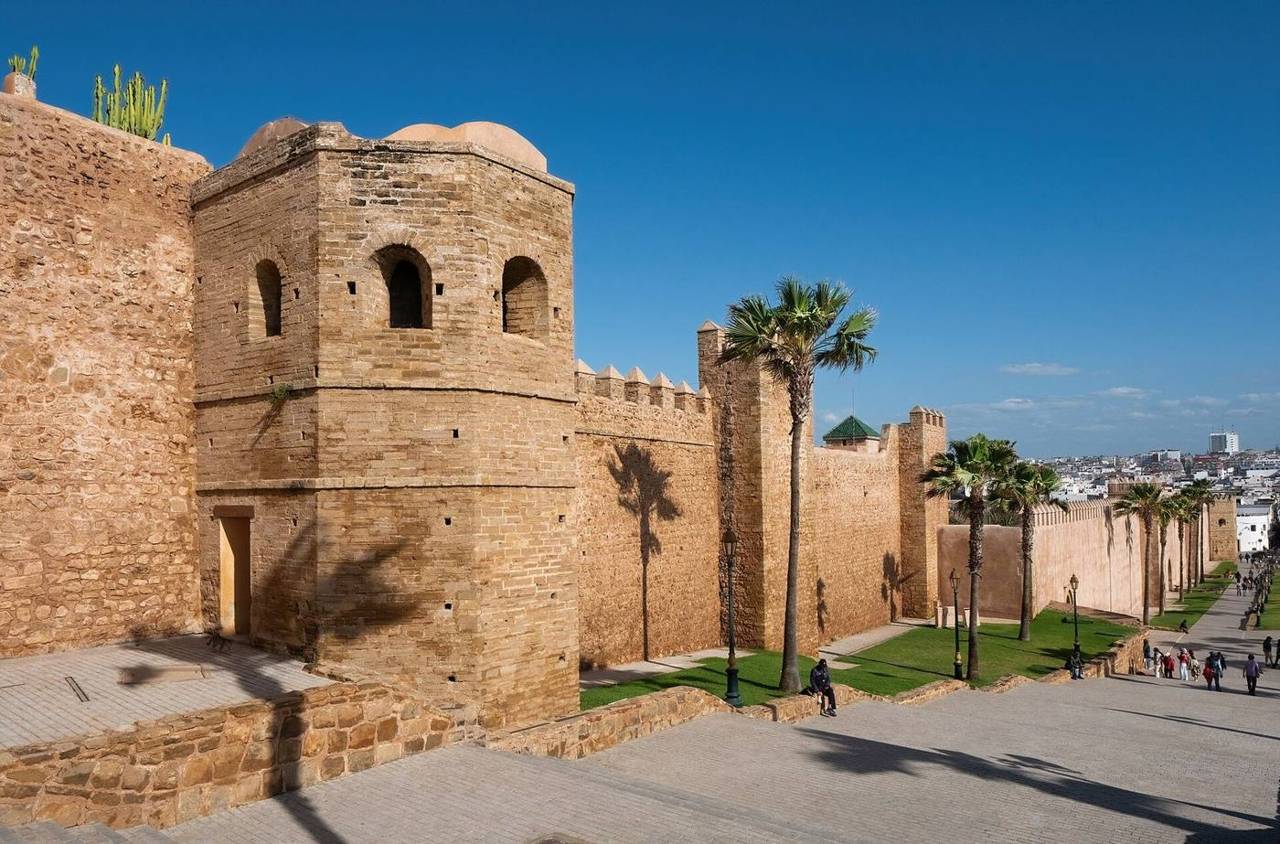
Atlantic, modern Morocco: Rabat, a UNESCO-listed capital, with the Hassan Tower, the Kasbah of the Udayas and the Chellah, the great Hassan II Mosque in Casablanca, the Portuguese cistern in El Jadida, Azemmour on its river and the Oualidia lagoon.
 5 daysEasy
Tangier, Tetouan and the Mediterranean coast
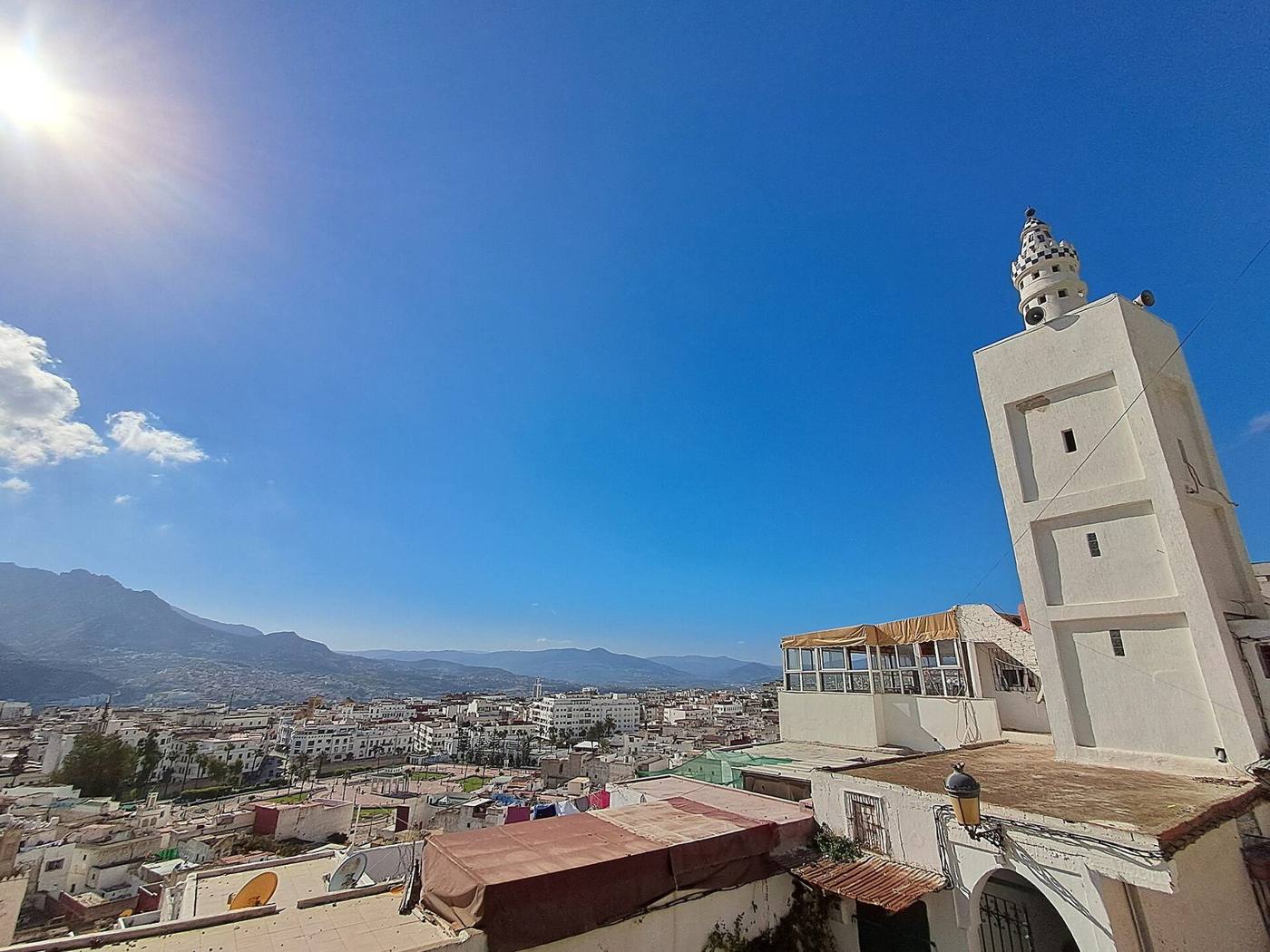
Morocco's Andalusian north: Tangier with its kasbah, Cape Spartel and the Caves of Hercules, the medina of Tetouan (UNESCO) with its white houses and craftsmen, the beaches of Martil and Oued Laou and the coast road towards Al Hoceima National Park.