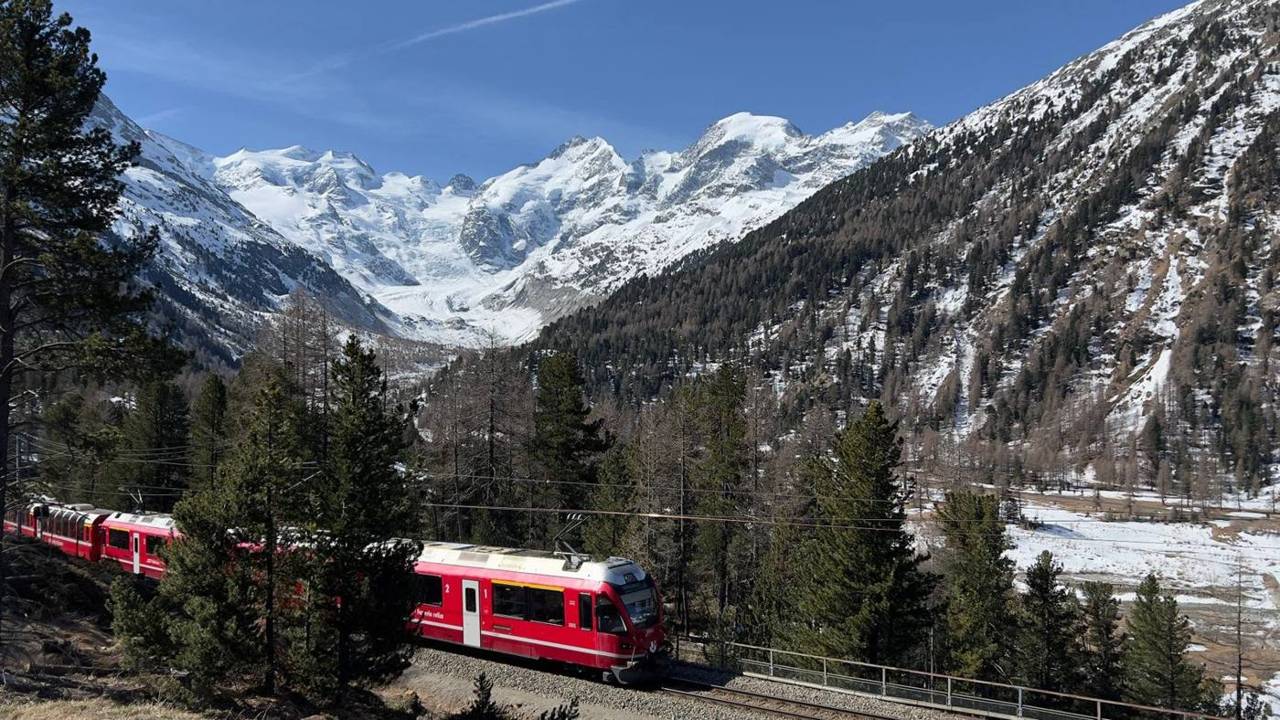
The Grand Train Tour
Switzerland by panoramic train: Zurich, Lucerne, the GoldenPass to Montreux, Zermatt with the Glacier Express and the Bernina Express to Tirano.
- Zürich
- Luzern
- Interlaken
- Montreux
- Zermatt
- St. Moritz
- Tirano
Day by day
- Day 1
Zurich, the old town and the lake
This trip crosses Switzerland in ten days entirely by train: Zurich, Lucerne and its mountains, the Luzern-Interlaken Express, the GoldenPass Express to Lake Geneva, Zermatt and the Matterhorn, then the Glacier Express and the Bernina Express down to Tirano. You never need to drive: every day you board a train and step off into a new landscape.
Before you go: Italian citizens only need an electronic identity card valid for travel abroad or a passport, with no visa. Switzerland is not in the European Union but is in the Schengen area; you pay in Swiss francs, and driving on motorways requires the vignette. Other nationalities should check their own rules. The country is very safe, but it is one of the most expensive in Europe: a simple lunch easily costs 30 francs.
You arrive at Zurich airport or main station. In the afternoon walk through the old town on both banks of the Limmat: the Lindenhof with its view over the rooftops, the Fraumünster with Chagall's windows and the twin-towered Grossmünster, linked to Zwingli's Reformation. Check prices and times.
Towards evening go down to the lake and walk along the shore to the Zürichhorn park, or take a short boat trip, with the Alps in the background on clear days.
Have Zürcher Geschnetzeltes for dinner, strips of veal in a cream sauce with rösti.
Practical tip: the Swiss Travel Pass covers trains, buses, boats and many museums and gives discounts on mountain lifts; for this trip it is almost always worth it. Start it on the first day and check prices and conditions on the Swiss railways website.
- Day 2
Lucerne, the Chapel Bridge and the lion
Today you go to Lucerne, about an hour by train, the city on Lake Lucerne with mountains all around.
In the morning cross the Chapel Bridge, the Kapellbrücke, a 14th-century covered wooden bridge with its octagonal water tower. Under the roof are painted panels with the history of the city; many were lost in the fire of 1993, after which the bridge was rebuilt. Continue into the old town, among squares with frescoed façades, to the Mill Bridge, the Spreuerbrücke, with its painted dance of death.
At midday walk along the Musegg walls, the medieval walls with nine towers: some can be visited in summer, and from the top you see the lake and the rooftops. Check prices and times.
In the afternoon go to the Lion Monument, the Löwendenkmal, carved into the rock in memory of the Swiss Guards who died in Paris in 1792, during the storming of the Tuileries. Mark Twain called it the most mournful and moving piece of stone in the world. Close by is the Glacier Garden, with potholes carved by water during the last ice age. Check prices and times.
In the evening walk along the lakeside to the culture and convention centre, the KKL, with Jean Nouvel's great overhanging roof.
Practical tip: in Lucerne stay near the station: all the trains and boats for the next few days leave from there.
- Day 3
Mount Pilatus or the Rigi
Today you go up one of Lucerne's two mountains: Pilatus, rugged and rocky, or the Rigi, green and gentle, known as the queen of the mountains.
For Pilatus do the Golden Round Trip: in the morning take the boat from Lucerne to Alpnachstad, then ride the steepest cogwheel railway in the world, with gradients of up to 48 per cent. The cogwheel railway only runs from spring to autumn, roughly May to November. At the top, at about 2,100 metres, there are short paths among the rocks and views over dozens of peaks. Then go down by cable car and gondola to Kriens and return to Lucerne by bus.
For the Rigi take the boat to Vitznau and ride the cogwheel railway, opened in 1871, the first mountain railway in Europe. From the summit, Rigi Kulm, you can see thirteen lakes on clear days. At midday walk down to Rigi Kaltbad, in about an hour, then take the cable car to Weggis and the boat back to Lucerne.
Choose according to the weather: with low cloud, check the webcams before leaving. Check prices and times: the Swiss Travel Pass covers the Rigi and gives a discount on Pilatus, but confirm the current conditions.
In the evening, on the Lucerne lakeside, try Luzerner Chügelipastete, a vol-au-vent filled with meat and mushrooms.
Practical tip: on the boat sit outside at the stern: the trip on the lake is as beautiful as the mountain.
- Day 4
The Luzern-Interlaken Express and Interlaken
Today you take the Luzern-Interlaken Express, a panoramic train that crosses the Brünig Pass in about two hours and descends into the Bernese Oberland.
In the morning you leave Lucerne along Lake Sarnen, then the train climbs on a cogwheel section to the Brünig Pass, at about a thousand metres. During the climb look out for Lake Lungern, emerald green, with the village on its shore. After the pass you go down towards Meiringen and run along Lake Brienz, an intense turquoise, to Interlaken.
At midday drop your bags and walk on the Höhematte, the large meadow in the centre of town, from where you can see the white summit of the Jungfrau. Interlaken lies between two lakes, Thun and Brienz, as its name says.
In the afternoon ride the funicular to Harder Kulm, at about 1,300 metres: from the platform over the drop you see both lakes and, in front, the Eiger, Mönch and Jungfrau. Check prices and times. If you prefer the water, take the boat on Lake Thun to Spiez, with its castle on the shore.
In the evening, if you have time, watch the sunset over the glaciers from the bank of the Aare, the river joining the two lakes.
Practical tip: on this line you do not need a seat reservation, but in summer the panoramic carriages fill up; board early in Lucerne to choose the lake side.
- Day 5
The GoldenPass Express to Montreux and Chillon Castle
Today you move from German-speaking to French-speaking Switzerland on the GoldenPass Express, from Interlaken to Montreux, in just over three hours.
In the morning you leave Interlaken and follow Lake Thun to Spiez, then climb the Simmental valley. Since 2022 the train changes from one track gauge to the other at Zweisimmen with no change of carriage, thanks to bogies that adjust their gauge. You pass through Gstaad, with its wooden chalets, then the pastures of the Pays-d'Enhaut, the region of paper cutting, and finally descend in hairpins above Lake Geneva.
At midday you arrive in Montreux and stroll along the flower-lined lakeside to the statue of Freddie Mercury, who recorded Queen albums here. The Montreux Jazz Festival takes place in July.
In the afternoon walk along the lake for about an hour, or take the bus, to Chillon Castle, built on a rock in the water. Visit the halls, towers and dungeons, where the prisoner celebrated by Lord Byron was chained; Byron carved his name on a pillar. Check prices and times.
In the evening try fillets of perch from the lake, served with butter and chips.
Practical tip: on the GoldenPass Express reservations are recommended and the front-row carriages need a supplement: book ahead, especially in summer.
- Day 6
From Montreux to Zermatt
Today you enter Valais and reach Zermatt, the village with no cars at the foot of the Matterhorn.
In the morning take the train from Montreux along the Rhône valley: you pass Martigny, Sion with its two castle hills of Valère and Tourbillon, and the terraced vineyards on the slopes. At Visp change to the mountain railway that climbs the valley to Zermatt, in just over an hour.
At midday drop your bags and walk along Bahnhofstrasse, the main street, among electric taxis and horse-drawn carriages. From almost every corner of the village you can see the Matterhorn, 4,478 metres.
In the afternoon visit the Matterhorn Museum, built like an underground village, with the story of the first ascent in 1865 and the rope that broke on the way down. Check prices and times. Then walk to Hinterdorf, the old quarter, with dark wooden granaries on stone pillars, and to the mountaineers' cemetery.
If you still have energy, walk up in about an hour to the chapel at Findeln or to the meadows above the village, to see the Matterhorn with no rooftops in front.
In the evening try raclette or a cheese fondue, the dishes of Valais.
Practical tip: check the webcams every evening and plan the next day's ascent according to the weather: the Matterhorn often hides in the clouds, and early morning is the best time.
- Day 7
The Gornergrat and the Matterhorn
Today you go up to the Gornergrat, the most famous viewpoint over the Matterhorn and the glaciers of Monte Rosa.
Early in the morning take the Gornergrat cogwheel railway, opened in 1898, which climbs from Zermatt to 3,089 metres in about 35 minutes. Sit on the right going up to see the Matterhorn. At the top, from the terrace, you face the Gorner glacier, one of the largest in the Alps, surrounded by a crown of peaks over four thousand metres, including the Dufourspitze of Monte Rosa, the highest in Switzerland. Check prices and times: the Swiss Travel Pass gives a discount.
Mid-morning take the train back down to Rotenboden and walk to the Riffelsee, the small lake where the Matterhorn is reflected on still mornings. Continue on the path to Riffelberg, in about an hour, among meadows and rocks.
In the afternoon go down by train or, if your legs are strong, on foot to Riffelalp and then to Zermatt, on a long path through the larches.
In the evening rest: tomorrow brings eight hours on the train.
Practical tip: even in summer it is cold at the top and the sun is very strong: bring a jacket, sunglasses and sun cream, and drink plenty, because above three thousand metres you dehydrate quickly.
- Day 8
The Glacier Express to St. Moritz
Today you cross the Alps from Zermatt to St. Moritz on the Glacier Express, the most famous panoramic train in Switzerland, in about eight hours.
In the morning you leave Zermatt and go down to Visp and Brig, then climb the Goms valley, with its villages of dark wood, and pass under the Furka in a tunnel. At Andermatt the train zigzags up on the cogwheel to the Oberalp Pass, at 2,033 metres, the highest point of the route, near the source of the Rhine.
At midday have lunch at your seat, served at the table, or a sandwich you brought with you, as you go down towards Disentis and its monastery.
In the afternoon the train enters the Rhine gorge, the Ruinaulta, with the white walls of a prehistoric landslide, then reaches Chur and takes the Albula line, a UNESCO World Heritage Site. Here you cross the Landwasser viaduct, with its stone arches ending inside a rock face, and climb through spiral tunnels to the Engadine. In all, the journey counts 291 bridges and 91 tunnels.
In the evening you reach St. Moritz and take a short walk by the lake.
Practical tip: a seat reservation on the Glacier Express is compulsory and paid separately even with the Swiss Travel Pass; in summer book months ahead and choose a window seat on the sunny side.
- Day 9
The Bernina Express to Tirano
Today you go down from the Alps to Italy on the Bernina Express, which runs from St. Moritz to Tirano in about two and a half hours on the Bernina line, a UNESCO World Heritage Site.
In the morning, before leaving, walk around the lake of St. Moritz or go up to the village centre to see the leaning tower. Then board the train, which passes near the Morteratsch glacier and reaches Ospizio Bernina, at 2,253 metres, beside Lago Bianco.
At midday the train passes Alp Grüm, above the Palü glacier, and begins its descent to the Poschiavo valley with tight curves and gradients of up to 7 per cent, with no cogwheel. If you want to stop, get off here and continue later on a regional train.
In the afternoon you pass Poschiavo, an Italian-speaking town, and the circular viaduct of Brusio, the most photographed stone spiral on the line. You arrive in Tirano, where the train crosses the square in front of the sanctuary of the Madonna, built from 1505.
In the evening have dinner with Valtellina pizzoccheri and a glass of local wine.
Practical tip: reservations are compulsory on the Bernina Express too; if you prefer windows that open for photos, choose a regional train on the same line, with no supplement.
- Day 10
Tirano and departure
You spend your last day in Tirano, in the Valtellina, before heading home.
In the morning visit the sanctuary of the Madonna di Tirano, with its great carved organ and frescoes, then stroll around the old village across the Adda, among noble palaces and medieval gates. Check prices and times.
In the afternoon take the regional train to Sondrio, Lake Como and Milan, from where trains and flights leave for all of Italy.
In ten days you have seen Switzerland without ever driving: the city of Zurich, Lucerne with Pilatus or the Rigi, the Bernese Oberland from Interlaken, Lake Geneva at Montreux, the Matterhorn from Zermatt and two of the most beautiful mountain railways in the world. It is an easy trip, suitable for everyone, with short walks and many hours of scenery from the window.
When to go: from June to September, when the Pilatus cogwheel railway, the high paths and all the lifts are open; July and August are the busiest and most expensive months, so book trains and beds months ahead. September is often clear and quieter. In winter the panoramic trains run through the snow, but some lifts close and the days are short.
Remember that Switzerland is very expensive: you save with the Swiss Travel Pass, picnic lunches bought in supermarkets and water from public fountains, which is drinkable.
Practical tip: send your luggage between stations with the Swiss railways' baggage service and travel light on the panoramic trains; check prices and times on the official website.
The finest way to see Switzerland, without driving. The Swiss Travel Pass covers trains, buses, boats and many museums and gives discounts on lifts: it is almost always worth it. Panoramic trains require a reservation supplement. Switzerland is very expensive: a simple lunch easily costs 30 francs.
Before you go
- Documents and visa
- Switzerland is not in the EU but is in the Schengen area. British visitors can stay up to 90 days in any 180 days without a visa, and the EU Entry/Exit System applies. Motorways need the vignette, as a sticker or an e-vignette from the official website.
- Health and vaccines
- No vaccines required. Healthcare is excellent but very expensive: take travel insurance that covers repatriation and mountain rescue, because helicopter rescue costs a great deal. Watch out for ticks in woods. Emergencies: 112, police 117, fire 118, ambulance 144, Rega air rescue 1414.
- Money and payments
- Swiss franc. Cards are accepted almost everywhere, even for small amounts; euros are taken in many places, but change comes in francs at a poor rate.
- Power sockets
- Swiss type J, 230 volts: you need an adapter for British plugs.
- Time zone
- Central European Time (UTC+1, summer UTC+2).
- Safety
- A very safe country. In the mountains carry the right gear, check the MeteoSwiss forecast and, in winter, the avalanche bulletin. Traffic fines are severe, especially for speeding. Official advice: GOV.UK.
Information checked in November 2026 for Italian and EU citizens. Rules change: always check before you travel.
Variations
Shorter: seven days, leaving out Interlaken and one day in Lucerne.
Longer: add three days in the Jungfrau region, in Wengen or Mürren, after Interlaken.
Frequently asked questions
Is the Swiss Travel Pass worth it for this trip?
Almost always: it covers trains, buses, boats and many museums and gives discounts on several lifts. Panoramic train reservations are paid separately. Check prices and conditions on the official website.
Do you need to book the panoramic trains?
The Glacier Express and the Bernina Express require compulsory reservations; on the GoldenPass Express they are recommended. In summer book months ahead.
How expensive is Switzerland?
It is one of the most expensive countries in Europe: a simple lunch easily costs 30 francs. Supermarkets, picnic lunches and fountain water help you save.
Indicative itinerary written by World Atlas. Before booking, check timetables, seasonal openings, documents and safety.
 5 daysModerate
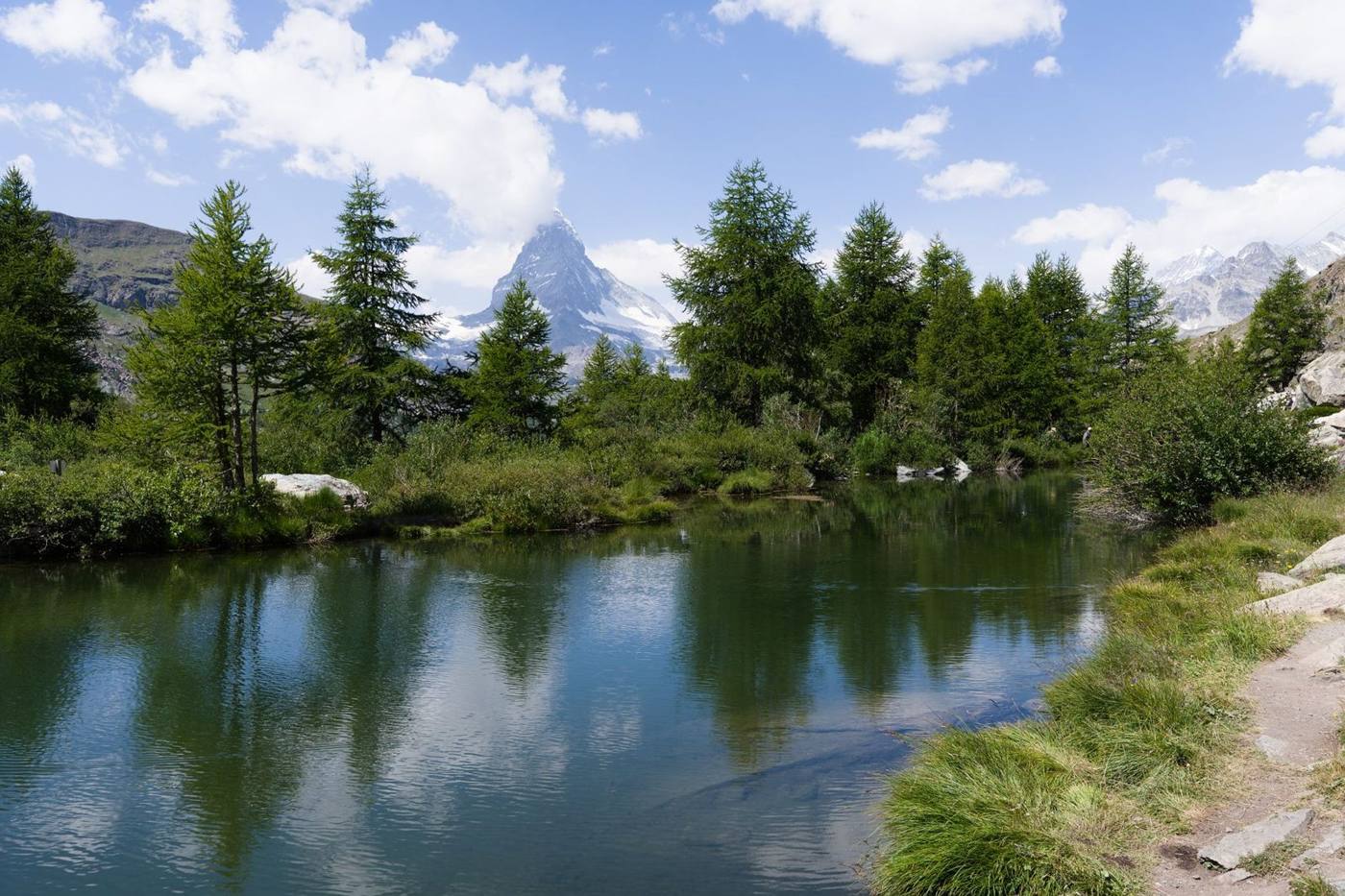
Zermatt and the Matterhorn
The village closed to cars below the Matterhorn, the Gornergrat, the Five Lakes Walk, the Matterhorn Glacier Paradise and the Hörnli hut.
 6 daysModerate
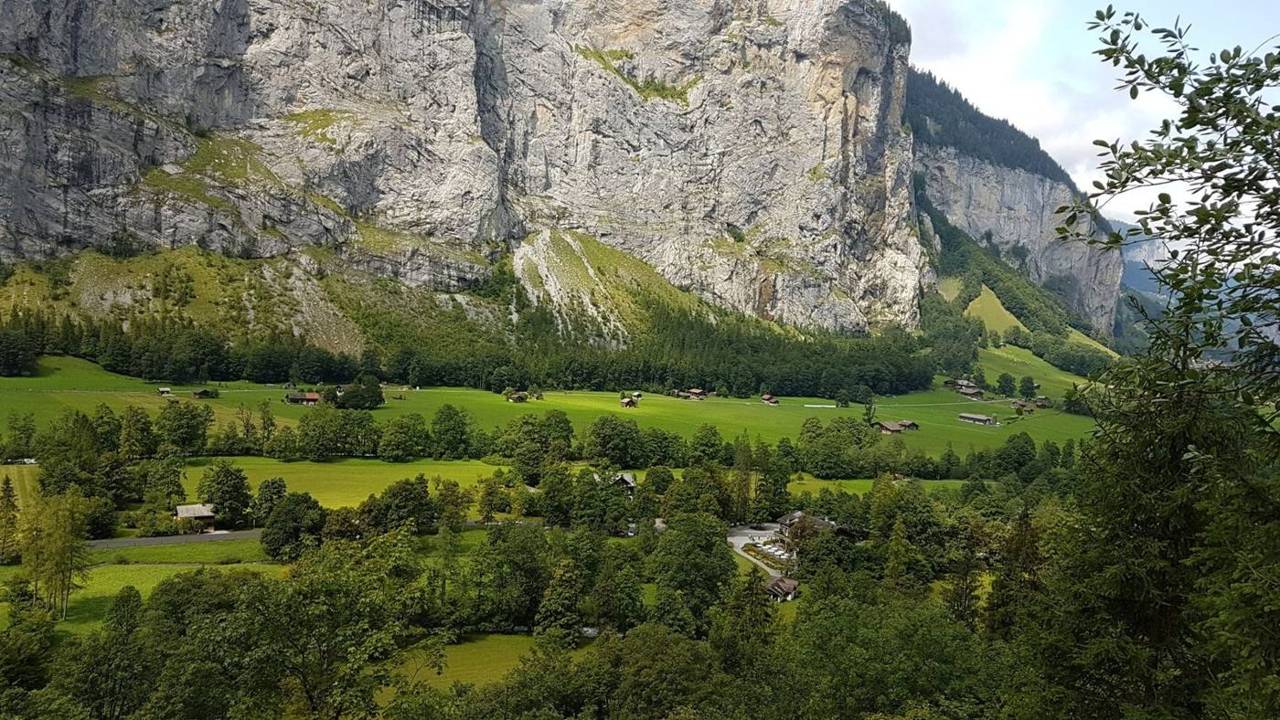
The Jungfrau and Lauterbrunnen
The valley of 72 waterfalls, the villages closed to cars of Wengen and Mürren, the Schilthorn, First with the Bachalpsee and the Jungfraujoch.
 5 daysEasy
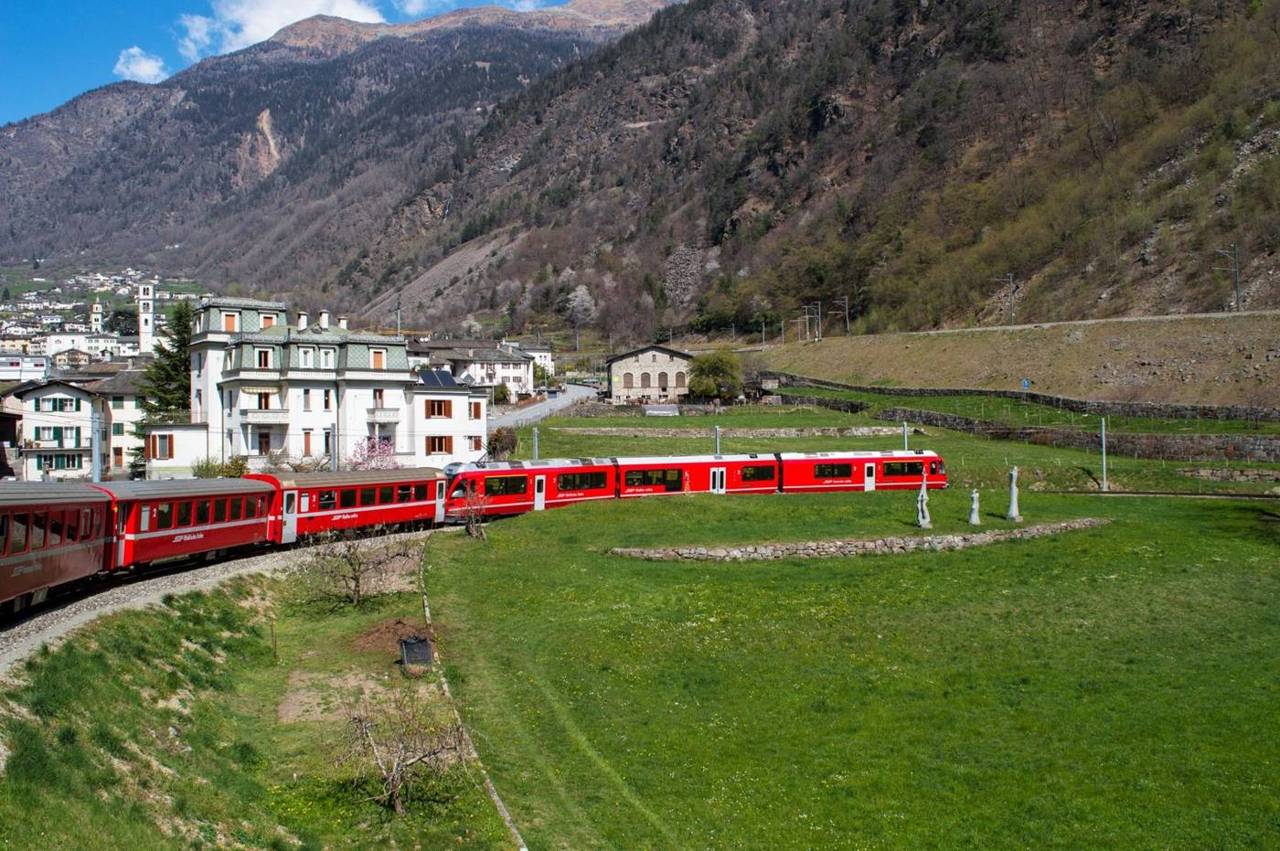
Glacier Express and Bernina Express
The two most famous panoramic trains in the Alps: from Zermatt to St. Moritz over the Oberalp, then down to Tirano over the Brusio viaduct.