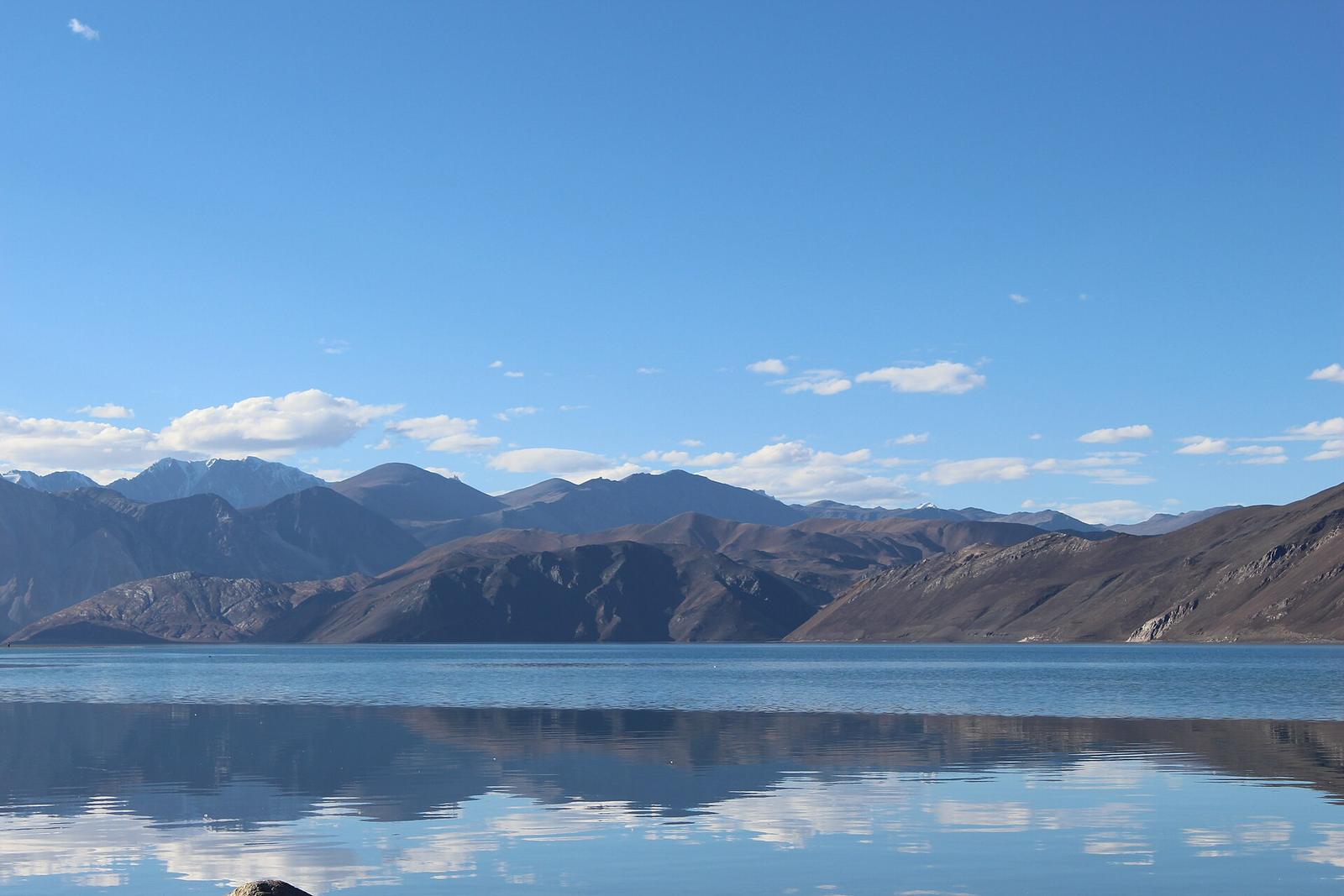
Ladakh, Little Tibet
Buddhist monasteries clinging to the rocks, the Nubra valley with its two-humped camels and Pangong lake at 4,300 metres.
- Delhi
- Leh
- Thiksey
- Hemis
- Khardung La
- Nubra Valley
- Pangong Lake
- Alchi
- Lamayuru
Day by day
- Day 1
Arrival in Delhi
This trip takes you to Ladakh, the «little Tibet» of India, a Himalayan plateau between 3,000 and 5,000 metres, with Buddhist monasteries clinging to the rocks, villages of white houses, the Nubra Valley with its dunes and two humped camels, and Pangong Lake, a blue that changes every hour. You travel with a domestic flight and then by car with a driver, on spectacular mountain roads.
Before you go: Italian citizens need an electronic visa for India. The 30 day tourist visa costs 25 dollars from July to March and 10 dollars from April to June; it is applied for online before departure. Other nationalities should check their own rules. For the Nubra Valley and Pangong Lake, foreigners also need a Protected Area Permit: you apply on the official portal of the Leh administration or through a registered agency, usually in groups of at least two people. The rules are under review in 2026: check them before you leave.
Safety: Ladakh borders Pakistan and China. The United Kingdom advises against travel to the Union Territory of Jammu and Kashmir, which does not include Ladakh, and within 10 kilometres of the border with Pakistan; the United States makes an explicit exception for Leh and eastern Ladakh. This route stays well away from the Line of Control: do not go beyond Lamayuru towards Kargil and do not pass the checkpoints. Check your government's travel advice before leaving.
You land at Delhi airport, in the capital. Today rest near the airport: tomorrow the flight to Leh leaves very early.
Overnight in Delhi.
Practical tip: drink only sealed bottled water and eat cooked, hot dishes, so you reach the mountains in good health.
- Day 2
Flight to Leh and complete rest
Early in the morning take the flight from Delhi to Leh, which takes about an hour and a half. It is one of the most beautiful flights in the world: it crosses the Himalayan ranges, with glaciers and snowy peaks. Sit by the window. Then the plane descends between bare mountains and lands at Leh, at about 3,500 metres.
Today you need to understand altitude sickness well, because it is the real danger of this trip. At high altitude the air holds less oxygen, and the body needs a few days to adjust. Arriving by plane from the plains, you climb more than three thousand metres in a few hours, with no time to adapt. Acute mountain sickness can strike anyone, even young and fit people. The signs are headache, nausea, heavy tiredness, poor appetite, dizziness and difficult sleep.
That is why today you do nothing. Stay in your room or in the garden, drink plenty of water and tea, eat light, avoid alcohol and make no effort, not even running up the stairs. Slight breathlessness and a mild headache are normal on the first day. If they get worse, though, tell your accommodation and a doctor at once.
There are medicines to prevent altitude sickness, but they must be decided with your doctor before departure, not taken on your own.
Overnight in Leh, for four nights.
Practical tip: take out health insurance that covers treatment at high altitude and emergency transport, and keep the insurer's number with you.
- Day 3
Leh: the palace, Shanti Stupa and the market
Today, if you feel well, spend a quiet day in town, always at a slow pace. For centuries Leh was a stop for caravans carrying wool, salt, silk and spices between Tibet, Central Asia and Kashmir.
In the morning walk slowly up to Leh Palace, built in the seventeenth century by the kings of Ladakh, with nine storeys of stone and mud overlooking the old town. It resembles the Potala Palace in Lhasa, in Tibet. From the terraces you see the flat roofs, the barley fields and the mountains of the Zanskar range. Check prices and times.
On the way down, walk through the lanes of the old town, with mud brick houses and wooden beams, white stupas and long walls of stones carved with the Tibetan prayer om mani padme hum. Always pass them keeping them on your right, as the Ladakhis do.
In the afternoon go to the main bazaar, with Ladakhi women selling dried apricots and vegetables, and shops of carpets, silver and turquoise jewellery and wool shawls.
At sunset go up by car, or on foot if you feel fit, to Shanti Stupa, the great white dome built in 1991 by Japanese monks on a hill above the town. The red light on the mountains is beautiful.
In the evening try thukpa, a noodle soup, and momos, steamed dumplings.
Overnight in Leh.
Practical tip: in Leh the sun is very strong and the air dry. Use sun cream, sunglasses and lip balm, and drink even when you are not thirsty.
- Day 4
Thiksey Monastery and the morning prayer
Today you leave Leh for the first time, along the Indus Valley to the south east. Set off very early, before dawn, to reach Thiksey Monastery, about half an hour away, in time for the puja, the morning prayer.
Thiksey is built on a terraced hill, with white and red buildings rising one above the other up to the temple at the top. At sunrise young monks blow long horns from the roof to call everyone to prayer. Then in the main hall the monks sit in rows and chant with deep voices, playing drums and cymbals, while the novices go round serving salty butter tea. You can sit quietly at the back of the hall. In one temple there is a large statue of the Maitreya Buddha, the Buddha of the future, two storeys high.
Then stop at Shey Palace, the old summer residence of the kings, with a large seated Buddha in gilded copper, and at Stok, the palace where the royal family still lives, with a small museum. Check prices and times.
In the afternoon return to Leh and rest. These are still your first days at altitude: do not overdo it.
Overnight in Leh.
Practical tip: in monasteries take off your shoes before entering the temples, cover your legs and shoulders, do not touch the statues and always ask before photographing the monks. Do not use flash during the prayer.
- Day 5
Hemis Monastery and the Indus Valley
Today you go further, still along the Indus, to Hemis Monastery, about an hour and a half from Leh. Hemis is the largest and richest monastery in Ladakh, founded in the seventeenth century and hidden in a side valley, among rocks and poplars. You cannot see it from the road until you are right in front of it.
You enter a large stone courtyard surrounded by painted wooden galleries. Here, in summer, the Hemis festival takes place, with the masked dances of the monks, the cham, which show the victory of good over evil. The date changes every year according to the Tibetan calendar, usually between June and July. If your trip coincides, it is a show not to be missed, but book well in advance. The monastery's small museum keeps statues, painted thangkas and ritual objects. Check prices and times.
On the way back you can stop to see the villages with green barley fields and stone walls, and the suspension bridges covered in colourful prayer flags, which the wind moves to send the prayers into the sky.
By today your body should already feel better. If you still have a bad headache or nausea, though, do not go up to the pass tomorrow: stay in Leh for an extra day.
Overnight in Leh.
Practical tip: make copies of your passport, visa and Protected Area Permit. At the road checkpoints you will often be asked to leave one.
- Day 6
Khardung La pass and the Nubra Valley
Today you leave early heading north, on the road that climbs to Khardung La pass, at about 5,300 metres, one of the highest road passes in the world. The road climbs with many hairpin bends above Leh, and in a few hours you go from 3,500 to over 5,000 metres. The landscape becomes ever barer: rocks, snow even in summer, prayer flags and a small temple at the top.
At the pass stop for twenty minutes at most. At this height there is about half as much oxygen as at sea level, and even people who feel well can get light headed. Take a few photos, walk slowly and move on.
Then the road descends towards the Nubra Valley, to the north, where the Shyok River meets the Nubra. The valley is lower than Leh, at about 3,100 metres, and greener, with villages, fields, apricot trees and sea buckthorn bushes, a plant with orange berries. The climate is warmer and you sleep better.
At the checkpoints, before and after the pass, show your Protected Area Permit and passport.
In the evening you settle into a tented camp or a family homestay near Hunder or Diskit.
Overnight in the Nubra Valley.
Practical tip: the cure for altitude sickness is to go down. If at the pass or in the following days you have severe symptoms, such as confusion, loss of balance or breathlessness even at rest, do not wait: descend and find a doctor at once.
- Day 7
Diskit, the Hunder dunes and the Bactrian camels
In the morning go to Diskit Monastery, the oldest and largest in the Nubra Valley, built on a rocky hill above the river. In front of the monastery, on another hill, there is a gigantic statue of the seated Maitreya Buddha, more than thirty metres high, facing the valley. From the terrace you see the whole Shyok Valley, wide and flat, with the river split into many channels. Check prices and times.
In the afternoon go to Hunder, home to one of the most surprising landscapes in Ladakh: dunes of pale sand in the middle of snowy mountains, at more than 3,000 metres. Here live the Bactrian camels, those with two humps, descendants of the animals of the old Silk Road caravans that crossed the Karakoram Pass towards Central Asia. When the trade stopped, some camels stayed in the valley.
You can take a short ride on the dunes on a camel, led by a local boy. At sunset the light on the sand and the mountains is magnificent.
In the evening, at the camp or the homestay, try Ladakhi bread cooked on the griddle with apricot jam, and yak, when available, in a soup.
Overnight in the Nubra Valley.
Practical tip: do not go beyond Hunder to the west, towards Turtuk and the Line of Control with Pakistan, unless you are sure about the permits and the latest safety advice.
- Day 8
From the Nubra Valley to Pangong Lake
Today is a long day on the road. You leave the Nubra Valley and follow the Shyok River to the south east, on a mountain road through isolated villages, narrow gorges and gravel stretches. Check with your driver beforehand that the road is open: in summer landslides or swollen streams sometimes close it, and then you head back towards Leh and go over the Chang La.
In the afternoon you reach Pangong Lake, at about 4,300 metres. It is one of the most famous landscapes in the Himalayas: a very long, narrow lake between ochre and purple mountains, with water that shifts from turquoise to deep blue with the light and the clouds. The water is salty and in winter it freezes completely. The largest part of the lake lies in Tibet, beyond the border line with China: from the Indian shore you see only part of it.
This is the highest night of the trip. You arrive after days in Leh and Nubra, so your body is already partly used to it, but you will feel the height. Walk slowly, drink a lot and avoid alcohol.
The evening is very cold, even in summer: the temperature can drop close to zero. Sleep in a tented camp or a simple guesthouse on the shore, near Spangmik or Lukung.
Overnight at Pangong Lake, for two nights.
Practical tip: bring layered clothing, a light down jacket, a hat and gloves even in July and August.
- Day 9
A full day at Pangong Lake
Today you wake up by the lake. If you can, get up before dawn: in still air the lake is a mirror, and when the sun arrives the mountains turn pink and then gold. It is the most beautiful moment of the day.
After breakfast walk slowly along the shore. The water is clear and cold, and around you see brown headed gulls, which nest on the lake, orange ruddy shelducks and sometimes Himalayan marmots, which come out of their burrows to sun themselves on the rocks.
With your driver you can follow the shore towards the villages of Man and Merak, where herders of the Changthang live, the plateau of the nomads, with flocks of pashmina goats, which give the finest wool in the world. Always follow the instructions of the soldiers: this is a border area, and beyond certain points you may not go or take photos.
In the afternoon rest. At this height even a short walk is tiring, and it is normal to be short of breath. If, however, you have a severe headache, vomiting or breathlessness even at rest, do not stay another night: head back towards Leh at once, which is lower.
In the evening look at the sky: with no lights and dry air, the Milky Way is wonderfully clear.
Overnight at Pangong Lake.
Practical tip: electricity and phone signal at the lake work only a few hours a day or not at all. Charge everything when you can and bring a power bank.
- Day 10
Back to Leh over the Chang La
Today you leave the lake and return to Leh, in about five hours. The road passes the village of Tangtse and then climbs to Chang La pass, at over 5,300 metres, the second great pass of this trip. There is snow here almost all year, and the road can be muddy from melting ice. Stop only briefly, as at Khardung La.
On the way down, near Durbuk and then in the Sakti Valley, watch for marmots near the road and yaks grazing, with their long black coats. In the villages the houses have flat roofs piled with firewood and fodder for the winter.
Before reaching Leh, if you have time, stop at the small monastery of Chemrey, on a cone shaped hill above the village, or at Takthok, built around a cave where a great Buddhist master is said to have meditated. Check prices and times.
In the afternoon you reach Leh. After two nights above 4,000 metres, the town will feel almost like the plains. Have a hot shower, rest, and in the evening have dinner in the centre, perhaps with butter tea or sweet spiced tea.
Overnight in Leh.
Practical tip: on Ladakh's mountain roads choose an experienced local driver and do not travel after sunset. If you suffer from car sickness, bring medicine from home.
- Day 11
The Indus Valley: Likir and Alchi
Today you head west, along the Indus Valley, on the road that links Leh to Kashmir. You stay two nights in the Alchi area, a few hours' drive away, one of the lowest and warmest parts of Ladakh.
Along the road stop at Nimmu, where the Indus and the Zanskar meet: the two rivers have different colours, one lighter and one darker, and you can see the line where they join.
Then go up to Likir Monastery, on a hill above the village, with a large golden statue of the Maitreya Buddha in the open air, looking over the valley.
In the afternoon you reach Alchi, a village among barley fields, apricot trees and willows, close to the Indus. The temple complex of Alchi is one of the treasures of Himalayan Buddhist art. The temples, small and low, date back about a thousand years and keep wall paintings with colours still bright, and large painted statues of wood and clay. The style recalls the Kashmiri art of the time, when artists came here from the west. It is dark inside: bring a small torch. Check prices and times. Photos are not allowed inside.
In the evening stroll through the village, which is very quiet, and have dinner with produce from the gardens: vegetables, apricots, bread and lentils.
Overnight in Alchi, for two nights.
Practical tip: in ancient temples never touch the paintings and do not use flash: strong light damages the colours.
- Day 12
Lamayuru and the moonland
Today is the longest day to the west, but it is also the last stage of the trip before heading back. Continue along the Indus and then climb a winding road to Lamayuru, about two hours from Alchi. This is the westernmost point of the route: beyond it, the road continues towards Kargil and the Line of Control with Pakistan, where you should not go.
Before the village you cross the «moonland», an area of yellow and grey earth hills, worn by erosion into strange shapes, spires and pinnacles, which really look like the surface of the Moon. They are the beds of an ancient lake that dried up.
Lamayuru Monastery is one of the oldest in Ladakh, built on a spur of rock above the village, with white houses clinging to the slope. According to legend, there was once a lake here that a saint made disappear in order to found the monastery. Visit the prayer halls and the cave where the master Naropa is said to have meditated. Check prices and times.
On the way back to Alchi, stop to photograph the Indus flowing at the bottom of the gorge.
In the evening you return to Alchi.
Overnight in Alchi.
Practical tip: even in the lower parts of Ladakh, the sun burns during the day and it is cold in the evening. Always keep a jacket, water and something to eat in the car.
- Day 13
Back to Leh
Today you return to Leh at an easy pace, a few hours on the road. It is a day of rest and of the last things to see.
On the way you can stop at Basgo Monastery, with an old mud palace on the rocks, where large statues and paintings are kept, or at the gurdwara of Pathar Sahib, a Sikh temple where visitors are given tea and a simple meal offered by the community. Further on is the famous «magnetic hill», where cars seem to roll uphill by themselves: it is only an optical illusion, but many people stop to try it.
Once in Leh, spend the afternoon in town. Visit the Central Asian Museum, in the old town, which tells the story of the caravans that passed through Leh, or Sankar Monastery, small and peaceful, on the edge of town. Check prices and times.
Do your last shopping at the bazaar: pashmina wool shawls, dried apricots, incense, prayer flags and silver and turquoise jewellery. Be wary of shawls that are too cheap: they are often not real pashmina.
In the evening have your last dinner in Ladakh, with momos and butter tea, and say goodbye to the mountains at sunset.
Overnight in Leh.
Practical tip: flights from Leh leave early in the morning and are sometimes cancelled because of bad weather. Do not book your long haul flight on the same day: always keep at least one night in Delhi.
- Day 14
Flight to Delhi
Early in the morning take the flight from Leh to Delhi. Look at the Himalayas one last time from the window: the snowy peaks, the glaciers and the desert valleys.
You arrive in Delhi and the contrast is huge: from a quiet, cool plateau to an enormous, hot and noisy metropolis, with more than twenty million people. In summer Delhi is very hot, often above thirty five degrees, and from July the monsoon arrives, with heavy rain.
After the weeks at altitude, your body is full of oxygen and you often feel stronger. But the heat is tiring: today rest at the hotel, drink a lot and move around in the cooler hours.
In the late afternoon visit the Lodi Gardens, a large park with the tombs of fifteenth and sixteenth century sultans among the trees, where local people jog and stroll. Then, if you like, go to India Gate, the great arch in memory of the Indian soldiers who died in the First World War, lit up in the evening, along the government avenue.
In the evening have northern Indian food: butter chicken, born in Delhi itself, dal, lentils, and naan baked in a clay oven.
Overnight in Delhi, for two nights.
Practical tip: in Delhi use taxis booked through an app or the metro, clean and fast, and always agree the price before getting into a rickshaw.
- Day 15
Delhi: Old Delhi and Humayun's Tomb
Today is your last full day in India. In the morning go to Old Delhi, the city built in the seventeenth century by the Mughal emperor Shah Jahan, the same who built the Taj Mahal.
Start with the Jama Masjid, one of the largest mosques in India, with a courtyard that can hold thousands of worshippers, minarets and domes of white marble and red sandstone. Take off your shoes and cover your legs and shoulders. Check prices and times.
Then walk through Chandni Chowk market, a maze of lanes full of people, rickshaws, stalls of spices, fabrics, jewellery and fried sweets. It is chaotic, but it is the living heart of the old city. Try jalebi, fried spirals soaked in syrup.
Further on you see the Red Fort, the great red sandstone fortress of the Mughals, a UNESCO site. Check prices and times.
In the afternoon go to Humayun's Tomb, also a UNESCO site, built in the sixteenth century for a Mughal emperor, with a white marble dome, red sandstone walls and a garden divided into four parts by water channels. It was a model for the Taj Mahal. Check prices and times.
Not far away is the Nizamuddin district, with the shrine of a fourteenth century Sufi saint, where in the evening, especially on Thursdays, you can hear qawwali songs. Enter with your head covered and without shoes.
Then go back to the hotel, pack and rest.
Overnight in Delhi.
Practical tip: in Old Delhi keep your phone and wallet in a closed bag in front of you, because there are pickpockets in the crowds.
- Day 16
Departure
Today is the day you go home. Reach Delhi airport with plenty of time, because traffic in the city is often slow and the checks at the airport entrance require your ticket and passport.
Looking back, you have seen the India most different from the rest of the country: a plateau of rock and sky, above three thousand metres, home to a Buddhist culture close to that of Tibet. You heard the morning prayer at Thiksey, entered the great courtyard of Hemis, crossed the Khardung La and the Chang La, above 5,300 metres, rode on the Hunder dunes with the two humped camels, slept on the shores of Pangong Lake, and saw the thousand year old paintings of Alchi and the moonland of Lamayuru. Altitude was the real challenge: the slow first days in Leh were not time wasted.
When to go: from June to September, when the passes are open and the roads passable. Ladakh lies behind the Himalayas, and in summer the monsoon barely reaches it: the sky is often clear and the days mild, while the nights stay cold. July and August are the busiest months; June and September are quieter. In winter it is bitterly cold and many roads close.
To recover, rest and drink plenty in your first days at home.
Practical tip: if after your return you have a fever or stomach problems that last, see a doctor and tell them you have been to India.
India's most spectacular trip and the most different from the rest of the country. Only go from June to September, when the passes are open; the monsoon doesn't reach here in summer. Altitude is the real challenge: the first two idle days in Leh are not time wasted.
Before you go
- Documents and visa
- Passport with at least six months' validity and two blank pages, plus an electronic tourist visa from the official Indian government website: 30 days for 25 dollars from July to March, 10 dollars from April to June.
- Health and vaccines
- No compulsory vaccines arriving from Europe; ask your doctor about hepatitis A, typhoid and malaria depending on the area. Drink only sealed bottled water. Emergencies: 112.
- Money and payments
- Indian rupee. Cards and digital payments are common in cities; markets, villages and rickshaws need cash.
- Power sockets
- Types C, D and M, 230 volts: a universal adapter is useful.
- Time zone
- UTC+5:30 all year: India does not use daylight saving time.
- Safety
- The United States rates India level 2, with level 4 for Jammu and Kashmir (except Ladakh), Manipur and the 10 km strip along the Pakistani border. Official advice: GOV.UK.
Information checked in November 2026 for Italian and EU citizens. Rules change: always check before you travel.
Variations
In 10 days: Delhi, Leh with two days of acclimatisation, Thiksey and Hemis, the Nubra Valley and one night at Pangong Lake, without the Indus Valley to the west.
In 20 days: add Tso Moriri lake, to the south east, with a Protected Area Permit, or a trek of a few days in the Markha Valley with nights in family homestays.
Frequently asked questions
What is altitude sickness and how do I avoid it?
It is the illness caused by thin air at high altitude: headache, nausea, tiredness and difficult sleep. You avoid it by resting for the first two days in Leh, going up slowly, drinking a lot and avoiding alcohol. If symptoms get worse you must go down. Talk to your doctor before you leave.
Do I need special permits?
Yes. Besides the Indian e-visa, foreigners need a Protected Area Permit for the Nubra Valley and Pangong Lake. You apply online on the official portal or through a registered agency in Leh; the rules are under review in 2026, so check them before you leave.
Is Ladakh safe?
Leh and the areas on this route are considered fine to visit. The United Kingdom advises against the Union Territory of Jammu and Kashmir and the 10 kilometres along the border with Pakistan; the United States excludes Leh and eastern Ladakh from its highest level. Stay away from the Line of Control and check official travel advice.
Indicative itinerary written by World Atlas. Before booking, check timetables, seasonal openings, documents and safety.
 7 daysEasy
The Golden Triangle: Delhi, Agra and Jaipur
A first time in India: the Taj Mahal at dawn, the forts of Rajasthan and the life of Old Delhi, in one week.
 15 daysModerate
Rajasthan and the tigers of Ranthambore
Palaces, desert and safari: from the Taj Mahal to the blue and golden cities of Rajasthan, with two days in tiger country.
 12 daysEasy
Delhi to Varanasi: the Taj Mahal, Khajuraho and the Ganges
The Taj Mahal, Amber fort, the forgotten town of Orchha, the temples of Khajuraho and the ghats of Varanasi at dawn.