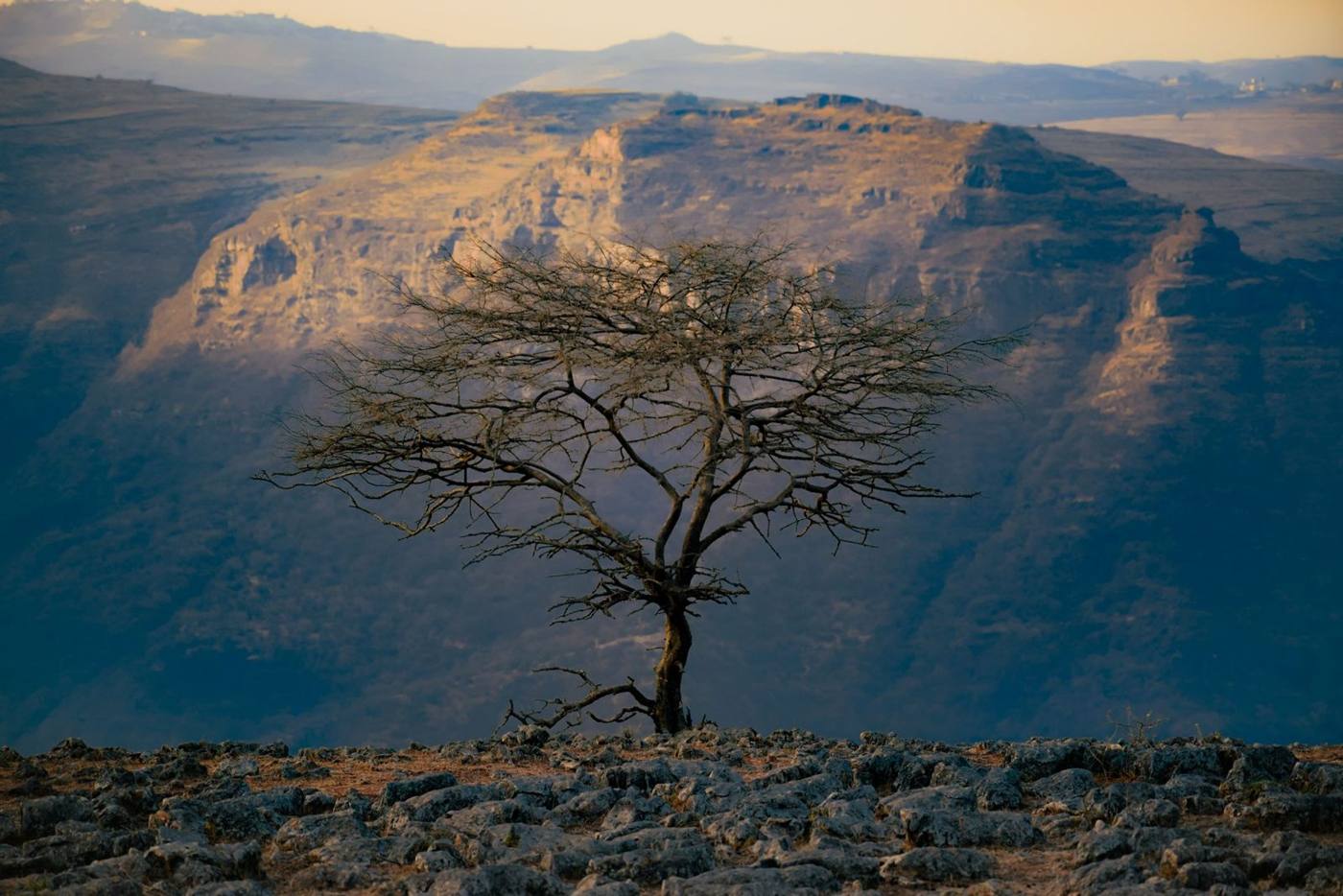
The Bale Mountains
The 4,000-metre Sanetti plateau with Ethiopian wolves, mountain nyala at Dinsho and the Harenna forest with monkeys and wild coffee.
- Addis Abeba
- Dinsho
- Sanetti Plateau
- Tullu Dimtu
- Harenna Forest
- Robe
Day by day
- Day 1
From Addis Ababa to Dinsho, towards the Bale Mountains
This six-day trip takes you to Bale Mountains National Park, in south-eastern Ethiopia: the woods of Dinsho with mountain nyala, the Sanetti Plateau at 4,000 metres with Ethiopian wolves, the summit of Tullu Dimtu and the great Harenna Forest.
Before you go: Italian citizens need a passport valid for at least six months and a visa, applied for online on the official evisa.gov.et portal before the flight; visa on arrival is not recommended, as it can lead to refusal of entry. Binoculars and drones cannot be imported without prior approval: for wildlife watching, ask the embassy first. Other nationalities should check their own rules. Some areas on this trip are close to borders or places where the situation changes often: check your government's travel advice before booking and again before you leave.
Today you face a long day on the road, usually between seven and nine hours. Travel only with an experienced driver and local guide, leave at dawn and arrive before dark. Before setting off ask them about the situation along the route; if you are not convinced, consider the domestic flight to Robe and from there the shorter road to Dinsho.
The road leaves the capital, crosses fields of wheat and barley and climbs slowly towards the mountains. Women walk with bundles of firewood on their backs, horses pull carts and shepherds wrapped in woollen blankets watch the cars go by.
In Dinsho, at more than 3,000 metres, the evening is cold. Have a hot soup for dinner and go to bed early.
Practical tip: bring a heavy jacket, a hat and gloves; on nights at altitude the temperature often drops below freezing.
- Day 2
Dinsho, mountain nyala and forest trails
Today you stay in Dinsho, home to the park headquarters. It is the right place to get used to the altitude before going higher. Here you hire a park guide, pay the entrance fee and ask about the trails. Check prices and times.
In the morning walk through the meadows and the juniper and hagenia woods around the headquarters. They are the realm of the mountain nyala, a large antelope that lives only in the Ethiopian highlands. The males have spiral horns and a dark grey coat with white spots; the females are smaller and hazel brown. Early in the morning they are calm and let you approach, but always keep your distance.
In the woods you also see Menelik's bushbuck, warthogs grazing on their knees and many birds, including ibises and colourful turacos. The branches are covered in long grey lichens that hang like beards.
In the afternoon, if your legs feel good, take a longer walk in the Gaysay grassland, not far away, where nyala gather in large groups. The landscape is open, with gentle hills and clear rivers.
Drink plenty of water, eat lightly and do not rush: even a short climb at this altitude leaves you out of breath. If you have a bad headache or nausea, rest and tell your guide.
Practical tip: bring binoculars only if you have approval; otherwise ask your guide whether you can borrow a pair, because many animals stay far from the trails.
- Day 3
The Sanetti Plateau at dawn and the Ethiopian wolves
Today you leave before dawn and climb onto the Sanetti Plateau, part of the largest high mountain area in Africa. The road passes through Goba and then climbs with many hairpin bends to about 4,000 metres.
At dawn the plateau is covered in frost. Around you lies an almost lunar landscape: small lakes, dark rocks, heather bushes and giant lobelias, plants that can grow taller than a person. The silence is deep and the air thin.
This is the realm of the Ethiopian wolf, the rarest canid in Africa. Only a few hundred remain, and a good share of them live right here. It has a reddish coat, a white chest and a long muzzle. It usually hunts alone in the early hours of the day, looking for the giant mole rats that live underground. With your guide, stop the car, get out quietly and watch: a wolf often passes a few dozen metres away, focused on the hunt.
As well as wolves you see eagles, vultures and groups of blue-winged geese, a bird found almost only in Ethiopia. The wind is strong and the sun, at this altitude, burns even when it is cold.
In the afternoon go down a little to sleep, in Goba or nearby, and rest. Your body needs time to recover after such a high day.
Practical tip: dress in layers, with a windproof jacket, and wear sunglasses and high-factor sun cream; in the morning it is cold, at midday the sun is very strong.
- Day 4
Tullu Dimtu and a second day at altitude
Today you return to the Sanetti Plateau for a second day, because wolves are best seen with patience and because the light changes every morning.
Head up towards Tullu Dimtu, the second-highest peak in Ethiopia, at 4,377 metres. The road gets very close to the summit, and it is one of the highest roads in Africa. The last metres are on foot along a stony path: walk slowly, breathe calmly and stop every few steps. From the top, on clear days, you see the whole plateau, with shining small lakes and valleys falling away to the south.
After the summit take an easy walk on the plateau with your guide, away from the road. It is the best moment to watch the giant mole rats, which come out of their burrows for a few seconds and then vanish, and to look for wolves again. Sometimes you also see packs greeting each other with games and short howls.
Stop for a packed lunch in the shelter of a rock. Remember to leave no rubbish: the high mountain environment is fragile and recovers very slowly.
In the afternoon, if the weather changes and fog rolls in, go down without waiting. Clouds rise quickly and visibility can drop to almost nothing.
Practical tip: carry at least two litres of water and something sweet; at this altitude you have little appetite, but your body burns a lot of energy even when walking slowly.
- Day 5
Down into the Harenna Forest
Today you cross the Sanetti Plateau southwards and then drop into the Harenna Forest, one of the largest mountain forests in Ethiopia. In a few hours you go from an alpine landscape to a damp green woodland, with a difference in altitude of more than a thousand metres.
The edge of the plateau offers a spectacular view: in front of you the road winds down in tight bends into a valley covered with giant trees. Stop at the viewpoint and watch the clouds rising from the forest.
Lower down begin the trees covered in moss and ferns, with bamboo and lianas. This forest hides one of Ethiopia's treasures: wild coffee, growing naturally beneath the tallest trees. With your guide look for the plants with glossy leaves and red berries. Remember that Ethiopia is considered the homeland of arabica coffee.
The forest is home to black and white colobus monkeys, the Bale monkey, which lives only in the mountain forests of southern Ethiopia, and many birds. There are also larger, shyer animals that are rarely seen. Walk only with your guide on the marked paths, without wandering off.
In the evening sleep in the forest area or return towards Goba and Robe, depending on your plan and your guide's advice.
Practical tip: the forest is damp and the paths are slippery; bring hiking boots with a good sole and a light waterproof jacket.
- Day 6
Flight from Robe or the road back, summary
Today you leave the Bale Mountains. If there is a flight from Robe airport to Addis Ababa and the times suit you, it is the easiest and quickest way back. Otherwise the long road to the capital awaits you again: leave at dawn with your driver and arrive before dark.
Before leaving stop at the market in Robe or Goba, where farmers sell honey, barley, potatoes and butter. It is a good moment to buy a small jar of mountain honey and to say goodbye to your guide, who has shown you the animals over these days.
In six days you have seen mountain nyala in the woods of Dinsho, the Sanetti Plateau with its giant lobelias and the Ethiopian wolf, one of the rarest animals in the world, the summit of Tullu Dimtu at 4,377 metres and the Harenna Forest with its wild coffee and Bale monkeys. It is a trip of pure nature, suited to those who love walking and watching animals with patience.
When to go: from October to February, in the dry season, the sky is clearer, the trails are dry and wolves are easier to see. The nights, however, are the coldest. From June to September it rains a lot and fog often covers the plateau.
Practical tip: if you go back by road, stop for a break every two or three hours; it is a long journey, and a hot tea in a village helps both the driver and you stay alert.
One of the world's best places to see the Ethiopian wolf, Africa's rarest canid. Nights at altitude are cold, below freezing. Security in the Oromia region changes: travel with a local operator and check beforehand.
Before you go
- Documents and visa
- Passport valid for at least six months and a visa, applied for before you travel on the official evisa.gov.et portal (30-day single-entry tourist e-visa); visa on arrival is not recommended as it can lead to refusal of entry. Binoculars, drones and satellite phones cannot be imported without prior approval. Travellers arriving from a country at risk must show a yellow fever certificate.
- Health and vaccines
- Malaria is present outside the capital and below 2,000 metres: ask your doctor about prevention. Vaccines against typhoid, hepatitis A and B, tetanus, meningitis and rabies are recommended. In Addis Ababa and above 4,000 metres in the Bale Mountains you feel the altitude: go up slowly. Drink only bottled water, and you need insurance covering medical costs and repatriation. Emergencies: Red Cross ambulance 907, police 991.
- Money and payments
- Ethiopian birr. Foreign currency over 10,000 dollars must be declared; change money only at banks or authorised offices and keep the receipts; the limits on birr in and out change, so check them before you travel. Cards work only in large hotels and in cities, and cash machines are found in the main towns: carry cash for villages.
- Power sockets
- Types C, E, F and L, 220 volts: bring a universal adapter.
- Time zone
- UTC+3 all year. Ethiopia also uses its own calendar and a local way of counting the hours: always check whether a time is 'Ethiopian' or international.
- Safety
- The situation changes often and varies greatly from region to region: several areas of the north, the west, Oromia and the Somali region, especially near the borders, are advised against. For travel outside Addis Ababa choose an experienced local guide or driver, prefer flying for long distances and do not travel by road at night. Official advice: GOV.UK.
Information checked in November 2026 for Italian and EU citizens. Rules change: always check before you travel.
Variations
Shorter version: in four days fly to Robe and back, spend one day at Dinsho and two on Sanetti, without going down to Harenna.
Longer version: add two days of trekking on horseback across the plateau with a park guide, sleeping in a tent.
Frequently asked questions
Are Ethiopian wolves always seen?
It is not guaranteed, but on the Sanetti Plateau the chances are very good, especially at dawn and in the dry season, with a guide who knows the packs' territories.
How cold is it at altitude?
By day the sun is strong, but nights above 3,000 metres often fall below freezing. Bring a heavy jacket, a hat, gloves and a warm sleeping bag if you sleep in a tent.
Do I need to be very fit?
You do not need mountaineering skills, but you feel the altitude. Walk slowly, drink a lot and spend a day at Dinsho before going up to Sanetti.
Indicative itinerary written by World Atlas. Before booking, check timetables, seasonal openings, documents and safety.
 4 daysEasy
Harar and the east
The UNESCO walled city of Harar with its alleys and dozens of mosques, Rimbaud's house, the hyena men at night and the Dire Dawa market.
 6 daysEasy
Addis Ababa and the Rift Valley lakes
Lucy at the National Museum, the coffee ceremony, lakes Ziway, Langano and Abijatta-Shala with flamingos and pelicans, and Hawassa with its fish market.