Cairo to Abu Simbel overland
The Nile without a cruise: a night train, Nubian villages, a felucca in Aswan, dawn at Abu Simbel and the Valley of the Kings.
- Cairo
- Giza
- Aswan
- Abu Simbel
- Kom Ombo
- Edfu
- Luxor
Day by day
- Day 1
Arrival in Cairo
This trip crosses Egypt along the Nile without a cruise, overland: Cairo with the pyramids and the Grand Egyptian Museum, the night train to Aswan, Abu Simbel at dawn, the temples of Kom Ombo and Edfu on the road, and finally Luxor with Karnak and the Valley of the Kings.
Before you go: to enter Egypt, Italian citizens need a passport valid for at least six months and a tourist visa. It can be requested online before departure on the official portal or on arrival at the airport, at the bank counters before passport control: from 1 March 2026 the visa on arrival costs 30 dollars, payable in cash. Other nationalities should check their own rules. Before leaving read the official travel advice: this itinerary stays in the Nile valley, away from the areas advised against.
You arrive at Cairo International Airport, north east of the city. Traffic is heavy at almost all hours: between the airport and the centre or Giza it takes from 45 minutes to more than an hour and a half.
In the afternoon rest. If you have energy, at sunset go to the bank of the Nile, in the Zamalek district, a green island with tree lined avenues and early twentieth century buildings.
In the evening try koshari, Cairo's popular dish: rice, lentils, pasta and chickpeas, with tomato sauce, fried onions and garlic vinegar.
Sleep in Cairo, for three nights.
Practical tip: keep small notes in dollars or euros for the visa and Egyptian pounds for tips, which are a widespread habit in Egypt. Choose accommodation near Giza if you want to see the pyramids at dawn.
- Day 2
Giza, Saqqara and the pyramids
Today you visit the most famous pyramids in the world and the oldest tombs.
Early in the morning go to the Giza plateau, at opening time, before the heat and the groups. The three great pyramids were built about 4,500 years ago for the pharaohs Khufu, Khafre and Menkaure. The Great Pyramid of Khufu, originally about 146 metres high, is the only one of the seven wonders of the ancient world still standing. You can enter one of the pyramids with a separate ticket. Then walk down to the Sphinx, with the body of a lion and the head of a pharaoh, carved from the rock. Check prices and opening times.
In the afternoon go to Saqqara, about half an hour by car to the south, the great necropolis of the ancient capital Memphis. Here is the Step Pyramid of Djoser, the oldest stone pyramid in the world, built about 4,700 years ago by the architect Imhotep. Also visit the tombs of the Old Kingdom nobles, with walls carved and painted with scenes of daily life: fishing, markets, animals. Check which tombs are open.
If you have time, stop at Memphis, with the great reclining statue of Ramesses II.
In the evening, in Cairo, have Egyptian food for dinner, such as molokhia, a green leaf soup, or pigeons stuffed with rice.
Sleep in Cairo.
Practical tip: at Giza and Saqqara there are many vendors offering horse or camel rides. Always agree the price first and never hand your ticket to anyone.
- Day 3
The Grand Egyptian Museum and Islamic Cairo
Today you visit the new great museum and the medieval city.
In the morning go to the Grand Egyptian Museum, near the Giza pyramids, one of the largest archaeological museums in the world. The grand staircase is lined with statues of pharaohs, and the Tutankhamun galleries display the entire contents of the tomb together for the first time, including the gold mask. From 1 November 2026 the ticket for foreign adults costs 1,830 Egyptian pounds, 920 for students and children. Buy it on the official website. Allow at least three or four hours.
In the afternoon go to Islamic Cairo, the medieval city, a UNESCO World Heritage site. Visit the Citadel of Saladin, the fortress built in the twelfth century on the hill, with the Mosque of Muhammad Ali, with its domes and slender minarets, from which you see the whole city. Then walk down to the Mosque of Sultan Hassan, from the fourteenth century, huge, with a great courtyard.
At sunset walk through the Khan el-Khalili bazaar, with shops of lamps, spices, fabrics and silver, and the nearby al-Muizz street, full of mosques, Koranic schools and restored medieval palaces.
In the evening drink mint tea or coffee in one of the old cafés of the bazaar.
Sleep in Cairo.
Practical tip: in mosques women must cover their hair, shoulders and legs, and everyone takes off their shoes. Bring a scarf and socks. Avoid Friday at midday, the time of prayer.
- Day 4
The night train to Aswan
Today you leave Cairo and head south along the Nile.
In the morning, if you like, visit the old Egyptian Museum on Tahrir Square, Egypt's first museum of antiquities, with halls full of statues, sarcophagi and everyday objects. Check opening times and tickets. Or visit Coptic Cairo, the old Christian quarter, with the Hanging Church, built over a gate of a Roman fortress, and the Ben Ezra synagogue.
In the afternoon relax and pack a small bag for the night.
In the evening take the night train with sleeping cars from Giza station or Ramses central station. The train takes about twelve to fourteen hours to reach Aswan. The cabins have two beds and a washbasin, and dinner and breakfast are usually served. It is a comfortable and traditional way to cross the country, and when you wake up you see the Nile valley with its palm groves, green fields and mud brick villages, between the desert hills.
Alternatively you can take a domestic flight to Aswan, about an hour and a half.
Sleep on the train.
Practical tip: sleeping car places must be booked in advance and are reserved for foreigners with prices in dollars. Check times, prices and booking on the official website and bring your passport: it is checked. Bring a light jacket too, as the air conditioning on board can be cold at night.
- Day 5
Aswan: Philae, the felucca and the Nubians
Today you discover Aswan, the southernmost city of tourist Egypt.
In the morning you arrive in Aswan, a quiet city where the Nile is narrower and full of granite islands, with golden desert running down to the water. Here Nubia began, the land of the peoples who lived between Egypt and Sudan.
Visit the Temple of Philae, dedicated to the goddess Isis, on an island in the middle of the Nile, reached by a small boat. The temple was taken apart and rebuilt stone by stone in the 1970s on another island, to save it from the waters of the lake created by the dam. It was one of the last Egyptian temples still in use, until the sixth century. Check prices and opening times.
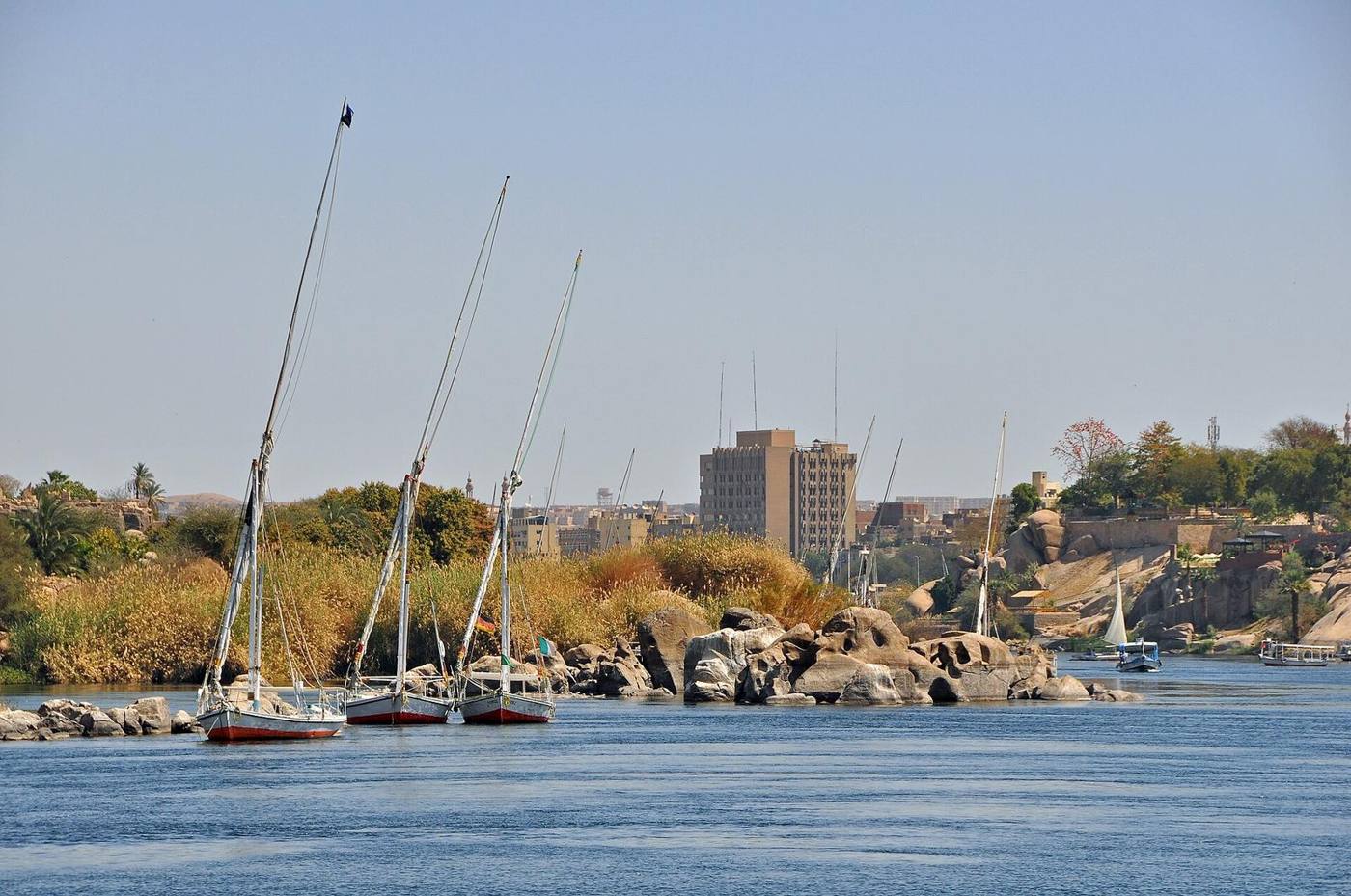
In the afternoon take a felucca ride, the traditional sailing boat of the Nile, between Elephantine Island and Kitchener's Island, with its botanical garden, as the sun sets over the hills of the west bank, with the tombs of the nobles and the mausoleum of the Aga Khan.
At sunset go by boat to a Nubian village on the west bank, with houses painted blue, yellow and pink, and drink tea with the village families.
In the evening walk through the Aswan souk, with spices, hibiscus tea and Nubian baskets.
Sleep in Aswan, for two nights.
Practical tip: before boarding the felucca agree the price and length of the ride. In the evening, near the river, bring a jumper: in the desert the temperature drops quickly.
- Day 6
Abu Simbel at dawn
Today you see one of the most impressive monuments of ancient Egypt.
Very early in the morning leave Aswan by car or coach for Abu Simbel, about three and a half hours on a desert road, towards the border with Sudan. You leave at night to arrive at dawn, before the heat. Alternatively there is a short flight. Check times and rules for the road.
Abu Simbel has two temples carved into the mountain by Ramesses II, more than 3,200 years ago. The great temple has a facade with four seated statues of the pharaoh, about 20 metres high. Inside, the halls are decorated with scenes of the battle of Kadesh. At the end, in the sanctuary, there are four seated statues: twice a year, around 22 February and 22 October, the morning sun reaches all the way in and lights up three of them. The small temple is dedicated to Queen Nefertari and the goddess Hathor.
These temples too were cut into great blocks and moved higher in the 1960s, with the help of many countries and UNESCO, to save them from Lake Nasser. Check prices and opening times.
In the afternoon return to Aswan and visit the dam, with the view over Lake Nasser, one of the largest artificial lakes in the world.
In the evening relax in Aswan.
Sleep in Aswan.
Practical tip: bring a hat, sunscreen and water. At Abu Simbel, in summer, the temperature often goes above 40 degrees by mid morning.
- Day 7
Kom Ombo and Edfu on the road to Luxor
Today you head back north, stopping at two temples along the Nile.
In the morning leave Aswan by car with a driver for Luxor, about three and a half hours without stops. The road runs along the river, through sugar cane fields, palm groves and villages.
After about an hour you reach Kom Ombo, a temple on a bend of the Nile dedicated to two gods together: Sobek, the crocodile god, and Horus, the falcon god. This is why the temple is double, with two entrances and two sanctuaries side by side. In the small museum next to it there are some crocodile mummies. On the walls there is a relief that many interpret as surgical instruments.
Then continue to Edfu, with the Temple of Horus, the best preserved Egyptian temple, built in the Ptolemaic period, just over two thousand years ago. It still has its roof, the great gateway 36 metres high, the columned courtyard and the sanctuary with the sacred boat. The walls tell of the struggle between Horus and the god Seth. Check prices and opening times.
In the afternoon you arrive in Luxor, ancient Thebes, the capital of Egypt for much of the New Kingdom.
In the evening walk along the corniche, the riverside promenade, and watch the sunset over the west bank.
Sleep in Luxor, for three nights.
Practical tip: at Edfu, between the parking area and the temple, the carriage drivers are insistent. Agree the price in advance or walk, if the heat allows.
- Day 8
Karnak and Luxor Temple
Today you visit the great temples of the east bank.
Early in the morning go to Karnak, north of the town, the largest religious complex of antiquity, built and enlarged over about two thousand years by many pharaohs. It was dedicated mainly to the god Amun. You enter along the avenue of ram headed sphinxes and pass through the great gateways to the hypostyle hall, with 134 gigantic columns, some more than 20 metres high, decorated with hieroglyphs and still with traces of colour. You also see the obelisks of Queen Hatshepsut and the sacred lake. Allow at least three hours. Check prices and opening times.
In the afternoon rest in the hot hours. Then, if you have time, visit the Luxor Museum, small but with very fine, well lit pieces.
At sunset and in the evening visit Luxor Temple, in the centre of town, dedicated to Amun and built mainly by Amenhotep III and Ramesses II. Under the lights the statues and columns are beautiful. In front of the entrance stands an obelisk: its twin is in Paris, on the Place de la Concorde. The avenue of sphinxes, about three kilometres long, once again links the two temples.
In the evening have dinner on the east bank or cross the river to eat on the quieter west bank.
Sleep in Luxor.
Practical tip: in Luxor site tickets are often payable only by card. Always carry a credit card and your passport, which is sometimes required for tickets.
- Day 9
The west bank: Valley of the Kings and Deir el-Bahari
Today you visit the tombs of the pharaohs and the funerary temples.
Early in the morning cross the Nile and go to the Valley of the Kings, a dry valley among limestone hills where for about five hundred years the pharaohs of the New Kingdom were buried. The tombs are cut into the rock, with long corridors decorated with texts and images of the pharaoh's journey into the afterlife, in colours that are still vivid. The basic ticket covers a few tombs; others, such as those of Tutankhamun or Seti I, need a separate ticket. Check prices and which tombs are open.
Then go to Deir el-Bahari, the funerary temple of Queen Hatshepsut, one of the few female pharaohs, with three great terraces cut at the foot of a rock wall. It is one of the most beautiful buildings of ancient Egypt.
In the afternoon, if you have energy, visit the Valley of the Queens or the tombs of the nobles, smaller but with scenes of daily life, and Medinet Habu, the temple of Ramesses III, very well preserved and uncrowded. On the way stop at the Colossi of Memnon, two huge seated statues of Amenhotep III, about 18 metres high.
In the evening return to the east bank.
Sleep in Luxor.
Practical tip: in the tombs flash photography is forbidden and a photo ticket is often required. Respect the rules: light damages the ancient colours. Go early, as the valley heats up quickly.
- Day 10
Balloon at dawn and flight to Cairo
Today you see Luxor from above and return to Cairo.
In the morning, if you like, take the optional balloon flight at dawn over the west bank. You set off before dawn and rise slowly as the sun comes up behind the mountains of the east bank. From above you see the temples, the green fields along the river, the sharp line where the desert begins and the hills of the Valley of the Kings. The flight lasts about 45 minutes. Choose an operator with good safety standards and check the wind conditions, which sometimes cause flights to be cancelled.
Then go back to rest. If you still have time, take a last walk through the Luxor souk or a felucca trip on the Nile.
In the afternoon take the domestic flight to Cairo, about an hour.
In the evening, in Cairo, have dinner by the Nile, or take a last walk in the centre.
Sleep in Cairo.
Practical tip: leave a wide margin between domestic and international flights. Domestic flights in Egypt can change times even the day before: check the confirmation the evening before. For the flight home to Italy, sleep in Cairo the night before, as in this programme: it is the safest choice, because a delayed domestic flight will not make you miss the international one.
- Day 11
Departure
Today you leave Egypt.
In the morning, if your flight leaves in the afternoon, make a last visit. You can see the pyramids of Dahshur, south of Saqqara, less crowded than Giza: the Bent Pyramid, whose angle changes halfway up, and the Red Pyramid, the first smooth sided pyramid in history, which you can enter. Check prices and opening times. Or walk in al-Azhar Park, a large garden on the hill with views over the domes and minarets of Islamic Cairo.
Then go to the airport well in advance, because of Cairo traffic and the security checks, of which there are several.
In these eleven days you have seen the Egypt of the pharaohs from beginning to end: the oldest pyramids and the new museum in Cairo, the Ptolemaic temples along the Nile, the Nubia of Aswan, Abu Simbel and the great temples and tombs of Thebes.
When to go: the best period is from October to April, when in the south temperatures are pleasant by day and cool at night. From May to September Aswan and Luxor are very hot, often over 40 degrees. December and January are the busiest months.
Practical tip: during Ramadan archaeological sites stay open, but opening times can change and many places close during the day. Check the dates before you go.
The cheapest and most authentic way to do grand Egypt: without the boat you have more freedom over timings and reach the temples before the groups. The night train is basic but works. Avoid June to August: Aswan and Luxor go above 40 °C.
Before you go
- Documents and visa
- Passport valid for at least six months and a tourist visa, obtained online on the official portal or on arrival at the airport, where since 1 March 2026 it costs 30 dollars in cash.
- Health and vaccines
- No compulsory vaccines for travellers from Europe. Drink only bottled water and take out travel health insurance. Emergencies: 122 police, 123 ambulance.
- Money and payments
- Egyptian pound. Cards work in hotels and larger shops, but for tips, taxis and markets you need cash in small notes.
- Power sockets
- Types C and F, 220 volts.
- Time zone
- UTC+2 in winter; Egypt uses daylight saving time in summer.
- Safety
- Tourist areas along the Nile and the Red Sea are busy and well policed. Governments advise against North Sinai, the Libyan border strip and much of the Western Desert off the main roads. Official advice: GOV.UK.
Information checked in November 2026 for Italian and EU citizens. Rules change: always check before you travel.
Variations
In 7 days: Cairo with Giza and the Grand Egyptian Museum, a flight to Luxor and two days on both banks, without Aswan and Abu Simbel.
In 14 days: add three nights on the Red Sea, at Hurghada or Marsa Alam, or replace the overland stretch with a four night cruise between Aswan and Luxor.
Frequently asked questions
What document do I need for Egypt?
A passport valid for at least six months and a tourist visa, requested online or on arrival at the airport: from 1 March 2026 it costs 30 dollars in cash on arrival. Other nationalities should check their own rules.
How much is the Grand Egyptian Museum?
From 1 November 2026 the ticket for foreign adults costs 1,830 Egyptian pounds and 920 for students and children. It is sold on the official website. For other sites check prices and opening times.
Is this itinerary safe?
The itinerary stays in the Nile valley, the most visited area, away from the areas advised against. Before leaving read the latest official travel advice and follow the rules on the desert road to Abu Simbel.
Indicative itinerary written by World Atlas. Before booking, check timetables, seasonal openings, documents and safety.
 7 daysEasy
Cairo and a Nile cruise
The pyramids of Giza and the Grand Egyptian Museum, then four days sailing between Luxor and Aswan.
 15 daysModerate
Complete Egypt: the Nile, the desert and the Red Sea
The pyramids, the Nile from Aswan to Luxor, a night in the White Desert and a finale on the Red Sea reef.
 6 daysEasy
Cairo and Alexandria
A long weekend among the pyramids, the new Grand Egyptian Museum, Islamic Cairo and Alexander's city on the Mediterranean.