Natural Brazil: Iguaçu, Bonito, the Pantanal and the Amazon
The crystal-clear rivers of Bonito where you swim among fish, the Pantanal of the jaguars, the falls and the Amazon forest: Brazil for wildlife lovers.
- Foz do Iguaçu
- Bonito
- Southern Pantanal
- Northern Pantanal
- Manaus
- Amazon
Day by day
- Day 1
Arrival in Foz do Iguaçu
This trip is devoted to Brazil's nature: the Iguaçu Falls, the clear rivers of Bonito, the Pantanal, the largest tropical wetland in the world, and the Amazon rainforest around Manaus. In seventeen days you see caimans, capybaras, macaws, giant otters and, with some luck, the jaguar. You travel by domestic flights and organised transfers.
Before you go: Italian citizens enter Brazil without a visa for tourism with a valid passport. Other nationalities should check their own rules. Some areas on this trip are close to borders or places where the situation changes often: check your government's travel advice before booking and again before you leave. For the Pantanal and the Amazon ask a travel health clinic about vaccines, such as yellow fever, and malaria prevention.
You land at Foz do Iguaçu airport, in the state of Paraná, where Brazil, Argentina and Paraguay meet along the Iguaçu and Paraná rivers. The town is modern and practical, built mainly for people visiting the falls.
If you arrive early, go to the Marco das Três Fronteiras, a viewpoint at the meeting of the two rivers, from where you see the banks of all three countries at once. At sunset there is often a light and music show: check prices and times.
In the evening try river fish, such as pacu or dourado, or a churrascaria, where grilled meat is carved at your table.
Practical tip: stay in the area between the town and the park, along the road to the falls, so that the next morning you reach the park gate at opening time, before the groups.
- Day 2
The falls from the Brazilian side
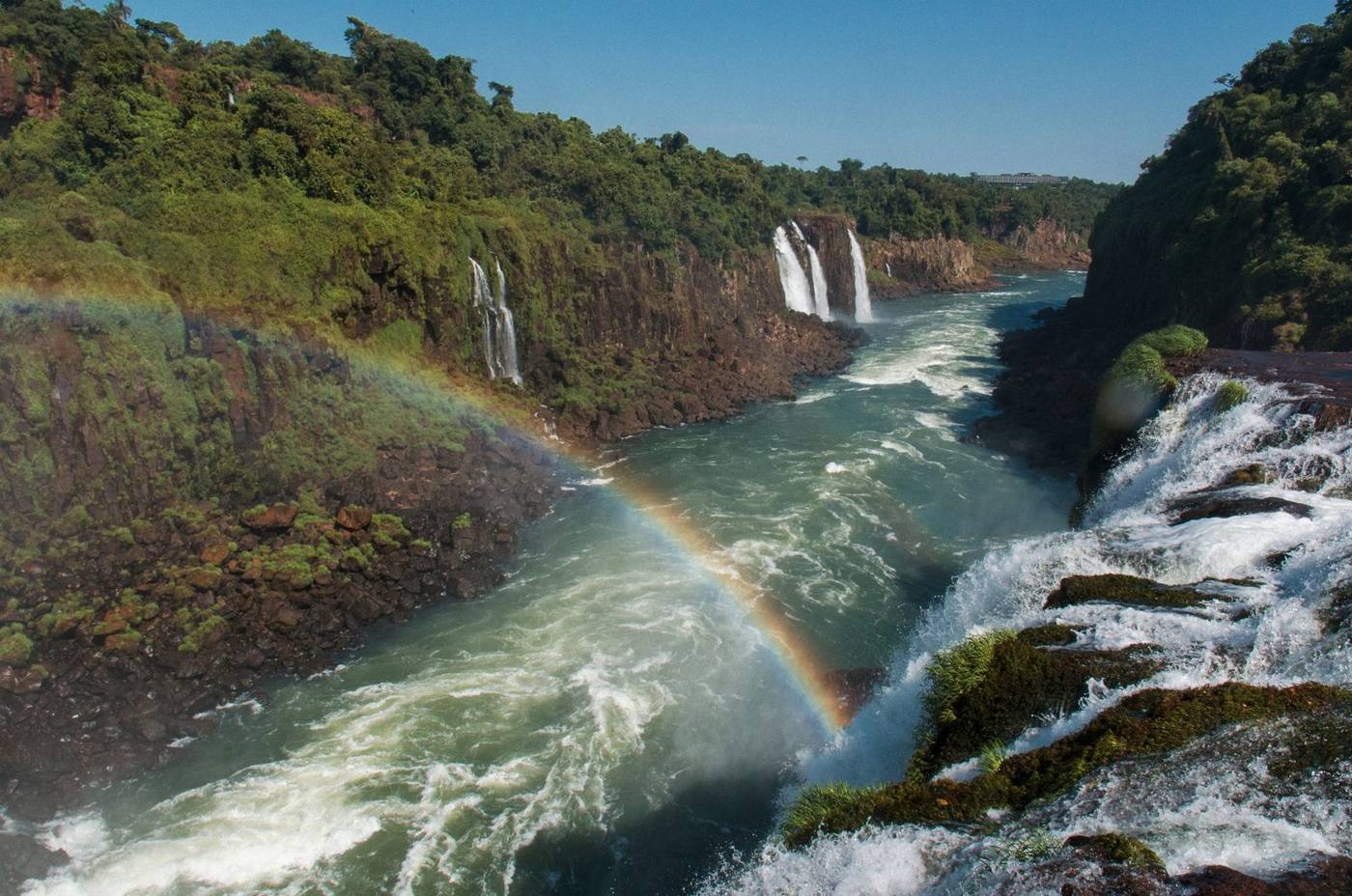
Today you visit Iguaçu National Park, a UNESCO World Heritage Site. The falls are a horseshoe shaped front of hundreds of cascades almost three kilometres long, where the Iguaçu River drops over a cliff of volcanic rock. Most of the cascades are on the Argentine side, but it is from Brazil that you get the overall view.
From the entrance a park bus runs along the forest road to the start of the main trail. The walk is about one and a half kilometres, easy, with many viewpoints over the falls. At every bend the view widens, until you reach the walkway that runs out over the river in front of the Garganta do Diabo, the Devil's Throat, where the water falls with a huge roar. You will get wet: bring a waterproof jacket or a poncho.
At the end of the trail a panoramic lift takes you up to the point where the buses return.
Along the way you will see coatis, small mammals with long snouts and ringed tails. They are used to people and look for food in bags: do not feed them, because they can bite and scratch.
In the afternoon you can visit the Parque das Aves, near the national park entrance, a centre that cares for birds of the Atlantic Forest, including toucans and macaws, in large aviaries you walk into. Check prices and times.
Practical tip: buy your park ticket online on the official website and arrive at opening time. The morning sun lights the falls well from the Brazilian side and often creates rainbows in the spray.
- Day 3
The falls from the Argentine side
Today you cross the border to visit Iguazú National Park in Argentina, also a World Heritage Site. Bring your passport: Italian citizens enter Argentina without a visa for tourism. Crossing the border on the Tancredo Neves bridge can take time; many people choose an organised transfer that handles the formalities.
The Argentine side is seen up close, walking on walkways above and below the falls. A small train through the forest takes you to the Garganta del Diablo station, from where a walkway about a kilometre long runs over the wide, calm river to the edge of the main gorge. Suddenly the water disappears into a void full of mist and noise: it is one of the strongest moments of the trip.
Then follow the two walking circuits. The upper circuit passes above the cascades, with a view from the top of the falling water; the lower one goes down through the vegetation to see the falls from below, with spray reaching your face. If the water level allows, there is also an inflatable boat that goes in under the falls: you get completely soaked.
In the forest you see colourful butterflies, lizards, toucans and small capuchin monkeys. The day is long and you walk a lot: bring water and shoes that can get wet.
In the evening you return to Foz do Iguaçu.
Practical tip: in the Argentine park you pay in Argentine pesos or by card: check prices and times on the official website. Keep your passport in a waterproof pouch, because you get wet on the walkways.
- Day 4
To Bonito and the Lago Azul cave
You leave Foz do Iguaçu for Bonito, in Mato Grosso do Sul. The journey is usually by plane to Campo Grande, sometimes with a connection, and then by road transfer for a few hours; at certain times of year there are direct flights to Bonito's small airport. Check the schedules before booking.
Bonito is a quiet town, built around a main street with shops, ice cream parlours and agencies. Around it, on a limestone plateau, river water is filtered by the rock and is so clear that you can see fish and the bottom many metres down. Tourism here is organised very strictly: every river float, cave or trail has a daily limit on visitors, and you book with a voucher through the authorised local agencies.
If time allows, in the afternoon visit the Gruta do Lago Azul, a natural monument a few kilometres from town. With a guide you go down a stone staircase into a large cave, until you see the underground lake, an intense blue, lit by the light coming in from above. Swimming is not allowed, you only look. The best light comes in the morning in certain months.
In the evening walk along Bonito's main street and try a dish with pacu or piraputanga, local river fish.
Practical tip: book Bonito's activities weeks or months ahead, especially during Brazilian school holidays, because places are few and sell out fast. In the cave you need closed shoes with non slip soles.
- Day 5
Snorkelling in the Rio da Prata
Today you try the region's most famous experience: floating down the Rio da Prata, in the Jardim area, about an hour from Bonito. You start from a farm with a trail through the forest to the river's source. There you put on a wetsuit, mask and snorkel and, with a guide, let the slow current carry you for a few kilometres.
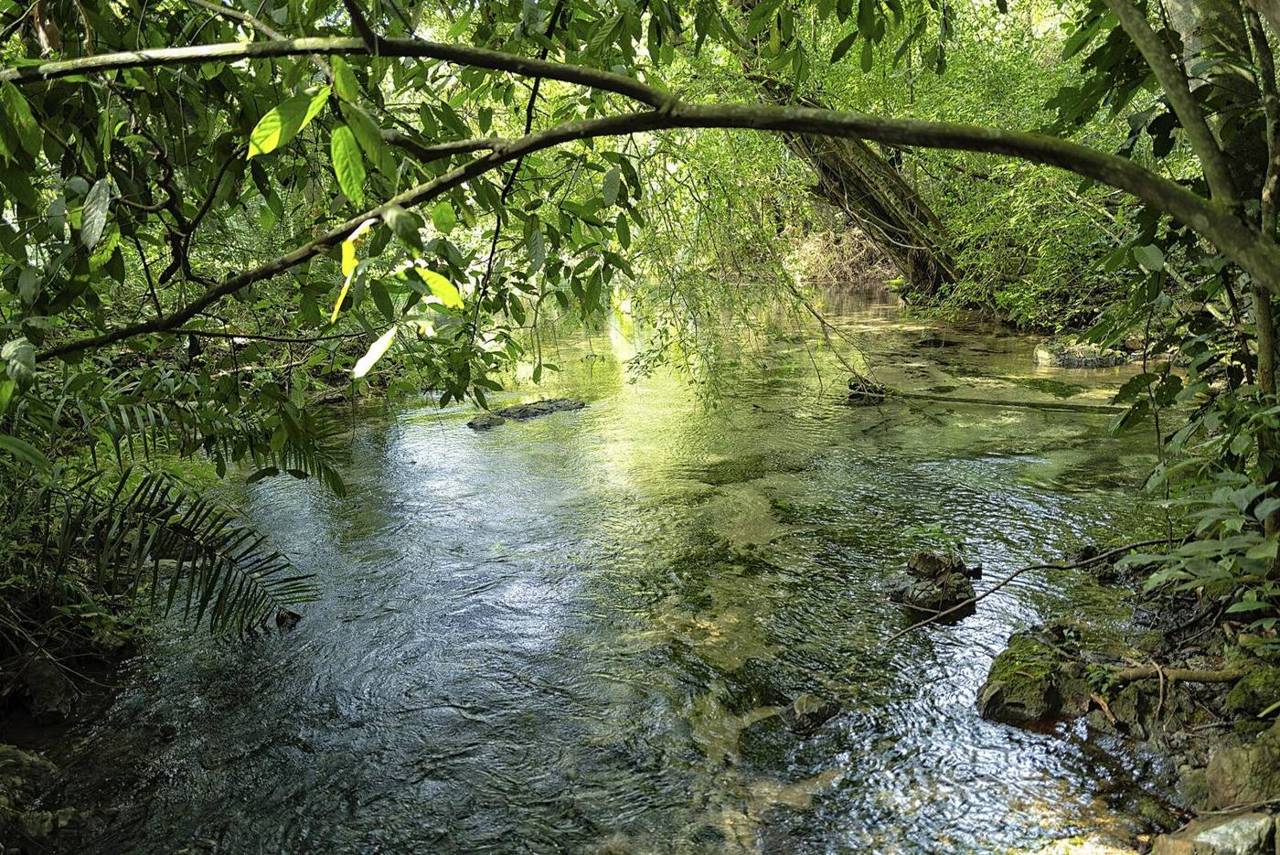
The water is as clear as glass. Below you, shoals of piraputangas, golden dourados and other fish swim among green water plants and white sand, where spring water rises from the bottom and makes the sand bubble. It feels like flying over an aquarium. You must not touch the bottom or the plants, so as not to stir up sand and spoil the visibility.
Before entering the water you may not use sun cream or insect repellent, to protect the river. That is another reason the wetsuit is useful: it protects you from the sun and from the cold, because the water is cool.
After the float you go back to the farm for lunch with local dishes, often included in the activity.
In the afternoon, if you want another activity, the region has other rivers to float with mask and snorkel, waterfalls on forest trails and Bonito's balneário municipal, a river beach where you swim among the fish.
Practical tip: if you are not a strong swimmer, do not worry: the water is shallow in many stretches and the wetsuit keeps you afloat. Leave valuables in your room and arrive with your swimsuit already on.
- Day 6
The Buraco das Araras and the waterfalls
In the morning go to the Buraco das Araras, a huge sinkhole, a vast hole in the ground created when the rock collapsed, more than a hundred metres deep, with a small green lake at the bottom. You walk with a guide along the rim, on an easy trail, to the viewpoints.
The place is named after the red macaws that nest in the rock walls. Early in the morning you see them flying in pairs in and out of the sinkhole, with their loud calls and red, blue and yellow feathers. Toucans are often seen too and, around it, in the cerrado savannah, birds such as the rhea. It is one of the most photogenic places on the trip.
In the afternoon relax with a walk in a waterfall park in the forest along the Rio Formoso or the Rio Mimoso, where the trail passes small waterfalls and natural pools of blue water. You can swim in some of them.
If you like adventure, Bonito also offers the Abismo Anhumas, a cave you abseil into down to an underground lake: it requires a preparation course the day before and is only for people who are not afraid of heights. It must be booked well in advance.
This is your last evening in Bonito: pack for the Pantanal and choose clothes in neutral colours, beige, green or brown, which do not frighten the animals.
Practical tip: for the birds of the Buraco das Araras choose the earliest possible time, when they are most active. Bring binoculars, which you will also use throughout the Pantanal.
- Day 7
Arrival in the southern Pantanal
Today you enter the Pantanal, the largest tropical wetland in the world, which stretches across Brazil, Bolivia and Paraguay. In the rainy season the rivers burst their banks and flood huge plains; in the dry season the water withdraws into lagoons and channels, and the animals gather around them, easy to see.
From Bonito a road transfer takes a few hours to the Miranda area or the Estrada Parque, a dirt road that crosses the southern Pantanal over wooden bridges. Along the road you already see caimans in the sun, capybaras, the largest rodent in the world, and the tuiuiú, the jabiru, a big black and white stork with a red neck, the symbol of the Pantanal.
In the southern Pantanal you stay on farms, the fazendas, where cattle ranching has lived alongside wildlife for centuries. The pantaneiros, the local cowboys, work on horseback in the flooded pastures and know nature extremely well.
In the afternoon go on your first outing with a naturalist guide, on foot or in an open vehicle. Sunset is when birds come back to roost in the trees: herons, roseate spoonbills and cormorants fill the branches.
In the evening, after dinner, many farms offer a night outing with a torch, to look for caiman eyes in the water and, with luck, animals such as the anteater, the tapir or the ocelot.
Practical tip: in the Pantanal there are many mosquitoes, especially at dawn and dusk. Use a good repellent, long sleeves and light trousers, and check that your room has a mosquito net.
- Day 8
Farms, capybaras and toucans
Early in the morning, when the animals are most active, head out with your guide. Outings vary by farm: on foot along trails, by boat or canoe on rivers and bays, on horseback with the pantaneiros in the flooded pastures, or in an open vehicle on dirt roads.
The southern Pantanal is famous for the arara-azul, the hyacinth macaw, the largest parrot in the world, cobalt blue with a yellow ring around its eyes. It nests in the hollow trunks of the farms' big trees and you often see it close up. Around the houses you will also see the toco toucan, with its huge orange beak, and rheas walking through the fields.
Along the rivers watch capybaras in family groups, dozens of caimans on the banks, turtles and kingfishers. With luck the giant otter, the ariranha, appears, living in noisy family groups.
In the afternoon try piranha fishing with a bamboo rod and small pieces of meat, a classic Pantanal activity: the guides show you the fish's sharp teeth, and sometimes it is cooked for dinner.
At sunset, from the riverbank or an observation tower, watch the sky turn orange over the flat plains. In the evening, under the stars, listen to the sounds of the night: frogs, night birds and insects.
Practical tip: on horseback wear long trousers and closed shoes, even if it is hot. Ask the guide for a calm horse if you are not experienced: Pantanal horses are used to water and heat.
- Day 9
Flight to Cuiabá and the start of the Transpantaneira
Today you move from the southern to the northern Pantanal. You go back by road to Campo Grande and take a flight to Cuiabá, the capital of Mato Grosso, often with a connection in another city: check the times carefully, because this is mostly a travel day.
Cuiabá is a very hot city, one of the hottest in Brazil, close to the geographical centre of South America. From here a transfer takes you south to Poconé, a town where the Transpantaneira begins.
The Transpantaneira is a dirt road almost one hundred and fifty kilometres long, built on an embankment across the flooded plain, which crosses the northern Pantanal to Porto Jofre, on the Cuiabá River. It has more than a hundred wooden bridges, some narrow and old. Along the road there are pools and channels where animals gather in the dry season, and the road itself becomes one long safari.
If you arrive in time, already in the late afternoon you will see hundreds of caimans in the pools beside the road, jabirus fishing, herons and capybaras. Sleep on a farm along the first part of the road.
After dinner, if the farm offers it, go on a night drive in an open vehicle. At night you look for the giant anteater, foxes, owls and, rarely, the ocelot.
Practical tip: drive the Transpantaneira only by day and with a local driver or guide. In the rainy season some stretches can be closed or difficult: check the conditions before setting off.
- Day 10
Along the Transpantaneira
Today you drive south along the Transpantaneira, with many stops. There is no hurry: the road is the safari. At first light the animals are most active and the light is soft, perfect for photos.
In the pools beside the road, in the dry season, fish get trapped and attract dozens of birds: storks, great egrets and cocoi herons, roseate spoonbills, ibises and anhingas, the bird that swims with only its neck above water. The caimans wait motionless. Sometimes you also see the marsh deer, the largest deer in South America, and hyacinth macaws on the palms.
The guides also stop on bridges and in clearings to look for howler monkeys, coatis and toucans. In open fields the giant anteater may appear, with a tail as long as a flag.
In the afternoon, at a farm halfway along the road, take a boat trip on a river or channel: you see kingfishers and caimans up close and, with luck, giant otters.
Sleep on a farm along the road, in simple but comfortable rooms with a fan or air conditioning. Dinner is often a buffet with rice, beans, meat and fish.
Practical tip: always keep your camera ready, with a telephoto lens if you have one. On the dirt road there is a lot of dust: protect your equipment with a bag and clean the lens often.
- Day 11
Porto Jofre and jaguars by boat
In the morning you reach the end of the Transpantaneira, at Porto Jofre, on the Cuiabá River. Here the road ends and the Pantanal can only be explored by boat. This area, around the Encontro das Águas State Park, is one of the places in the world where you are most likely to see a jaguar in the wild, especially from July to October.
Boat trips last most of the day, with a break for lunch. The boats go up the Cuiabá River and its tributaries, such as the Três Irmãos and the Piquiri, and the guides keep in touch by radio to share sightings. The jaguar is often seen resting in the shade on the bank, walking along the river or swimming from one side to the other to hunt caimans and capybaras. It is the largest cat in the Americas and the animals here are very powerful.
During the hours of waiting, watch the rest of the river's life: giant otters, caimans, capybaras, fishing eagles and dozens of birds. Sometimes you also see a tapir on the banks.
The rules for watching jaguars matter: boats must keep their distance, without disturbing the animal or blocking its way to the water. Choose guides who respect these rules.
Practical tip: on the boat the sun is very strong and there is not always shade. Bring a wide brimmed hat, sun cream, plenty of water and a light jacket for the early morning, when the speed of the boat makes it feel cool.
- Day 12
A second day on the river
Today you go out by boat from Porto Jofre again. A second day greatly increases the chance of seeing a jaguar, and those who have already seen one often watch it in a different situation: a female with cubs, a male patrolling the bank or, very rarely, a hunt.
Set off at dawn, when the river is calm and mist rises from the water. The first hours are the best for light and for animal activity. Then, in the hottest hours, the jaguars rest in the vegetation on the banks and the guides move slowly along the side channels, switching off the engine to listen.
In your spare time watch the other species: the yacaré caiman, giant otters eating fish on a fallen tree trunk, capuchin monkeys, jabirus with their big nests at the top of the trees.
In the afternoon you return to Porto Jofre and, depending on the programme, start the journey back north along the Transpantaneira, stopping for animals, or stay another night on the river.
In the evening think back over what you have seen: in a few days the Pantanal shows a concentration of animals that few places in the world can offer, comparable to the great parks of Africa.
Practical tip: book your stay at Porto Jofre many months ahead for August and September, the busiest months. For jaguar photos, binoculars also help you spot them among the leaves before the guide does.
- Day 13
Flight to Manaus
Today you leave the Pantanal. In the morning you drive back along the Transpantaneira to Poconé and Cuiabá, saying goodbye to the last caimans and birds along the wooden bridges. Then you take a flight to Manaus, often with a connection: check the times carefully and leave some spare time.
Manaus is the capital of the state of Amazonas, a big city in the middle of the forest, on the Rio Negro, just before it joins the Solimões to form the Amazon. From the plane you see the endless forest and the rivers winding like snakes.
In the nineteenth and early twentieth centuries Manaus became extremely rich thanks to rubber, tapped from forest trees. From that time remains the Teatro Amazonas, opened in 1896, with its dome covered in coloured tiles in the colours of the Brazilian flag. If you arrive in time, see it on a guided tour: inside there are the painted ceiling, the boxes and the chandeliers. Check prices and times and the concert programme.
In the evening walk in the square in front of the theatre, the Largo de São Sebastião, with its black and white wave patterned paving that recalls the meeting of the waters. Try tacacá, a hot soup with dried shrimp and a herb that slightly numbs the tongue, or grilled tambaqui, a large river fish.
Practical tip: in Manaus use app taxis or ones called by your accommodation, especially in the evening, and do not show your phone or valuables in the streets of the centre.
- Day 14
The meeting of the waters and the forest lodge
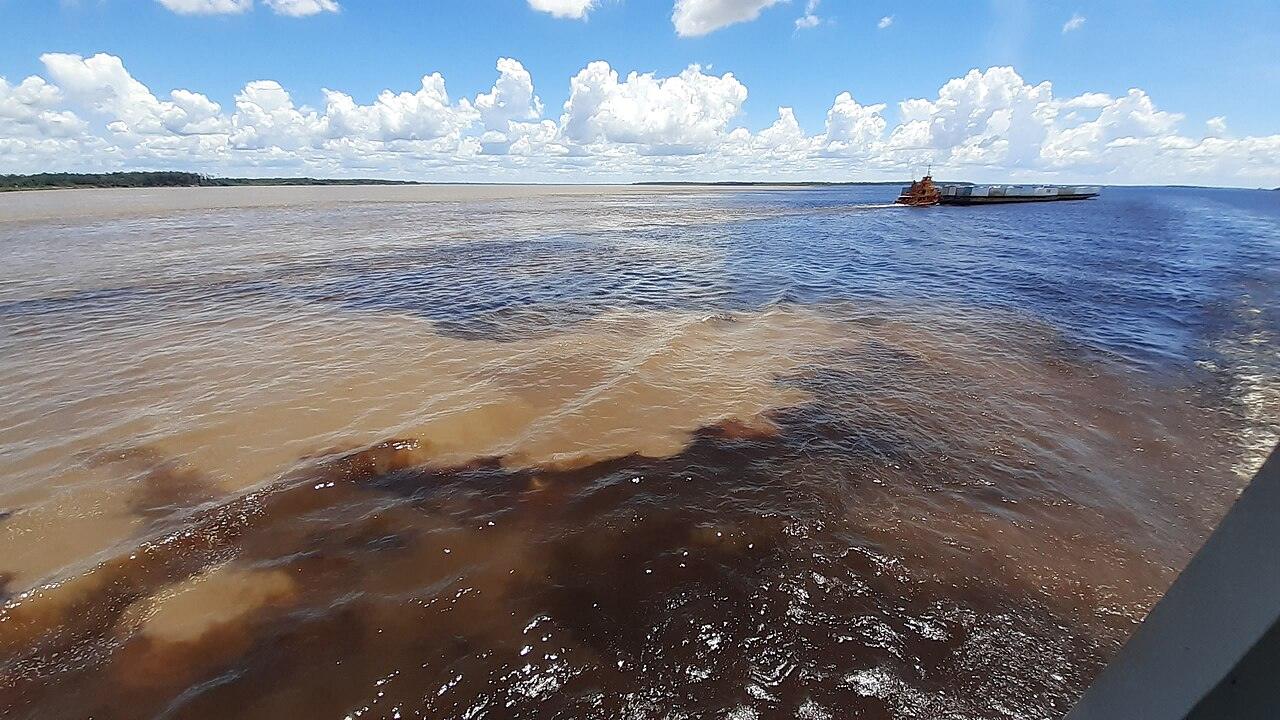
In the morning you leave Manaus by boat. A little downstream from the city you see the meeting of the waters, where the Rio Negro, dark like tea, meets the sandy coloured Solimões. The two waters, different in temperature, speed and density, flow side by side for several kilometres without mixing, with a sharp line clearly visible from the boat.
Then you continue, by boat and road depending on the programme, to the forest lodge, which may be a few hours from Manaus. Lodges are built of wood, often on stilts or floating platforms, with walkways among the trees and simple rooms with a fan and mosquito net.
In the afternoon your guide takes you on a first canoe trip along the igarapés, narrow waterways that run into the forest. The silence is broken by parrots, monkeys and insects. You see sloths hanging from branches, iguanas, colourful birds and, near the banks, the big floating leaves of the Victoria water lily, the giant lily of the Amazon.
At sunset, from the boat, look for pink river dolphins, the botos, which surface to breathe. They are river dolphins, with a long snout and a pink colour that grows deeper with age.
After dinner a night canoe trip with a torch looks for the red eyes of caimans and listens to the forest at night.
Practical tip: in lodges electricity may be limited to certain hours. Bring a head torch, a power bank and light, quick drying long sleeved clothes.
- Day 15
The flooded forest by canoe
Today you discover the Amazon rainforest up close. The Amazon changes a lot with the seasons: when the river is high, usually between May and July, the water flows in among the trees and creates the igapó, the flooded forest, which you cross by canoe between trunks and under branches; when the river is low, between September and November, sandy beaches and trails appear.
Early in the morning take a canoe trip to see the birds: toucans, macaws, parrots, herons and, with luck, the hoatzin, an odd crested bird that lives near the water. Monkeys, such as squirrel monkeys or howlers, move through the high branches.
Later take a forest walk with your guide, who shows you the giant trees, such as the samaúma, with huge plank shaped roots, the lianas, the medicinal plants and the ants. You learn how river people use the forest for food, medicine and building. The heat is humid and you sweat a lot: walk slowly and drink often.
In the afternoon try piranha fishing from the canoe, with a line and small pieces of meat. Then, if conditions allow, the guide shows you where to swim in the Rio Negro, whose dark, acidic water has fewer mosquitoes.
At sunset watch the sky reflected on the dark water, like a mirror.
Practical tip: in the forest wear closed shoes or rubber boots, which lodges often lend, and long trousers. Do not touch trunks and branches without looking, to avoid ants and thorns.
- Day 16
Ribeirinho villages and life on the river
Today you meet the people of the Amazon. The ribeirinhos are the people of the riverbanks, who live in wooden houses on stilts or floating, from fishing, small scale farming and forest fruits. They travel only by boat, and the school, church and football pitch are often right on the bank.
With your guide, visit a community near the lodge. You will see how farinha is made, the toasted cassava flour that comes with almost every meal in the Amazon: the root is peeled, grated, squeezed to remove the poisonous juice and toasted in big pans. Also taste forest fruits such as cupuaçu and açaí, which here is eaten as a thick cream, often with fish.
Behave respectfully: always ask before photographing people and, if you want to leave something, buy the community's crafts, such as baskets and objects made of fibre or seeds.
In the afternoon go on your last boat trip. With luck you see pink dolphins again and the grey ones, the smaller tucuxi, leaping out of the water.
In the evening, your last in the forest, listen to the sounds around the lodge: frogs, insects and sometimes the distant call of howler monkeys before dawn.
Practical tip: before leaving the lodge, confirm the time of the transfer to Manaus and allow plenty of time before your flight, because boat times can change with the river level and the weather.
- Day 17
Departure from Manaus
In the morning you return from the lodge to Manaus by boat and road. If your flight leaves in the evening, you have a few hours for the city.
Visit the Adolpho Lisboa municipal market, on the river, with its late nineteenth century iron structure inspired by European markets. Inside and around it they sell huge river fish, Amazon fruits, herbs, farinha and crafts. If you have not seen it yet, go into the Teatro Amazonas. Check prices and times. Then go to the airport, about half an hour from the centre, in good time.
In these seventeen days you have seen Brazil's nature at its most powerful: the Iguaçu Falls from both sides of the border, the clear water of the Rio da Prata and the red macaws of the Buraco das Araras in Bonito, the farms of the southern Pantanal with hyacinth macaws and capybaras, the Transpantaneira with its wooden bridges, the jaguars on the riverbanks at Porto Jofre and, finally, the Amazon rainforest with the meeting of the waters, pink dolphins and the life of the ribeirinhos.
When to go: the best period is July to October, the dry season in the Pantanal, when animals gather near water and jaguars are seen more often at Porto Jofre. In Bonito the water is clearest in the dry months. The Iguaçu Falls are beautiful all year and most powerful after the rains. In the Amazon every season makes sense, with the river high or low.
Practical tip: keep all your vouchers, domestic flights and transfers together in one document on your phone and on paper. On a trip with so many moves, one delay can change the next day.
The ultimate wildlife Brazil. Bonito is a surprise: water so clear you seem to fly over the fish; activities have capped numbers and must be booked. To see jaguars almost for certain, go to Porto Jofre between July and October.
Before you go
- Documents and visa
- Valid passport; no visa for tourism up to 90 days for EU citizens.
- Health and vaccines
- No compulsory vaccines arriving from Europe; yellow fever is recommended for the Amazon and some inland areas. Protect yourself against mosquitoes because of dengue. Emergencies: 190 police, 192 ambulance, 193 fire.
- Money and payments
- Brazilian real. Cards and instant payments are everywhere; carry little cash.
- Power sockets
- Type N, plus C, 127 or 220 volts depending on the city: check the voltage before plugging in devices.
- Time zone
- Rio and São Paulo are UTC-3 all year: Brazil does not use daylight saving time.
- Safety
- The United States rates Brazil level 2 for crime, with level 4 within 160 km of land borders (except Foz do Iguaçu and the Pantanal). No favelas without a community guide. Official advice: GOV.UK.
Information checked in November 2026 for Italian and EU citizens. Rules change: always check before you travel.
Variations
In 11 days: Iguaçu, Bonito and the northern Pantanal with Porto Jofre, leaving out the southern Pantanal and the Amazon.
In 21 days: add a few days in Rio de Janeiro at the end, with Sugarloaf Mountain, Christ the Redeemer and the beaches.
Frequently asked questions
Will you really see a jaguar in the Pantanal?
In the Porto Jofre area, on the Cuiabá River, from July to October the chances are high with two or more days of boat trips, but there is never a guarantee. Elsewhere in the Pantanal the jaguar is present but seen much more rarely.
How do you book activities in Bonito?
Each activity has a daily limit on places and is booked with a voucher through Bonito's authorised local agencies. It is worth booking well ahead, especially in July and during Brazilian school holidays.
Do you need vaccines for this trip?
For the Pantanal and the Amazon ask a travel health clinic about yellow fever and malaria prevention a few weeks before departure. Bring a good repellent and long sleeved clothes.
Indicative itinerary written by World Atlas. Before booking, check timetables, seasonal openings, documents and safety.
 7 daysEasy
Rio de Janeiro and the Iguaçu Falls
South America's most spectacular city and its mightiest falls, seen from both sides of the border.
 15 daysModerate
Pantanal, Amazon and Rio
The jaguars of the Pantanal, a lodge in the Amazon rainforest and a finale in Rio de Janeiro.
 12 daysEasy
Brazil express: Rio, Iguaçu and Salvador da Bahia
Postcard Brazil in under two weeks: Sugarloaf Mountain, the world's mightiest falls and the most African city in the Americas.