The Mekong Delta and Phu Quoc
A week on the water among canals, dawn markets and flooded forests up to the Cambodian border, then a few days by the sea on Phu Quoc.
- Ho Chi Minh
- Ben Tre
- Can Tho
- Chau Doc
- Tra Su
- Ha Tien
- Phu Quoc
Day by day
- Day 1
Arrival in Ho Chi Minh City
This trip starts in Ho Chi Minh City, the great city of southern Vietnam that many still call Saigon, and heads down into the Mekong Delta, a maze of rivers, canals, rice fields, orchards and floating markets, as far as the Cambodian border and then to Phu Quoc island in the Gulf of Thailand, with beaches and forest.
Before you leave: Italian citizens can enter Vietnam without a visa for up to forty five days under rules in force until 14 March 2028. For longer stays you need an e-visa. Check that your passport has the required validity. Other nationalities should check their own rules.
You fly into Tan Son Nhat airport, about half an hour from the centre, District 1, depending on traffic. Take a metered taxi or a car booked through an app.
In the afternoon rest after the journey and, when the heat drops, walk around the centre: Dong Khoi street, with French colonial buildings, the Opera House, Notre Dame cathedral, built with bricks brought from France and now under restoration, and the Central Post Office, with an iron and glass ceiling designed by an associate of Eiffel.
In the evening have southern street food: banh mi, the sandwich in French bread, and com tam, broken rice with grilled pork.
Sleep in Ho Chi Minh City.
Practical tip: the best time for the south is December to April, the dry season. From May to October it often rains in the afternoon.
- Day 2
Ben Thanh, Cho Lon and street food
Today you explore Ho Chi Minh City.
In the morning visit the War Remnants Museum, which tells the story of the Vietnam War from the Vietnamese point of view, with aircraft, tanks, photographs by the great war photographers and very harrowing rooms on the effects of bombing and defoliants. Then the Reunification Palace, the former presidential palace of South Vietnam, with 1960s rooms left as they were in 1975, when tanks from the north broke through the gate. Check opening hours and prices.
At midday go into Ben Thanh market, the city's most famous covered market, with stalls of fabrics, crafts, tropical fruit and cooked food. Prices for tourists are high: bargain politely.
In the afternoon go to Cho Lon, the Chinese quarter in District 5, with the large Binh Tay market and Chinese temples full of incense, such as the Thien Hau pagoda, dedicated to the goddess of the sea, with coils of incense hanging from the ceiling.
In the evening do a street food tour, perhaps by scooter with a guide, trying pho, banh xeo, the crisp pancake with prawns and bean sprouts, and snails cooked in many ways.
Sleep in Ho Chi Minh City.
Practical tip: to cross the road, walk at a slow, steady pace. The scooters will flow around you.
- Day 3
Ben Tre by bike and sampan
In the morning leave Ho Chi Minh City with a car and driver or a minibus and drive south, about two hours, to Ben Tre, a province of islands between branches of the Mekong, called the land of coconuts.
Here the landscape changes: coconut groves, small canals, wooden and concrete bridges, low houses with fruit gardens. Rent a bicycle and ride the paths between the villages, where you see coconut being turned into sweets, oil, rope and objects, and bricks being made in dome shaped kilns.
In the afternoon get into a sampan, a small rowing boat, steered by a village woman in a conical hat, and glide along narrow canals under water palms, nipa, whose leaves are used for roofs. It is one of the most peaceful moments of the trip.
In some delta houses you can taste tropical fruit, tea with honey and traditional southern music, don ca tai tu, which is on the UNESCO intangible heritage list.
In the evening sleep in a family homestay on the bank of a canal, or in a small hotel.
Sleep in Ben Tre.
Practical tip: there are many mosquitoes in the delta. Use repellent and wear long clothes at sunset.
- Day 4
Can Tho and the Cai Rang floating market
Early in the morning, before dawn, leave for Can Tho, the largest city in the delta, about two hours by road, or sleep in Can Tho the night before so you are on the river at sunrise.
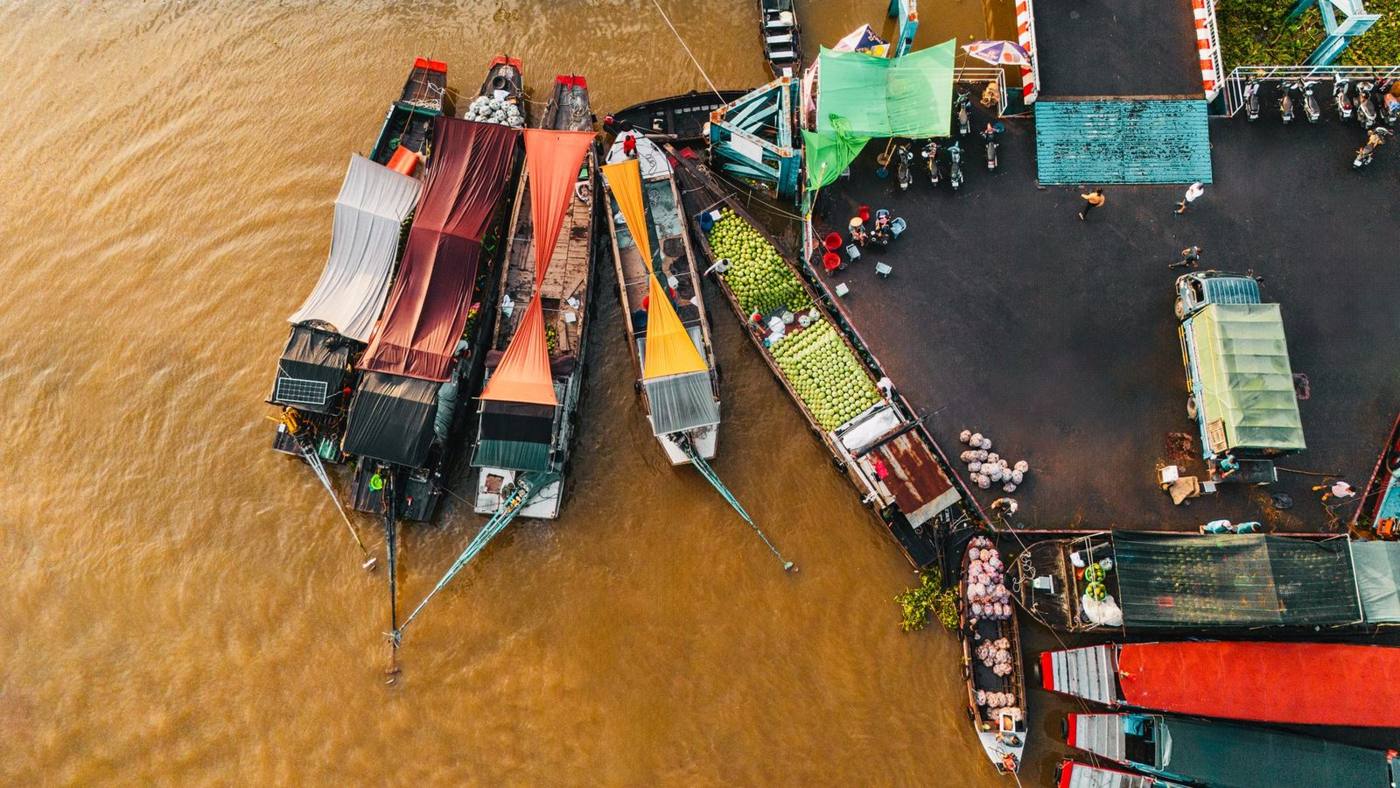
Take a boat to the Cai Rang floating market, the largest in the delta. Wholesalers' boats laden with watermelons, pineapples, sweet potatoes and vegetables are anchored in the middle of the river; each hangs a sample of what it sells from the top of a tall pole, so it can be seen from afar. Traders' small boats pull alongside to buy. Other little boats sell coffee, noodle soup and fruit to tourists and boatmen. The market is busiest between five and eight in the morning. In recent years it has shrunk as roads and land markets have grown.
Then visit a small workshop where rice noodles are made, with the sheets laid out to dry in the sun on bamboo mats.
In the afternoon visit an orchard where rambutan, longan, mango, pomelo and durian grow, depending on the season.
In the evening walk along the Can Tho riverfront, with the night market and the statue of Ho Chi Minh.
Sleep in Can Tho.
Practical tip: bring a light jacket for the boat at dawn. On the river early in the morning it is cool.
- Day 5
To Chau Doc and the Tra Su flooded forest
In the morning drive west, about three hours, to Chau Doc, a small town on the Hau river a few kilometres from the Cambodian border, where Vietnamese, Muslim Cham and Khmer people live side by side.
On the way, or just after arriving, visit the Tra Su cajuput forest, a forest flooded in the rainy season, which you enter by motorboat and then by small rowing boat along canals covered in bright green duckweed among melaleuca trees. You see herons, cormorants, egrets, storks and other birds that nest here. There is an observation tower overlooking the whole forest. Water levels vary a lot: the best time is September to November, but you can visit almost all year. Check the price.
In the late afternoon you reach Chau Doc. Walk along the riverfront and through the market.
In the evening try fermented fish, mam, for which Chau Doc is the capital: at the market there are dozens of kinds in large jars, with a very strong smell. It is eaten with vegetables and noodles in a soup, bun mam.
Sleep in Chau Doc.
Practical tip: in Tra Su forest bring a hat and water. On the boat the sun is strong and there is no shade.
- Day 6
Cham villages and Sam Mountain
Today you stay in Chau Doc.
In the morning cross the river by small ferry or boat to the Cham villages, Muslims descended from the kingdom of Champa, who live in stilt houses along the bank. Visit a mosque, wearing clothes that cover legs and shoulders and taking off your shoes, and watch the looms where women weave checked cloth.
Then visit a floating fish farm: houses on platforms over the river, under which catfish are raised in large cages. The floor has trapdoors through which you see the fish thrashing when they are fed.
In the afternoon go up Sam Mountain, a hill a few kilometres from town, with temples and shrines, including the temple of the goddess Ba Chua Xu, the goal of large pilgrimages, especially in spring. From the top, on clear days, you see the delta plain with its rice fields and, to the west, the Cambodian border. You can go up on foot, by motorbike taxi or by cable car: check.
At sunset stay at the top to see the sun go down over the rice fields.
Sleep in Chau Doc.
Practical tip: in temples and mosques always ask before photographing people, and dress modestly.
- Day 7
Along the border to Ha Tien and the ferry to Phu Quoc
In the morning leave Chau Doc and drive south west on the road along the Vinh Te canal and the Cambodian border, about two and a half hours, among rice fields, Khmer villages with pointed roofed pagodas and isolated limestone hills rising from the plain.
This road runs close to the frontier: stay on the main roads, do not approach the border line and do not try to cross it except at an official crossing with the right documents.
You reach Ha Tien, a quiet town by the sea near the border, with a river and a bridge, the Phu Dung pagoda and the tombs of the Mac family, who ruled the area in the eighteenth century. Visit the fish market on the river.
In the early afternoon take the fast ferry or the car ferry from Ha Tien to Phu Quoc island, about an hour and a half or two and a half hours depending on the vessel. In rough seas sailings may be cancelled: check times and conditions.
You arrive in Phu Quoc, Vietnam's largest island, with its west coast facing the sunset.
In the evening have fish and seafood at the Duong Dong night market.
Sleep in Phu Quoc.
Practical tip: from July to September the sea between Ha Tien and Phu Quoc can be rough. At that time consider flying from Ho Chi Minh City.
- Day 8
The north coast and the national park
Today you explore the north of the island, the wildest part.
In the morning rent a scooter, if you are experienced and hold a valid licence, or hire a car with driver, and head north. Phu Quoc National Park covers much of the north of the island, with tropical forest, hills and streams. Walk one of the trails, such as the one to the Suoi Tranh falls, which are best in the rainy season when there is water.
Then reach the northern beaches: Bai Dai, Ganh Dau, near the north west tip, from where you can see the coast of Cambodia, and Bai Thom, on the north east coast, quiet and with few buildings. Some beaches on the north coast have large new resorts; others are still simple, with fishermen's huts.
In the afternoon visit a plantation of Phu Quoc black pepper, famous throughout Vietnam, with the vines climbing up wooden poles.
At sunset return to the west coast, at Duong Dong or Ong Lang, to watch the sun go down into the sea.
Sleep in Phu Quoc.
Practical tip: traffic on the island has grown a lot. Ride a scooter only if you are experienced, with a helmet and suitable insurance.
- Day 9
By boat among the An Thoi islands and nuoc mam
Today you spend the day at sea in the south of the island.
In the morning go to An Thoi harbour, at the southern tip of Phu Quoc, and board a boat for the An Thoi islands, an archipelago of small islands with white beaches, turquoise water and coral reefs. You snorkel at two or three spots, seeing tropical fish, sea urchins and corals, and have lunch on board or on an island. The corals are partly damaged, but some spots are still alive. Do not touch the coral and do not use sunscreens that harm the sea.
Alternatively you can take the long cable car over the sea linking An Thoi to Hon Thom island, among the longest in the world, with an amusement park at the end. Check times and prices.
In the afternoon visit a nuoc mam factory, making the fish sauce for which Phu Quoc is famous: anchovies are left to ferment with salt for a year in large wooden barrels. The smell is very strong. Many airlines do not allow fish sauce in luggage: check.
In the evening relax on Sao beach on the east coast, with white sand and calm water.
Sleep in Phu Quoc.
Practical tip: on the boat protect your head from the sun and drink plenty of water. The glare off the water burns even when it is cloudy.
- Day 10
Flight to Ho Chi Minh City and home
On the last day take the flight from Phu Quoc to Ho Chi Minh City, about an hour, and your connection to Europe. Phu Quoc international airport is in the centre of the island, about twenty minutes from Duong Dong. Some airlines also have direct international flights from the island: check.
If your flight leaves in the afternoon, in the morning you can visit Phu Quoc prison, called the coconut tree prison, where thousands of prisoners were held during the war, with reconstructions of the cells and of torture that are very hard to look at. Or have a last swim on the beach near your hotel.
Before leaving buy something to take home: Phu Quoc black pepper, cultured pearls from the island bought in shops with a certificate, Vietnamese coffee, coconut sweets from Ben Tre, lacquerware and conical hats.
This trip shows southern Vietnam away from the main routes: life on the river in the Mekong Delta, floating markets, flooded forests, the Cham and Khmer peoples of the border, and a tropical island of forest and sea.
Practical tip: between the domestic flight and your intercontinental flight from Ho Chi Minh City leave at least three hours. With luggage to collect, allow even more time.
An easy-paced trip that also works as a second half to a northern itinerary, or for winter travel. See the delta away from Cai Be and the day cruises from Saigon: Chau Doc and Tra Su show what life on the water really looks like. The drawback is Phu Quoc, whose south is now built up with resorts and theme parks, so stay on the north coast. The sea is pleasant, but snorkelling is modest compared with Thailand or the Philippines.
Before you go
- Documents and visa
- Passport with at least six months' validity remaining. Italian, French and several other European citizens need no visa for tourism up to 45 days, an exemption valid until 14 March 2028; otherwise use the e-visa from the official portal.
- Health and vaccines
- No compulsory vaccines. Protect yourself against mosquitoes because of dengue; drink only bottled water. Emergencies: 113 police, 114 fire, 115 ambulance.
- Money and payments
- Vietnamese dong. Cards and QR code payments are widespread in cities; in markets, villages and for small purchases you need cash.
- Power sockets
- Types A and C, among others, 220 volts: a universal adapter is useful.
- Time zone
- UTC+7 all year: Vietnam does not use daylight saving time.
- Safety
- A safe country for travellers. In big cities beware of snatch thefts from scooters; from July to December typhoons and floods hit the centre and north. Official advice: GOV.UK.
Information checked in November 2026 for Italian and EU citizens. Rules change: always check before you travel.
Variations
In 7 days: Ho Chi Minh City, Ben Tre, Can Tho and Chau Doc, returning by road to Ho Chi Minh City, without Phu Quoc.
In 14 days: add the Cu Chi tunnels and the Con Dao islands, reached by air from Ho Chi Minh City.
Frequently asked questions
Do I need a visa for Vietnam?
Italian citizens can enter without a visa for up to forty five days under rules in force until 14 March 2028. For longer stays you need an e-visa. Other nationalities should check their own rules.
When should I go to the Mekong Delta?
December to April, the dry season, is most comfortable. Tra Su flooded forest is at its best from September to November, when there is more water.
Can I cross the border into Cambodia?
Only at official crossings, with the visa and documents Cambodia requires, which should be checked before you travel. Do not approach the border away from the main roads.
Indicative itinerary written by World Atlas. Before booking, check timetables, seasonal openings, documents and safety.
 4 daysEasy
Hanoi in depth
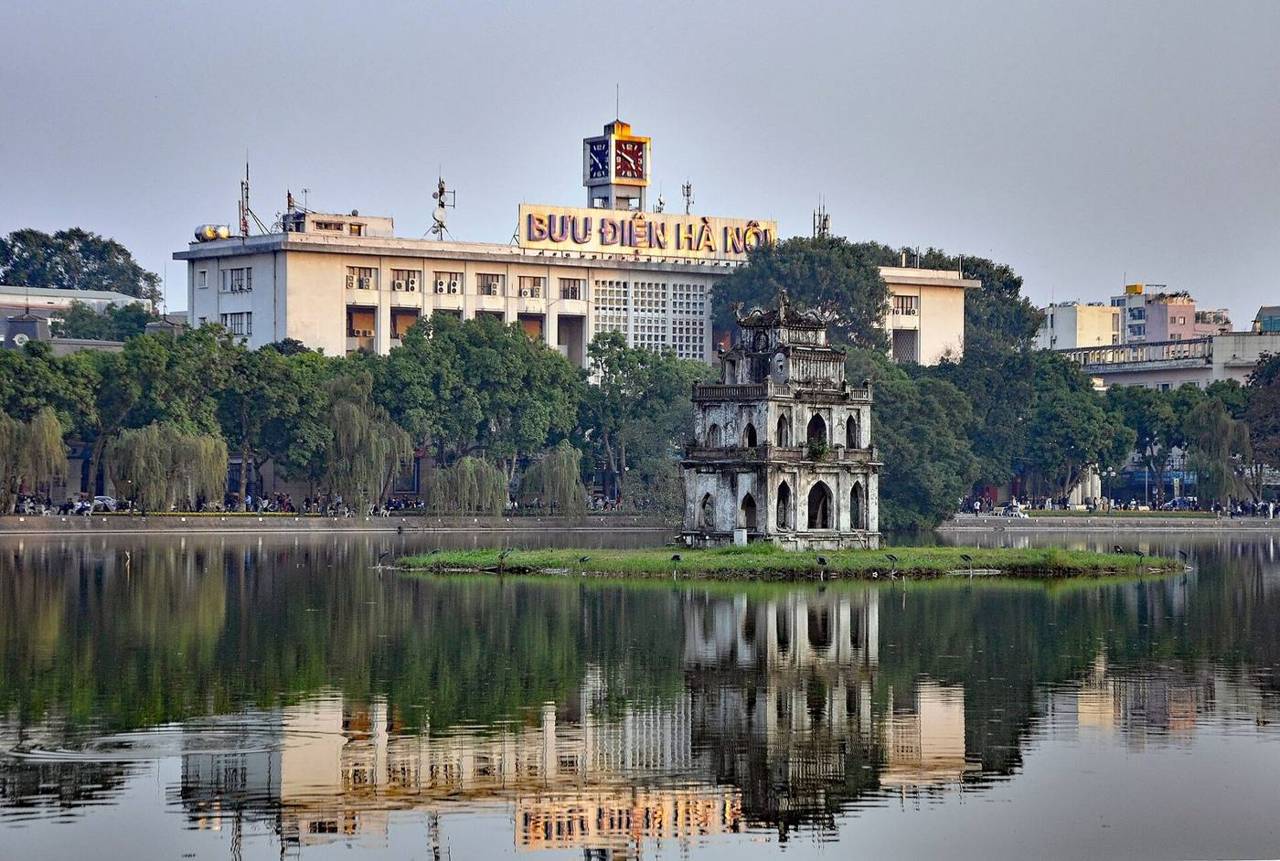
The capital at a gentle pace: the Old Quarter of the 36 streets, Hoan Kiem Lake, the Temple of Literature, the Ho Chi Minh Mausoleum, the Museum of Ethnology, the water puppet theatre and street food, from pho to bun cha.
 5 daysModerate
The Ha Giang Loop
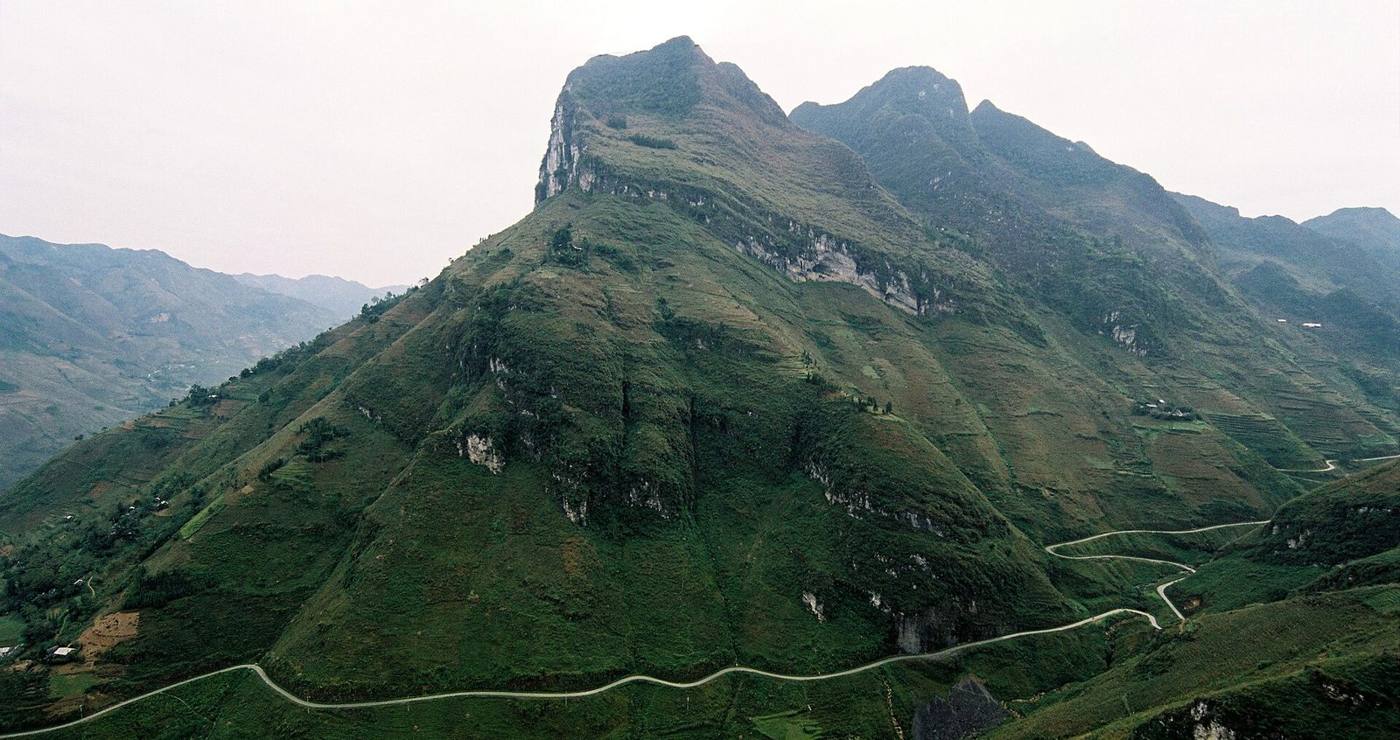
The limestone mountains of the far north: Ma Pi Leng Pass above the Nho Que river canyon, the terraces of Hoang Su Phi, Hmong and Lo Lo villages, the Hmong king's palace at Sa Phin and weekend markets, travelled with a motorbike driver.
 5 daysEasy
Ba Be and the Ban Gioc Falls
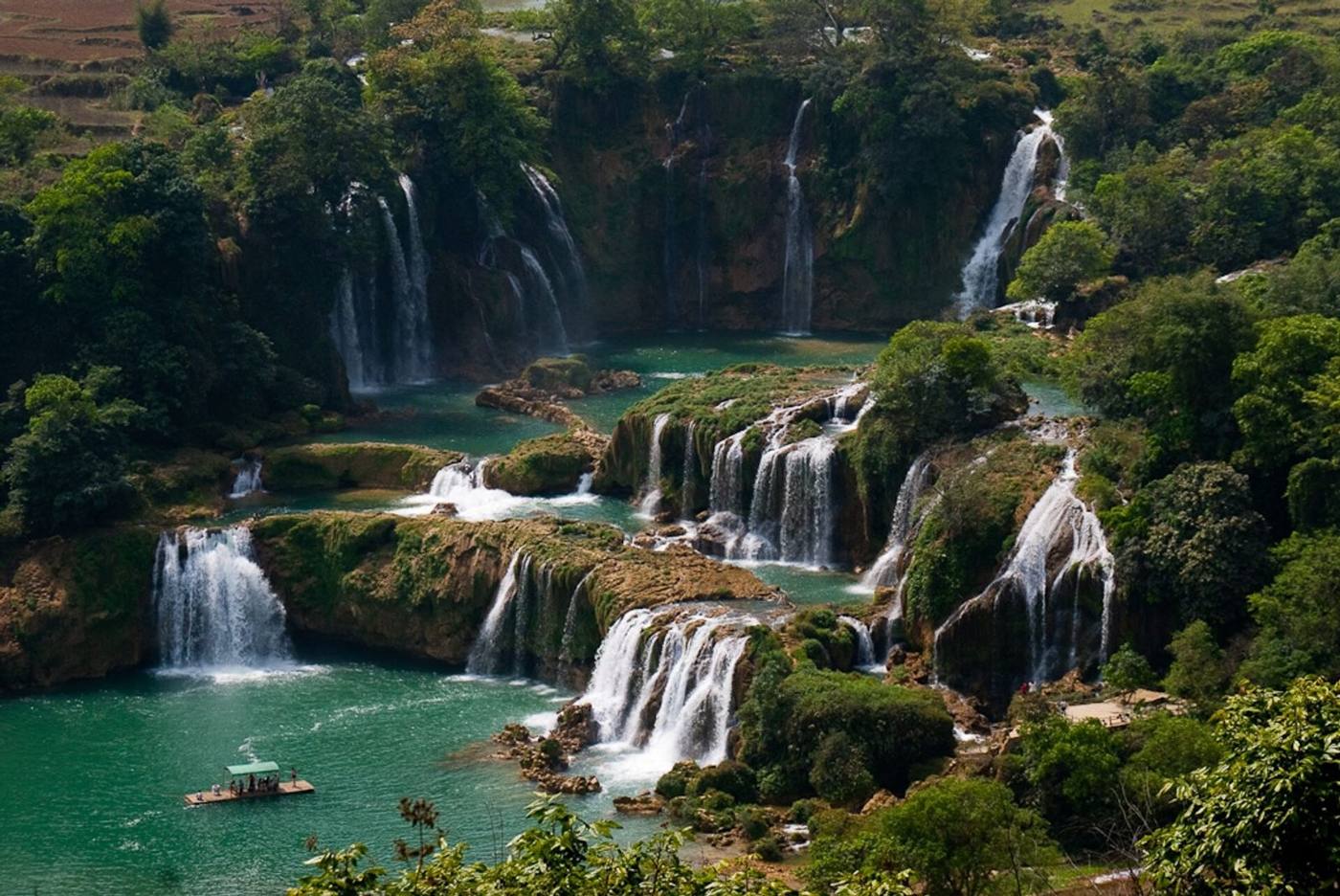
The green, little-visited northeast: Ba Be Lake among karst mountains, with Tay stilt houses and Puong Cave crossed by the river, then Cao Bang, Nguom Ngao Cave and the Ban Gioc Falls, among the widest in Asia.