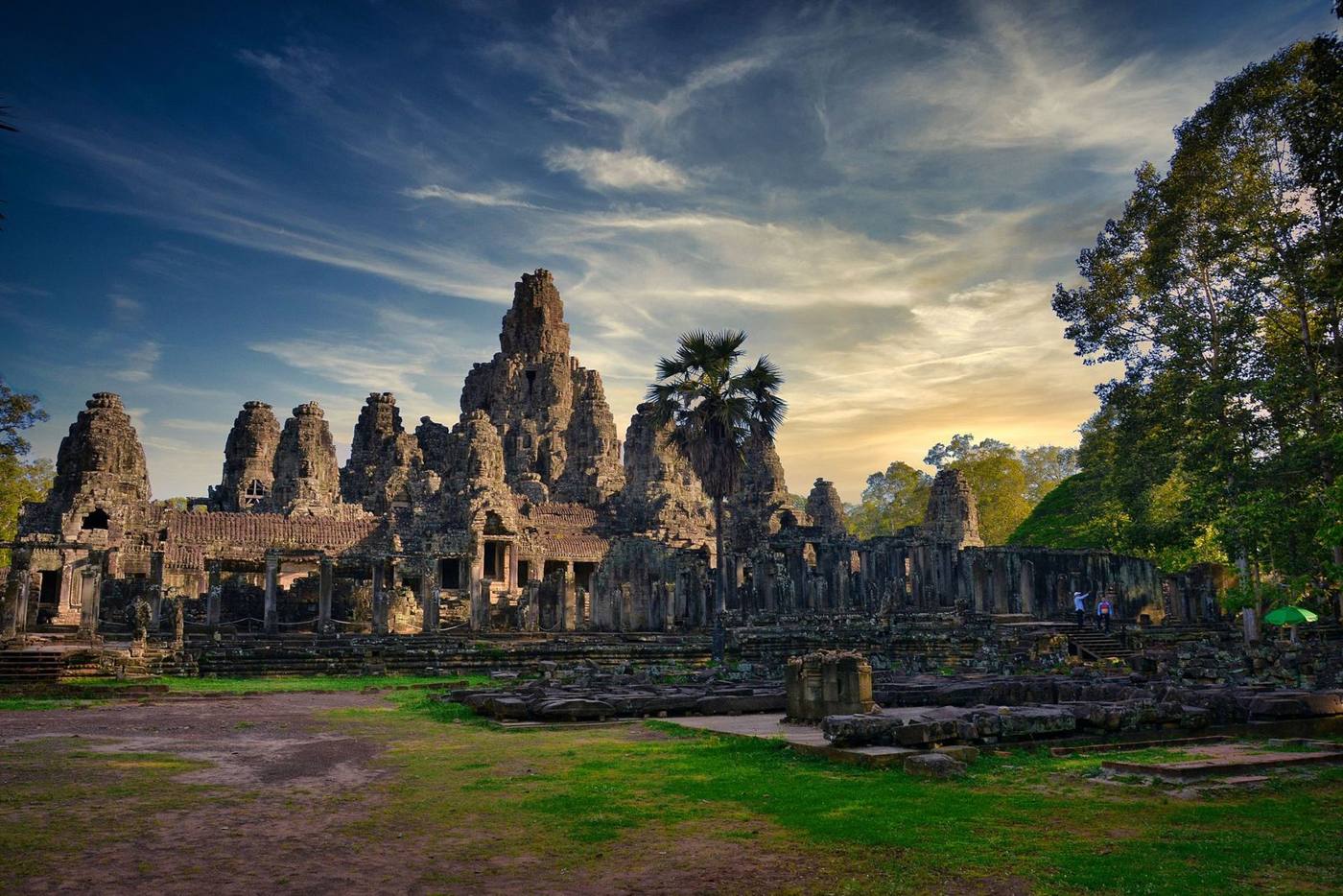
From Angkor to Ha Long Bay
A week in Cambodia among the temples of Angkor and the memory of Phnom Penh, then Vietnam travelled north from the Mekong to Hanoi.
- Siem Reap
- Angkor
- Kampong Phluk
- Phnom Penh
- Delta del Mekong
- Ho Chi Minh
- Hoi An
- Hue
- Ha Long Bay
- Ninh Binh
Day by day
- Day 1
Departure for South-East Asia
This trip combines Cambodia and Vietnam in seventeen days: the temples of Angkor, the stilt village of Kampong Phluk on Tonle Sap lake, Phnom Penh and the memory of the Khmer Rouge, then the Mekong into Vietnam, Ho Chi Minh City, Hoi An, Hue, Ha Long Bay and Ninh Binh. You travel by plane, bus, boat and night train.
Before you go: Italian citizens need a visa for Cambodia. Apply for the tourist e-visa only on the official website evisa.gov.kh, with a passport valid for at least six months from entry, and before arrival also fill in the electronic arrival form. For Vietnam, Italian citizens can enter without a visa for stays of up to 45 days, an exemption valid until 14 March 2028; for longer stays there is the 90 day electronic visa. Other nationalities should check their own rules. If you need to leave the airport in Bangkok, also check the entry rules for Thailand.
Safety: the British government advises against all but essential travel within 20 kilometres of the land border between Cambodia and Thailand, where the crossings are closed and landmines and unexploded ordnance remain. This trip stays well away from that area: you fly into Siem Reap and leave Cambodia for Vietnam along the Mekong.
Today you take the flight from Italy to Bangkok, usually with a stop in Europe or the Gulf, and spend the night on the plane. Cambodia and Vietnam are six hours ahead of Italy in winter, five in summer.
Practical tip: carry a printed copy of your e-visa and some US dollar notes, widely used in Cambodia alongside the riel, the local currency.
- Day 2
From Bangkok to Siem Reap
Today you arrive in Cambodia.
You land in Bangkok in the morning and take the domestic connection to Siem Reap, a little over an hour. Do not try to do this stretch overland: the border between Thailand and Cambodia is closed. The new Siem Reap Angkor international airport lies outside the city: allow about an hour by road to the centre.
On arrival show your e-visa and passport. Then settle into the city, where you will sleep for four nights.
Siem Reap is the gateway to Angkor: a low, green town crossed by the river of the same name, which has grown in a few decades thanks to visitors to the temples. In the afternoon rest after the journey, then walk along the river, past the footbridges and the royal gardens, to the old market, with stalls of spices, dried fish, silks and wooden objects.
In the late afternoon you can visit the Angkor National Museum, which explains the history of the Khmer empire and the art of the temples before you see them for real, with statues of the Buddha and of Hindu gods. Check prices and times.
In the evening try Khmer cooking: amok, fish steamed in a banana leaf with coconut milk and lemongrass, lok lak, stir fried beef served with a sauce of Kampot pepper and lime, and the morning rice noodles called num banh chok.
Go to bed early: tomorrow the alarm goes off before dawn.
Practical tip: buy your Angkor ticket online on the official website angkorenterprise.gov.kh, so you avoid the queue at dawn. The ticket is personal and carries your photo.
- Day 3
Angkor Wat at sunrise and Angkor Thom
Today you enter the heart of the Khmer empire.
Angkor was the capital of the Khmer kings from the ninth to the fifteenth century and is now an archaeological park on the UNESCO list, with dozens of temples scattered through the forest. The official ticket costs 37 dollars for one day, 62 dollars for three days to be used within a week and 72 dollars for seven days to be used within a month; the temples open at five in the morning. For this trip the three day ticket is the best choice.
Before dawn reach Angkor Wat by tuk tuk and wait for the sun in front of the pools, with the five towers shaped like lotus buds reflected in the water. The temple was built in the twelfth century by King Suryavarman II and dedicated to the god Vishnu. Then go inside and walk along the galleries, covered in bas reliefs hundreds of metres long, with battles, kings and the churning of the ocean of milk. Shoulders and knees must be covered.
In mid morning pass through the south gate of Angkor Thom, with rows of statues pulling the sacred serpent, and enter the Bayon, the temple of faces: dozens of towers with large smiling stone faces, built for King Jayavarman VII. Nearby you see the Baphuon, a stepped pyramid, the Terrace of the Elephants and the Terrace of the Leper King.
In the afternoon, when it is hottest, go back to town to rest.
Practical tip: agree the price of the tuk tuk for the whole day in advance, with the dawn departure time and the temple circuit already settled.
- Day 4
Ta Prohm and the temples in the forest
Today you see the temples where the forest has taken back its space.
Set off early for Ta Prohm, built at the end of the twelfth century by Jayavarman VII as a Buddhist monastery. Archaeologists left it partly as they found it: huge trees, such as the kapok and the strangler fig, grow on top of the walls, with roots running down over the stones like waterfalls of wood. Arrive at opening time, before the groups, to enjoy the silence and the morning light in the courtyards.
Then visit Ta Keo, an unfinished temple mountain of smooth stone without decoration, and Banteay Kdei, with its long corridors and gateways carved with faces. In front lies Sras Srang, a large royal pool where the kings bathed.
At midday have lunch at one of the small restaurants in the park and rest in the shade.
In the afternoon, if you still have energy, enter Preah Khan, another great monastery of Jayavarman VII, with long galleries and trees on the roofs, and then Neak Pean, a small shrine on an island in the middle of a pool.
At sunset climb Pre Rup, a temple of red brick with a wide view over the rice fields and the trees of the park. The late afternoon light turns the stone orange.
Return to Siem Reap for dinner and try a Khmer fish soup with aromatic herbs and tamarind.
Practical tip: carry at least two litres of water per person, a hat and sun cream. Between March and May the afternoon heat is very strong.
- Day 5
Kampong Phluk and Tonle Sap lake
Today you discover life on the water.
Tonle Sap is the largest freshwater lake in South-East Asia. During the rainy season the Tonle Sap river reverses its flow: the swollen Mekong pushes water towards the lake, which grows several times larger and floods the surrounding forests. In the dry season the lake shrinks and the water flows back towards the Mekong. Fishermen, villages and flooded forests live by this rhythm.
In the morning go by car or tuk tuk to Kampong Phluk, about an hour south-east of Siem Reap. It is a fishing village with houses on very tall wooden stilts, which in the dry season stand high above the ground and in the rainy season almost touch the water. Board a boat and glide along the main channel, past the houses, the school, the pagoda and the nets hung out to dry.
Then change to a small rowing boat and cross the flooded forest, with trees rising out of the water. Further on the channel opens onto the lake, so large that it looks like the sea.
In the afternoon return to Siem Reap and rest. In the evening stroll through the night markets or watch a show of traditional Khmer dance, with dancers telling the stories of the Ramayana through slow movements of the hands. Check prices and times.
Practical tip: in the dry season, between March and May, the water level can be very low. Ask beforehand whether the boats can reach the flooded forest and the lake.
- Day 6
By bus to Phnom Penh
Today you cross the heart of Cambodia.
In the morning take a scheduled bus to Phnom Penh, about six hours by road, with a stop halfway. From the window you see flat rice fields, sugar palms, villages of wooden houses on stilts, pagodas with golden roofs and markets along the road. At some stops people sell fruit, rice cooked in bamboo and, for the curious, fried spiders, a speciality of the Skuon area.
Phnom Penh, the capital of Cambodia, stands where the Tonle Sap river meets the Mekong. In the 1960s it was called the pearl of Asia for its boulevards and modern buildings. In 1975 the Khmer Rouge emptied it and forced all its inhabitants into the countryside. Today it is a lively city, with new tower blocks beside old colonial villas.
In the late afternoon walk along the riverfront, Sisowath Quay, where in the evening people exercise, play games and enjoy the cooler air. Reach Wat Phnom, the temple on the small hill that gave the city its name.
In the evening have local food, such as kuy teav, a rice noodle soup with pork and herbs, or fish from the Mekong.
Sleep in Phnom Penh, for two nights.
Practical tip: buy your bus ticket a day ahead and choose a company with assigned seats. Keep water and something to eat with you for the journey.
- Day 7
Phnom Penh, the Royal Palace and remembrance
Today you learn about the recent history of Cambodia, the hardest part of the trip.
In the morning visit the Tuol Sleng genocide museum, a former secondary school that the Khmer Rouge turned into the S-21 prison. Thousands of people were imprisoned and tortured here between 1975 and 1979. The classrooms still hold the cells, the iron beds and walls covered in photographs of the prisoners. The audio guide helps you understand without hurrying.
Then go to Choeung Ek, about half an hour from the centre, one of the killing fields where many S-21 prisoners were murdered. Today it is a memorial with a tall stupa filled with skulls and a path among the mass graves, explained by an audio guide. Check prices and times for both.
These are heavy visits: approach them prepared, in silence, and keep the afternoon lighter.
In the afternoon visit the Royal Palace, with its yellow and gold roofs, where the king still lives, and the Silver Pagoda, named after its floor covered in silver tiles, which holds a small Buddha known as the Emerald Buddha. Shoulders and knees must be covered. Then go into the National Museum, a red building with a fine collection of Khmer sculpture. Check prices and times.
In the evening stroll through the night market by the river.
Practical tip: if you travel with teenagers, think carefully about the visits to S-21 and Choeung Ek: the images and the stories are very strong.
- Day 8
Along the Mekong into Vietnam
Today you move from Cambodia to Vietnam along the Mekong.
Early in the morning take a fast boat down the Mekong from Phnom Penh towards Vietnam. The journey takes half a day: the river is wide and brown, with barges loaded with sand, fishermen in dugout canoes and villages of wooden houses on the banks. At the border the boat stops twice: first for the exit stamps from Cambodia, then for entry into Vietnam, where Italian citizens enter without a visa.
You arrive in Chau Doc, a delta town near the border, with many Cham Muslim communities and floating houses where fish are farmed beneath the floor. Have lunch with river fish and fermented fish sauce, mam, a speciality of the town.
In the afternoon continue by car to Can Tho, about three hours, crossing the Mekong Delta, a plain of rice fields, orchards and canals that produces much of Vietnam's rice. Along the road you see boats loaded with fruit, houses with little bridges and family tombs in the middle of the fields.
Can Tho is the largest city in the delta. In the evening walk along the riverfront, near the market, and try banh xeo, a large crispy pancake of rice flour and turmeric filled with prawns and bean sprouts, to be wrapped in mustard leaves.
Sleep in Can Tho.
Practical tip: keep your passport within reach on the boat. Border checks on the river can take time.
- Day 9
The floating market, Ben Tre and Ho Chi Minh City
Today you see the delta at dawn and reach the great city of the south.
At half past five board a boat to the Cai Rang floating market, where wholesalers sell fruit and vegetables from their boats. Each boat hangs a sample of what it sells from a tall pole: a watermelon, a pineapple, a pumpkin. Have breakfast with a noodle soup served from a small boat. The market is smaller than it used to be, but the river waking up is still a fine sight.
Then head north and stop in Ben Tre, the coconut province. Board a small rowing boat and glide along narrow canals under the water palms, then visit a workshop where coconut sweets are made and taste tropical fruit.
In the early afternoon you reach Ho Chi Minh City, the old Saigon, the largest city in Vietnam, with millions of scooters. Visit the War Remnants Museum, with the photographs of war reporters, American tanks and aircraft and the rooms on the effects of Agent Orange. Check prices and times.
At sunset walk around District 1, near Notre-Dame cathedral and the central post office, built by the French at the end of the nineteenth century.
In the evening eat com tam, broken rice with grilled pork, typical of Saigon.
Sleep in Ho Chi Minh City.
Practical tip: to get around the city use ride hailing apps with a fixed price, for both cars and motorbike taxis.
- Day 10
The Cu Chi tunnels and the night train
Today you see how people fought underground, then set off for the centre.
In the morning go to the Cu Chi tunnels, about an hour and a half north-west of the city. During the war the Viet Cong guerrillas dug by hand a network of tunnels hundreds of kilometres long, on several levels, with kitchens, hospitals, stores and meeting rooms. A guide shows you trapdoors hidden in the ground, bamboo traps and the vents used to disperse smoke. You can go into a stretch of tunnel widened for visitors: it is narrow, dark and hot. Check prices and times.
In the early afternoon return to the city and visit the Independence Palace, also called the Reunification Palace, seat of the president of South Vietnam. On 30 April 1975 a North Vietnamese tank broke through the gate and the war ended. Inside, the rooms have been left as they were, with the bunkers and the communications room. Check prices and times.
Then take a last walk around Ben Thanh market, with stalls of coffee, fruit, fabrics and food.
In the evening board the night train to Da Nang, which follows the coast north all night. Choose a soft sleeper, in a four berth compartment.
Sleep on the train.
Practical tip: bring water, fruit, a warm layer for the air conditioning and earplugs on the train. If you prefer, there is also a night bus with reclining berths, less comfortable.
- Day 11
Da Nang, the Marble Mountains and Hoi An
Today you reach central Vietnam.
In the morning watch the coast, the rice fields and the dunes from the train window. You arrive in Da Nang around the middle of the day: check the timetable of the train you choose, because the journey is long. Da Nang is a modern city with a long beach and many bridges over the Han river.
On the way to Hoi An stop at the Marble Mountains, five hills of marble and limestone rising from the plain. Climb the steps to the caves, which hold pagodas, statues of the Buddha and altars lit by light coming in from above. From the terraces you see the coast and the sea. Check prices and times.
In the afternoon you arrive in Hoi An, an old trading port on the Thu Bon river, on the UNESCO list. Between the sixteenth and nineteenth centuries Chinese, Japanese and European merchants stopped here. The yellow wooden houses with dark tiles have survived almost intact. With the old town ticket you enter some merchant houses, the halls of the Chinese congregations and the area by the covered Japanese bridge. Check prices and times.
At sunset the streets fill with coloured silk lanterns. On the river people float small paper candles.
In the evening try cao lau, the thick Hoi An noodles with pork and herbs, and banh mi, the Vietnamese sandwich.
Sleep in Hoi An, for two nights.
Practical tip: visit the old town early in the morning or after dinner, when scooters are banned from many of its streets.
- Day 12
My Son, the Hai Van Pass and Hue
Today you see the Cham temples and cross the most famous pass in Vietnam.
At dawn go to the My Son sanctuary, about an hour from Hoi An, in a green valley ringed by mountains. Between the fourth and thirteenth centuries the kings of the Champa kingdom built red brick temples here dedicated to the god Shiva. During the war many buildings were destroyed by bombing, and you can still see the craters. The site is on the UNESCO list. Arrive at opening time, before the heat and the groups. Check prices and times.
Return towards the coast and, after lunch, set off north by car. Pass Da Nang and climb the Hai Van Pass, the pass of the clouds, a winding road over a mountain range that drops to the sea. At the top stand the ruins of an old fort, with a view over Da Nang bay on one side and the Lang Co lagoon on the other. This range divides the climate of the north from that of the south.
Descend towards Lang Co, with its lagoon and fishermen, and continue to Hue, about three hours in all.
Hue was the capital of Vietnam under the Nguyen dynasty, from 1802 to 1945. In the evening walk along the Perfume River and try bun bo Hue, a spicy beef noodle soup with lemongrass.
Sleep in Hue.
Practical tip: for the Hai Van Pass choose a car with a driver who will stop at the top. On misty days the view disappears, but the road is still beautiful.
- Day 13
The imperial city of Hue and the flight to Hanoi
Today you go from the city of the emperors to the capital.
Early in the morning enter the Hue Citadel, on the UNESCO list, surrounded by walls and a moat. Inside is the Imperial City, with the Ngo Mon gate, the Palace of Supreme Harmony, where the emperors received the court, pavilions, gardens and ponds. The innermost part was the Forbidden City, reserved for the emperor and his family, largely destroyed in the wars of the twentieth century and now being restored. Check prices and times.
If you have time before the flight, reach Thien Mu pagoda, on the bank of the Perfume River, with its seven storey octagonal tower.
At midday take the flight to Hanoi, about an hour and a quarter.
In the afternoon visit the Temple of Literature, built in 1070 in honour of Confucius, seat of Vietnam's first university, with courtyards, gardens and stone turtles carrying the steles with the names of the graduates. Check prices and times.
Then walk through the Old Quarter, where each street was devoted to a trade, to Hoan Kiem Lake, with the red bridge of Ngoc Son temple.
In the evening try pho, the rice noodle soup with beef, the national dish born right here in the north.
Sleep in Hanoi.
Practical tip: the Ho Chi Minh mausoleum opens only in the morning and closes at certain times of year for maintenance: if you want to see it tomorrow, check the times this evening.
- Day 14
The mausoleum and Ha Long Bay
Today you leave the capital for the sea.
Early in the morning, if it is open, visit the mausoleum of Ho Chi Minh, the founder of modern Vietnam, in a large granite building on Ba Dinh square, where you see his embalmed body. The rules are strict: shoulders and legs covered, silence, no photos inside. Nearby are the stilt house where he lived and the One Pillar Pagoda, a small wooden pagoda on a single column.
Then take the bus to Halong City, about two and a half or three hours on the motorway. At the port board the boat for a night in Ha Long Bay, on the UNESCO list, with more than a thousand islands and limestone stacks rising from the green water. If you prefer calmer waters, choose Bai Tu Long Bay next door, with fewer boats.
In the afternoon the boat sails among the islands. Paddle a kayak or ride a rowing boat between the rock walls, visit a cave with stalactites or a fishing village, depending on the boat's itinerary. Check beforehand what is included.
At sunset go up to the top deck and watch the islands turn into dark shapes. Dinner on board is usually based on fish and seafood.
Sleep on board, in the bay.
Practical tip: between July and October typhoons can cancel boat departures. Choose a booking with a refund in case of bad weather.
- Day 15
The bay at dawn and the road to Ninh Binh
Today you wake up among the islands and head down to the limestone mountains on the mainland.
At dawn many boats offer a tai chi lesson on deck. The sea is calm and the islands emerge from the morning haze. After breakfast visit a cave or a beach, or go back out in a kayak among the rocks if you did not do it yesterday. Towards the end of the morning the boat returns to port, after lunch or brunch on board.
In the early afternoon leave by car or bus for Ninh Binh, about three hours to the south. The road crosses the Red River plain, with rice fields, villages, country churches and cemeteries in the middle of the fields.
You reach Ninh Binh in the late afternoon. Settle in the Tam Coc area, a village surrounded by limestone pinnacles covered in vegetation, with rice fields reaching the foot of the rocks. Here the landscape recalls Ha Long Bay, but on land: that is why it is called Ha Long Bay on land.
Before dinner, hire a bicycle and ride among the rice fields and the nearby villages, on flat roads, while the sun sets behind the mountains.
In the evening try the local speciality, mountain goat meat, grilled or stir fried with ginger, and crispy burnt rice, com chay.
Sleep in Ninh Binh, for one night.
Practical tip: if you suffer from seasickness, the water in the bay is usually calm. Still, bring something for nausea for windy days.
- Day 16
Trang An and the view above Tam Coc
Today you sail among the mountains and climb to the top to see them from above.
Early in the morning go to the Trang An landing, part of a landscape complex on the UNESCO list for both nature and culture. Board a small metal boat steered by a rower and for about two or three hours glide along calm rivers, between sheer limestone walls and flooded rice fields. The boat passes under long, low caves, where you must lower your head, and stops at small temples on the banks. Check prices and times.
At midday have lunch in a nearby village and rest in the hottest hours.
In the afternoon go to Mua cave, above Tam Coc. A stone staircase of about five hundred steps climbs to a peak with a dragon statue and a small pagoda. From the top you see the river winding between the rice fields and the pinnacles: it is one of the most famous views in northern Vietnam. Check prices and times.
Alternatively, visit Bai Dinh pagoda, a large Buddhist complex with long arcades full of arhat statues and huge bronze statues of the Buddha.
In the evening, on the way back, take a last ride by bicycle or a walk along the Tam Coc river, where small boats rowed with the feet go by.
Sleep in Ninh Binh.
Practical tip: climb to Mua cave an hour before sunset, with water and shoes with a good sole. The steps are uneven and it is hot in the middle of the day.
- Day 17
Back to Hanoi and the flight to Italy
Today is the last day.
In the morning return to Hanoi by car or bus, about two hours. If your flight leaves in the evening, use the last hours in the Old Quarter: drink egg coffee, a city speciality, with strong coffee and a cream of egg yolk and sugar, and buy Vietnamese coffee, green tea, lacquerware and silk. You can also visit the Museum of Ethnology, with traditional houses of the minorities rebuilt in the garden. Check prices and times.
In the afternoon go to Noi Bai international airport, about forty minutes from the centre, and take the flight to Italy, usually with one stop.
In these seventeen days you have seen the temples of Angkor at sunrise, the roots of Ta Prohm, the stilt houses of Kampong Phluk on Tonle Sap, the hard history of Phnom Penh, the Mekong down to the delta, Ho Chi Minh City and the Cu Chi tunnels, the lanterns of Hoi An, the temples of My Son, the Hai Van Pass, the imperial city of Hue, the capital Hanoi, Ha Long Bay and the mountains of Ninh Binh.
When to go: the best period is from November to March, with the driest weather in Cambodia and southern Vietnam. In winter Hanoi and the bay are cool and the sky is often grey. Between March and May the heat becomes heavy, especially at Angkor. From May to October the rains arrive, and between September and November central Vietnam can have typhoons and floods.
Practical tip: in Vietnam and Cambodia tipping is not compulsory, but it is much appreciated by guides, drivers and boat crews.
The right choice for anyone with time for one trip who wants Angkor as well as Vietnam. The Cambodian section is the most intense, for the temples and for the genocide sites, which call for some preparation. The limit is the pace: Vietnam is covered almost end to end in six days, with a night journey and an internal flight. Reach Angkor at dawn and keep the afternoons no-cost, as from March to May the heat becomes heavy.
Before you go
- Documents and visa
- Passport with at least six months' validity remaining. Italian, French and several other European citizens need no visa for tourism up to 45 days, an exemption valid until 14 March 2028; otherwise use the e-visa from the official portal.
- Health and vaccines
- No compulsory vaccines. Protect yourself against mosquitoes because of dengue; drink only bottled water. Emergencies: 113 police, 114 fire, 115 ambulance.
- Money and payments
- Vietnamese dong. Cards and QR code payments are widespread in cities; in markets, villages and for small purchases you need cash.
- Power sockets
- Types A and C, among others, 220 volts: a universal adapter is useful.
- Time zone
- UTC+7 all year: Vietnam does not use daylight saving time.
- Safety
- A safe country for travellers. In big cities beware of snatch thefts from scooters; from July to December typhoons and floods hit the centre and north. Official advice: GOV.UK.
Information checked in November 2026 for Italian and EU citizens. Rules change: always check before you travel.
Variations
In 12 days: Angkor and Phnom Penh, then a flight to Hanoi with Ha Long Bay and Ninh Binh, without southern and central Vietnam.
In 21 days: add two days by the sea at Hoi An or Da Nang and two days in Sapa, among the terraced rice fields of the north, before Ha Long Bay.
Frequently asked questions
What documents do I need for Cambodia and Vietnam?
Italian citizens need a visa for Cambodia: apply for the e-visa only on the official website evisa.gov.kh, with a passport valid for at least six months, and fill in the electronic arrival form. In Vietnam Italian citizens enter without a visa for up to 45 days, until 14 March 2028. Other nationalities should check their own rules.
How much is the Angkor ticket?
On the official website the ticket costs 37 dollars for one day, 62 dollars for three days to be used within seven days and 72 dollars for seven days to be used within thirty days. For this trip the three day ticket is enough.
Does the trip go near the border with Thailand?
No. The British government advises against all but essential travel within 20 kilometres of the land border between Cambodia and Thailand, where the crossings are closed. That is why you fly into Siem Reap from Bangkok and leave Cambodia for Vietnam along the Mekong.
Indicative itinerary written by World Atlas. Before booking, check timetables, seasonal openings, documents and safety.
 21 daysChallenging
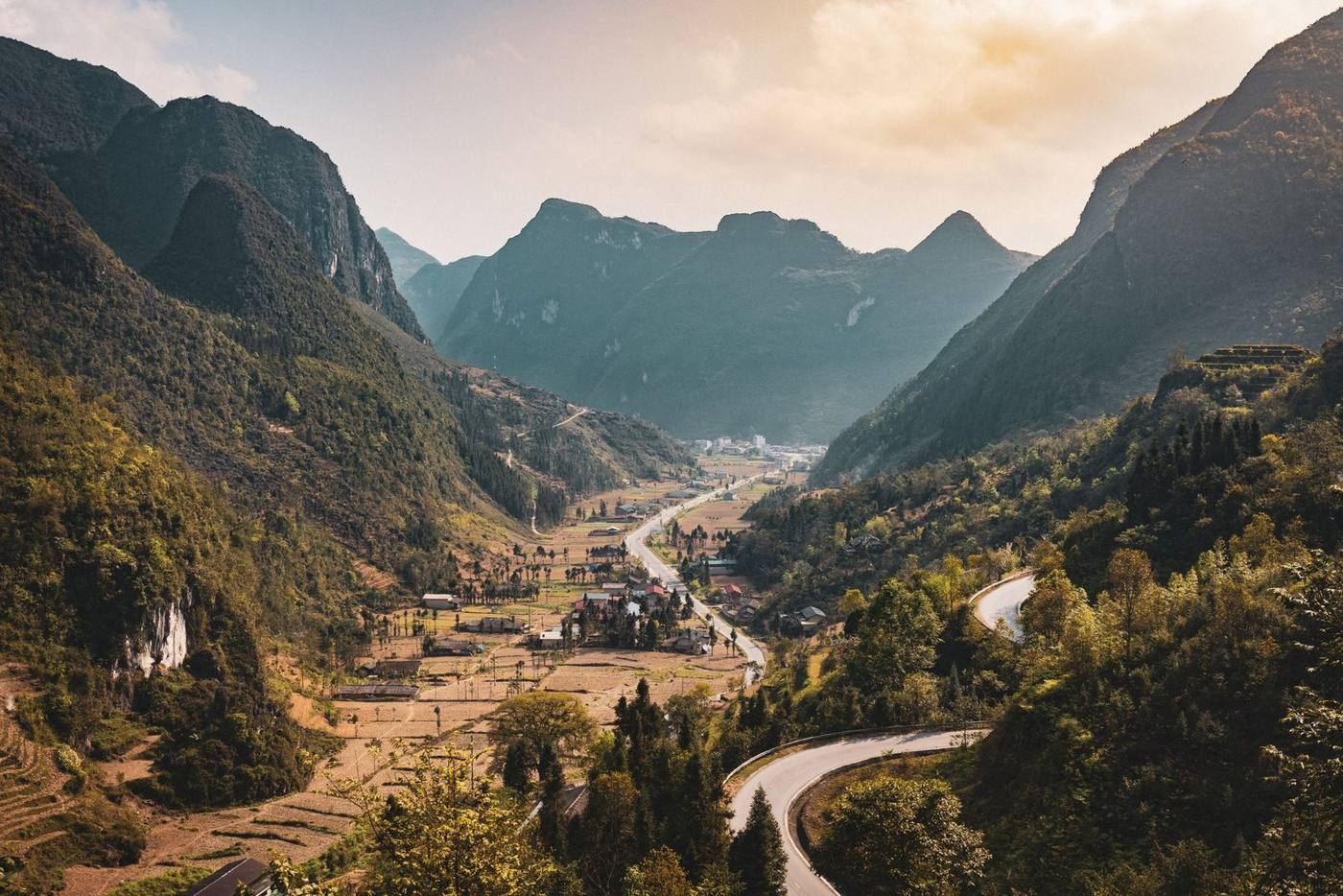
Hill tribes of Vietnam and Laos
Northern Vietnam from Ha Giang to Dien Bien Phu, then across the border to Phongsaly for three days of trekking and the calm of Luang Prabang.
 17 daysChallenging
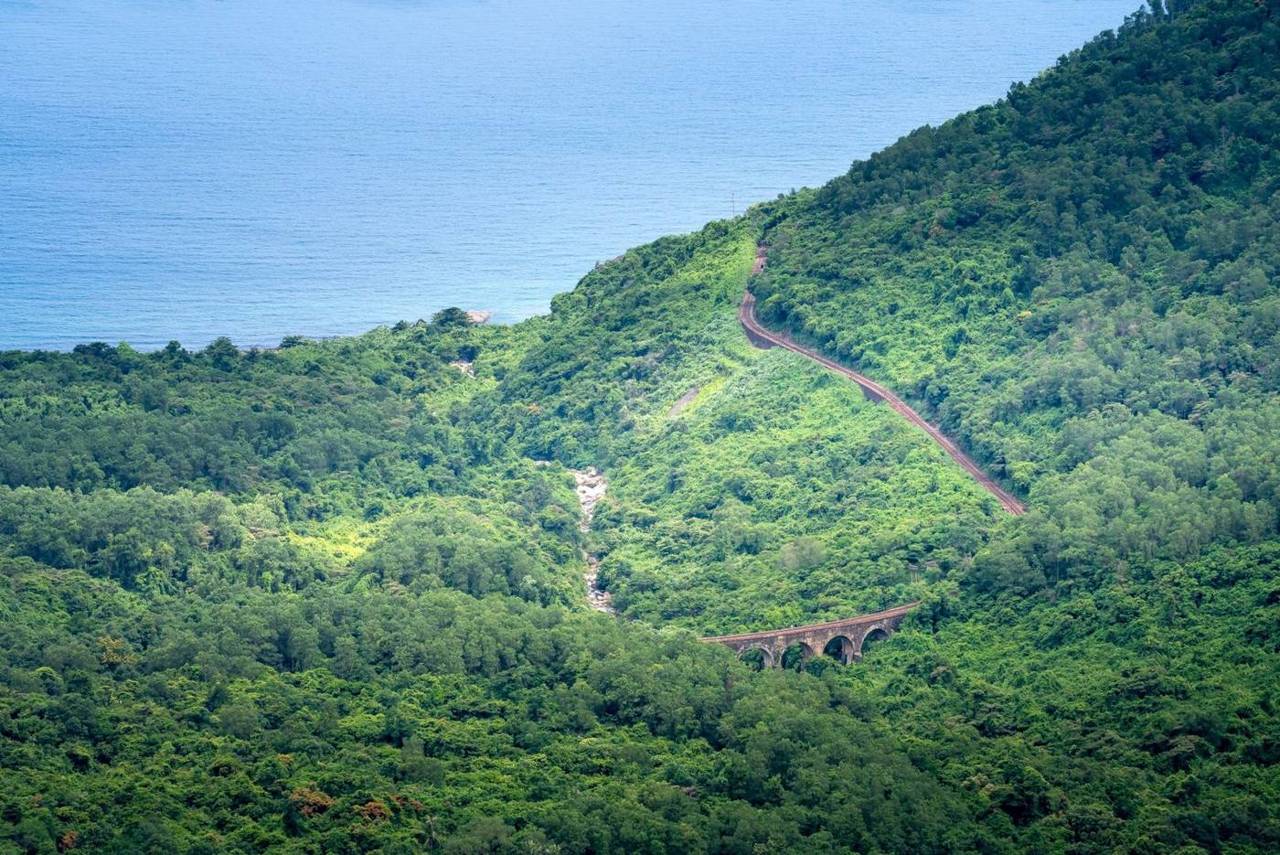
By motorbike on the Ho Chi Minh Trail
Hanoi to Saigon in the saddle, through the interior: Phong Nha, Khe Sanh, the Kon Tum highlands, Dalat and the Cat Tien forest.
 23 daysModerate
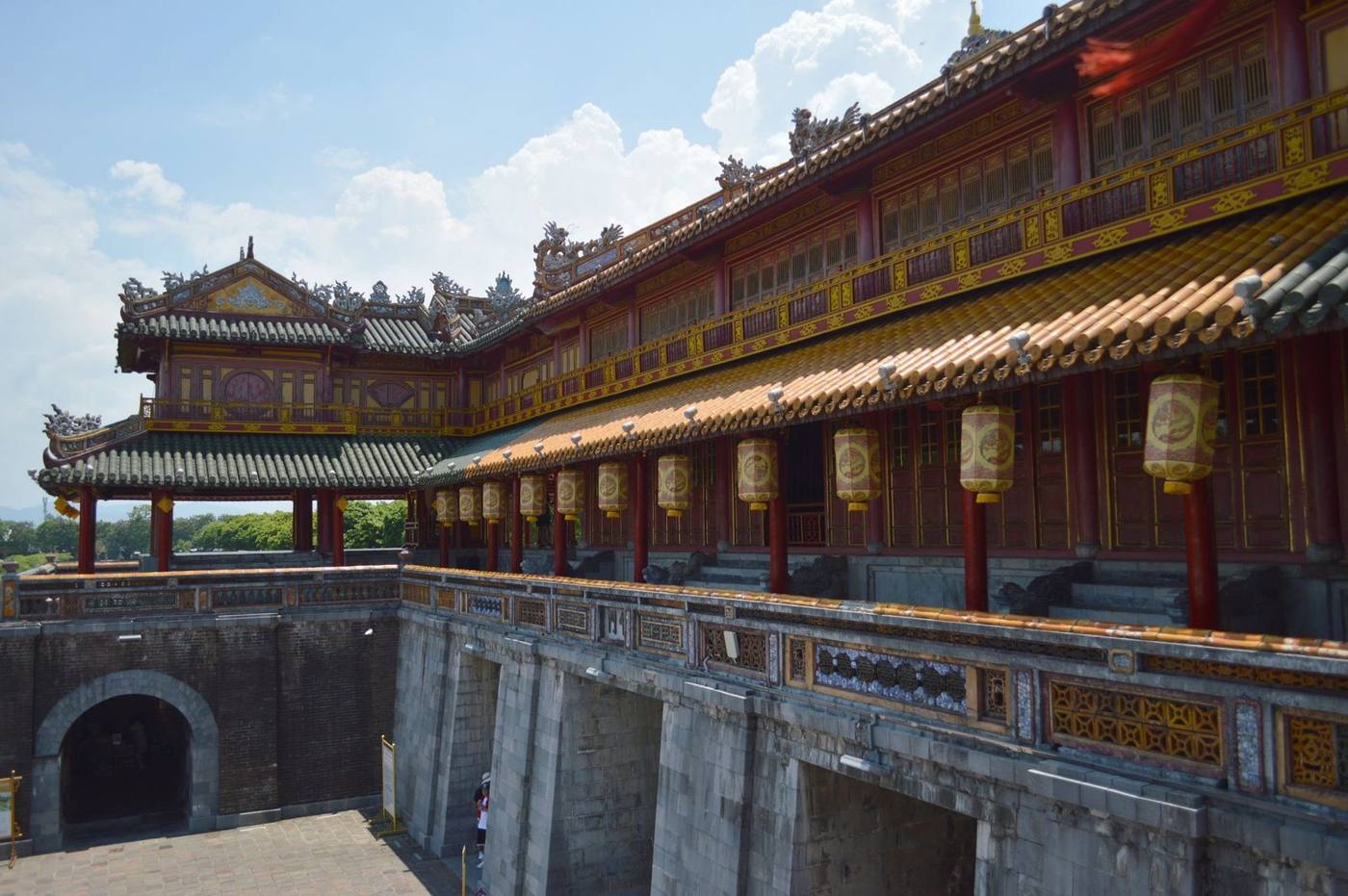
Indochina: Cambodia, Vietnam and Laos
Three countries in just over three weeks: Angkor's temples as far as Koh Ker, Vietnam from Saigon to Ha Long, Laos from Vientiane to Luang Prabang.