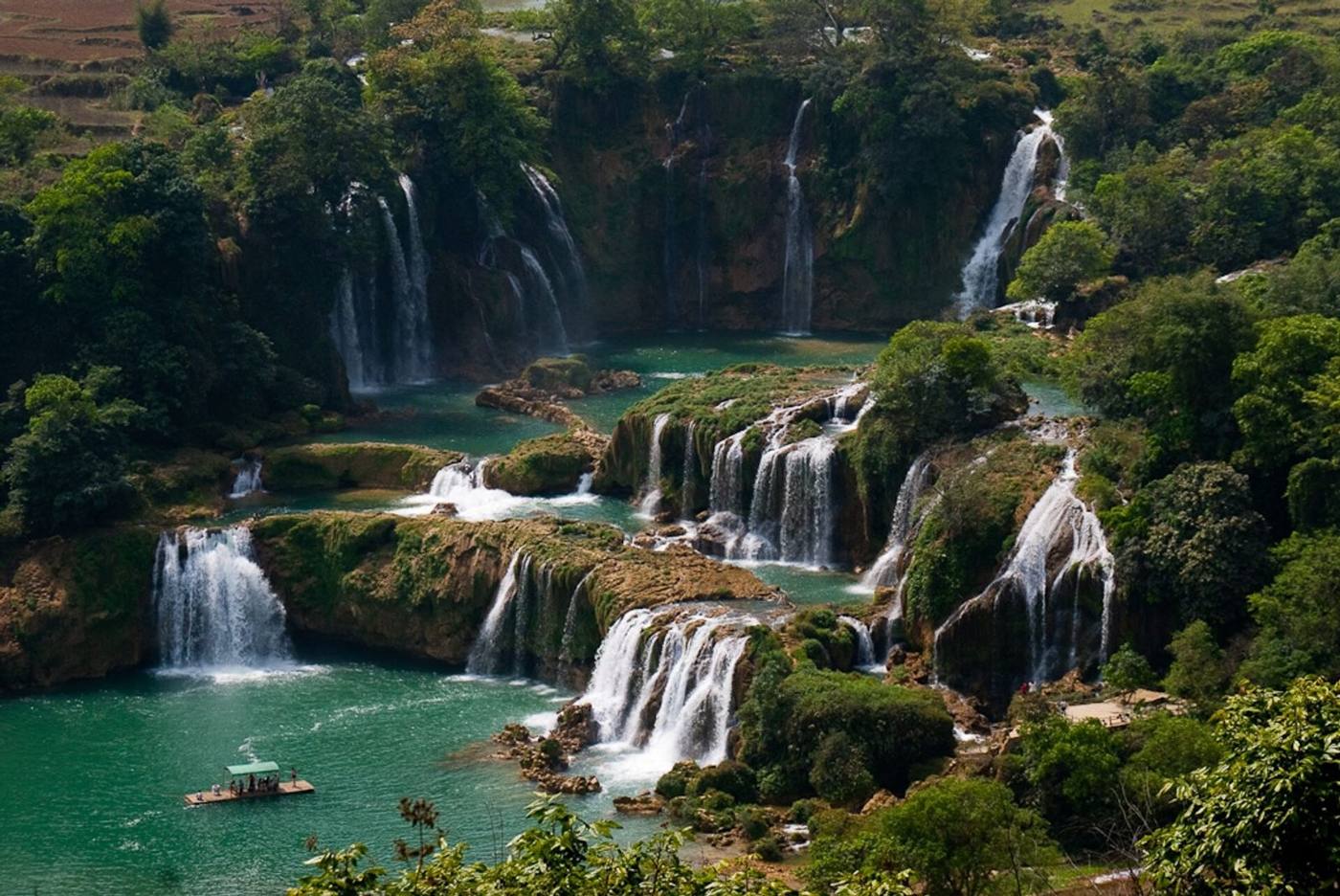
Ba Be and the Ban Gioc Falls
The green, little-visited northeast: Ba Be Lake among karst mountains, with Tay stilt houses and Puong Cave crossed by the river, then Cao Bang, Nguom Ngao Cave and the Ban Gioc Falls, among the widest in Asia.
- Hanoi
- Ba Be
- Cao Bang
- Nguom Ngao
- Ban Gioc
Day by day
- Day 1
From Hanoi to Ba Be and a night in a Tay house
North-eastern Vietnam, between the provinces of Bac Kan and Cao Bang, is a region of forest-covered limestone mountains, lakes, green rivers, caves and rice fields, home mainly to the Tay, Nung and Dao peoples. It is far less visited than the north-west around Sapa and Ha Giang, and keeps a quiet rural atmosphere. In five days you see Ba Be lake, the largest natural lake in Vietnam, and the Ban Gioc waterfalls, among the largest in Asia, on the border with China.
In the morning, leave Hanoi by car or minibus heading north, through the plains of the Red River delta and then hills planted with tea and rice. The drive to Ba Be National Park takes about five or six hours.
In the afternoon you reach the village of Pac Ngoi, on the lakeshore, home to the Tay people. Their houses are built on wooden stilts, with tiled or palm-leaf roofs, and animals and tools are kept beneath the house. Many families welcome travellers into their homes, with mattresses on the wooden floor of the large common room.
Before dinner, take a walk through the village and along the rice fields, where people work with water buffalo.
In the evening, the family prepares dinner with produce from the garden and the lake: grilled lake fish, mountain black pork, bamboo shoots and sticky rice. There is often a toast with home-made rice spirit.
Practical tip: in Tay houses you take off your shoes before climbing the stairs. Bring a towel, slippers and a torch: facilities are simple.
- Day 2
A boat on the lake and Puong cave
Ba Be lake is made up of three connected lakes, about eight kilometres long in all, among limestone mountains covered in tropical forest. It is part of a national park with many species of birds, butterflies, monkeys and orchids.
In the morning, board a motorboat or a canoe with a village boatman and cross the lake. The water is calm and green, and the mountains are reflected on its surface. You pass an islet with a small temple, the Widow's temple, linked to a legend about the lake's origin.
The boat continues along the Nang river to Puong cave, a large cave crossed by the river, about three hundred metres long and tens of metres high, with stalactites hanging from the ceiling. The boat passes under the vault of the cave, where thousands of bats live.
Further on, the boat reaches the Dau Dang waterfall, a series of rapids and small falls where the river drops between rocks, surrounded by forest.
In the afternoon, return to the village. You can walk through the forest to the fairy pond, a small lake hidden among the mountains, or cycle along the village roads, among rice fields, gardens and stilt houses.
In the evening, sleep in the Tay house again and listen to traditional songs, if the family offers them.
Practical tip: always wear a life jacket on the boats. In the rainy season the river is higher and some areas may be closed.
- Day 3
Transfer to Cao Bang and towards the waterfalls
In the morning, leave Ba Be and head north-east through the mountains to Cao Bang, a small provincial capital, in about three hours. The road crosses green valleys, mountain passes and villages of the Nung and Dao.
On the way, if you have time, make a detour to Pac Bo cave, near the Chinese border, where Ho Chi Minh lived in 1941, on his return to Vietnam after thirty years abroad, and from where he led the struggle for independence. The place is surrounded by beautiful scenery, with a stream of clear water that Ho Chi Minh named the Lenin stream and a mountain he named Karl Marx. It is a very important place for Vietnamese people and draws many visitors.
In the afternoon, continue from Cao Bang eastwards for about two and a half hours, on a scenic road through valleys of rice fields and cone-shaped limestone mountains, sometimes called Ha Long Bay on land.
You reach the Trung Khanh area, near the Ban Gioc waterfalls, where you sleep in a local house or a simple guesthouse.
In the evening, try the cooking of the Nung and Tay of Cao Bang: roast duck with mac mat leaves, rice cakes and sticky rice cooked in bamboo.
Practical tip: roads in this region are long and slow, with many bends. In the rainy season there may be landslides: always allow some spare time.
- Day 4
The Ban Gioc waterfalls and Nguom Ngao cave
Early in the morning, go to the Ban Gioc waterfalls, on the Quay Son river, which marks the border between Vietnam and China. They are among the largest waterfalls in Asia: the river, about three hundred metres wide, drops in several leaps over a limestone wall, surrounded by rice fields and green mountains. On the Chinese side the falls are called Detian.
A path along the river leads to several viewpoints, with views of the different tiers of water. On a bamboo raft you can get close to the base of the main fall, in the mist of the spray. The raft stays on the Vietnamese side of the river: on the other bank you see China, with another raft full of Chinese tourists.
The falls are most impressive from August to October, when the river is full after the rains. In these months the surrounding rice fields turn yellow for the harvest.
In the afternoon, visit Nguom Ngao cave, a few kilometres away, a large limestone cave with a lit path of about a kilometre among stalactites and stalagmites of extraordinary shapes, some like curtains, flowers or animals.
If you still have time, visit the Phat Tich Truc Lam Ban Gioc pagoda, on the hill near the falls, with views over the whole valley.
In the evening, return to Cao Bang or sleep near the falls again.
Practical tip: the falls are right on the border. Always stay on the Vietnamese side, follow the signs and carry your passport.
- Day 5
Back to Hanoi
On your last morning, if you slept near the falls, go back to see them at dawn, when mist rises from the water and there are no visitors yet.
Then set off on the long journey back to Hanoi, through Cao Bang and the mountains, in about seven or eight hours. Along the way, stop at viewpoints over the valleys and, if it is the right day, at village markets, where minority women sell vegetables, fabrics and animals.
In some places around Cao Bang you can also see villages where incense sticks or traditional paper are made by hand, and blacksmiths forging knives and farm tools, a craft passed down for generations.
Once in Hanoi in the evening, have dinner in the old quarter, with pho or bun cha, grilled pork patties with rice noodles and herbs.
This trip combines well with other parts of northern Vietnam: Hanoi and Ha Long Bay, the Ha Giang loop further west with its spectacular passes, or Sapa and its rice terraces.
Practical tip: Italian citizens can enter Vietnam without a visa for up to 45 days, under an exemption valid until 14 March 2028, with a passport valid for at least six months. For longer stays you need the 90-day e-visa.
For those seeking a rural, uncrowded Vietnam. The falls are on the Chinese border: stay on the Vietnamese side and always carry your documents. Roads are long and slow; in the rainy season there may be landslides. The falls are fullest from August to October. Italians enter without a visa for up to 45 days (exemption valid until 14 March 2028), with a passport valid for at least six months; longer stays need the 90-day e-visa.
Before you go
- Documents and visa
- Passport with at least six months' validity remaining. Italian, French and several other European citizens need no visa for tourism up to 45 days, an exemption valid until 14 March 2028; otherwise use the e-visa from the official portal.
- Health and vaccines
- No compulsory vaccines. Protect yourself against mosquitoes because of dengue; drink only bottled water. Emergencies: 113 police, 114 fire, 115 ambulance.
- Money and payments
- Vietnamese dong. Cards and QR code payments are widespread in cities; in markets, villages and for small purchases you need cash.
- Power sockets
- Types A and C, among others, 220 volts: a universal adapter is useful.
- Time zone
- UTC+7 all year: Vietnam does not use daylight saving time.
- Safety
- A safe country for travellers. In big cities beware of snatch thefts from scooters; from July to December typhoons and floods hit the centre and north. Official advice: GOV.UK.
Information checked in November 2026 for Italian and EU citizens. Rules change: always check before you travel.
Variations
In 3 days: Ba Be only, with two nights in a Tay house and the boat on the lake.
In 9 days: after Ban Gioc, continue to the Ha Giang loop, with Dong Van and the Ma Pi Leng pass.
Frequently asked questions
When is the best time to go?
From September to November, with the falls still full and clearer skies. In spring the landscapes are green. In summer there is heavy rain and possible landslides.
How do I get around?
By car with a driver or by minibus from Hanoi. Public transport exists but is slow, with few connections between Ba Be and Ban Gioc.
What documents do I need?
A passport valid for at least six months. Italian citizens can enter without a visa for up to 45 days, under an exemption valid until 14 March 2028. Near the border always carry your passport.
Indicative itinerary written by World Atlas. Before booking, check timetables, seasonal openings, documents and safety.
 4 daysEasy
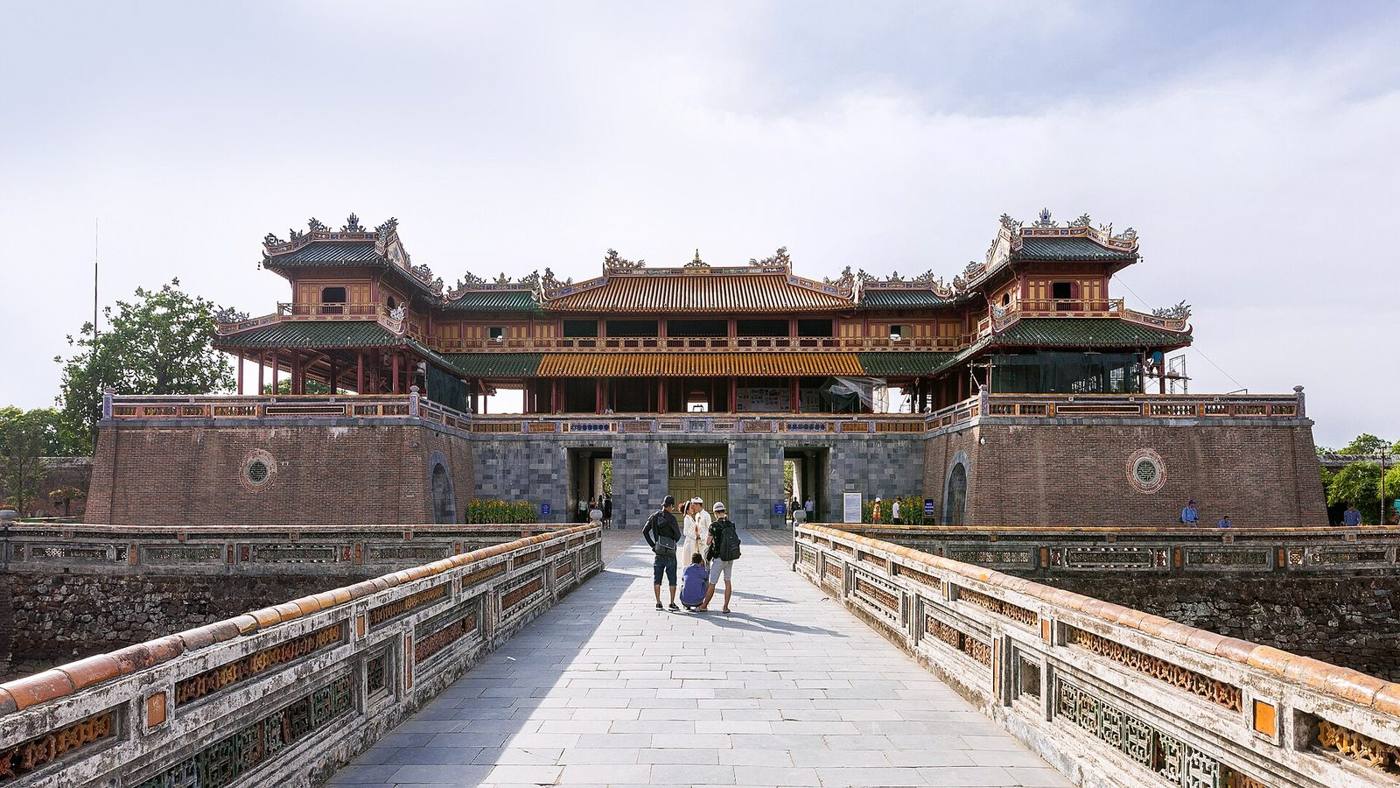
Hue, the Imperial City and the DMZ
The former Nguyen capital, a UNESCO World Heritage site: the Imperial City inside the citadel, the emperors' tombs along the Perfume River, Thien Mu Pagoda, and the wartime demilitarised zone with the Vinh Moc tunnels.
 4 daysEasy
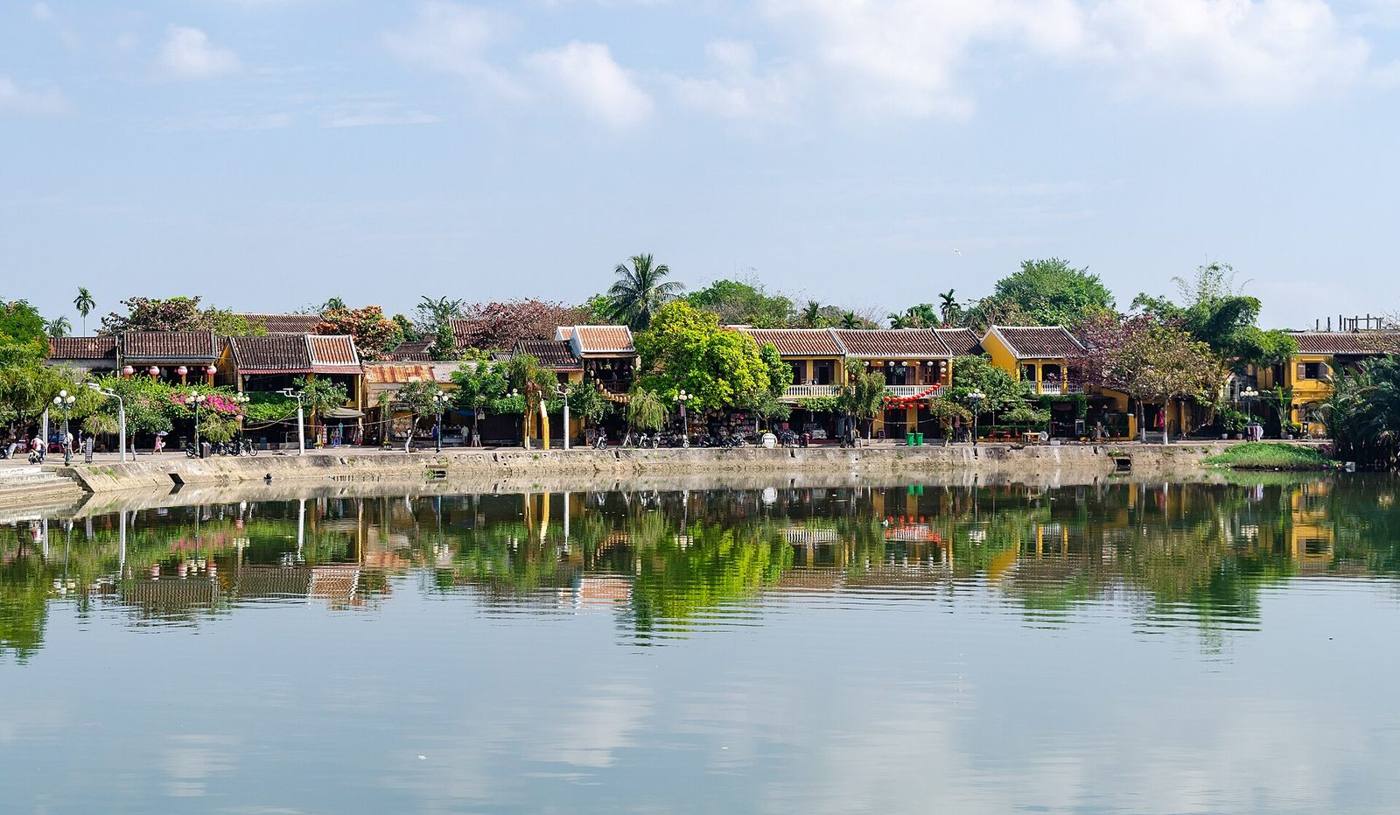
Hoi An in depth and My Son
The merchant port of Hoi An, a UNESCO World Heritage site, with Chinese and Japanese merchants' houses, the covered bridge and lanterns at night, countryside villages by bike, An Bang beach and the Cham ruins of My Son in the jungle.
 5 daysEasy
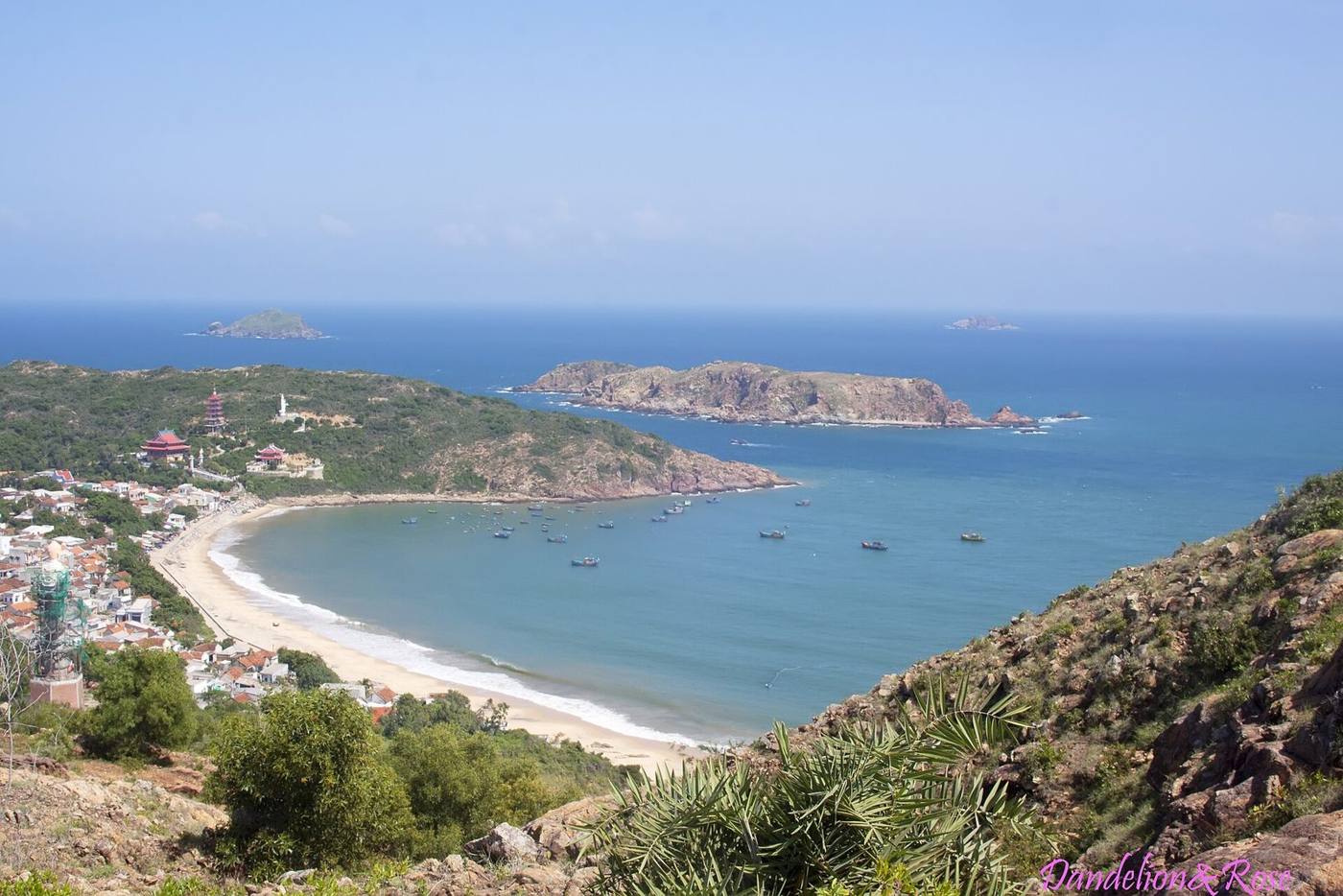
Quy Nhon and the central coast
Vietnam's less crowded seaside: the beaches and bays of Quy Nhon, the Cham towers of Banh It and Doi, the fishing village of Eo Gio, Ky Co with its turquoise water and, further south, the volcanic rocks of Ganh Da Dia at Tuy Hoa.