Grand tour of Turkey
Istanbul, Cappadocia, Konya, the Lycian coast, Pamukkale and Ephesus: the very best in two weeks.
- Istanbul
- Cappadocia
- Konya
- Antalya
- Kaş
- Fethiye
- Pamukkale
- Ephesus
- Izmir
Day by day
- Day 1
Arrival in Istanbul
This trip is the grand tour of Turkey in two weeks: Istanbul, between Europe and Asia, Cappadocia with its balloons and underground cities, Konya and the Taurus road, Antalya and the theatre of Aspendos, the Lycian coast with Kaş, Kekova, Fethiye and Ölüdeniz, the white terraces of Pamukkale and Ephesus. You travel with a domestic flight and by rental car.
Before you go: Italian citizens can enter Turkey with an electronic identity card or a passport. Other nationalities should check their own rules. The US government rates Turkey at level 2, with level 4 only within ten kilometres of the borders with Syria and Iraq, an area this trip does not touch.
You land at Istanbul airport, one of the largest in the world, about an hour from the centre. Istanbul, ancient Byzantium and Constantinople, capital of the Eastern Roman Empire and then of the Ottoman Empire, is the only great city built on two continents, divided by the Bosphorus strait.
In the afternoon, settle into Sultanahmet, the old city, a UNESCO World Heritage Site, or Karaköy, near the Galata Bridge.
At sunset, walk across the Galata Bridge, over the Golden Horn, with fishermen leaning their rods on the railing, ferries coming and going and views of the minarets of the mosques.
In the evening, have meze, the small Turkish dishes to share, such as hummus, smoked aubergine, stuffed vine leaves and yoghurt with garlic, and fish from the Bosphorus.
Overnight in Istanbul, for three nights.
Practical tip: buy an Istanbulkart for trams, the metro and ferries: it is easy to top up and much more convenient than single tickets.
- Day 2
Hagia Sophia, the Blue Mosque and the Grand Bazaar
Today you visit the most famous monuments of the old city.
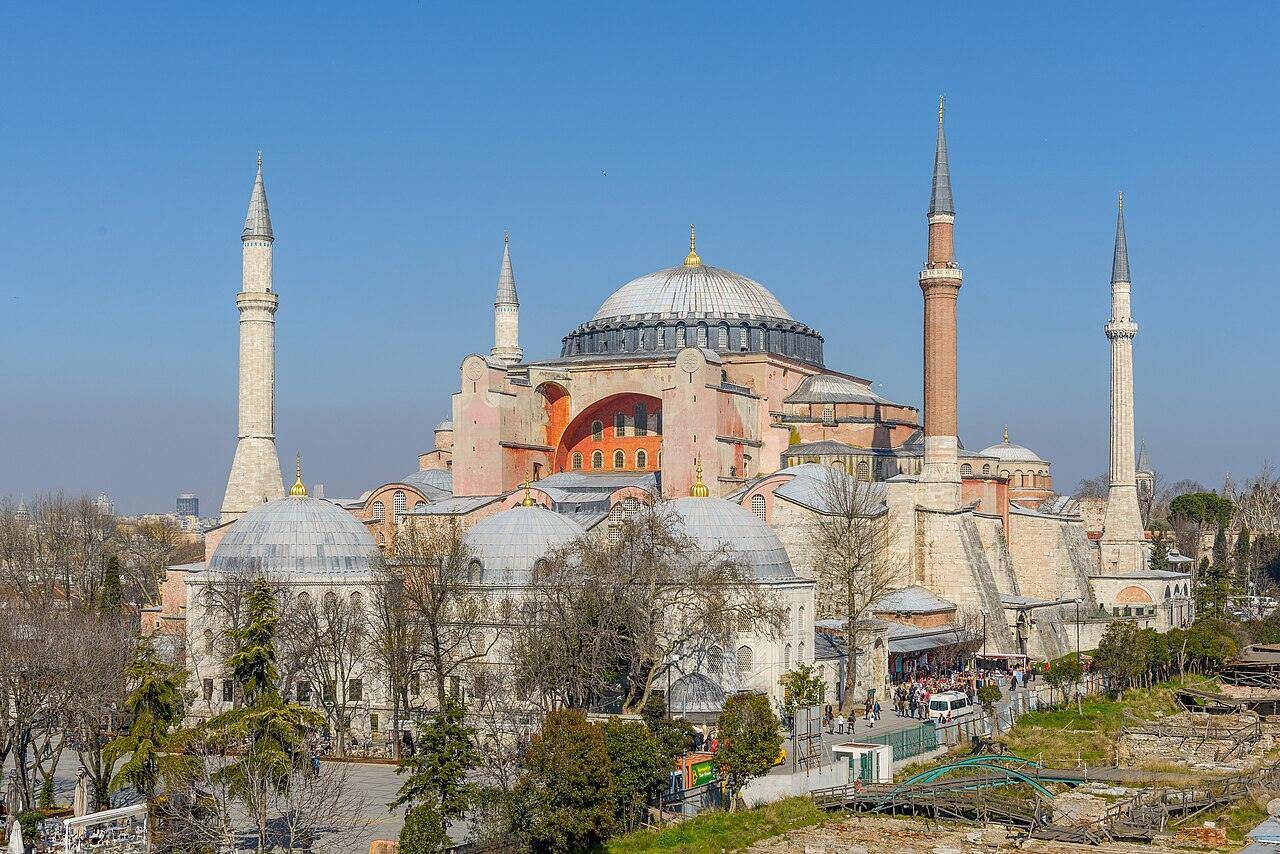
Early in the morning, enter Hagia Sophia, built in the sixth century by the emperor Justinian as a cathedral, with one of the largest domes of the ancient world. For almost a thousand years it was the most important church of Eastern Christianity, then a mosque from 1453, a museum from 1934 and a mosque again since 2020. Foreign visitors enter the upper gallery, with its golden Byzantine mosaics, with a ticket of 25 euros, while the ground floor is reserved for prayer. Check times and rules.
Then visit the Blue Mosque, the mosque of Sultan Ahmet, from the seventeenth century, with six minarets and an interior covered in thousands of blue Iznik tiles. Go in barefoot, with shoulders and legs covered, and women with a scarf over their hair. It closes during prayers.
At midday, visit the Basilica Cistern, a large sixth-century Roman underground cistern with hundreds of columns in the water and two Medusa heads at the base of two columns. Check prices and times.
In the afternoon, visit Topkapı Palace, the residence of the Ottoman sultans for almost four centuries, with its courtyards, harem, treasury and terraces over the Bosphorus. Check prices and times; it is closed on Tuesdays.
In the evening, go into the Grand Bazaar, one of the largest and oldest covered markets in the world, with thousands of shops selling carpets, lamps, jewellery, ceramics and spices.
Overnight in Istanbul.
Practical tip: for Hagia Sophia and Topkapı arrive at opening time: the queues grow very quickly.
- Day 3
The Bosphorus and Balat
Today you discover Istanbul from the water and its districts.
In the morning, visit the Spice Bazaar, near the port of Eminönü, with colourful mountains of spices, tea, lokum, Turkish delight, dried fruit and coffee. Then visit the Rüstem Pasha Mosque, small and little known, with walls covered in some of the city's finest Iznik tiles.
At midday, take a cruise on the Bosphorus, the strait about 30 kilometres long that joins the Black Sea to the Sea of Marmara and separates Europe from Asia. From the boat you see the Ottoman palaces on the shore, such as Dolmabahçe, the wooden villas called yalı, the fortress of Rumeli Hisarı and the great suspension bridges. You can take the public ferry, very cheap, or a tourist cruise. Check prices and times.
In the afternoon, go to the Fener and Balat districts, on the Golden Horn, with colourful wooden and stone houses, steep streets, cafés, Greek and Armenian churches and synagogues, signs of the multicultural city of the past. Visit the Church of the Holy Saviour in Chora, with some of the finest Byzantine mosaics and frescoes in the world, now a mosque. Check times and rules.
At sunset, take the ferry from Eminönü to Kadıköy, on the Asian shore, and walk through the market and the lanes full of restaurants.
In the evening, have dinner in Kadıköy with fish and meze.
Overnight in Istanbul.
Practical tip: the ferry between Europe and Asia costs very little with the Istanbulkart and offers one of the finest views of the city, especially at sunset.
- Day 4
Flight to Cappadocia
Today you fly to the heart of Anatolia.
In the morning, take the flight from Istanbul to Kayseri or Nevşehir, about an hour and a half, and pick up your rental car. Drive to Göreme, about an hour, the main village of Cappadocia.
Cappadocia, a UNESCO World Heritage Site, is a volcanic plateau where eruptions millions of years ago covered the land in ash, later turned into a soft rock called tuff. Wind and water have carved it into valleys, towers and cones, called fairy chimneys. For centuries people dug houses, churches, dovecotes and whole underground cities into the rock.
In the afternoon, visit the Göreme Open Air Museum, a group of monasteries and rock churches carved between the tenth and twelfth centuries, with Byzantine frescoes of the stories of Christ and the saints, still full of colour, as in the Dark Church. Check prices and times.
At sunset, climb one of the hills above Göreme, such as the sunset viewpoint, to see the sun turn the valleys and fairy chimneys pink and gold.
In the evening, have testi kebabı, meat slowly cooked in a clay pot that is broken at the table, a typical dish of Cappadocia.
Overnight in Göreme, for three nights, if you wish in a cave hotel carved into the rock.
Practical tip: book your balloon flight in advance, for one of your first days in Cappadocia: in strong wind flights are cancelled, and having a spare day helps.
- Day 5
The balloon and the valleys
Today you see Cappadocia from above and walk through it.
Before dawn, if the weather allows, take the hot-air balloon flight, one of the most famous experiences in Turkey. Every morning dozens of colourful balloons rise together over the valleys as the sun comes up over the fairy chimneys. The flight usually lasts about an hour. Choose a licensed operator with experienced pilots, and check prices, safety and conditions. If you do not want to fly, watch the spectacle from a hill or terrace: it is beautiful from the ground too.
Then rest and have breakfast.
For the rest of the morning, walk through the Rose Valley and the Red Valley, between Göreme and Çavuşin, on trails among pink and red rocks, rock churches, vineyards and orchards. The route takes about three hours.
In the afternoon, visit Uçhisar, with its great tuff citadel riddled with holes like a beehive, the highest point in Cappadocia, with views over all the valleys. Then go to Paşabağı, known as Monks Valley, with the most famous fairy chimneys, topped with two or three caps of dark rock, and to Devrent valley, with rocks shaped like animals. Check prices and times.
In the evening, if you wish, watch a whirling dervish ceremony, the Sufi religious dance, in one of the area's caravanserais. Check prices and times.
Overnight in Göreme.
Practical tip: there are few signs on the valley trails. Download a map to your phone, bring water and walking shoes, and do not walk alone in the most isolated valleys.
- Day 6
The underground cities
Today you go underground and visit the valleys of the south.
In the morning, go to the underground city of Kaymaklı or Derinkuyu, about half an hour from Göreme. They are real cities dug underground on several levels, more than fifty metres deep at Derinkuyu, with rooms, stables, kitchens, cellars, churches, wells and air shafts, linked by very narrow tunnels. They could shelter thousands of people with their animals, who hid here during invasions. The doors were great round stones, like millstones, rolled to close the passages. Check prices and times.
Then continue south to the Ihlara Valley, about an hour away, a gorge about a hundred metres deep carved by the Melendiz River, its walls full of painted rock churches, caves and poplars along the river. Go down the steps to the bottom of the gorge and walk along the river, past the churches, to the village of Belisırma, about three hours, where you have lunch by the water. Check prices and times.
In the afternoon, visit Selime Monastery, at the end of the valley, a great monastery carved into a rock face with its church, rooms and kitchens.
In the evening, return to Göreme.
Overnight in Göreme.
Practical tip: in the underground cities the passages are low and narrow, and in places you have to walk bent over. They are not suitable for people with claustrophobia or back problems.
Nights in Cappadocia are cold even in spring and autumn, and in winter it snows. Bring a fleece.
- Day 7
Konya and the Taurus road
Today you cross Anatolia to the Taurus mountains.
In the morning, leave Cappadocia heading west to Konya, about three and a half hours, across the plateau of central Anatolia, with wheat fields and mountains on the horizon. On the way, stop at the Sultanhanı caravanserai, one of the largest and finest in Turkey, built in the thirteenth century by the Seljuks on the Silk Road, with its great carved portal and courtyard. Check prices and times.
Konya was the capital of the Seljuk Sultanate of Rum. Here lived and died the poet and mystic Jalal al-Din Rumi, called Mevlâna, who founded the order of whirling dervishes. Visit the Mevlâna museum, in the poet's mausoleum, with its turquoise tiled dome, manuscripts, musical instruments and tomb, one of the most visited places in Turkey. Check times; cover your shoulders and legs.
In the afternoon, continue south through the Taurus mountains, with the road climbing through pine and cedar forests and mountain passes, then descending towards the Mediterranean, about four hours to Antalya. Alternatively, stay overnight on the way, near Lake Beyşehir, with the wooden Eşrefoğlu Mosque, a UNESCO World Heritage Site.
In the evening, you arrive in Antalya, on the coast.
Overnight in Antalya, for two nights.
Practical tip: today is a long day on the road. Stop often, drink plenty of water and try etli ekmek on the way, the long, thin flatbread with meat, a speciality of Konya.
- Day 8
Antalya and the old town
Today you discover the capital of the Turkish Riviera.
In the morning, walk through Kaleiçi, Antalya's old town, enclosed by its walls, with narrow streets, wooden Ottoman houses with balconies, mosques, gardens and craft shops. Enter through Hadrian's Gate, a Roman triumphal arch built for the emperor's visit in the second century, with three marble arches. Then see the fluted Yivli minaret, the symbol of the city, from the thirteenth century.
Go down to the old Roman harbour, at the foot of the walls, with its wooden boats and views of the Taurus mountains plunging into the sea. If you wish, take a boat trip along the coast to the Düden waterfalls, which fall from the cliff straight into the sea. Check prices and times.
In the afternoon, visit the Antalya Archaeological Museum, one of the most important in Turkey, with Roman statues from Perge, sarcophagi and mosaics. Check prices and times.
At sunset, go to Konyaaltı beach, a long pebble beach west of the city, with mountains behind, or to Karaalioğlu Park, on the cliffs, with views over the gulf.
In the evening, have dinner in the old town with piyaz, the white bean salad typical of Antalya, and Mediterranean fish.
Overnight in Antalya.
Practical tip: in summer Antalya is very hot, often over 35 degrees. Visit the sites early in the morning and late in the afternoon, and rest in the hot hours.
- Day 9
Aspendos and Perge
Today you visit the ancient cities around Antalya.
In the morning, head east to Perge, about half an hour, a great Greek and Roman city of Pamphylia, with Hellenistic gates, a colonnaded street with a water channel in the centre, baths, an agora and a stadium, one of the best preserved of the ancient world. Saint Paul preached here on his first journey. Check prices and times.
Then continue to Aspendos, about half an hour, famous for its Roman theatre, built in the second century, considered the best preserved ancient theatre in the world, with its tall, intact stage building, seating for about fifteen thousand people and perfect acoustics. In summer an opera and ballet festival is held here. Nearby are the remains of a Roman aqueduct. Check prices and times.
In the afternoon, if you have time, visit Side, about half an hour away, a small seaside town built among ancient ruins, with the Temple of Apollo on the shore, the theatre and the harbour. At sunset the columns of the Temple of Apollo, in front of the sea, are one of the most photographed spots on the coast.
Alternatively, go rafting in Köprülü Canyon, in the national park in the Taurus mountains. Check prices and safety.
In the evening, return to Antalya.
Overnight in Antalya.
Practical tip: there is very little shade at the ancient sites. Bring a hat, sun cream and plenty of water, and comfortable shoes for walking on the ancient stones.
- Day 10
To Kaş
Today you follow the Lycian coast to Kaş.
In the morning, leave Antalya heading south-west along the coast, one of the most beautiful coastal roads in the Mediterranean, with mountains dropping sheer into the turquoise sea, bays and pine forests.
On the way, stop at Olympos, an ancient Lycian city hidden in a green valley near the sea, with ruins among the trees and a long pebble beach. Nearby, on Mount Chimaera, are the flames of Yanartaş, natural gas fires that come out of the rocks and have burned for thousands of years, linked to the legend of the Chimaera. They are best seen in the evening. Check prices and times.
Then pass through Demre, ancient Myra, with Lycian tombs carved into the rock face like temple facades, the Roman theatre and the church of Saint Nicholas, the bishop who inspired the figure of Santa Claus. Check prices and times.
In the late afternoon, you arrive in Kaş, a small village by the sea, with white houses, bougainvillea, a harbour full of boats and views of the Greek island of Kastellorizo, a few kilometres away.
In the evening, have dinner at the harbour in Kaş with fish and meze.
Overnight in Kaş, for two nights.
Practical tip: the coastal road between Antalya and Kaş has many bends and narrow stretches above the sea. Drive calmly, stop in the lay-bys for photos and do not drive at night if you do not know the road.
Lycia was an ancient region with its own language and a federation of cities, mentioned as early as Homer.
- Day 11
Kekova and the sunken city
Today you sail over a sunken ancient city.
In the morning, set off by boat from Kaş or the village of Üçağız to Kekova, a long, narrow island off the coast. Along the island's north shore, under the clear water, you see the remains of the ancient city of Dolchiste, which sank into the sea after earthquakes in the second century: house foundations, stairs, walls and the harbour, a few metres deep. To protect the site, swimming over the ruins is not allowed, but you can see them very well from the boat or by kayak. Check prices and rules.
Then the boat stops near the village of Kaleköy, ancient Simena, reachable only by sea, with stone houses, a Lycian sarcophagus in the water in front of the harbour and a castle on the hill, from which you see the bays and islands. Climb to the castle, about twenty minutes on foot. Check prices and times.
During the trip there are swimming stops in bays of turquoise water, and lunch on board with fish.
In the afternoon, return to Kaş and, if you wish, swim from the wooden platforms along the coast, or go diving: Kaş is one of the best places in Turkey for diving, with caves, wrecks and excellent visibility.
In the evening, walk around the village and watch the sunset over the sea from Kaş's ancient theatre, on the hill west of the harbour.
Overnight in Kaş.
Practical tip: in summer the organised boat trips are crowded. Choose a small boat or a guided sea kayak trip, quieter and closer to the water.
- Day 12
Fethiye and Ölüdeniz
Today you reach one of the most famous lagoons in the Mediterranean.
In the morning, leave Kaş heading west. Stop at Kaputaş beach, a small bay of white sand with turquoise water, enclosed between cliffs, below the road, reached by a flight of steps. Then visit the ruins of Xanthos and the sanctuary of Letoon, a UNESCO World Heritage Site, the ancient capital of Lycia and its religious sanctuary, with tombs, theatres and temples. Check prices and times.
Then continue to Saklıkent, a deep, narrow gorge cut into the mountain, where you walk in the cold water of the stream between walls about three hundred metres high. Check prices and times.
In the afternoon, you arrive at Ölüdeniz, near Fethiye, with its lagoon of calm turquoise water, protected by a spit of sand, at the foot of Mount Babadağ. It is one of the most photographed beaches in Turkey. Swim in the lagoon, which is a nature park with an entrance fee: check prices and times. Those who wish can paraglide from Mount Babadağ, over 1,900 metres high, one of the most famous flights in the world, gliding down over the lagoon with an instructor. Check prices and safety.
In the evening, have dinner in Fethiye at the fish market, where you choose fish from the stalls and have it cooked in the restaurants around it.
Overnight in Fethiye or Ölüdeniz.
Practical tip: in the Saklıkent gorge the water is very cold even in summer and the bottom is stony. Bring water shoes and clothes that can get wet.
Above Fethiye, visit the Lycian tombs of Amyntas, carved into the rock.
- Day 13
Pamukkale and Hierapolis
Today you visit the white limestone terraces.
In the morning, leave Fethiye heading north, through the mountains, to Pamukkale, about three and a half hours.
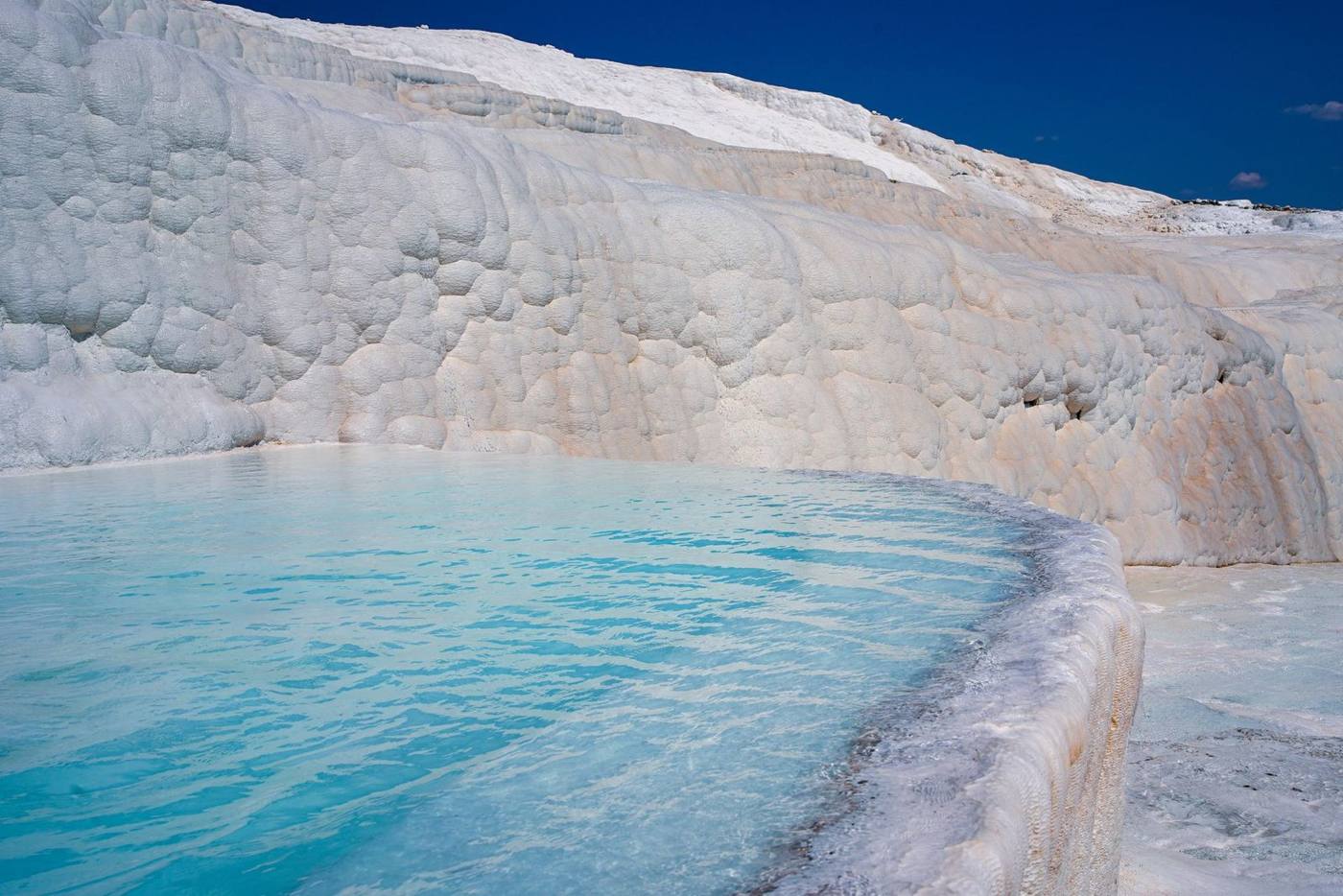
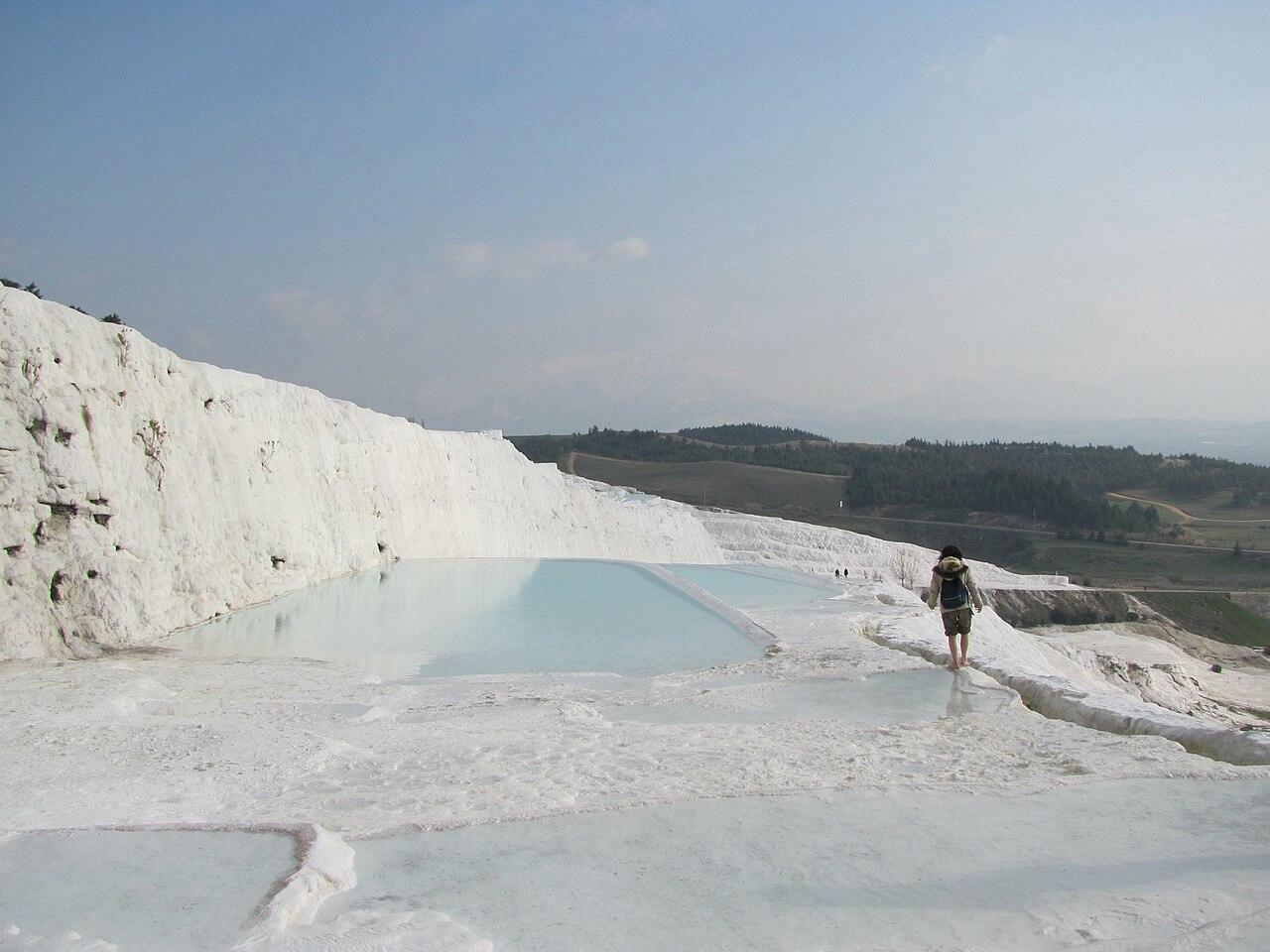
Pamukkale, which means cotton castle in Turkish, a UNESCO World Heritage Site, is a hill covered in white limestone terraces, formed over thousands of years by the hot water of the springs, rich in calcium, which flows down the hillside and leaves white deposits. In the pools of the terraces the water is warm and blue. You walk barefoot along a marked route, to protect the terraces. Check prices, times and rules.
At the top of the terraces are the ruins of Hierapolis, a Greek and Roman spa city, with a great Roman theatre, a colonnaded street, the Gate of Domitian, baths and one of the largest necropolises of the ancient world, with hundreds of tombs and sarcophagi. Also visit the ancient pool, known as Cleopatra's Pool, where you swim in warm water among ancient columns fallen to the bottom. Check prices and times.
At sunset, return to the terraces, when the light turns them pink and gold and there are fewer people.
In the evening, have dinner in Pamukkale village, at the foot of the hill.
Overnight in Pamukkale.
Practical tip: the limestone of the terraces is white and reflects the sun: bring sunglasses and sun cream. Walking on the terraces in shoes is forbidden: bring a bag to carry them.
If you have time, about an hour away visit the ruins of Aphrodisias, with its stadium and Temple of Aphrodite.
- Day 14
Ephesus and Şirince
Today you visit one of the most beautiful ancient cities in the Mediterranean.
Early in the morning, leave Pamukkale heading west to Ephesus, about three hours, near the town of Selçuk.
Ephesus, a UNESCO World Heritage Site, was one of the largest and richest cities of the Roman Empire, capital of the province of Asia, with perhaps more than two hundred thousand inhabitants. Entry costs 40 euros until 31 March 2027: check for any changes. Walk down Curetes Street, sloping between columns, statues and fountains, to the Library of Celsus, with its rebuilt two-storey facade, one of the most photographed monuments of the ancient world. Then visit the great theatre, for about twenty-five thousand people, where according to the Acts of the Apostles Saint Paul preached, and the Temple of Hadrian. Also visit the Terrace Houses, the homes of rich Romans with mosaics and frescoes, with a separate ticket. Check prices and times.
In the afternoon, in Selçuk, visit the Basilica of Saint John, built over the apostle's tomb, and see the single column that remains of the Temple of Artemis, one of the seven wonders of the ancient world. If you wish, go up to the House of the Virgin Mary, on the mountain, a place of pilgrimage. Check times.
Then go up to Şirince, a village in the hills about a quarter of an hour away, with white houses and tiled roofs, once home to Greeks, famous for its fruit wines.
In the evening, have dinner in Şirince or Selçuk.
Overnight in Selçuk or Şirince.
Practical tip: many groups from cruise ships arrive at Ephesus in mid-morning. Enter at opening time through the upper gate and walk down towards the library.
- Day 15
Departure from Izmir
Today you leave Turkey.
In the morning, leave Selçuk heading north to Izmir airport, about an hour. If your flight leaves late, visit Izmir, ancient Smyrna, Turkey's third city, with its seafront promenade, called the Kordon, the clock tower in Konak square and the Kemeraltı bazaar, one of the largest markets in the country. Check times.
Then return the car at the airport and take your flight home, often with a connection in Istanbul.
In these fifteen days you have seen the most complete Turkey: the mosques, bazaars and Bosphorus of Istanbul, the balloons, fairy chimneys and underground cities of Cappadocia, Rumi's mausoleum in Konya, the theatre of Aspendos, the Lycian coast with Kaş, the sunken city of Kekova and the Ölüdeniz lagoon, the white terraces of Pamukkale and Ephesus.
When to go: the best months are from April to June and September and October, with a pleasant climate and the sea already warm on the coast from June. In summer the coast is very hot and crowded. In winter it snows and is cold in Cappadocia, but the snow-covered valleys are beautiful.
Practical tip: before you leave, buy something to take home: lokum, the Turkish sweets, Turkish tea and coffee, spices from the bazaar, painted ceramics, fabrics or a small carpet. For carpets, always ask for a certificate and a receipt.
In Turkey tipping is customary in restaurants, usually around ten per cent, and for guides and drivers too.
All of classic Turkey in two weeks: a rich trip, but with many kilometres. Istanbul and Cappadocia deserve more days than they usually get. The balloon flight must be booked in advance and can be cancelled for wind.
Before you go
- Documents and visa
- Passport, or for some EU citizens a national identity card; no visa for tourism up to 90 days in 180 for most EU nationalities.
- Health and vaccines
- No compulsory vaccines. Drink bottled water. Emergencies: 112.
- Money and payments
- Turkish lira. Cards work almost everywhere; state site tickets are set in euros but paid in lira at the day's rate.
- Power sockets
- Types C and F, 230 volts: the same round-pin sockets as much of Europe.
- Time zone
- UTC+3 all year: Turkey does not use daylight saving time.
- Safety
- The United States rates Turkey level 2, with level 4 within 10 km of the Syrian and Iraqi borders. Tourist areas are busy and calm. Official advice: GOV.UK.
Information checked in November 2026 for Italian and EU citizens. Rules change: always check before you travel.
Variations
In 10 days: Istanbul, Cappadocia, Pamukkale and Ephesus, with the domestic flight between Istanbul and Cappadocia and the return from Izmir, without the Lycian coast.
In 19 days: add Bodrum and the Datça peninsula after Fethiye, or a four-day cruise on a gulet, the traditional wooden boat, between Fethiye and Olympos.
Frequently asked questions
What document do I need for Turkey?
Italian citizens can enter with an electronic identity card or a passport. Other nationalities should check their own rules.
How much do Hagia Sophia and Ephesus cost?
For foreign visitors the upper gallery of Hagia Sophia costs 25 euros. Entry to Ephesus costs 40 euros until 31 March 2027. The Terrace Houses at Ephesus are paid separately: check the current prices.
Is Turkey safe?
The United States rates Turkey at level 2, with level 4 only within ten kilometres of the borders with Syria and Iraq, an area this trip does not touch. In the cities watch out for pickpockets and scams in tourist places.
Indicative itinerary written by World Atlas. Before booking, check timetables, seasonal openings, documents and safety.
 7 daysEasy
Istanbul and Cappadocia
The city on the Bosphorus and the fairy chimneys seen from a balloon: essential Turkey in a week.
 10 daysModerate
The Aegean and Lycian coast: Ephesus, Pamukkale and the sea
Greek and Roman ruins, the white terraces of Pamukkale and the turquoise bays between Fethiye and Kaş.
 7 daysModerate
Walking the Lycian Way
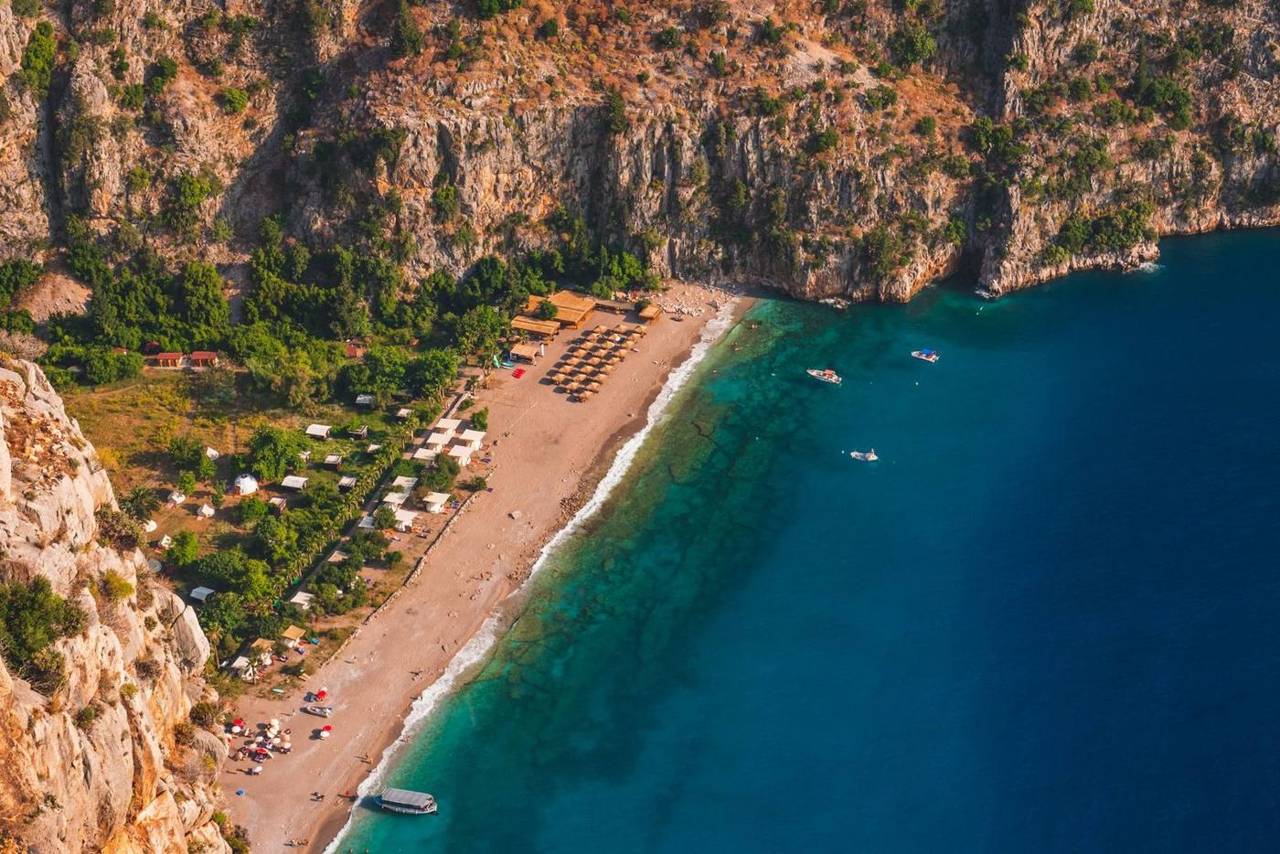
Turkey's finest trail: selected stretches between Fethiye and Kaş, with nights in villages and swims in small coves.