The Eastern Canaries: Lanzarote and Fuerteventura
Young volcanoes, vines dug into ash and César Manrique's buildings on Lanzarote, then dunes and ocean beaches on Fuerteventura.
- Tenerife
- Lanzarote
- Timanfaya
- La Geria
- Corralejo
- Betancuria
- Cofete
- Morro Jable
Day by day
- Day 1
Arrival in Tenerife and Santa Cruz
This trip combines three Canary Islands: Tenerife with the Teide volcano and the Anaga forests, Lanzarote with its lava landscapes and the works of the artist César Manrique, and Fuerteventura with the largest dunes and beaches of the archipelago. They are volcanic islands in the Atlantic, off Africa, with a mild climate all year.
Before you leave: the Canaries are Spain and part of the Schengen area. EU citizens only need a valid electronic identity card or passport; other nationalities should check their own rules. On each island it is worth renting a car.
You fly into Tenerife, with direct flights from various European cities, to the north or south airport. Pick up the car and go to Santa Cruz, the island's capital, on the north east coast.
In the afternoon walk around central Santa Cruz, with the Plaza de España and its large pool, the Nuestra Señora de África market, with tropical fruit, goat's cheese and fish, and the promenade to the Auditorio, a white sail shaped building by the sea.
In the evening have Canarian food: papas arrugadas, small potatoes boiled in salted water with wrinkled skins, served with mojo, a spicy red or green coriander sauce, grilled fish and goat's cheese.
Sleep in Santa Cruz or La Laguna.
Practical tip: the best time is October to June. In summer it is hot and a strong wind often blows on the eastern islands.
- Day 2
La Laguna and the Anaga mountains
In the morning visit San Cristóbal de La Laguna, a few kilometres from Santa Cruz, the island's old capital and a UNESCO site. It was founded at the end of the fifteenth century on a regular grid plan, without walls, which served as a model for many colonial cities in the Americas. Walk the pedestrian streets with colourful houses, wooden balconies, inner courtyards with plants and churches such as the cathedral and the church of La Concepción with its bell tower.
Then climb into the Anaga mountains, at Tenerife's north eastern tip, a range of steep ridges covered in laurisilva, the ancient humid laurel forest, one of the last left in Europe, a biosphere reserve. The road runs along the ridge, often in mist, with viewpoints over valleys and sea.
Walk the Sendero de los Sentidos near the Cruz del Carmen visitor centre, a short easy trail in the forest, with moss covered trees and ferns. If you are fit, walk down a path to an isolated village such as Chinamada, with houses cut into the rock.
In the late afternoon go down to Las Teresitas beach near Santa Cruz, a beach of golden sand brought from the Sahara, with palm trees.
Sleep in Santa Cruz or La Laguna.
Practical tip: in Anaga the weather changes quickly and it is cooler. Bring a jacket and hiking shoes.
- Day 3
Teide National Park and Puerto de la Cruz
Today you go up into Teide National Park, a UNESCO site, in the centre of Tenerife. The road climbs through Canary pine forests to a great caldera almost twenty kilometres across, at over two thousand metres, a lunar landscape of lava flows, coloured rocks and volcanic cones. Above it all rises Teide, at over three thousand seven hundred metres, the highest mountain in Spain.
Stop at the Roques de García, a group of oddly shaped rocks, with a loop trail of about an hour and a half, and at the Ruleta viewpoint, facing Teide.
The cable car goes up to about three thousand five hundred metres, close to the summit. From the top station paths lead to two viewpoints. To climb the last section to the crater you need a permit, booked online well in advance. The cable car closes in strong wind and ice: check times, prices and status.
At that altitude the air is thin: walk slowly, and do not go up if you have heart or breathing problems.
In the afternoon descend to the north coast to Puerto de la Cruz, a resort town with an old centre, a fishing harbour and seawater pools designed by César Manrique on the seafront.
Sleep in Puerto de la Cruz.
Practical tip: it is cold on Teide even when it is hot on the coast. Bring a fleece and a windproof jacket.
- Day 4
Northern Lanzarote
In the morning take a short flight, about an hour, from Tenerife to Lanzarote, the easternmost of the Canaries. Pick up a car at the airport.
Lanzarote is an island of black lava, craters and villages of white houses with green or blue doors. Its look today owes much to César Manrique, an artist born on the island in 1919, who persuaded the authorities to protect the landscape: no billboards, low white houses and a series of places he created that combine art and nature.
Go north to the Jameos del Agua, a partly collapsed volcanic cave inside a lava tube, which Manrique turned into a place with an underground lake, home to tiny blind white crabs found only here, a turquoise pool among the rocks and an auditorium inside the cave. Nearby visit the Cueva de los Verdes, another section of the same lava tube, kilometres long, with a guided visit through the galleries and a surprising optical effect at the end.
In the afternoon go up to the Mirador del Río, a viewpoint Manrique carved into the cliff at almost five hundred metres, overlooking the island of La Graciosa and the El Río strait.
Check opening hours and prices for the Manrique centres; there is a combined ticket.
Sleep on Lanzarote.
Practical tip: on Lanzarote the wind is almost constant. Keep a sweater in the car even in summer.
- Day 5
Timanfaya and La Geria
Today you visit Timanfaya National Park, in the south west of Lanzarote, born from the eruptions that between 1730 and 1736 covered a quarter of the island and dozens of villages in lava. It is a landscape of red, black and ochre craters, solidified lava flows and volcanic sands, almost without vegetation.
The park can only be visited by the bus that leaves the Islote de Hilario centre and drives the volcano route, with recorded commentary. To protect the ground you cannot walk freely in the park, except on some guided trails booked in advance. At the centre, staff show the heat of the earth: a few metres down it is hundreds of degrees, water poured into a hole shoots out as a geyser and a dry branch bursts into flames. The restaurant grills meat over a volcanic pit. Check times and prices.
Near the entrance you can take a short camel ride on the volcano slopes.
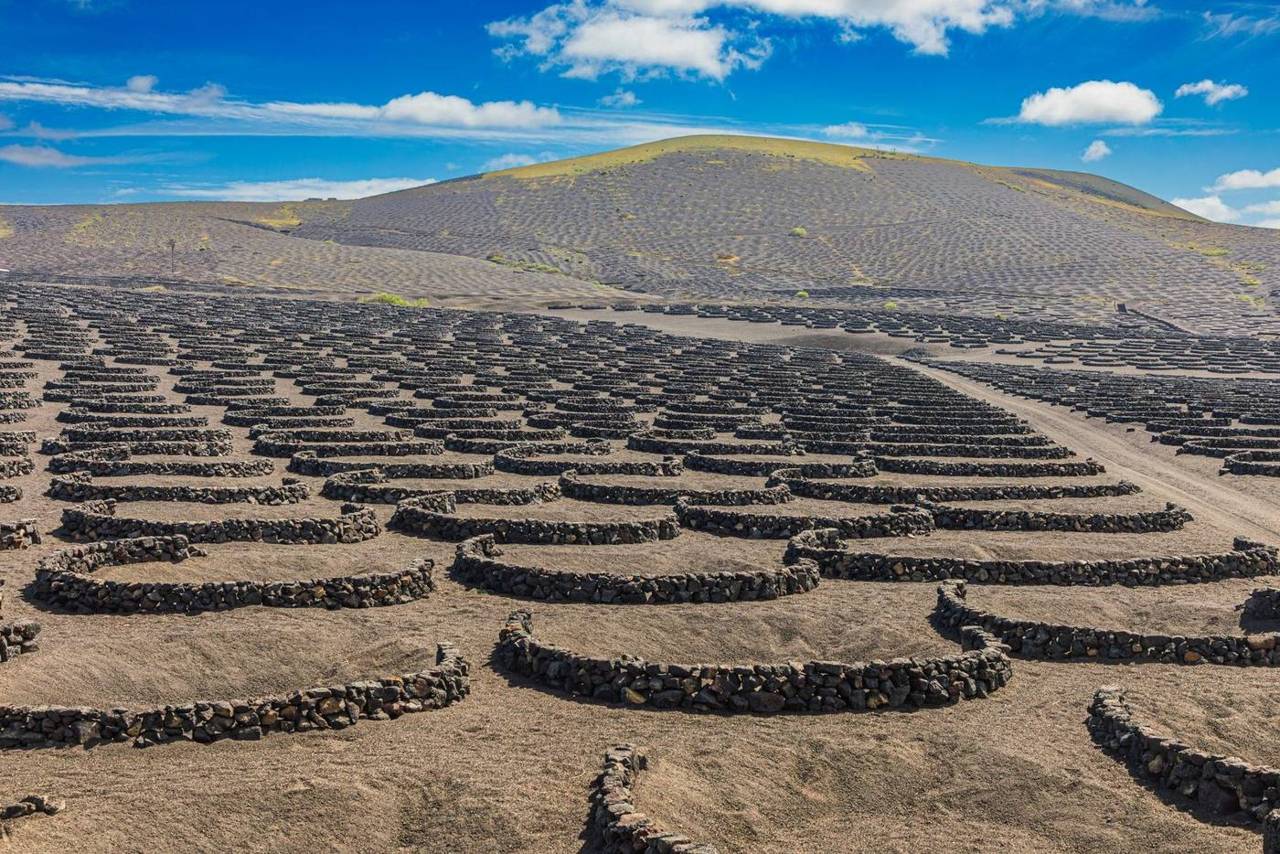
In the afternoon cross La Geria, the vineyard area, one of the most original farming landscapes in the world: each vine grows at the bottom of a hollow dug in black volcanic ash, sheltered from the wind by a crescent shaped stone wall. The ash holds the night's moisture. Stop at a winery to taste malvasía, the island's white wine.
Sleep on Lanzarote.
Practical tip: arrive at Timanfaya at opening time. By mid morning the queue for the bus gets long.
- Day 6
The Cactus Garden and the ferry to Fuerteventura
In the morning visit the Jardín de Cactus, César Manrique's last great work, at Guatiza in the north east. It is an amphitheatre in an old volcanic ash quarry, with more than four thousand cacti of hundreds of species from all over the world, arranged on terraces, with stone sculptures and an old white windmill at the top. Check opening hours and prices.
If you have time, also visit César Manrique's house at Tahíche, now a foundation, built over five volcanic bubbles linked by tunnels, with rooms carved into the lava, or the village of Teguise, the old capital, with a big Sunday market.
In the early afternoon drive south to Playa Blanca, at the southern tip of Lanzarote, and take the ferry to Corralejo on the northern tip of Fuerteventura. The crossing takes about half an hour, with a view of the islet of Lobos. Sailings are frequent; you can take the car if the rental allows it, or change cars on the other island. Check times and rental conditions.
Corralejo is a fishing village turned resort, with a small harbour, a seafront and beaches.
In the evening have dinner in Corralejo with the catch of the day.
Sleep in Corralejo.
Practical tip: many rental companies do not allow cars to be taken between islands. Ask first.
- Day 7
The Corralejo dunes and Calderón Hondo
Today you explore northern Fuerteventura. In the morning go to the Corralejo Dunes Natural Park, a few minutes from town, a desert of fine white sand reaching down to the turquoise sea, with dunes that move with the wind. The road crosses the dunes for several kilometres. Walk on the sand and swim at the big beaches in front of the park, often windy and loved by kitesurfers and windsurfers.
Then drive inland to Lajares and climb Calderón Hondo, a volcanic crater with an easy path of about an hour and a half return across lava fields. From the rim you look into the crater, about seventy metres deep, and see the islands of Lanzarote and Lobos. Ground squirrels live along the path and are very curious: do not feed them.
In the afternoon go to the north coast at Majanicho, to Bajo de la Burra beach, known as Popcorn Beach, covered in rhodoliths, white calcareous algae that look like popcorn. They are living organisms or algae remains that took thousands of years to form: taking them away is forbidden.
At sunset head to El Cotillo, a village on the west coast with lagoons and sheltered beaches.
Sleep in Corralejo or El Cotillo.
Practical tip: at Popcorn Beach do not collect the rhodoliths. Every tourist who takes a handful impoverishes the beach.
- Day 8
Betancuria and the Sotavento lagoon
In the morning drive to central Fuerteventura, to Betancuria, the island's first European settlement, founded in 1404 by the Norman conqueror Jean de Béthencourt in a hidden inland valley among the mountains, to protect it from pirates. It is a small village of white houses, palm trees and stone streets, with the church of Santa María and a small archaeological museum. The road climbing and dropping through the bare mountains offers spectacular viewpoints, such as Morro Velosa, designed by Manrique.
Along the road you see giant bronze statues of two Guanche kings, the ancient inhabitants of the Canaries before the Spanish conquest.
In the afternoon go down to the east coast, to the Sotavento lagoon on the Jandía peninsula, one of the largest beaches in the Canaries: kilometres of white sand, with a lagoon that forms at high tide between the beach and a sand bar, and water in every shade of turquoise. It is famous for windsurfing and kitesurfing, with plenty of wind.
Walk at low tide on the wet sand of the lagoon.
Sleep in Costa Calma or on the Jandía peninsula.
Practical tip: at Sotavento the wind lifts the sand. Bring sunglasses and protection for your phone and camera.
- Day 9
Cofete and the Jandía peninsula
Today you go to the far south west of Fuerteventura, on the Jandía peninsula, one of the wildest places in the Canaries.
From Morro Jable a dirt track of about twenty kilometres, with potholes, dust and hairpins, crosses the mountains to a pass from which you descend to the west coast. From the pass you see Cofete beach, a huge beach of golden sand more than twelve kilometres long, beneath a wall of high dark mountains, without buildings, pounded by ocean waves. Many rental contracts do not cover dirt roads: check first, or take the four wheel drive bus that runs the route.
On the beach is an old cemetery among the dunes and, on the hill, Villa Winter, an isolated house built in the 1940s by a German engineer, surrounded by legends.
At Cofete the sea is dangerous, with very strong currents and sudden waves: swimming is not advised. There are no facilities or lifeguards.
In the afternoon return to Morro Jable, a small town with a fishing harbour, a promenade and a sheltered white sand beach where you can swim. Near the lighthouse is a sea turtle rescue centre.
Sleep in Morro Jable.
Practical tip: bring water, food and fuel for Cofete. There is nothing along the track.
- Day 10
Back to Tenerife and flight home
On the last day drive to Fuerteventura airport, near Puerto del Rosario, about an hour and a half from Morro Jable, and take a flight to Tenerife, or, if you find a direct flight home from Fuerteventura, leave directly from here. Check times and connections: inter island flights are frequent but can change.
If you have time before the flight, stop at Puerto del Rosario, Fuerteventura's capital, with dozens of open air sculptures along the streets and seafront, or have a last swim on an east coast beach such as those at Caleta de Fuste.
In Tenerife, if you have a few hours between flights, you can visit the town of La Orotava, in the valley below Teide, with noble houses with carved wooden balconies, or the north coast and its villages.
Return the car with a full tank and check for damage with the agency. Arrive at the airport early.
Before leaving buy something to take home: jars of mojo, majorero goat's cheese from Fuerteventura, Lanzarote malvasía wine, Canarian honey rum, or crafts made with lava stone.
This trip shows three faces of the Canaries: the forests and volcano of Tenerife, the lava and art of Lanzarote, the dunes and beaches of Fuerteventura.
Practical tip: flights between the islands are quick but sometimes late. Leave a margin before your flight home.
For travellers who already know Tenerife or prefer mineral landscapes to green ones: thanks to Manrique, Lanzarote has the strongest visual identity of all the Canaries. The drawback is that the first days on Tenerife mostly serve flight logistics, and island hops eat up half-days. At Cofete the currents often make swimming dangerous, so look rather than swim.
Before you go
- Documents and visa
- EU citizens need a valid identity card or passport. Other nationalities should check the Schengen rules.
- Health and vaccines
- No vaccines required. EU citizens should bring their EHIC; in summer the south often goes above 40 °C. Emergencies: 112.
- Money and payments
- Euro. Cards are accepted almost everywhere. Catalonia, the Balearics and some other areas charge a tourist tax per person per night.
- Power sockets
- Types C and F, 230 volts.
- Time zone
- Central European Time (UTC+1, summer UTC+2); the Canary Islands are one hour behind.
- Safety
- A safe country. In Barcelona and Madrid pickpocketing is common on the metro, on the Ramblas and in crowded places. Official advice: GOV.UK.
Information checked in November 2026 for Italian and EU citizens. Rules change: always check before you travel.
Variations
In 7 days: only Lanzarote and Fuerteventura, arriving on Lanzarote and leaving from Fuerteventura.
In 13 days: add La Gomera, with Garajonay park, or a few days of hiking on Teide.
Frequently asked questions
What document do I need?
The Canaries are Spain and in the Schengen area. EU citizens only need a valid electronic identity card or passport. Other nationalities should check their own rules.
Can you climb to the top of Teide?
The cable car goes close to the summit. For the last section to the crater you need a permit, booked online well in advance. In strong wind the cable car closes.
When is the best time to go?
October to June. The climate is mild all year, but summer is hotter and on the eastern islands the wind is strong and constant.
Indicative itinerary written by World Atlas. Before booking, check timetables, seasonal openings, documents and safety.
 12 daysChallenging
The Pyrenees Hut to Hut: Gavarnie, Ordesa and Vignemale
Ten days crossing back and forth over the border, from the Cirque de Gavarnie to the Ordesa canyon and on to the Ossau, sleeping high every night.
 9 daysEasy
Castile and Extremadura: Segovia to Mérida
Roman aqueducts and theatres, walled towns and a university of golden stone, through the inland Spain that the classic circuits skip.
 7 daysEasy
Almería, Cabo de Gata and Murcia
Europe's driest corner: volcanic coves without high-rises, the badlands of Sergio Leone's westerns and two little-visited cities.