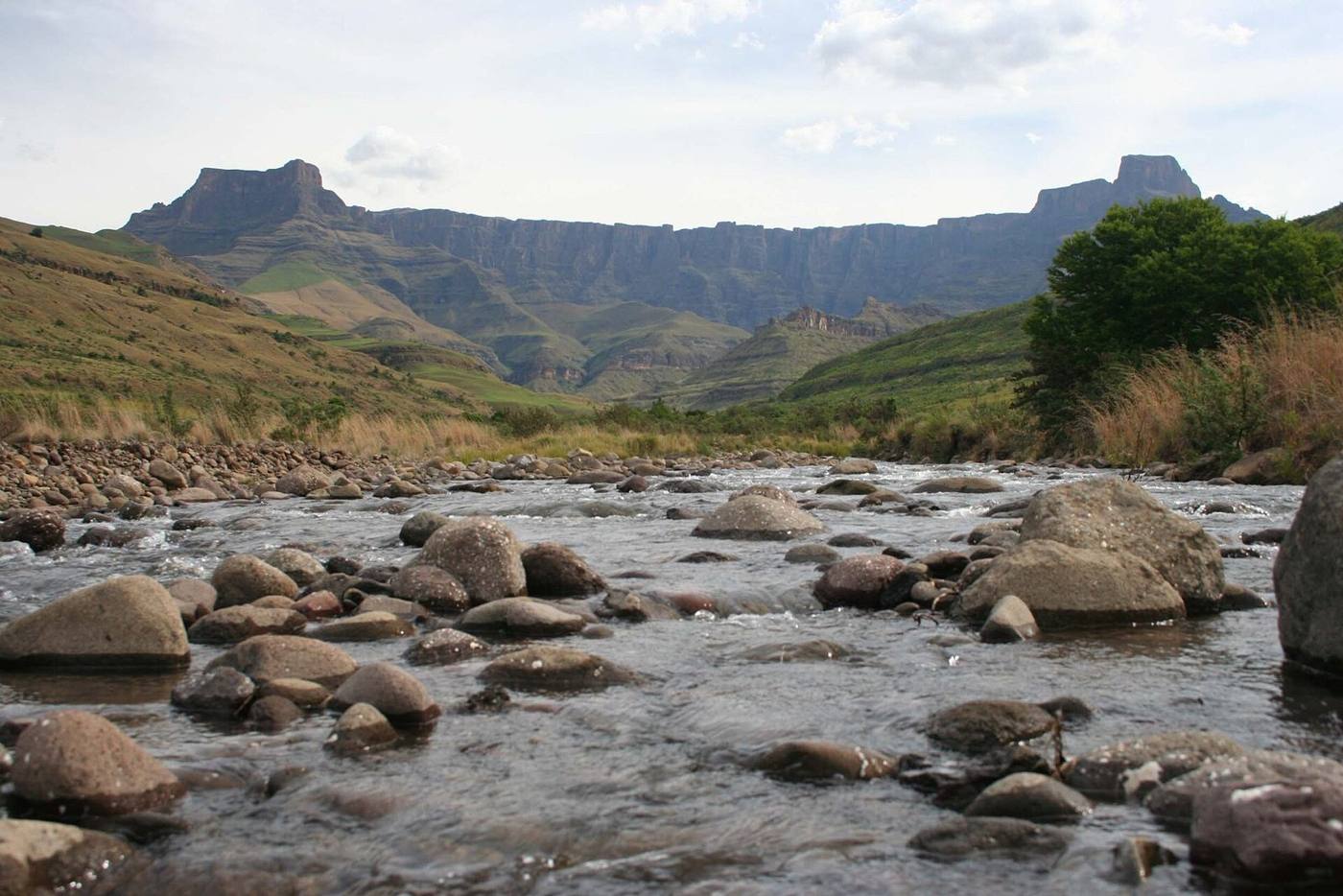
The Drakensberg in depth
The dragon mountains of KwaZulu-Natal, a UNESCO World Heritage site: the Amphitheatre with Tugela Falls among the highest in the world, the San rock paintings at Giant's Castle and Kamberg, the valleys of Cathedral Peak and the Midlands Meander with craft workshops.
- Durban
- Midlands Meander
- Giant's Castle
- Cathedral Peak
- Amphitheatre
- Tugela Falls
Day by day
- Day 1
From Durban to the Midlands
The Drakensberg, the dragon mountain, is South Africa's highest mountain range, a basalt wall about two hundred kilometres long on the border with Lesotho, with vertical cliffs rising over three thousand metres. The uKhahlamba-Drakensberg park, whose Zulu name means barrier of spears, is a UNESCO site both for its nature and for the thousands of rock paintings left in its caves by the San people. In six days you cross it from south to north, walking every day.
You arrive in Durban, on the Indian Ocean coast. If you have a few hours, walk along the seafront, the Golden Mile, and try bunny chow, a hollowed-out loaf filled with curry, born in the city's Indian community.
Then take the car and drive inland on the N3, in about an hour and a half, to the KwaZulu-Natal Midlands, a region of green hills, lakes, woods and farms at the foot of the Drakensberg. The Midlands Meander runs through here, a route of craft workshops, dairies, potteries and art galleries.
On the way, at Howick, stop at the Howick Falls, about ninety metres high, and at the Nelson Mandela capture site, where police arrested him on the road in 1962. Today a museum and a sculpture made of fifty steel columns, which from one exact point form his face, commemorate the event.
In the evening, sleep on one of the farms or in a country house in the Midlands.
Practical tip: in the Drakensberg the roads to the different sections of the park are not linked at the top. To move from one section to another you must drop back to the lowlands each time: plan your times carefully.
- Day 2
Giant's Castle: San paintings and bearded vultures
In the morning, drive to the Giant's Castle section, in the central Drakensberg, about an hour and a half from the Midlands. The name comes from the great mountain over the valley, more than three thousand metres high, which from afar looks like a reclining giant.
From the main camp a trail of about an hour and a half leads to the Main Caves, two large sandstone overhangs where the San lived for centuries. A guide accompanies visitors and explains the paintings: hundreds of figures of people, eland antelopes, hunters and ritual scenes, painted with pigments of earth, blood and animal fat. Some are a few hundred years old, others much older. A small museum shows the life of the San, the hunter-gatherers who lived in these mountains until the nineteenth century.
In the afternoon, if you have booked, go to the vulture hide, a small hut on the edge of an escarpment where, in the winter months, food is put out for the birds of prey. You see bearded vultures up close, also called lammergeiers, with a wingspan of nearly three metres, as well as Cape vultures and eagles. The bearded vulture is very rare in southern Africa.
In the evening, from the camp, watch the sunset on the mountain.
Practical tip: the vulture hide can only be visited by booking and usually in the winter months, from May to September. Ask the camp in advance.
- Day 3
Kamberg and the Game Pass rock art site
In the morning, go down and drive south to the Kamberg section, about an hour and a half away, a quiet valley with a river, trout ponds and green hills beneath the mountain walls.
From the small Kamberg visitor centre, the walk to the Game Pass shelter sets off, only with a guide, taking about two hours one way on a trail that climbs through the hills and crosses the river. The shelter is called the Rosetta Stone of San rock art, because it was here that researchers first understood the meaning of many paintings.
The paintings show a dying eland antelope and, beside it, a man with crossed legs and an animal head holding the eland's tail. Researchers have interpreted them as a depiction of the trance of San shamans, who during dances entered the spirit world and felt the power of the eland, their most important animal. The guide explains this interpretation and the life of the San.
In the afternoon, return to the centre and, if you have energy, walk the trails by the river, or try trout fishing.
In the evening, sleep at Kamberg or in the Midlands.
Practical tip: rock paintings are fragile. Never touch them, never wet them to make them more visible, and do not use flash. They can only be visited with an authorised guide.
- Day 4
Cathedral Peak: trails in the valley
In the morning, drive north to the Cathedral Peak section, in about two and a half hours, in a deep valley closed by mountains of spectacular shapes: Cathedral Peak, over three thousand metres, the Bell, the Pic du Pic and the Twins.
Cathedral Peak is one of the best places to walk in the Drakensberg, with trails for every level. An easy walk of about two and a half hours leads to Rainbow Gorge, a narrow gorge with a great boulder wedged between its walls and a clear stream. Another leads to Ribbon Falls.
For fit hikers there is the climb of Cathedral Peak itself, a full day of about ten hours with a final stretch on steep rock: it is done with a guide, starting at dawn.
An easier way to see the mountain from above is the Mike's Pass road, which climbs to a scenic plateau with views over the whole valley.
In the afternoon, after the walk, rest at the camp or swim in one of the river pools.
In the evening, from the valley, watch the sunset turn the basalt walls red.
Practical tip: in summer, from November to March, violent thunderstorms with lightning often arrive in the afternoon. Start early and come down from the ridges before midday. In winter the nights are cold and it may snow up high.
- Day 5
The Amphitheatre: the Sentinel trail and the Tugela Falls
Today is the most spectacular day. The Amphitheatre is a basalt wall about five kilometres long and more than a thousand metres high, in the north of the park, one of the most famous images of southern Africa. From its rim fall the Tugela Falls, dropping in five leaps for about nine hundred and fifty metres, considered among the highest waterfalls in the world.
Early in the morning, drive to the Sentinel car park at Witsieshoek, reached from the No-cost State side through Phuthaditjhaba. You pay the trail fee and set off from about two thousand five hundred metres.
The trail climbs below Sentinel mountain, crosses a rocky slope and reaches two chain ladders, about thirty metres long, fixed to the vertical wall. The ladders take you to the top of the plateau, at about three thousand metres. From here you walk to the rim of the Amphitheatre and the point where the Tugela river begins to fall. The view over the valley, a thousand metres below, is dizzying. The round trip takes about six hours.
The chain ladders are exposed: those who suffer from vertigo can stop below and still enjoy the view. There is also an alternative route up a gully, more tiring and without ladders.
In the evening, sleep in the Royal Natal area, below the Amphitheatre.
Practical tip: do not go up in fog or bad weather. It is easy to get lost on the plateau, and temperatures can fall below zero even in summer.
- Day 6
The Tugela Gorge from below and the return
On your last morning, see the Amphitheatre from below, in Royal Natal park. The Tugela Gorge trail starts near Thendele camp and follows the river valley for about seven kilometres, through woods, meadows and rock walls, to the narrow gorge where the river runs between cliffs. In the last stretch you walk in the riverbed, hopping on stones, and pass through a short natural rock tunnel, or up a chain ladder. At the end you see, high above, the Amphitheatre wall with the falls. The round trip takes about five hours.
The park also has shorter trails, for example to the pools of Gudu Falls, and ponds with views of the wall, where in the morning the mountains are reflected in the water.
In the afternoon, set off back to Durban, in about three and a half hours, or to Johannesburg, in about four and a half hours.
This trip combines well with Lesotho, reached by four-wheel drive over Sani Pass to the south, with the KwaZulu-Natal battlefields, or with Hluhluwe park and the iSimangaliso coast to the north-east.
Practical tip: Italian citizens can enter South Africa without a visa for up to 90 days, with a passport valid for at least thirty days after departure and two blank pages. The US government rates South Africa level 2 of 4, exercise increased caution: do not leave items visible in the car and do not drive at night.
For mountain walkers. The Sentinel trail climbs above 3,000 metres with exposed metal ladders: only for those without vertigo. Summer brings strong afternoon storms; winter brings snow up high. A guide is required for the Game Pass paintings. The United States advises increased caution (level 2) because of crime: no driving at night, windows closed in cities, no valuables on show. Italians need no visa for up to 90 days.
Before you go
- Documents and visa
- Passport valid for at least 30 days beyond departure, with at least two completely blank pages; no visa for tourism up to 90 days. A return ticket is required.
- Health and vaccines
- No compulsory vaccines arriving from Europe; a yellow fever certificate is needed only if arriving from a risk country. Kruger and the north-east have seasonal malaria risk: ask your doctor before travelling. Emergencies: 10111 police, 10177 ambulance, 112 from mobiles.
- Money and payments
- South African rand. Cards work almost everywhere; keep some cash for tips and car guards.
- Power sockets
- Type M, plus C and N, 230 volts: you need an adapter for the large three round-pin plugs.
- Time zone
- UTC+2 all year: South Africa does not use daylight saving time.
- Safety
- The United States rates South Africa level 2 for crime. In cities avoid walking alone at night, leave nothing visible in the car and use ride-hailing apps after dark. Official advice: GOV.UK.
Information checked in November 2026 for Italian and EU citizens. Rules change: always check before you travel.
Variations
In 3 days: the north only, with Royal Natal, the Tugela Gorge and the Sentinel trail.
In 9 days: add Lesotho with Sani Pass and the village of Malealea.
Frequently asked questions
When is the best time to go?
Spring and autumn, from March to May and from September to November. Summer has afternoon thunderstorms; in winter the nights are cold and it snows up high.
Is the walking difficult?
There are trails for everyone. The Sentinel trail with its chain ladders requires good fitness and no fear of heights.
What documents do I need?
A passport valid for at least thirty days after departure, with two blank pages. Italian citizens can enter without a visa for up to 90 days.
Indicative itinerary written by World Atlas. Before booking, check timetables, seasonal openings, documents and safety.
 5 daysEasy
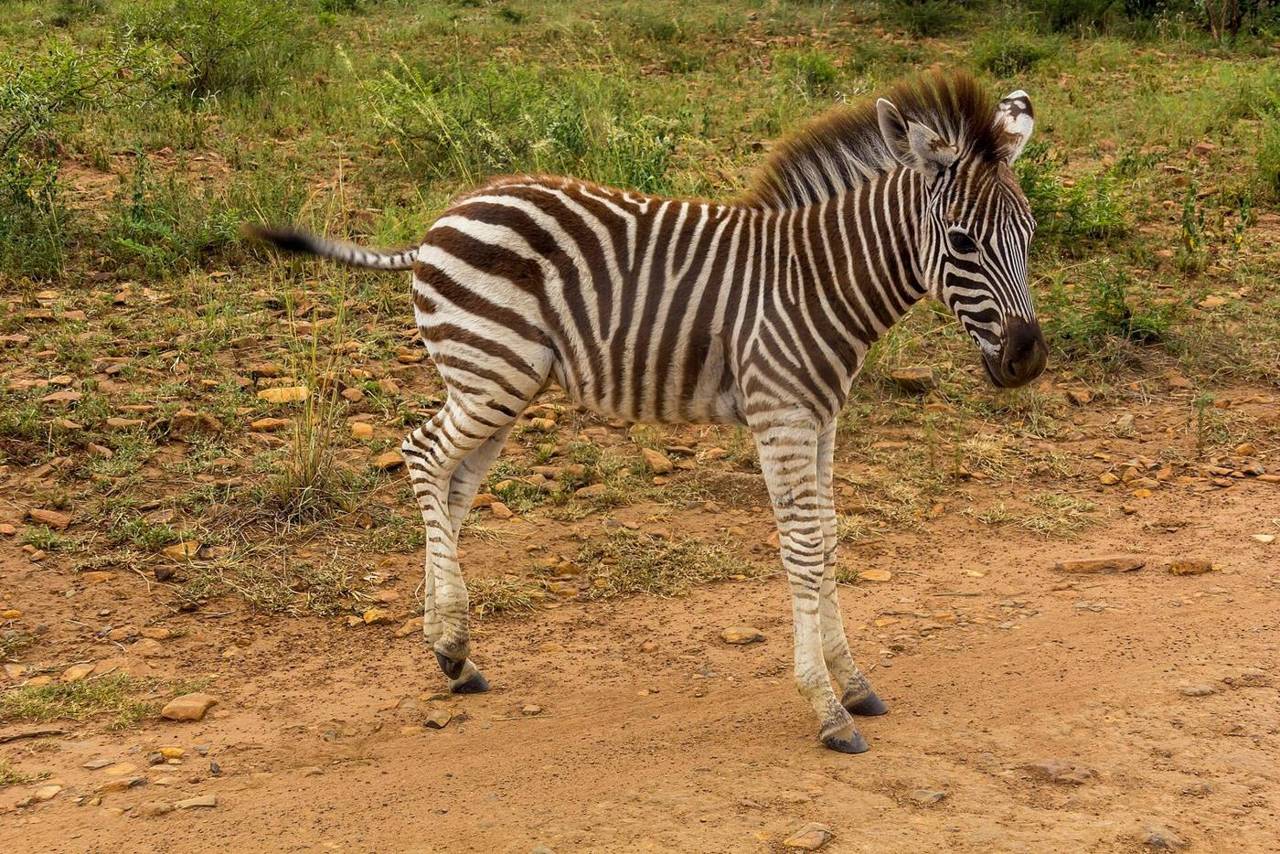
Madikwe and Pilanesberg, clear of malaria safari
Big Five safaris with no malaria risk, a few hours from Johannesburg: Pilanesberg in the crater of an ancient volcano, easy even in your own car, and Madikwe reserve on the Botswana border, with lodges, wild dogs and open-jeep game drives.
 6 daysModerate
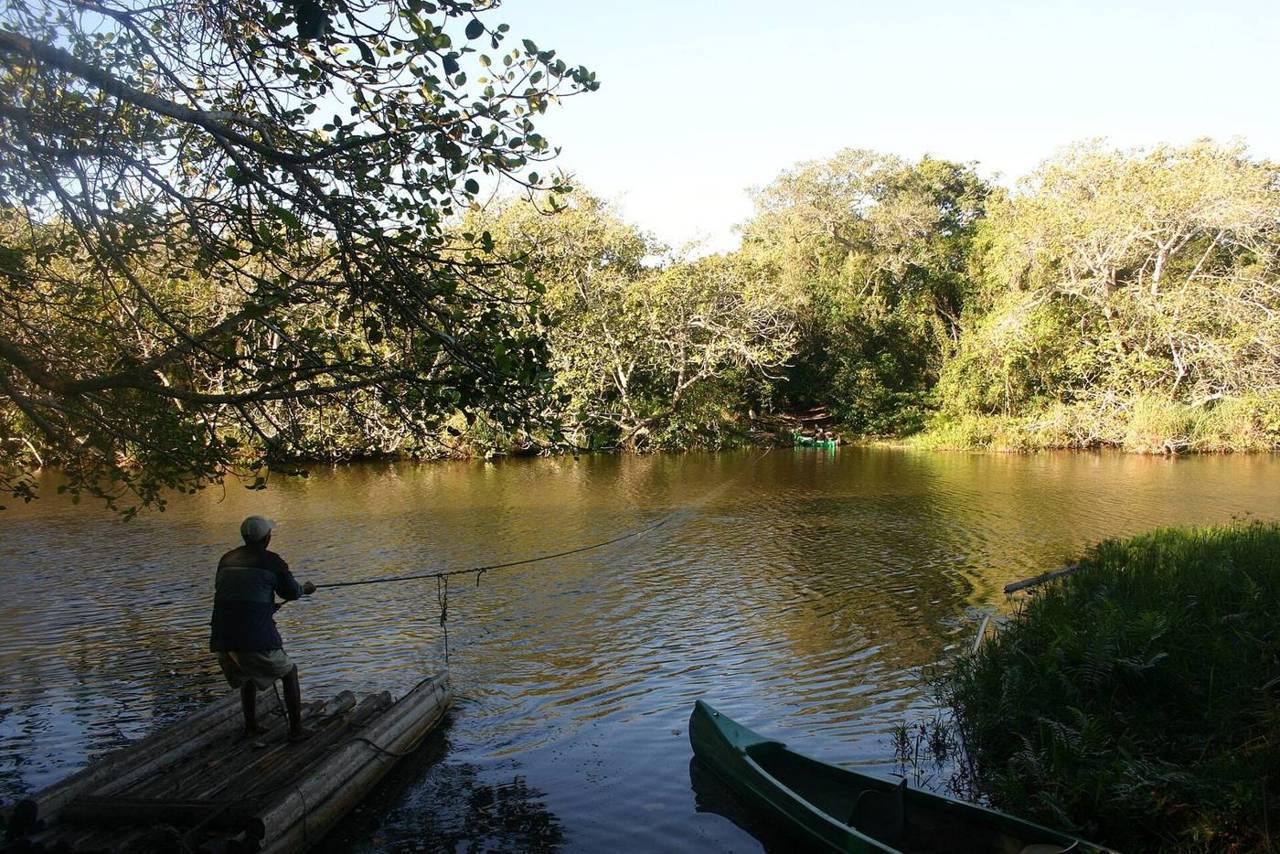
Maputaland: Sodwana and Kosi Bay
The wildest corner of KwaZulu-Natal, in iSimangaliso park: Africa's southernmost coral reefs at Sodwana Bay, turtles nesting on the beaches in summer, the lakes and traditional fish traps of Kosi Bay and Tembe reserve with its big-tusked elephants.
 4 daysEasy
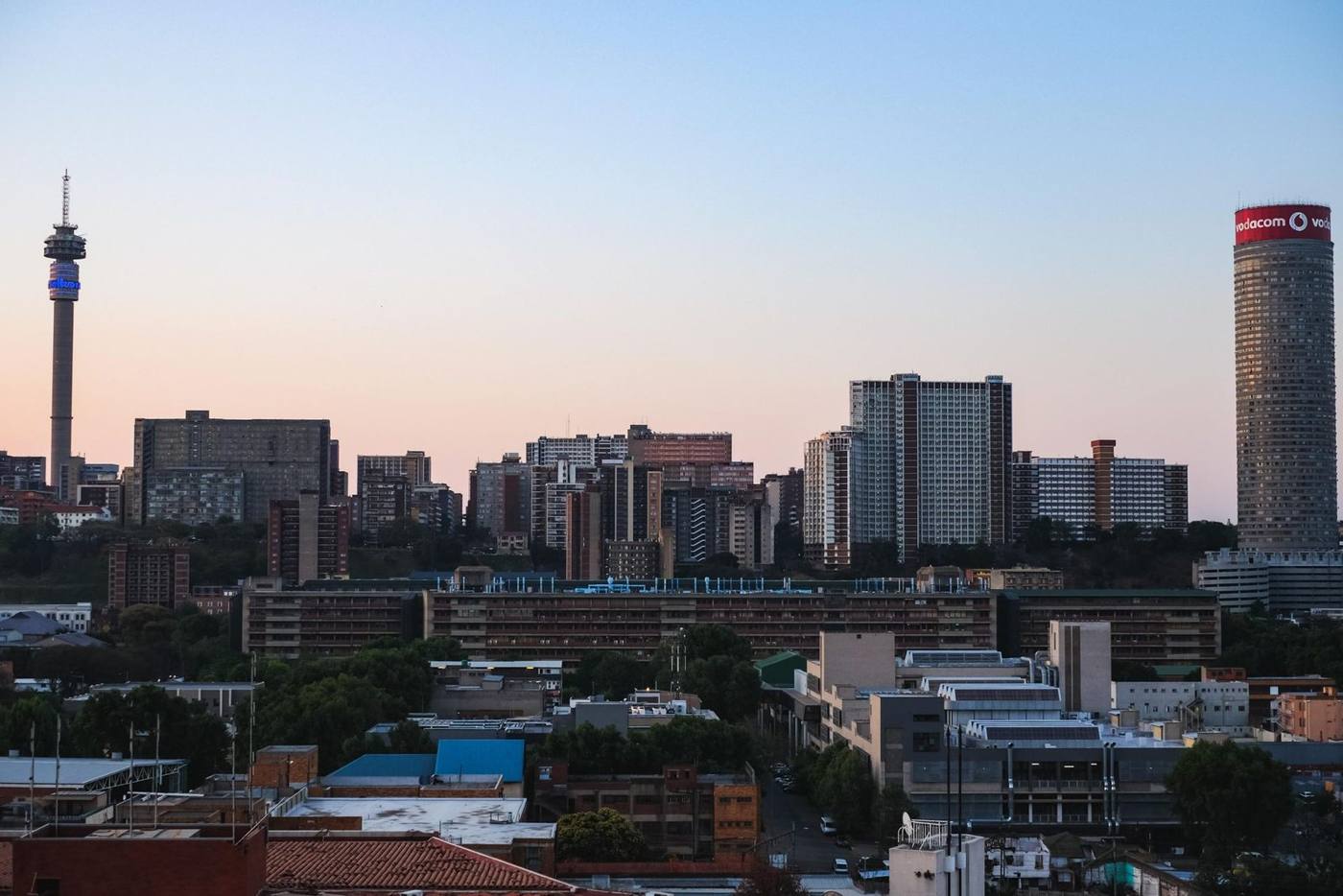
Johannesburg, Soweto and the Cradle of Humankind
The story of modern South Africa: the Apartheid Museum, Constitution Hill, Soweto with Mandela's house and the Hector Pieterson memorial, the creative Maboneng district, Pretoria with the Union Buildings and the Sterkfontein caves, where some of humanity's oldest ancestors were found.