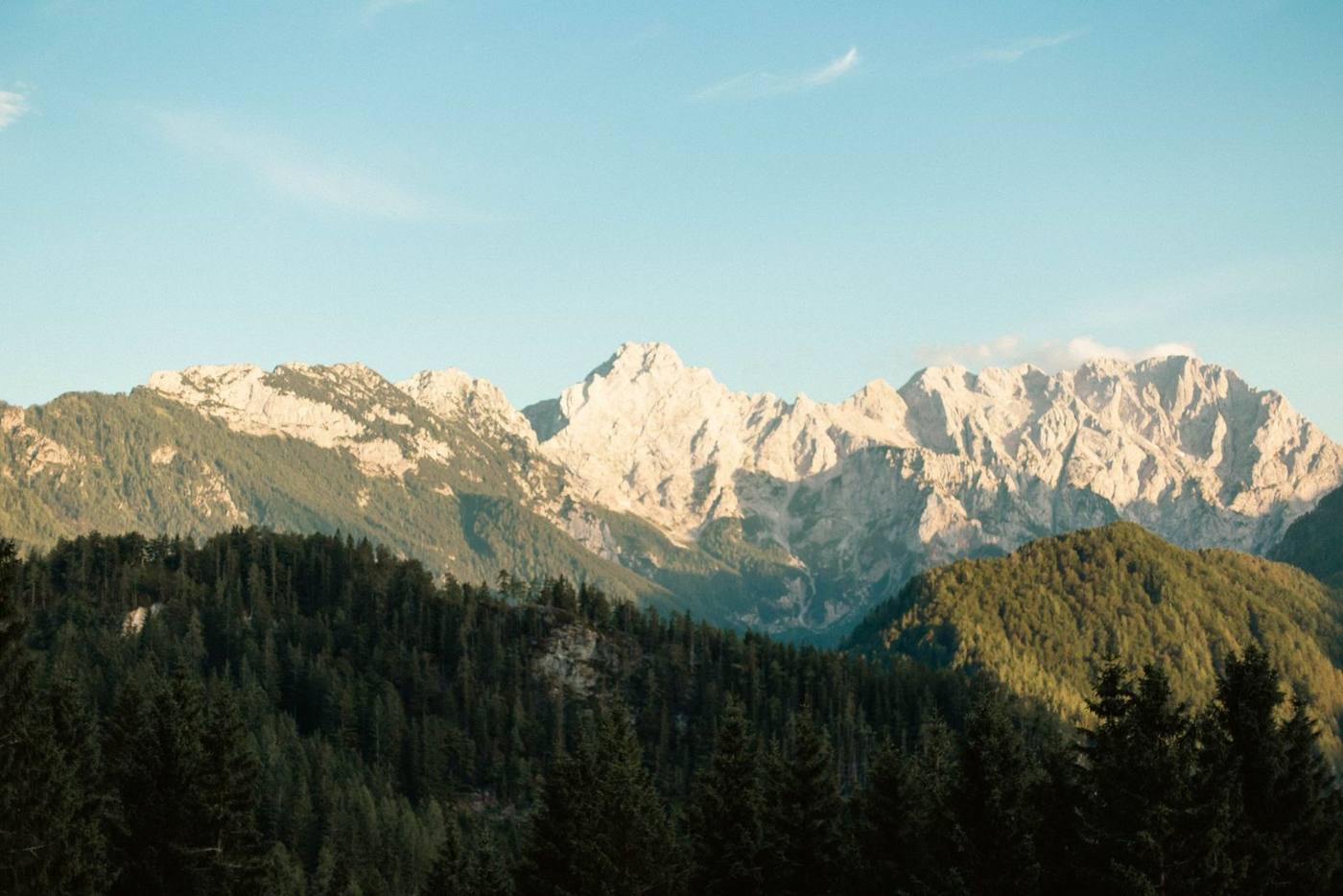
The Juliana Trail
A week on foot around the Julian Alps at mid altitude, from Kranjska Gora to Bohinj and Bled via the Soča valley.
- Kranjska Gora
- Mojstrana
- Trenta
- Bovec
- Kobarid
- Tolmin
- Bohinj
- Bled
Day by day
- Day 1
Arrival in Kranjska Gora and the Zelenci springs
This trip is a week on foot around the Julian Alps, along a selection of stages of the Juliana Trail, the circular route of about 270 kilometres that loops around Triglav National Park without climbing the peaks. You sleep in a village every night and use buses and trains to skip the less interesting sections.
Before you leave: Slovenia is part of the European Union and the Schengen area and uses the euro. Italian citizens need a valid electronic identity card for travel abroad or a passport; the paper identity card has no longer been valid for travel abroad since 3 August 2026. There may be temporary checks at the borders, so always carry your document. Other nationalities should check their own rules. There are ticks in the woods: ask your doctor about the tick-borne encephalitis vaccine.
You arrive in Kranjska Gora, the best known mountain village in Slovenia, a few kilometres from the borders with Italy and Austria. From Tarvisio it is about half an hour away.
In the afternoon take an easy walk to the Zelenci nature reserve, near Podkoren: a small spring lake with emerald green water, the source of the Sava Dolinka, one of the two branches of the river Sava. A wooden boardwalk crosses the marsh.
In the evening stroll through the village, with its church and old farmhouses, and dine on mountain dishes, such as barley and bean soup or žganci, buckwheat polenta.
Sleep in Kranjska Gora, for two nights.
Practical tip: buy or download the official Juliana Trail map; the route is marked with the trail symbol on a green background.
- Day 2
The first stage: from Kranjska Gora to Mojstrana
Today you walk the first official stage of the Juliana Trail, from Kranjska Gora to Mojstrana, along the upper Sava valley. It is an easy day, almost all gently downhill, through meadows, fir woods and small villages, with the walls of the Julian Alps always on your right.
The stage passes close to Gozd Martuljek, where a detour leads to the Martuljek waterfalls, in a narrow gorge below the Špik group. Allow an extra hour or two if you want to climb to the first waterfall. Then the path continues among the farms to Mojstrana, a quiet village at the mouth of the Vrata valley.
In the afternoon visit the Slovenian Alpine Museum, devoted to the history of the mountains and of mountaineering in the country: the first climbers of Triglav, the guides, the huts, mountain rescue and the life of the shepherds. It is a modern, well made museum that helps you understand why the mountains matter so much to Slovenians. Check prices and times.
If you still have energy, walk up in about an hour to the Peričnik waterfall, at the entrance to the Vrata valley: you can walk behind the falling water, under the rock.
In the evening return to Kranjska Gora by bus, or sleep in Mojstrana instead.
Practical tip: the Juliana Trail luggage transfer service is booked before you leave; with a light pack the stages are far more enjoyable.
- Day 3
The Vršič pass and the source of the Soča
Today you leave the Sava valley and cross to the southern side of the Alps, into the Soča valley. This section is not part of the Juliana Trail: you cross the Vršič pass, at 1,611 metres, the highest road pass in Slovenia, on the scheduled bus that links Kranjska Gora and Bovec in summer.
The road climbs through dozens of numbered hairpin bends, built during the First World War by Russian prisoners. On the northern side stands the Russian Chapel, made of wood, in memory of the prisoners killed by an avalanche in 1916. At the top of the pass the view of the walls of Prisojnik and Mojstrovka is magnificent.
Drop down into the Trenta valley, a narrow green valley with a few scattered houses. Stop at the statue of Julius Kugy, the climber and writer who told the story of these mountains, and at the Juliana alpine botanical garden, with the plants of the Julian Alps. Then follow the path to the source of the Soča, which flows out of a cave in the rock: the last section is steep and fitted with a cable.
From here the Soča Trail begins, following the river down to Bovec. Walk the first section, between suspension bridges and emerald water, and stop on the white gravel banks to watch the current.
Sleep in the Trenta valley.
Practical tip: check the times of the Vršič bus, which runs only in summer with few departures a day; the pass is closed in winter.
- Day 4
Along the Soča to Bovec
Today you walk all day along the Soča, on the path that runs down from the Trenta valley to Bovec. This too is a separate waymarked trail, but it is one of the most beautiful stretches of the Julian Alps, which is why we include it in the trip.
The path crosses from one bank to the other on suspension bridges, runs through meadows and woods, and meets the gorges where the river squeezes between the rocks. The most famous is Velika korita, the great gorge, where the clear green water flows through a channel only a few metres wide but full of colour. Look from above, from the bridges, without climbing down: the rocks are slippery and the water is icy, around ten degrees even in summer.
Further down the valley opens out and you reach the Bovec basin, ringed by mountains, with Kanin keeping its snow until early summer. Bovec is the centre of water sports in Slovenia: rafting, kayaking and canyoning trips start from here.
The walk is long but easy, without big climbs. You can shorten it by taking the bus for part of the way.
In the evening dine in Bovec on the dishes of the valley, such as Soča marble trout, alpine cheese and krafi, pastries filled with dried fruit.
Sleep in Bovec.
Practical tip: carry a pair of sandals or light shoes to rest your feet by the river during your breaks.
- Day 5
Kobarid, the Great War and Tolmin
Today you follow the Soča south to Kobarid, Caporetto in Italian, and then to Tolmin. The official Juliana Trail stage between Bovec and Kobarid is about 21 kilometres long: if you want to walk all of it, set off early; otherwise take the morning bus and walk only the final section.
In Kobarid visit the museum of the Great War, which tells the story of the Isonzo front and of the twelfth battle, the rout of Caporetto in October 1917, from the point of view of soldiers of every army, with letters, photographs and objects from life in the trenches. It is a balanced and moving museum. The writer Ernest Hemingway described this retreat in his novel A Farewell to Arms. Check prices and times.
Then climb the hill above the town to the Italian ossuary, the Church of St Anthony surrounded by the tombs of thousands of soldiers. From here the Kobarid historical trail starts, a loop of a few hours that passes trenches, the remains of an ancient settlement and the Napoleon Bridge, and reaches the Kozjak waterfall, hidden in a rocky cave and reached on a wooden walkway.
In the late afternoon carry on by bus to Tolmin, where the Soča meets the Tolminka.
Sleep in Tolmin.
Practical tip: for the Kozjak waterfall you need shoes with a good grip, because the stones on the path are often wet.
- Day 6
The Tolmin gorges and the Bohinj railway
In the morning visit the Tolmin gorges, at the lowest entrance to Triglav National Park. A loop of about an hour drops between the rocks where the Tolminka and the Zadlaščica meet, with green water at the bottom of deep, narrow gorges. You cross the Devil's Bridge, suspended above the canyon, and see the bear's head, a large boulder wedged between the walls. Check prices and times, because the gorges are only open in the warmer months.
Then go to the station at Most na Soči, a few kilometres south, on the lake formed by the Soča, where boats and kayaks can be hired in summer. Here you take the train on the Bohinj railway, the line built at the beginning of the twentieth century to link Austria with Trieste. The train climbs the Bača valley, passes small villages and then enters the long Bohinj tunnel, which crosses the mountains in a few minutes and comes out on the other side, in the Sava valley.
Get off at Bohinjska Bistrica and walk the section of the Juliana Trail that climbs the valley to Lake Bohinj and the village of Stara Fužina, past hay meadows, wooden hayracks and small churches.
Sleep around Lake Bohinj, for one night.
Practical tip: trains on this line are not frequent; check the timetable on the Slovenian Railways website the day before.
- Day 7
Lake Bohinj and Bled
This morning is for Lake Bohinj, the largest permanent natural lake in Slovenia, inside Triglav National Park. It is wilder and quieter than Bled: no grand buildings on the shore, only woods, meadows and mountains.
Start at the bridge at Ribčev Laz, with the Church of St John the Baptist and its medieval frescoes, reflected in the water. Then walk from Stara Fužina to the Mostnica gorge, a narrow canyon carved by the stream, with a path on both banks and a stone bridge. In a couple of hours you are back in the village.
In the afternoon take the train from Bohinjska Bistrica to Bled Jezero station, on the same railway, or the bus. Alternatively, keen walkers can follow the official Juliana Trail stages across the Pokljuka plateau, but they are two long days of more than twenty kilometres each.
In Bled walk around the lake, a loop of about six kilometres, easy and flat, with views of the island and of the castle on its rock.
In the evening try kremšnita, the Bled cream cake, with a layer of custard and a layer of whipped cream between two sheets of puff pastry.
Sleep in Bled.
Practical tip: at Lake Bohinj the car parks are paid in summer and fill up; with trains, buses and your own feet you avoid that problem.
- Day 8
Bled and departure
You spend the last morning in Bled. If you have time, take a pletna, the traditional wooden rowing boat of the lake, to the island, where you climb the stone steps to the Church of the Assumption and ring the wishing bell. Check prices and times for the boat and the church.
Alternatively walk up in half an hour to the Ojstrica viewpoint, above the south shore of the lake, for the classic photo of the island with the castle and the mountains behind, or visit Bled Castle, the oldest in Slovenia, on the cliff above the water.
Then leave. From Bled, Ljubljana airport is about half an hour away; you can also travel back by train towards Jesenice and Austria, or by car towards Tarvisio and Italy.
In eight days you have walked around the Julian Alps: the sources of the Sava and the Soča, the villages of the upper Sava valley, the Vršič pass, the emerald water of the Soča, the places of the Great War in Kobarid, the Tolmin gorges, the Bohinj railway and the two most famous lakes in the country. It is a mid mountain route, well marked, with no difficult passages, but you need good legs for days of five or six hours.
When to go: from May to October. In spring and autumn the peaks are snowy but the trail paths stay open, with fewer people and splendid colours. July and August are the busiest months.
Practical tip: in a thunderstorm do not stay on exposed sections; in Slovenia the emergency number, in the mountains too, is 112.
A mid-mountain walk away from the difficult peaks, with village lodging every night. The full route has 16 stages; this is a selection with transfers over the less interesting parts. It is well marked and baggage transfer is available. It also works in spring and autumn, when the summits are snowbound.
Before you go
- Documents and visa
- EU citizens need a valid identity card or passport: Slovenia is in the EU and the Schengen area. A driving licence is not accepted as identification. There may be temporary checks and queues on the borders with Italy, Croatia and Hungary: always carry your document. Other nationalities should check the Schengen rules.
- Health and vaccines
- No vaccines required. Tick-borne encephalitis is present: if you hike in summer, ask your doctor about the vaccine. EU citizens should bring their EHIC, plus insurance covering mountain rescue. Emergencies and mountain rescue: 112, police 113.
- Money and payments
- Euro. Cards are accepted almost everywhere, but carry some cash for mountain huts and small taverns. Motorways and expressways require an electronic vignette from the official DARS website; fines without one are high.
- Power sockets
- Types C and F, 230 volts.
- Time zone
- Central European Time (UTC+1, summer UTC+2).
- Safety
- A calm country with no particular areas to avoid. Watch for pickpockets in central Ljubljana and at tourist sites. In the mountains the weather changes quickly and summer storms are dangerous on ridges. Many bears live in the forests of the inner Karst and Notranjska: avoid the woods at dawn, dusk and night. Wild camping is banned. Official advice: GOV.UK.
Information checked in November 2026 for Italian and EU citizens. Rules change: always check before you travel.
Variations
Short version: in four days walk from Kranjska Gora to Mojstrana and along the Soča to Bovec.
Long version: in sixteen days walk the whole official Juliana Trail loop, also passing Tarvisio and the hills of Begunje.
Frequently asked questions
Is the Juliana Trail difficult?
No: it stays below the peaks and has no exposed passages. You do need to be fit enough to walk five or six hours a day.
Do I need a guide?
No, the route is waymarked and there is an official app with maps. Many walkers still prefer to book accommodation and luggage transfer in advance.
Can I walk it in spring or autumn?
Yes, that is one of its advantages: it stays at medium altitude, so you can walk even when the peaks are snowy. Just check that the Vršič pass is open.
Indicative itinerary written by World Atlas. Before booking, check timetables, seasonal openings, documents and safety.
 4 daysEasy
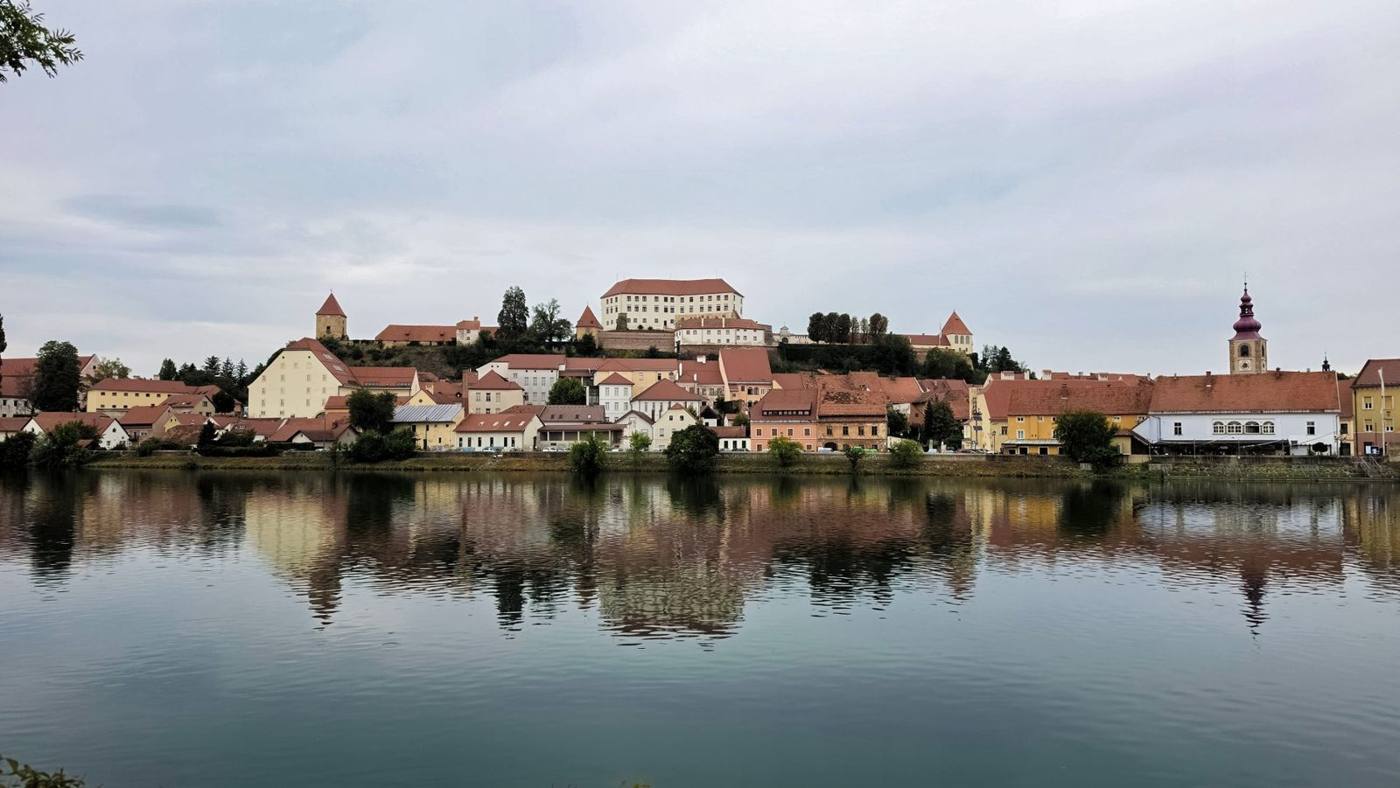
Maribor, Ptuj and Slovenian Styria
The world's oldest vine in Maribor, Ptuj, Slovenia's oldest town, and the wine hills of Jeruzalem and the Pohorje.
 4 daysModerate
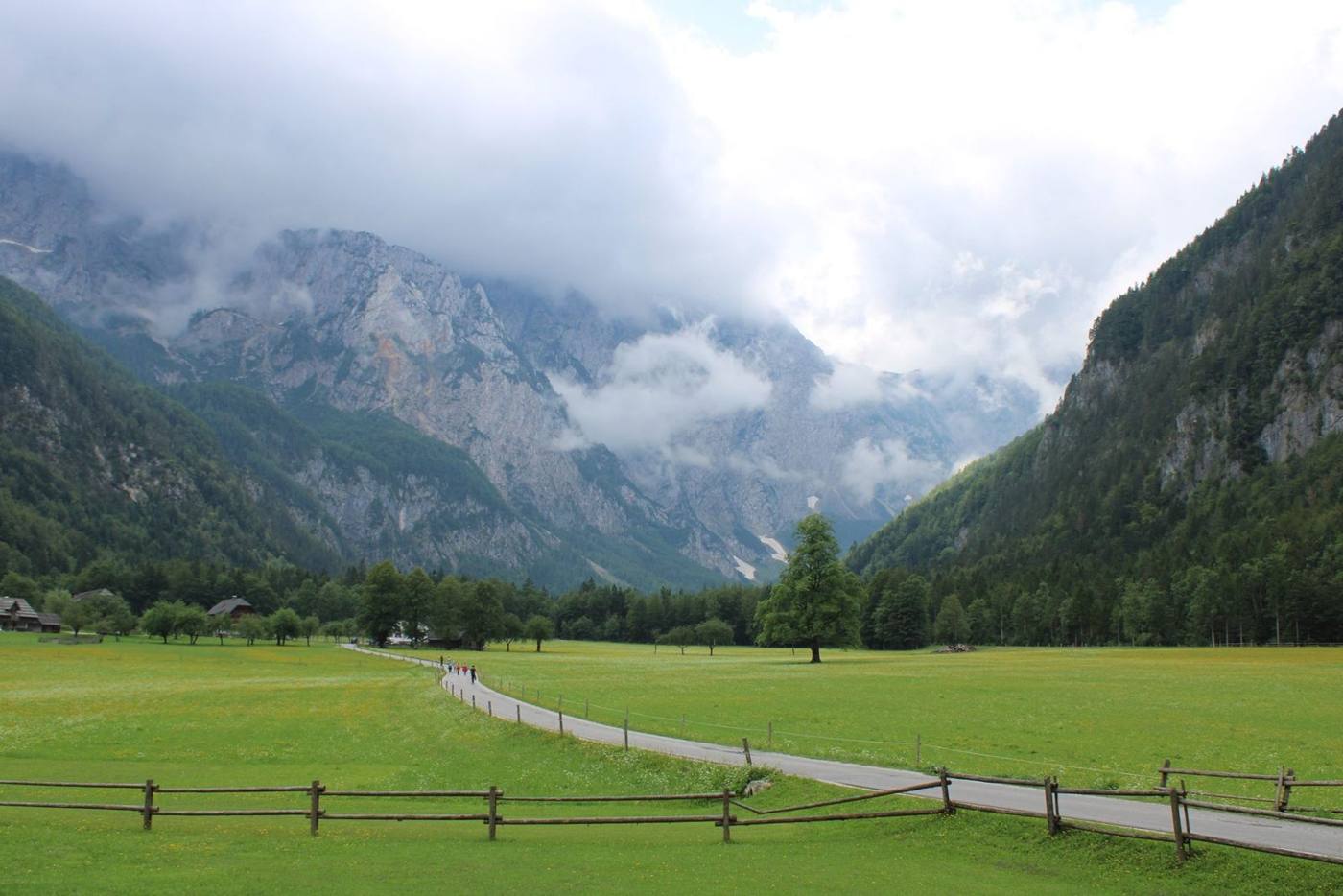
Logarska dolina and the Kamnik Alps
A glacial valley between limestone walls with the Rinka waterfall, the Solčava panoramic road and the herders' plateau of Velika planina.
 10 daysEasy
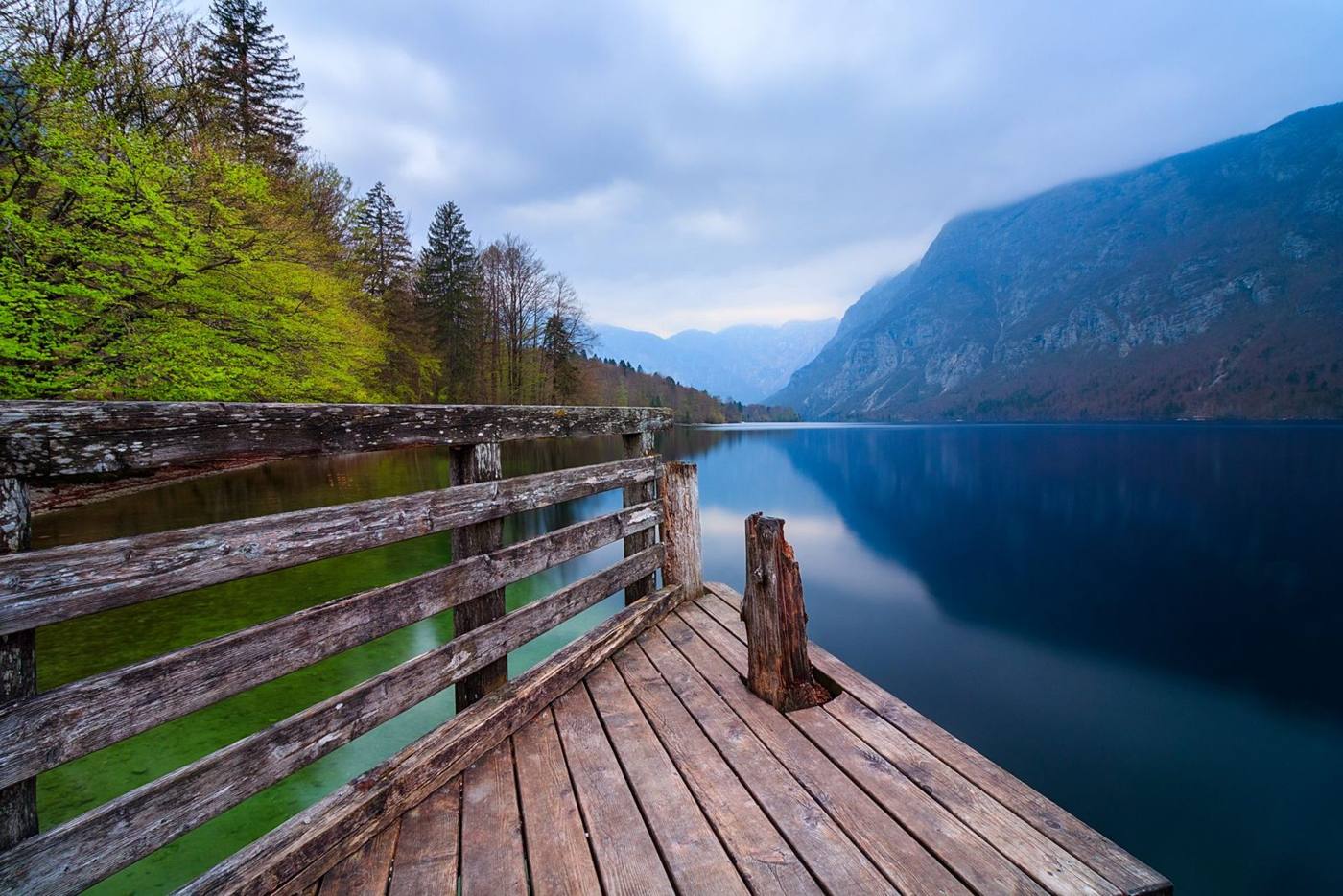
Slovenia and Croatia
Ljubljana, Bled and the Postojna caves, then Croatian Istria with Rovinj, the Plitvice Lakes and Zagreb to close the loop.