All-sea Philippines: Palawan, Bohol and Cebu
Three islands, three seas: El Nido's lagoons, the tarsiers and Chocolate Hills of Bohol, the sardines and turtles of Moalboal on Cebu.
- Manila
- El Nido
- Coron
- Bohol
- Panglao
- Cebu
- Moalboal
Day by day
- Day 1
Arrival in Manila
This is a trip all about the sea, designed for those who love snorkelling: three islands and three different seas. On Palawan there are the lagoons of El Nido and the lakes of Coron, on Bohol the Chocolate Hills, the tarsiers and the turtles of Balicasag, on Cebu the sardine shoals and turtles of Moalboal and the Kawasan waterfalls. You travel by domestic flights, fast boats and ferries, and you see a great deal even without a diving licence.
Before you go: Italian citizens enter the Philippines without a visa for tourism for up to 30 days, with a passport valid for at least six months and an onward ticket. Within the 72 hours before the flight you must fill in the eTravel form online on the official government website: beware of sites that charge for it. Other nationalities should check their own rules. The United States rates the Philippines at level 2 and advises against some areas of Mindanao and the Sulu Sea; the islands on this trip are far from those areas.
Today you arrive in Manila after a long flight, almost always with a connection. The Philippines is seven hours ahead of Italy in winter and six in summer.
The capital is big and congested, and on this trip it serves mainly as a gateway. Settle into a lodging near the airport, in the bay area, and rest.
If you still have energy, walk in Rizal Park, dedicated to the national hero José Rizal, or watch the sunset over Manila Bay.
In the evening, have kare-kare for dinner, a stew of oxtail and vegetables in peanut sauce, served with bagoong, a fermented shrimp paste.
Overnight in Manila.
Practical tip: buy a local SIM card at the airport, with enough data for the whole trip. You will need it for transport apps, maps and messages with the boats.
- Day 2
Flight to El Nido
Today you reach northern Palawan and its sea of limestone islands.
In the morning, take the direct flight from Manila to El Nido, in just over an hour, on a small propeller plane. Lio airport is tiny, surrounded by palm trees, about a quarter of an hour from the town. Alternatively, you can fly to Puerto Princesa and continue by van, in about five or six hours. Check times and prices, and the baggage weight limit, which is often low on small flights.
El Nido is a fishing town that has become one of the most famous destinations in Asia. In front of the beach opens Bacuit Bay, with over forty islands of dark limestone, sheer cliffs, lagoons and small white beaches. The whole area is protected.
On arrival you pay the ecotourism development fee of 400 Philippine pesos, valid for the whole stay. Keep the receipt with you: you need it on every boat trip.
In the afternoon, have your first swim and walk along the town's bay, among the bangka, the fishing boats with bamboo outriggers. Then take a tricycle to Las Cabañas beach for the sunset, with the sun sinking between the islands.
In the evening, try sisig, chopped crispy pork served on a sizzling plate with onion, chilli and calamansi.
Overnight in El Nido, for four nights.
Practical tip: book the boat trips for the coming days as soon as you arrive, choosing an operator authorised by the municipality. Ask what is included: lunch, kayak, mask and entry fees.
- Day 3
The lagoons of Miniloc
Today you explore the most famous lagoons in the Philippines.
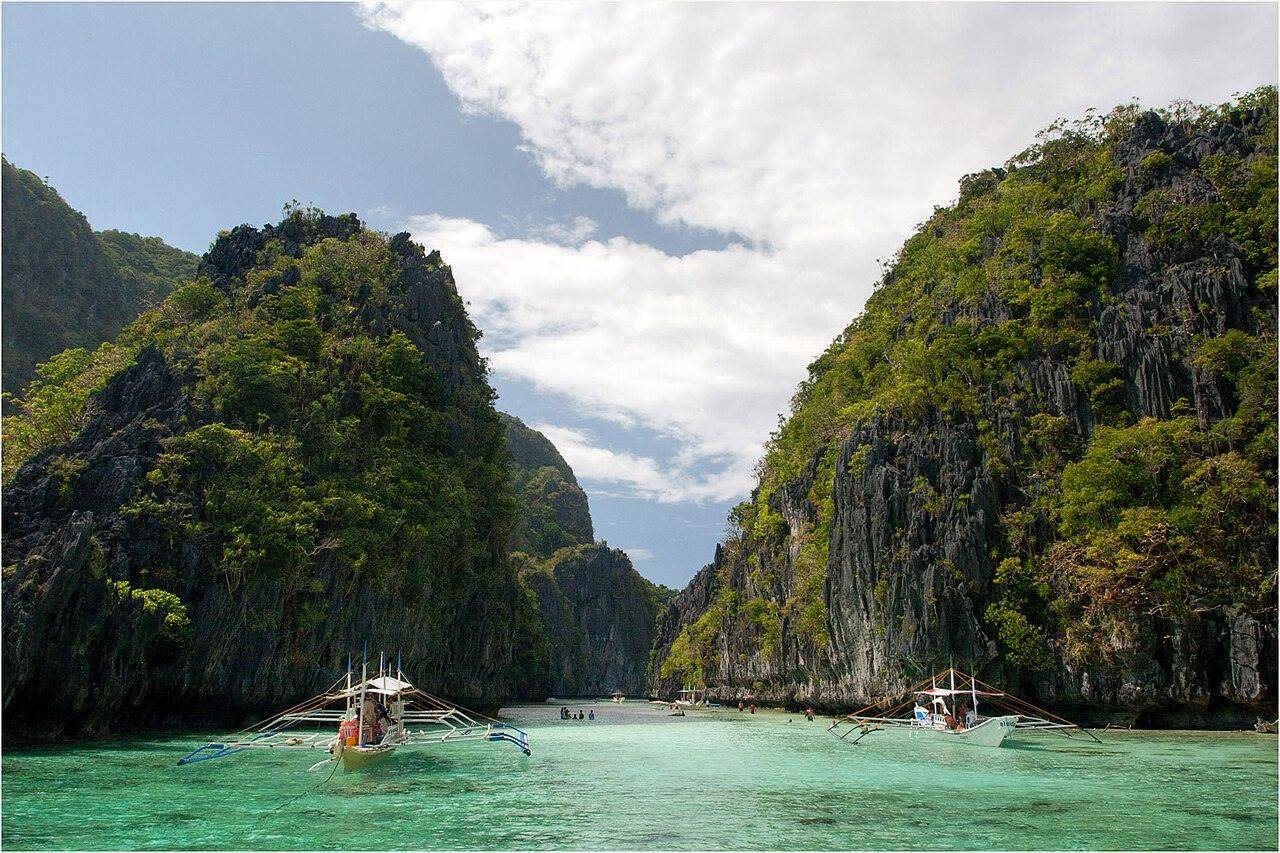
In the morning, set off on tour A, the best-known boat trip in El Nido. The boat heads for Miniloc Island, tall and vertical, where two lagoons are hidden. In the Big Lagoon you paddle by kayak into a large expanse of pale green water, between rock walls tens of metres high, with the seabed clearly visible. The Small Lagoon is more intimate: you pass through a narrow crack and reach a natural pool surrounded by rock, where you hear only the sound of the paddles.
Entry to the lagoons is limited each day and some visits require a booking with a time slot. Check rules and prices, which are separate from the El Nido fee.
At midday the boat stops at a beach, and the crew prepares lunch with grilled fish, pork, rice, salad and tropical fruit.
In the afternoon, snorkel in the coral gardens near the islands, among parrotfish, butterflyfish and soft corals. Then stop at Seven Commando Beach, a beach with palm trees and shallow water, ideal for a last swim.
Around four you return to town.
In the evening, try grilled fish with a sauce of soy, vinegar and calamansi, and a fresh mango juice.
Overnight in El Nido.
Practical tip: many people arrive at the lagoons in mid-morning. Ask the crew whether it is possible to leave early or reverse the order of the stops. Wear a swim shirt to protect yourself from the sun, which is very strong on the water even on cloudy days.
- Day 4
The secret beaches of Matinloc
Today you head for the outer islands of the bay, where the sea is more open and the corals are richer.
In the morning, set off on tour C, which goes among the islands of Matinloc and Tapiutan. The first stop is Hidden Beach, a small beach enclosed by rocks, reached by swimming between the boulders. Then comes Secret Beach: the boat stops in front of a rock wall, and you enter by swimming through a low opening in the rock, to a hidden beach surrounded by cliffs.
On Matinloc Island, visit the shrine, an old abandoned chapel, and climb the small ladder to the viewpoint on the rocks, with the view over the open sea.
At lunch the crew cooks for you on a beach. Then snorkel in the Tapiutan channel, one of the best spots in El Nido, with hard corals, anemones, clownfish, shoals of colourful fish and, with a bit of luck, a turtle.
If the sea on the open side is too rough, replace this trip with tour B, more sheltered, with Snake Island, a curved strip of sand that emerges at low tide, and Cudugnon Cave.
In the late afternoon you return to town.
In the evening, have a coconut and prawn curry for dinner, a dish cooked on Palawan with fresh coconut milk.
Overnight in El Nido.
Practical tip: to get into Secret Beach you need a little calm and your mask. If the waves are strong, do not go in: the rocks at the opening are sharp. Water shoes are essential, and a dry bag keeps your phone safe in the boat.
- Day 5
Kayaking and Nacpan beach
Today you spend a slower day, between a kayak trip and a long beach.
Early in the morning, with the sea calm, hire a kayak in town and paddle to Cadlao Island, the large island opposite El Nido, or along the coast to Ipil beach. It is the quietest way to see the rock walls up close, without the noise of engines. Stay close to the shore and return before the wind picks up.
At midday, take a tricycle north, for about an hour, to Nacpan beach. It is a beach about four kilometres long, with golden sand, coconut palms and gentle waves, much quieter than the beaches near the town. Eat at the huts on the sand, with the catch of the day.
In the afternoon, climb the hill at the end of the beach: from the top you see the twin bays of Nacpan and Calitang, divided by a thin strip of sand, one of the finest views on Palawan.
At sunset, return to town.
In the evening, at your last dinner in El Nido, try halo-halo, the dessert of shaved ice with milk, fruit, sweet beans and ube, the purple sweet potato.
Pack your bags for tomorrow's crossing.
Overnight in El Nido.
Practical tip: in El Nido cash machines are few and often empty. Work out the cash you need for boat trips, tricycles and dinners, and keep a reserve of pesos for Coron, where the situation is similar. Some places accept cards, but often with a surcharge.
- Day 6
The crossing to Coron
Today you cross the sea between El Nido and Coron, in northern Palawan.
In the morning, take the fast boat to Coron, in about four hours. During the journey you pass dozens of green islands, limestone rocks and fishing villages on stilts, and sometimes dolphins swim near the hull. Check times, prices and sea conditions, and book a day ahead.
Coron is the name both of the town, on Busuanga Island, and of the mountainous island opposite, a great mass of limestone covered in forest. It is the base for two things: the lakes among the rocks and the wrecks of ships sunk during the Second World War.
In the early afternoon, settle in town and take a walk around the harbour market, with fish, shellfish, fruit and cashew nuts, which are widely grown on Palawan.
In the late afternoon, climb Mount Tapyas, a hill above the town, with hundreds of steps and a large white cross. Reach the top a little before sunset, to see the islands turn dark against the orange sea.
In the evening, relax in the warm water of the Maquinit hot springs, about half an hour by tricycle, a natural pool of warm salt water near the mangroves. Check prices and times.
Overnight in Coron, for three nights.
Practical tip: on the fast boats keep a light jacket to hand, because the air conditioning and the wind on deck can be cold. Put your backpack in a waterproof bag, as spray often comes over the sides.
- Day 7
Kayangan, Barracuda and the Twin Lagoon
Today you visit the lakes of Coron Island, the heart of the area.
Early in the morning, set off on a boat trip. Coron Island is the ancestral land of the Tagbanwa people, who live from fishing and look after the lakes: entry fees are paid to them, at each site. Check prices and rules.
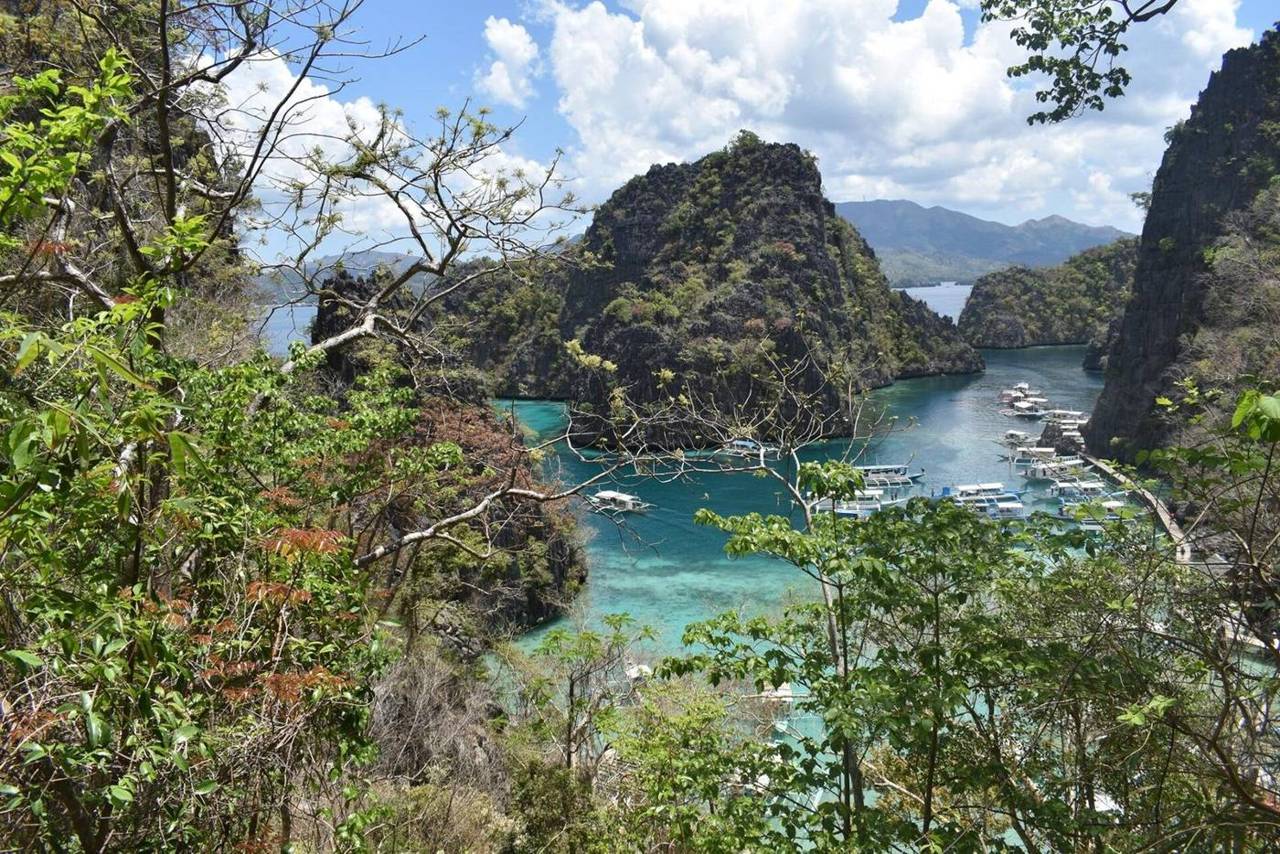
At Kayangan Lake, climb about 300 steps to the viewpoint over the bay, with the rock pinnacles rising from the turquoise water. Then go down to the lake: the water is fresh and crystal clear, and beneath the surface you see rocks and walls dropping into the blue. Swim with a life jacket, as the rules require.
Then go to Barracuda Lake, enclosed by jagged rock walls. It is famous among divers because below the surface the water suddenly becomes much warmer, due to hot springs. Even with a mask you can clearly see the rocks and small fish.
In the afternoon, enter the Twin Lagoon: a rock wall separates two lagoons, and you pass by swimming under an arch at low tide, or by a wooden ladder. Here salt water from the sea and fresh water from the streams mix, creating layers of different temperature.
To finish, snorkel at the Skeleton Wreck, a small wreck in shallow water.
In the evening, have squid and crab from the market for dinner.
Overnight in Coron.
Practical tip: the steps at Kayangan Lake are made of wood and rock, wet and slippery. Wear water shoes with a good sole and keep your mask in your backpack.
- Day 8
Wrecks or white sand islands
Today you choose between wreck diving and a day of beaches.
If you have a diving licence, Coron is one of the best places in the world for wreck diving. On 24 September 1944 American aircraft attacked a fleet of Japanese ships hidden in the bays around Busuanga, and many sank. Today the wrecks lie at different depths, covered in coral, sponges and fish, with holds and decks still recognisable. Choose a reputable centre with certified instructors and check the level required, because some wrecks are deep.
If you do not dive, set off on an island-hopping trip south of Coron, towards Banana Island and Malcapuya, with very white sand, clear water and corals close to the shore. You can add Bulog Dos, a sandbar that appears at low tide in the middle of the sea. Check prices and what is included.
Another option, for animal lovers, is Calauit Safari Park, in the north of Busuanga, where giraffes and zebras were brought from Africa in the 1970s, and now live alongside the Calamian deer, a local species. The journey is long, about three hours. Check prices and times.
In the evening, at your last dinner on Palawan, try lechon, roast suckling pig with crispy skin.
Overnight in Coron.
Practical tip: if you dive today, you cannot fly tomorrow until at least 24 hours have passed. Check your flight time before booking the dives, and tell the dive centre when you are leaving.
- Day 9
Flight to Cebu and ferry to Bohol
Today you leave Palawan and reach the Visayas, in the centre of the archipelago.
In the morning, go to Busuanga airport, about thirty to forty-five minutes from Coron, and take the flight to Cebu, in about an hour and a quarter. Check times and prices: if you cannot find a direct flight, you go via Manila.
Cebu is the second largest urban area in the Philippines and the place where, in 1521, Ferdinand Magellan's expedition arrived. From the airport, on Mactan Island, take a taxi to the port, in about thirty minutes to an hour, depending on the traffic.
In the afternoon, board the fast ferry to Tagbilaran, the capital of Bohol, in about two hours. Check times and prices, and book ahead at weekends.
Bohol is a quiet, green island, famous for its conical hills, its Spanish churches built of coral stone and its tarsiers, small nocturnal primates. South of Tagbilaran, linked by two bridges, is Panglao Island, with white beaches and clear sea.
In the evening you arrive in Panglao and settle into a lodging near the sea.
Have kinilaw for dinner, raw fish marinated in coconut vinegar, ginger and onion, a typical dish of the Visayas.
Overnight in Panglao, for four nights.
Practical tip: in the ports of Cebu and Bohol there are many people offering to carry your bags or find you a taxi. Use only official taxis or apps, and ask the price before setting off. Keep your bags in sight at all times when boarding the ferry.
- Day 10
Tarsiers, the Loboc River and the Chocolate Hills
Today you discover the green, hilly interior of Bohol.
In the morning, hire a car with a driver for the day. The first stop is the Corella tarsier sanctuary, run by an association that protects these animals. The Philippine tarsier is one of the smallest primates in the world: it fits in the palm of a hand, has enormous eyes and can turn its head almost all the way round. By day it sleeps on the branches: watch it in silence, without flash and without touching it. Avoid places that keep them in cages or let you handle them. Check prices and times.
Then go to the Loboc River, where a cruise on a covered boat glides between palms and bamboo, with a buffet lunch and traditional music. On the way you stop in the Bilar mahogany forest, a stretch of road beneath very tall trees planted by people.
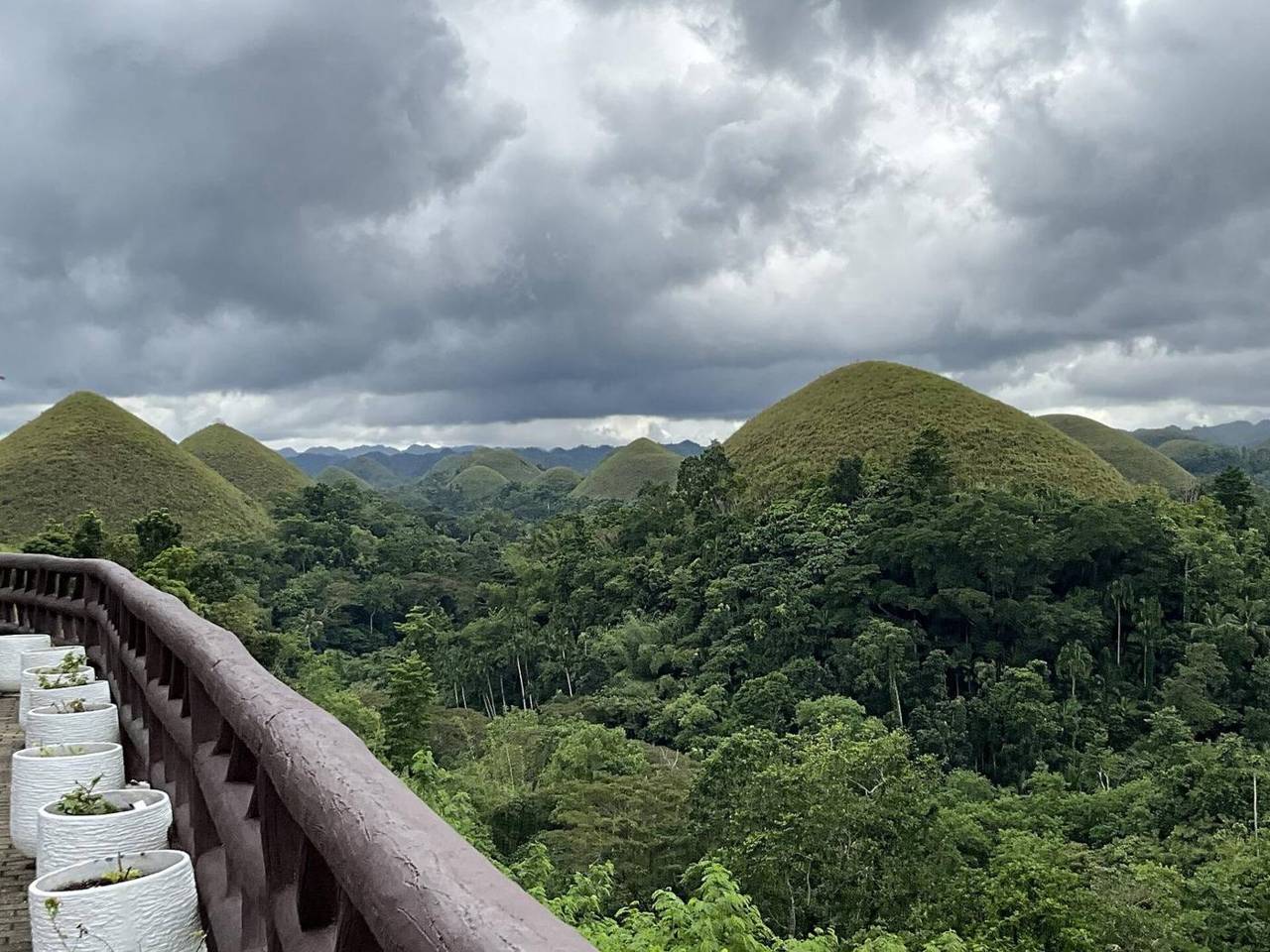
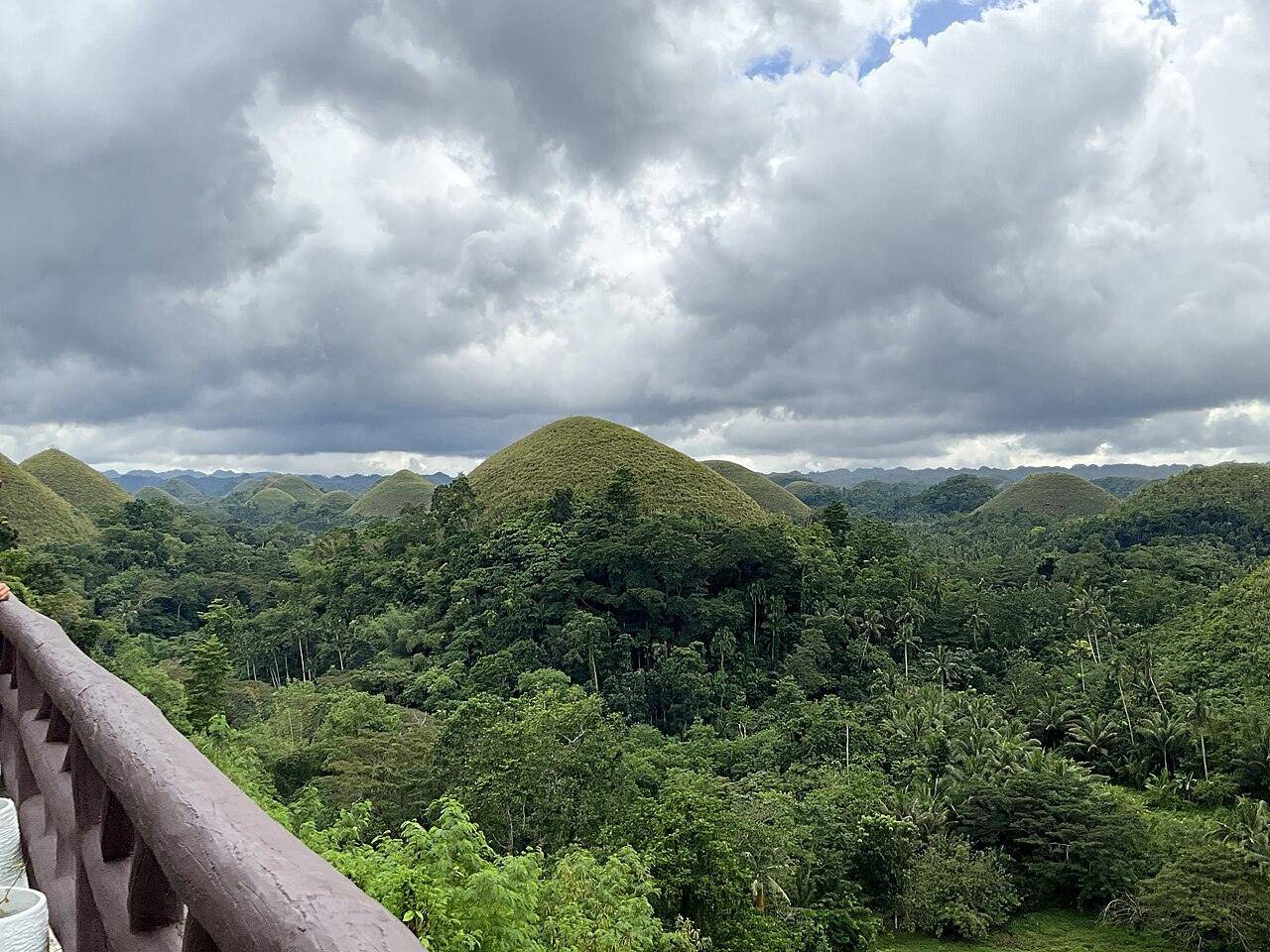
In the afternoon you reach the Chocolate Hills, more than a thousand cone-shaped hills covered in grass, spread across a wide plain. In the dry season the grass turns brown and the hills look like chocolates, hence the name. Climb the stairs of the main viewpoint for the view over the whole area. Check prices and times.
In the evening, return to Panglao.
Have grilled fish for dinner and ube cake, made with the purple sweet potato.
Overnight in Panglao.
Practical tip: at the Chocolate Hills the best light is in the late afternoon, when the hills cast long shadows. Bring water and a hat, because the viewpoint is exposed to the sun.
- Day 11
Panglao: churches, caves and beaches
Today you stay on Panglao Island, between history and the sea.
In the morning, visit Dauis Church, a Spanish church of coral stone facing the sea, with a painted ceiling and a well inside linked to a local legend. Then, on the Bohol mainland a few kilometres away, stop at Baclayon Church, one of the oldest in the Philippines, damaged by the 2013 earthquake and then restored.
Not far away, along the Tagbilaran coast, is the Blood Compact monument, which recalls the alliance of 1565 between the local chief Sikatuna and the Spaniard Miguel López de Legazpi, sealed by drinking blood mixed with wine.
At midday, return to Panglao and visit Hinagdanan Cave, a small limestone cave with an underground pool lit by the light coming in through two openings in the ceiling. Check prices and rules for swimming.
In the afternoon, relax on Alona beach, the most famous and lively on the island, or on Dumaluan beach, longer and quieter. Snorkel off the beach, where the reef begins a few metres from the shore.
In the evening, watch the sunset on the beach and have Bohol food for dinner, such as calamay, a sweet of sticky rice, coconut and sugar, sold in coconut shells.
Overnight in Panglao.
Practical tip: in churches, cover your shoulders and knees. Keep a sarong or a light T-shirt in your backpack, to go from the beach to a visit. Churches are places of worship: avoid visiting during Mass.
- Day 12
Balicasag and the turtles
Today is one of the best days of the trip for snorkellers.
At dawn, set off by boat from Panglao. Some trips pass first off Pamilacan Island, where dolphins are often seen swimming and leaping near the boat. Choose an operator that respects the animals: boats must not chase or surround them.
Then you reach Balicasag, a small round island surrounded by a marine sanctuary. Here the coral reef, a few metres from the beach, ends in a wall dropping towards the deep blue. Swimming along the edge you see hard and soft corals, gorgonian fans, clownfish, shoals of silvery jacks and above all sea turtles, which are almost always seen feeding on the bottom or rising to breathe. A sanctuary fee is charged: check prices and rules.
On the way back, stop at Virgin Island, a strip of white sand that stretches out into the sea at low tide, with starfish in the shallow water.
In the afternoon, rest on the beach in Panglao. If you dive, Balicasag also offers some of the best wall dives in the Visayas.
In the evening, have sea urchins and fresh seaweed for dinner, if you find them at the market.
Overnight in Panglao.
Practical tip: with turtles, stay at least a few metres away, do not touch them and do not block their way to the surface. Never feed the fish, and check the sea the evening before: in strong wind the boats may not leave.
- Day 13
Ferry to Cebu and the old city
Today you return to Cebu and discover its history.
In the morning, take the fast ferry from Tagbilaran to Cebu, in about two hours. Check times and prices.
Cebu is the oldest city in the Philippines founded by the Spanish. Here, in 1521, Magellan planted a cross and had the local king and his court baptised. In 1565 Legazpi founded the first Spanish city in the archipelago.
Visit Magellan's Cross, kept in a small pavilion with a painted ceiling, and the nearby Basilica of the Santo Niño, which holds a small statue of the Christ Child brought by the Spanish in 1521, the oldest Christian image in the country. Every January the city celebrates Sinulog, a great festival with dances and processions in its honour.
Then walk to Fort San Pedro, a small triangular fort built by the Spanish near the port, and along Colón Street, considered the oldest street in the Philippines. Check prices and times.
In the afternoon, if you have time, go up into the hills above the city to the Taoist temple, with its colourful stairways and views over the city and the sea.
In the evening, try Cebu lechon, considered the best in the country, with crispy skin and meat scented with lemongrass and garlic, and puso, rice cooked in small pouches of woven palm leaves.
Overnight in Cebu.
Practical tip: in central Cebu the traffic is very heavy and the pavements are narrow. Get around by taxi or app, and keep an eye on your bags and phone in crowded places.
- Day 14
Moalboal and the sardines
Today you reach the west coast of Cebu, one of the most famous places in the Philippines for snorkelling.
In the morning, leave by car with a driver or by bus from Cebu's south terminal for Moalboal, in about three hours. The road crosses the island among hills, maize fields and villages, then descends towards the sea.
Moalboal is a fishing village with a coral reef that begins right in front of Panagsama beach. Its special feature is the great sardine shoal that lives near the shore: millions of small silvery fish moving together, forming clouds, spirals and walls that open and close around swimmers. Predators such as jacks often arrive too, and the shoal suddenly changes shape.
In the afternoon, after settling in, get into the water with mask and snorkel from the shore. You only need to swim for a few minutes beyond the edge of the reef: the seabed drops suddenly and the shoal is there, a few metres down. With a bit of luck you also see a turtle on the bottom.
In the evening, watch the sunset over the island of Negros, on the other side of the strait, and have the catch of the day for dinner.
Overnight in Moalboal, for two nights.
Practical tip: many boats pass in front of Panagsama. Stay close to the shore or use a brightly coloured buoy, and do not swim alone. The sea is calmer and clearer early in the morning, before the tour boats arrive.
- Day 15
Pescador and the turtles of Moalboal
Today you explore the sea of Moalboal by boat.
In the morning, take a bangka to Pescador Island, a small islet about half an hour from the coast, inside a marine sanctuary. Around the island the reef drops into a deep wall, covered in corals, sponges and gorgonians, where tropical fish of every colour swim, along with turtles and sometimes, here too, the sardine shoals. It is one of the best-known snorkelling and diving spots in the area. A sanctuary fee is charged: check prices and rules.
On the way back the boat often stops at a spot near the coast where green turtles feed on seagrass in the shallows. Watch them rise to breathe, a few metres from you.
In the afternoon, relax on Moalboal's White Beach, also called Basdaku, north of the village, with pale sand and a calm sea, or take a last swim with the sardines off Panagsama.
A note on whale sharks: at Oslob, in the south of Cebu, they are fed every day to bring them close to tourists, and this changes their natural behaviour. If you want to swim with them, choose Donsol, in southern Luzon, in the right season, or an encounter in the open sea without feeding.
In the evening, have dinner on the beach, with grilled squid and garlic rice.
Overnight in Moalboal.
Practical tip: bring your own mask if you have one: rental masks sometimes do not seal well. Use reef-friendly sun cream and a swim shirt, and drink plenty of water after hours in the sun.
- Day 16
Kawasan Falls and back towards Cebu
Today you spend the morning among turquoise waterfalls and then head back towards the airport.
Early in the morning, go to Kawasan Falls, in Badian, about half an hour south of Moalboal. After a short walk along the river, in the forest, you reach a series of intensely blue pools, with the main waterfall dropping into a large, deep basin. You can swim and ride a bamboo raft right under the falling water.
Adventurous visitors can go canyoneering, descending the river on foot and swimming, with jumps into the pools, roped sections and passages between the rocks, all the way to the falls. You need a guide, a helmet and a life jacket. Choose reputable operators and follow the instructions. Check prices, conditions and safety.
At midday, return to Moalboal, have a shower and pack your bags.
In the afternoon, leave by car for Cebu, in about three or four hours. Sleep on Mactan Island, near the airport, so as not to risk the traffic tomorrow.
In the evening, in Mactan, have seafood for dinner and one last halo-halo.
Overnight in Mactan.
Practical tip: many people arrive at Kawasan Falls from mid-morning, with the canyoneering groups. Arrive around seven or eight. Leave valuables at your lodging and use a waterproof pouch for your phone.
Do not do the highest jumps if you do not feel like it: they can always be avoided by walking round them.
- Day 17
Departure from Cebu
Today you leave the Philippines.
If your flight is in the afternoon, visit the Lapu-Lapu shrine in Mactan in the morning, where a large statue recalls the local chief who in 1521 defeated Magellan at the Battle of Mactan, in which the explorer died. For Filipinos Lapu-Lapu is the first national hero, a symbol of resistance to foreigners.
Then go to Mactan-Cebu airport and take your return flight, almost always with a connection in Asia or the Gulf, or via Manila. If you go via Manila, leave plenty of time between the two flights.
Over these seventeen days you have seen the sea of the Philippines on three different islands: the lagoons and secret beaches of El Nido, the clear lakes, wrecks and sand islands of Coron, the tarsiers, the Chocolate Hills and the turtles of Balicasag on Bohol, the historic city of Cebu, the sardines and turtles of Moalboal and the Kawasan waterfalls. An easy trip, suitable even for those without a diving licence.
When to go: the right months are from December to May, in the dry season, with calm seas and the best visibility. March, April and May are the hottest months. From June to November the rains and typhoons arrive, which can stop boats and flights for days.
Practical tip: spend the pesos you have left before leaving, because they are hard to change in Europe. And take home something local, such as Cebu's dried mango or a hand-woven bag.
The perfect beach holiday for snorkellers: you see a huge amount even without a diving licence. I'd skip the whale-shark watching at Oslob, where they are fed for tourists; Donsol or the open sea are better. Right months: December-May.
Before you go
- Documents and visa
- Passport valid for at least six months and an onward ticket; no visa for tourism up to 30 days for EU citizens. In the 72 hours before the flight you fill in the no-cost eTravel form online.
- Health and vaccines
- No compulsory vaccines arriving from Europe. Protect yourself against mosquitoes because of dengue and keep away from dogs and monkeys because of rabies. Drink only bottled water. Emergencies: 911.
- Money and payments
- Philippine peso. On small islands cash machines are few and often empty: carry cash.
- Power sockets
- Types A, B and C, 220 volts: bring a universal adapter.
- Time zone
- UTC+8 all year.
- Safety
- The United States rates the Philippines level 2, with level 4 for the Sulu archipelago, the southern Sulu Sea and Marawi, and level 3 for much of Mindanao. Typhoons occur from June to November. Official advice: GOV.UK.
Information checked in November 2026 for Italian and EU citizens. Rules change: always check before you travel.
Variations
In 11 days: only El Nido and Coron, then the flight to Cebu and three nights in Moalboal, without Bohol.
In 20 days: add Siquijor, the island of waterfalls and traditions, between Bohol and Cebu, or a few days of diving at Malapascua.
Frequently asked questions
What document do I need for the Philippines?
Italian citizens enter without a visa for tourism for up to 30 days, with a passport valid for at least six months and an onward ticket. Within the 72 hours before the flight you must fill in the eTravel form online on the official website. Other nationalities should check their own rules.
Do I need a diving licence?
No. The lagoons of El Nido, the lakes of Coron, the turtles of Balicasag and the sardines of Moalboal can be seen perfectly well with mask and snorkel. A licence is only needed to go down to the Coron wrecks and the deep walls.
Why avoid the Oslob whale sharks?
At Oslob the whale sharks are fed every day to keep them close to tourists, and this changes their behaviour. It is better to see them at Donsol, in the right season, or in the open sea without feeding.
Indicative itinerary written by World Atlas. Before booking, check timetables, seasonal openings, documents and safety.
 7 daysEasy
Palawan: El Nido and the lagoons
A week of islands, turquoise lagoons and snorkelling in the Bacuit archipelago, with a stop at the underground river.
 15 daysModerate
Palawan, Coron, Bohol and Cebu
The finest islands in two weeks: El Nido's lagoons, Coron's lakes and wrecks, Bohol's Chocolate Hills and tarsiers.
 12 daysEasy
Philippines express: Palawan, El Nido and Coron
Puerto Princesa's underground river, the lagoons of El Nido among limestone cliffs, and Coron's lakes and wrecks.