Northern Peru: Chachapoyas, Kuélap, the coastal huacas and Huaraz
The Peru before the Incas: cloud forest fortresses, Moche royal tombs, the mud city of Chan Chan and two days beneath the Cordillera Blanca glaciers.
- Lima
- Tarapoto
- Chachapoyas
- Kuélap
- Gocta
- Chiclayo
- Trujillo
- Huaraz
- Laguna 69
Day by day
- Day 1
Arrival in Lima
This trip shows the Peru that existed before the Incas, in the north of the country, far from the crowds of Cusco: the Chachapoya fortresses among the clouds, the sarcophagi on rock walls, the Gocta waterfall, the royal tombs of the Moche, the pyramids of Túcume, the mud city of Chan Chan and finally the glaciers of the Cordillera Blanca. You travel by domestic flight, with drivers and by bus, on long and slow roads.
Before you go: Italian citizens enter Peru without a visa for tourism, with a passport valid for at least six months; the length of stay, up to 183 days, is decided at the border. Other nationalities should check their own rules. Check your government's travel advice before leaving. The United States rates Peru at level 2, meaning exercise increased caution, and says not to travel to the valley of the Apurímac, Ene and Mantaro rivers, called the VRAEM, or near the border with Colombia: this trip stays far from those areas. Trujillo and Lima have several times been placed under a state of emergency against crime: follow local news, use organised transport and do not travel by road at night. The United Kingdom reminds travellers that protests and roadblocks can close roads without warning. For the altitude in Huaraz, talk to your doctor first.
Today you land in Lima, on the Pacific Ocean. In the evening walk in Miraflores, on the cliffs, and taste ceviche, raw fish marinated in lime.
Overnight in Lima.
Practical tip: in Lima use taxis called by your accommodation or through an app, not those hailed in the street.
- Day 2
From Tarapoto to Chachapoyas
Today you fly towards the forest and climb the Andes by car.
Early in the morning take the flight from Lima to Tarapoto, about an hour and a half. Tarapoto is a hot and green city, on the edge of the Amazon, surrounded by forest covered hills and cocoa and coffee plantations.
From the airport set off by car with a driver towards Chachapoyas. It is a long day on the road, almost all paved: you cross the Alto Mayo valley, with rice fields, orchids and the town of Moyobamba, then climb into the cloud forest, among mists, ferns and waterfalls along the road. At Pedro Ruiz you enter the narrow valley of the Utcubamba river, which accompanies you all the way to Chachapoyas.
In the late afternoon you arrive in Chachapoyas, at about 2,300 metres, a small colonial town with white houses, wooden balconies and a quiet square. The name comes from the Chachapoya people, also called the warriors of the clouds, who lived in these mountains for centuries before being conquered by the Incas in the fifteenth century.
In the evening take a stroll in the square and have dinner with dishes from the region, such as juane, rice with chicken wrapped in a leaf and steamed, which is also eaten in the Amazon.
Overnight in Chachapoyas, for three nights.
Practical tip: the mountain roads of the north are slow, with bends, roadworks and sometimes landslides. Travel only by day, with a driver who knows the area, and always keep water and something to eat in the car.
- Day 3
Kuélap and the Karajía sarcophagi
Today you visit the largest fortress of the Chachapoya.
In the morning drive to Nuevo Tingo, in the Utcubamba valley. From here a cable car climbs over the canyon in a few minutes to a station near the site, then you walk a stretch uphill. When the cable car is closed, usually for about two weeks in May for maintenance, you go up by road. Check prices and times.
Kuélap lies at about 3,000 metres, on top of a ridge. It is a citadel surrounded by enormous stone walls, almost twenty metres high in places, with a few narrow entrances that could be easily defended. Inside are the remains of hundreds of round houses, some decorated with diamond and zigzag patterns. It was built by the Chachapoya many centuries before the Incas. After part of the walls collapsed in 2022, it is visited along set routes: follow the signs.
In the afternoon go to Karajía, near the village of Cruzpata. A path goes down in half an hour to the foot of a rock wall. High up, on a ledge, stand the clay sarcophagi, more than two metres tall, with elongated faces looking over the valley. Important people were buried inside them. Check prices and times.
In the evening return to Chachapoyas.
Overnight in Chachapoyas.
Practical tip: at Kuélap and Karajía the weather changes fast, with strong sun and then cold rain. Bring a waterproof jacket, sun cream and walking shoes: the dirt paths become slippery.
- Day 4
The Revash tombs and the Leymebamba museum
Today you head south, along the Utcubamba valley.
In the morning drive to the village of San Bartolo, then walk for about an hour on a mountain path to the site of Revash. On a rock wall, protected by an overhang, you see small buildings of stone and mud that look like two storey houses, painted red and white. They are collective tombs of the Chachapoya, built in an almost unreachable place. Red paintings can still be seen on the walls. Check prices and times.
Then continue by car to Leymebamba, a quiet village further south. Here is the museum that holds the mummies found in 1997 at the Laguna de los Cóndores, an isolated lake many hours' walk away. There are more than two hundred, wrapped in textiles, some with a face embroidered on the bundle. The museum also displays ceramics, textiles and quipus, the knotted cords used by the Incas to count and keep records. Check prices and times.
In the afternoon, if you have time, walk around the village of Leymebamba, with its square, church and houses with tiled roofs. In the gardens and along the valley you often see hummingbirds, which come in many different species in this region.
In the evening return to Chachapoyas.
Overnight in Chachapoyas.
Practical tip: the road to Leymebamba is long and full of bends. If you prefer, you can spend a night in Leymebamba and visit Revash on the way back. Ask the driver to stop in the villages to see the life of the valley.
- Day 5
The Sonche canyon, the Gocta waterfall and the road to Chiclayo
Today you see one of the highest waterfalls in South America and then go down towards the coast.
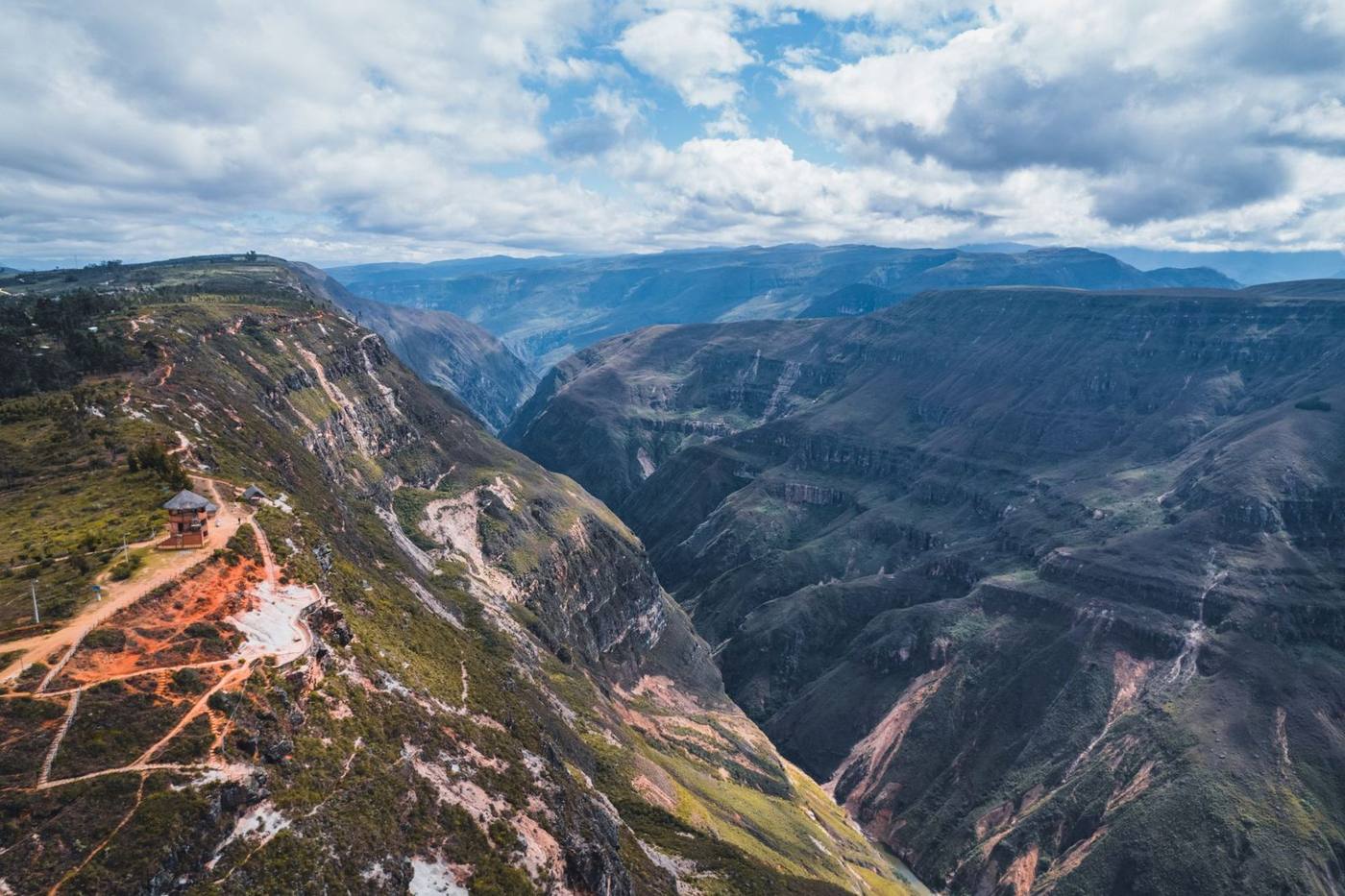
At dawn, leaving Chachapoyas, stop at the viewpoint over the Sonche canyon, near the village of Huancas. The canyon is hundreds of metres deep, with vertical walls and the morning mist rising from the bottom.
Then go to the village of Cocachimba, where the path to the Gocta waterfall begins. The waterfall drops in two tiers, about 770 metres in total, in the middle of the cloud forest. It was made known to the world only in 2006, although local people had always known it. The path climbs and descends through fields, forest and orchids, for two or three hours each way, to the foot of the lower tier, where the spray reaches you. Along the way you often see the cock of the rock, bright red. Check prices and times.
In the early afternoon leave for Chiclayo, on the coast. It is a very long transfer, of many hours: you go down towards the Marañón river, pass near Jaén and cross the Porculla pass, the lowest in the Peruvian Andes, to reach the coastal desert.
You arrive in Chiclayo late in the evening, tired.
Overnight in Chiclayo, for three nights.
Practical tip: today is a very heavy day. Leave Chachapoyas at dawn and bring lunch to eat after the walk. If you want a calmer pace, spend a night in Jaén or near Gocta and reach Chiclayo the next day, removing a day on the coast.
- Day 6
The Lord of Sipán and the pyramids of Túcume
Today you see the treasures of the Moche and a valley of pyramids.
In the morning go to Huaca Rajada, near the village of Sipán, east of Chiclayo. Here, in 1987, the Peruvian archaeologist Walter Alva discovered the intact tomb of the Lord of Sipán, a Moche ruler who lived about 1,700 years ago, buried with gold jewellery, warriors and servants. You see the adobe platforms, made of sun dried mud bricks, and the reconstructed tombs with copies of the grave goods. Check prices and times.
Then go to Lambayeque, to the Museo Tumbas Reales de Sipán, a pyramid shaped building. Here the original treasures are on display: necklaces with gold beads shaped like peanuts, ear ornaments with tiny warriors, sceptres and headdresses. You go down through the museum as if into a tomb, floor by floor. It is one of the finest archaeological museums in South America. Check prices and times.
In the afternoon go to Túcume, the valley of the pyramids, where dozens of large adobe pyramids, worn by rain and wind, rise around a rocky hill called Cerro Purgatorio. Walk up to the viewpoint on top of the hill, at sunset, to see all the pyramids from above. The Norwegian explorer Thor Heyerdahl also excavated here. Check prices and times.
In the evening return to Chiclayo.
Overnight in Chiclayo.
Practical tip: in the Museo Tumbas Reales photos are usually not allowed and you must leave backpacks at the entrance: ask about the rules at the ticket office. Go at opening time to avoid school groups.
- Day 7
The Chaparrí reserve and the spectacled bear
Today you explore the dry forest of the north coast.
Early in the morning drive east, towards Chongoyape and the Chaparrí reserve, about two hours. It is a protected area created and run by the local farming community, which chose to protect the forest and its animals instead of cutting the trees. It was one of the first private conservation areas in Peru.
The landscape is very different from the Andes: dry hills, algarrobo and palo santo trees, cacti and the Chaparrí mountain, sacred to the communities of the area. With a local guide you walk the paths of the reserve. This is home to the spectacled bear, the only bear in South America, with pale markings around its eyes. The reserve also has a centre where bears rescued from hunting or illegal trade live.
You also see many birds, such as the white winged guan, a large black bird with white wings that was thought to be extinct and has returned to live in the wild here thanks to a protection project, as well as hummingbirds, parrots and vultures.
In the afternoon return to Chiclayo. If you have time, visit the Chiclayo market, with stalls of medicinal herbs and the healers of the north.
In the evening taste arroz con pato, green rice cooked with coriander and dark beer and served with duck, the typical dish of Chiclayo.
Overnight in Chiclayo.
Practical tip: in the dry forest it is very hot by day and there is little shade. Leave early, bring plenty of water, a hat and long trousers against thorns and insects.
- Day 8
Pimentel, Monsefú, the Huaca El Brujo and Trujillo
Today you travel down the coast, among fishermen, craftspeople and an ancient queen.
In the morning go to Pimentel, the beach of Chiclayo, with its long wooden pier on the Pacific. Here fishermen still use caballitos de totora, small boats made of tied reeds, on which you go to sea sitting or kneeling, as the coastal peoples did thousands of years ago. Then pass through Santa Rosa, a fishing village with colourful boats on the beach.
Stop in Monsefú, the town of craftspeople, where straw hats, baskets, textiles and handmade embroidery are sold.
Then continue south, on the Pan-American Highway, to the El Brujo archaeological complex, near the sea, in the Chicama valley. Here, in the Huaca Cao Viejo, in 2006 the mummy of the Señora de Cao was found, a Moche woman who lived about 1,600 years ago, with her arms covered in tattoos of snakes and spiders, buried with weapons and jewellery. She was probably a ruler or a very powerful priestess. You also see walls painted with figures of warriors and prisoners, and the museum with the mummy. Check prices and times.
In the late afternoon you arrive in Trujillo, the great city of the north coast, with its colonial centre and houses painted in bright colours around the Plaza de Armas.
Overnight in Trujillo, for two nights.
Practical tip: in Trujillo get around by taxis called by your accommodation or through an app, even for short trips in the evening. Do not show your phone or camera in quiet areas.
- Day 9
The Huacas del Sol y de la Luna, Chan Chan and Huanchaco
Today you visit the two great civilisations of the north coast: the Moche and the Chimú.
In the morning go south of Trujillo, to the Huacas del Sol y de la Luna, at the foot of Cerro Blanco. They were the centre of the Moche capital. The Huaca del Sol is an enormous pyramid of adobe bricks, largely worn away. At the Huaca de la Luna you go in with a guide and see walls decorated with figures in colours that are still bright, red, yellow, white and black: the fanged god, spiders, snakes and warriors. The museum nearby tells the story of Moche life. Check prices and times.
In the afternoon visit Chan Chan, the capital of the Chimú kingdom, the largest adobe city in the Americas, a UNESCO World Heritage Site. It was conquered by the Incas shortly before the arrival of the Spanish. You visit the palace called Nik An, or Tschudi, with high mud walls decorated with fish, seabirds and waves, the ceremonial squares and the large reservoir. Check prices and times.
At sunset go to Huanchaco, a village of fishermen and surfers near Chan Chan. On the beach you see the caballitos de totora standing upright to dry, and fishermen coming back from the sea on the waves.
In the evening eat fresh fish in Huanchaco, for example a ceviche or a fish soup, and then return to Trujillo.
Overnight in Trujillo.
Practical tip: at Chan Chan and the Huacas the sun is strong and there is little shade. Bring water, a hat and sun cream. A single ticket is often valid for several Chan Chan sites: ask at the entrance.
- Day 10
The transfer to Huaraz
Today you leave the coast and climb into the northern Andes.
In the morning leave Trujillo by bus or with a driver towards Huaraz. It is a long journey, taking most of the day. You head south on the Pan-American Highway, along the coastal desert, passing through Chimbote, then climb from the coast towards the mountains. The road crosses dry valleys, villages and fields, and finally enters the Callejón de Huaylas, the great valley of the Santa river, between two mountain ranges: the Cordillera Negra, without snow, and the Cordillera Blanca, with its glaciers.
The Cordillera Blanca is the highest tropical mountain range in the world, with dozens of peaks above 6,000 metres, including Huascarán, the highest mountain in Peru. Much of it is protected by Huascarán National Park, a UNESCO World Heritage Site.
In the late afternoon you arrive in Huaraz, a city at about 3,050 metres, almost completely rebuilt after the 1970 earthquake. From the city, on clear days, you see the white peaks above the roofs.
In the evening eat lightly, drink plenty of water and a mate de coca. Rest: your body needs to get used to the altitude.
Overnight in Huaraz, for three nights.
Practical tip: going from sea level to more than 3,000 metres in a single day is something you feel. For the first two days avoid alcohol and effort. If you have a strong headache, nausea or shortness of breath even at rest, find a doctor and consider going down to a lower altitude.
- Day 11
The Pastoruri glacier and the Patococha lagoon
Today you climb up to a glacier, above 5,000 metres.
In the morning drive south, along the valley, then enter Huascarán National Park from the Pachacoto area. Check the park's prices and times. The road climbs into the puna, a high altitude grassland with yellow grass, vicuñas and small lakes.
Along the way stop at the Patococha lagoon, a high altitude lake that reflects the sky, and in the groves of Puya raimondii, an enormous plant of the pineapple family that grows only in the Andes. It lives for many decades and flowers only once, with a spike as tall as a house and thousands of flowers, then dies. You also see ancient rock paintings and springs of sparkling water.
Then you reach the foot of the Pastoruri glacier. From here you climb on foot, slowly, for about an hour, until you pass 5,000 metres, in front of the ice front and a small lake. The glacier has retreated a great deal in recent decades, and signs along the route explain the effects of climate change. If you are short of breath, stop or turn back: it is not a race.
In the afternoon return to Huaraz and rest.
In the evening have a hot soup for dinner, such as caldo de gallina, hen broth with potatoes and eggs.
Overnight in Huaraz.
Practical tip: at Pastoruri, climb only if you feel well after your first night in Huaraz. Walk very slowly and come down at once if you have a strong headache or dizziness. Bring warm clothes, gloves and sunglasses: up there the wind is icy and the sun very strong.
- Day 12
Chavín de Huántar
Today you visit one of the oldest sites in Peru.
In the morning leave Huaraz heading south east. The road passes near the Querococha lagoon, with the peaks reflected in it, then crosses the Cordillera Blanca through a high tunnel, below a pass, and goes down into the valley of the Mosna river, on the eastern side.
After a few hours you reach Chavín de Huántar, a UNESCO World Heritage Site. It was a great religious centre built about 3,000 years ago by the Chavín culture, long before the Moche and the Incas. Pilgrims came from all over ancient Peru. You see the squares, the stone platforms and the Old Temple.
The most incredible part is underground: a network of narrow, dark galleries, with channels for water and air. In one of them stands the Lanzón, a large granite monolith shaped like a lance, carved with a figure half human and half jaguar, with fangs. It is still in its original place, after three thousand years. Check prices and times.
Also visit the Chavín National Museum, which holds the cabezas clavas, carved stone heads that were fixed into the temple walls, with faces that turn into animals.
In the afternoon return to Huaraz.
Overnight in Huaraz.
Practical tip: the Chavín galleries are low and narrow: mind your head and talk to the guide if you suffer from claustrophobia. The national museum usually closes one day a week: check the opening times before you leave.
- Day 13
The Llanganuco lagoons and the Portachuelo pass
Today you enter the heart of the Cordillera Blanca.
In the morning leave Huaraz heading north, along the Callejón de Huaylas. Stop in Yungay, at the Campo Santo: here on 31 May 1970 an earthquake broke off a huge avalanche of ice and rock from Huascarán, which buried the town and thousands of people. Today it is a place of remembrance, with gardens, the large statue of Christ and the four palm trees left from the old square.
Then climb towards the Llanganuco valley, in Huascarán National Park. The road passes between two turquoise lagoons, Chinancocha and Orconcocha, surrounded by woods of queñual, Andean trees with red bark that peels like paper, and below very high rock walls.
Then the road climbs through many bends to the Portachuelo pass, at almost 4,800 metres. From the top you see Huascarán up close, the highest mountain in Peru, and a line of other ice covered peaks. It is one of the finest views in the Andes.
In the afternoon go down to the camp in the valley, at the foot of the mountains, where you will spend the night in a tent. It gets cold as soon as the sun sets.
Overnight in a tent in the Llanganuco valley.
Practical tip: at the Portachuelo pass get out of the car calmly and walk slowly: you are very high. In the rainy season the road can be closed by landslides or snow, so ask before you set off.
- Day 14
The trek to Laguna 69
Today you walk to one of the most famous lagoons in the Andes.
Early in the morning set off on foot from the camp. The path first crosses a flat valley with a stream, cows grazing and waterfalls coming down the walls. Then it starts to zigzag upwards, onto a first step, to a hollow with a small lake and a meadow. From here you can already see Chacraraju, a steep, pointed peak covered in ice.
The last stretch is the hardest: a steady climb to about 4,600 metres, where the air is very thin. Walk slowly, breathe deeply and stop often. The climb takes about three hours in total.
At the end Laguna 69 appears, a lake of an intense, almost unreal blue, at the foot of the Chacraraju wall, with a waterfall coming down from the glacier. Sit down and rest: the reward is great. Do not swim, the water is icy.
Then go down the same path, about two hours, to the starting point. There the car is waiting to take you back to Huaraz, a few hours on the road.
In the evening, in Huaraz, celebrate with a hot dinner and a pisco sour.
Overnight in Huaraz.
Practical tip: Laguna 69 comes after only a few days at altitude. If you feel a strong headache, nausea or dizziness, stop and turn back: the lagoon is not worth your health. Leave early to avoid the afternoon clouds and rain. Check the park's prices and rules.
- Day 15
Back to Lima
Today you come down from the Andes to the ocean.
In the morning leave Huaraz by bus towards Lima, a long day on the road. The road climbs the valley to the Conococha plateau, near a large lagoon where the Santa river rises, and then descends a long dry valley to the coast, at Pativilca. From here the Pan-American Highway runs along the desert and the sea to Lima.
Along the road near Pativilca and Barranca, in the Supe valley, lies Caral, the oldest city in the Americas, with pyramids built almost five thousand years ago. If you have a driver and some time, you can ask for a detour, but the visit takes half a day. Check prices and times.
In the late afternoon you arrive in Lima. Settle into Miraflores or Barranco, the artists' district, with colourful nineteenth century houses, murals and the Puente de los Suspiros, the Bridge of Sighs.
At sunset walk along the cliffs, watching the paragliders and the sun going down into the ocean.
In the evening try Nikkei cuisine, born from the meeting of Japanese and Peruvian cooking, or a tiradito, thinly sliced raw fish with a spicy sauce.
Overnight in Lima, for one night.
Practical tip: travel on long distance buses only by day and choose companies with a good reputation, with numbered seats and luggage checks. Keep your passport, money and phone with you, never in the hold.
- Day 16
Lima and the flight home
Today is your last day in Peru.
In the morning visit the historic centre of Lima, a UNESCO World Heritage Site: the Plaza Mayor with the cathedral and the government palace, the dark wooden balconies of the colonial houses and the convent of San Francisco, with its old library and underground catacombs. Check prices and times.
Then go to the Larco Museum, in the Pueblo Libre district, in a colonial mansion with a flowering garden. Here you find again the cultures you saw in the north: Moche ceramics, with portraits of people so realistic that they look like photographs, Chimú textiles, the gold of Lambayeque and Chavín vessels. After the trip, every room will have a new meaning. Check prices and times.
For lunch have a last ceviche, or an arroz con mariscos, rice with seafood, and a Lima dessert such as suspiro limeño, milk caramel cream with meringue.
In the afternoon go back to your accommodation, pack your bags and head to the airport. Lima has very heavy traffic: leave with plenty of time.
In the evening or during the night take the flight to Italy, almost always with a stop in Europe or in the Americas.
Overnight on the plane.
Practical tip: do not buy archaeological objects, even if the seller says they are copies: taking ancient artefacts out of Peru is forbidden and can land you in court. Buy only modern crafts and ask for a receipt.
- Day 17
Arrival in Italy
Today you arrive home.
You land in Italy after the long flight, with jet lag to recover from: in winter Peru is six hours behind Italy, in summer seven. In the first days rest and drink plenty.
In these seventeen days you have seen a Peru that few people know: the walls of Kuélap and the sarcophagi of Karajía, the Revash tombs and the Leymebamba mummies, the Gocta waterfall, the gold of the Lord of Sipán and the pyramids of Túcume, the spectacled bear of Chaparrí, the Señora de Cao, Chan Chan and the caballitos de totora, and then the glaciers of the Cordillera Blanca, Chavín and Laguna 69.
When to go: the trip can be done all year round. In the mountains of Chachapoyas and Huaraz the driest period is from May to October, with clearer skies and better paths; from December to March it often rains, there are landslides and the peaks are more hidden by clouds. On the north coast, by contrast, it hardly ever rains and from December to March it is summer, with sunshine and heat, while from June to September the sky is greyer and cooler. In the years of the phenomenon called El Niño the coast can have heavy rain and floods.
If you want to return to Peru, the south is waiting for you, with Cusco, Machu Picchu and Lake Titicaca.
Practical tip: if in the next few weeks you have a fever, diarrhoea that does not stop or an unusual cough, see a doctor and tell them you have been in Peru, both at high altitude and in the warm areas near the Amazon.
The right route for anyone who has already seen Cusco and Machu Picchu, or wants a less crowded Peru: first-rate archaeology, excellent museums and a mountain finale. The drawback is the transfers, long and on slow roads, especially between Chachapoyas and the coast. Laguna 69 comes after only a few days at altitude and you will feel it: walk slowly and drink plenty.
Before you go
- Documents and visa
- Passport with at least six months' validity on arrival; no visa is needed for tourism, up to a maximum of 183 days.
- Health and vaccines
- No compulsory vaccines for Lima and the Andes; yellow fever vaccination is recommended for the Amazon. Beware of altitude sickness in Cusco and the Andes. Emergencies: 105 police, 116 fire.
- Money and payments
- Peruvian sol. Cards work in cities and hotels; in markets, villages and for tips you need cash.
- Power sockets
- Types A and C, 220 volts: you may need an adapter for flat-pin sockets.
- Time zone
- UTC-5 all year: Peru does not use daylight saving time.
- Safety
- The United States rates Peru level 2. Avoid the Apurímac, Ene and Mantaro valley (VRAEM), the Colombian border in Loreto and some rural areas named by governments. Official advice: GOV.UK.
Information checked in November 2026 for Italian and EU citizens. Rules change: always check before you travel.
Variations
In 12 days: drop Huaraz and the Cordillera Blanca and fly back to Lima from Trujillo after Chan Chan.
In 21 days: add three or four days of trekking in the Cordillera Blanca, for example the Santa Cruz circuit, and a night at Caral on the way to Lima.
Frequently asked questions
How do you get to Chachapoyas?
The most common way is to fly from Lima to Tarapoto or Jaén and then continue by car for many hours. There are also night buses from Chiclayo, but it is better to travel by day, with a driver who knows the mountain roads.
Is Laguna 69 difficult?
It is a full day walk, with about three hours of climbing to about 4,600 metres and two hours of descent. It is not technical, but the altitude makes it tiring. First spend at least two or three nights in Huaraz and do the Pastoruri trip, and talk to your doctor before the trip.
Is northern Peru safe?
The areas of this trip are not among those the United States and the United Kingdom advise against. In Trujillo, Chiclayo and Lima, however, crime is high and there is sometimes a state of emergency: use taxis called by your accommodation or through an app, do not travel by road at night and follow local news.
Indicative itinerary written by World Atlas. Before booking, check timetables, seasonal openings, documents and safety.
 23 daysModerate
Active Peru: Apurímac rafting, Salkantay and the Tambopata forest
You reach Machu Picchu on foot over the Salkantay pass after two days on the river, then drop into the Amazon before the classic southern loop.
 17 daysChallenging
The Ausangate circuit and Machu Picchu from the forest
Six days around Cusco's sacred mountain, 6,384 metres, over passes above 5,000, past coloured lakes and alpaca herds, after reaching Machu Picchu on foot.
 29 daysModerate
Peru and Bolivia: from the northern coast to the Uyuni salt flat
A month on the road from Chan Chan to Machu Picchu by way of Huaraz, Nazca, Titicaca, La Paz and the high lagoons of southern Bolivia.