Havana and Varadero
Four days in the Caribbean's most musical capital and three days on Cuba's most famous beach.
- Havana
- Matanzas
- Varadero
Day by day
- Day 1
Arrival in Havana
This trip is the simplest Cuban week: four days in Havana, the most musical capital in the Caribbean, a stop in Matanzas, the city of bridges, and three days on the beach at Varadero, the most famous in Cuba, with short transfers.
Before you go: Italian citizens enter Cuba with a passport valid for at least six months after the date of arrival; the electronic identity card is not enough. You need the tourist card, the tourist visa, now issued in electronic form, then the online D'Viajeros form to fill in within 72 hours before arrival, a return ticket and health insurance covering medical costs in Cuba, which is compulsory on entry. The rules change often: check them on the website of the Cuban embassy before you leave. Other nationalities should check their own rules. Some areas on this trip are close to borders or places where the situation changes often: check your government's travel advice before booking and again before you leave.
Power cuts and shortages of fuel and medicines are common on the island: bring a power bank, a torch, your own medicines and cash in euros, because foreign cards often do not work.
You land at José Martí airport, about half an hour from the centre. Use an official taxi or a transfer booked through your accommodation, and choose a room in a registered casa particular, with the sign on the door, in Old Havana or in Vedado.
In the evening, take a short walk near your accommodation and rest. Sleep in Havana, for four nights.
Practical tip: bring euro notes in small denominations, because it is often hard to get change.
- Day 2
Old Havana on foot and the four squares
Today you explore Habana Vieja on foot, the historic centre and a UNESCO World Heritage Site. The narrow streets, iron balconies and courtyards full of plants tell four centuries of history, between restored mansions and houses falling to pieces.
The easiest way to find your bearings is to follow the four squares. Start in the Plaza de Armas, the oldest, with its trees, second hand book stalls and the Castillo de la Real Fuerza. Then go to the Plaza de la Catedral, with the baroque cathedral and its stone façade, and the Plaza de San Francisco, open to the harbour, with the basilica and the lion fountain. Finish in the Plaza Vieja, with its colourful mansions and arcades. Check prices and times for the museums.
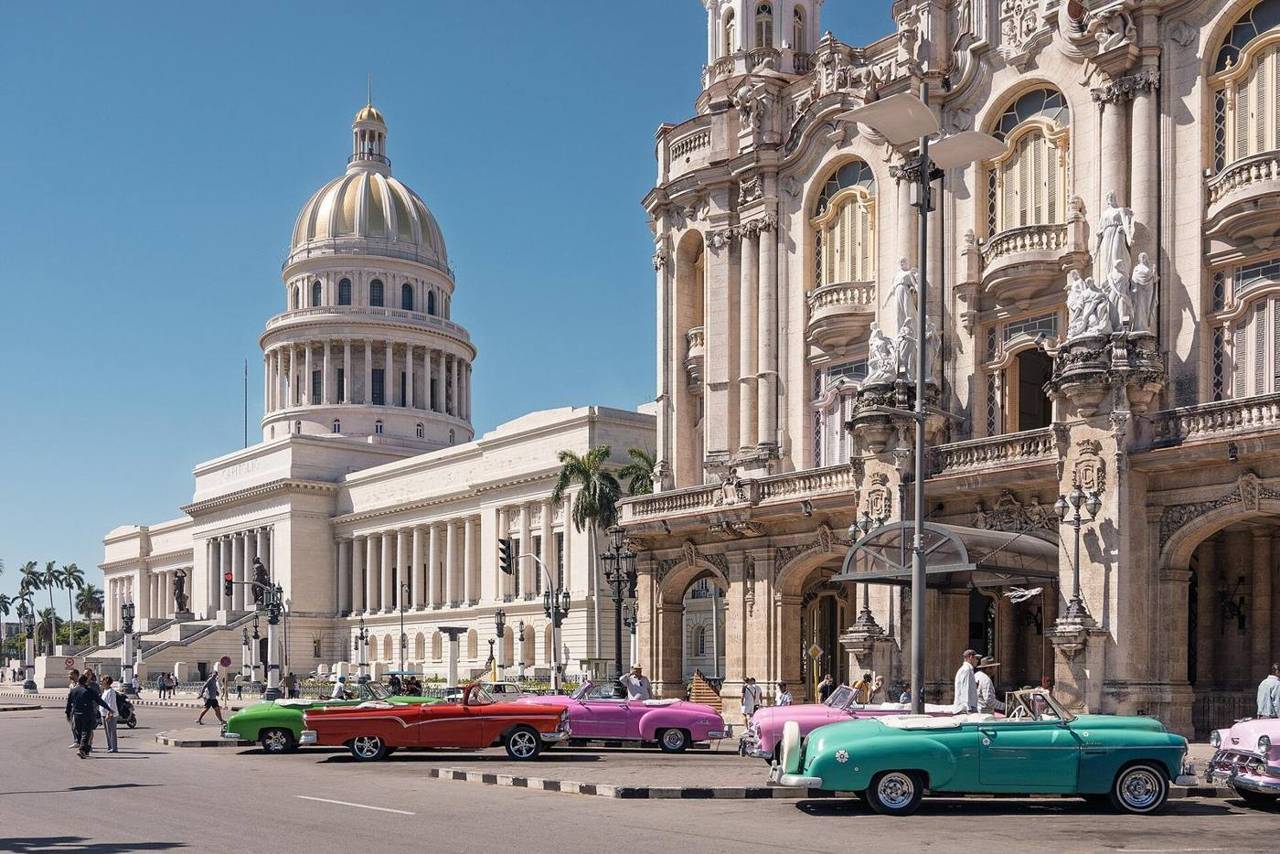
In the afternoon, walk along calle Obispo, the busy pedestrian street, to Parque Central, the Capitolio with its great dome and the Gran Teatro.
In this area there are also the two bars linked to Ernest Hemingway, famous for the mojito and the daiquiri: they are always crowded and expensive, but many visitors stop by at least for a photo.
In the evening, have a typical dish for dinner, such as ropa vieja, shredded beef in tomato, with rice and black beans.
Practical tip: wear your backpack on your front in crowded streets and do not keep taking your phone out, because thefts are on the rise.
- Day 3
Vedado, the Malecón in a vintage car and art in the evening
Today you discover modern Havana. In the morning, go to Vedado, the district built between the late nineteenth century and the 1950s, with tree lined avenues, elegant villas and large buildings. Pass the university, with its long stairway, and reach the Plaza de la Revolución, the vast square with the memorial to José Martí and the portraits of Che and Camilo Cienfuegos on the façades of the ministries.
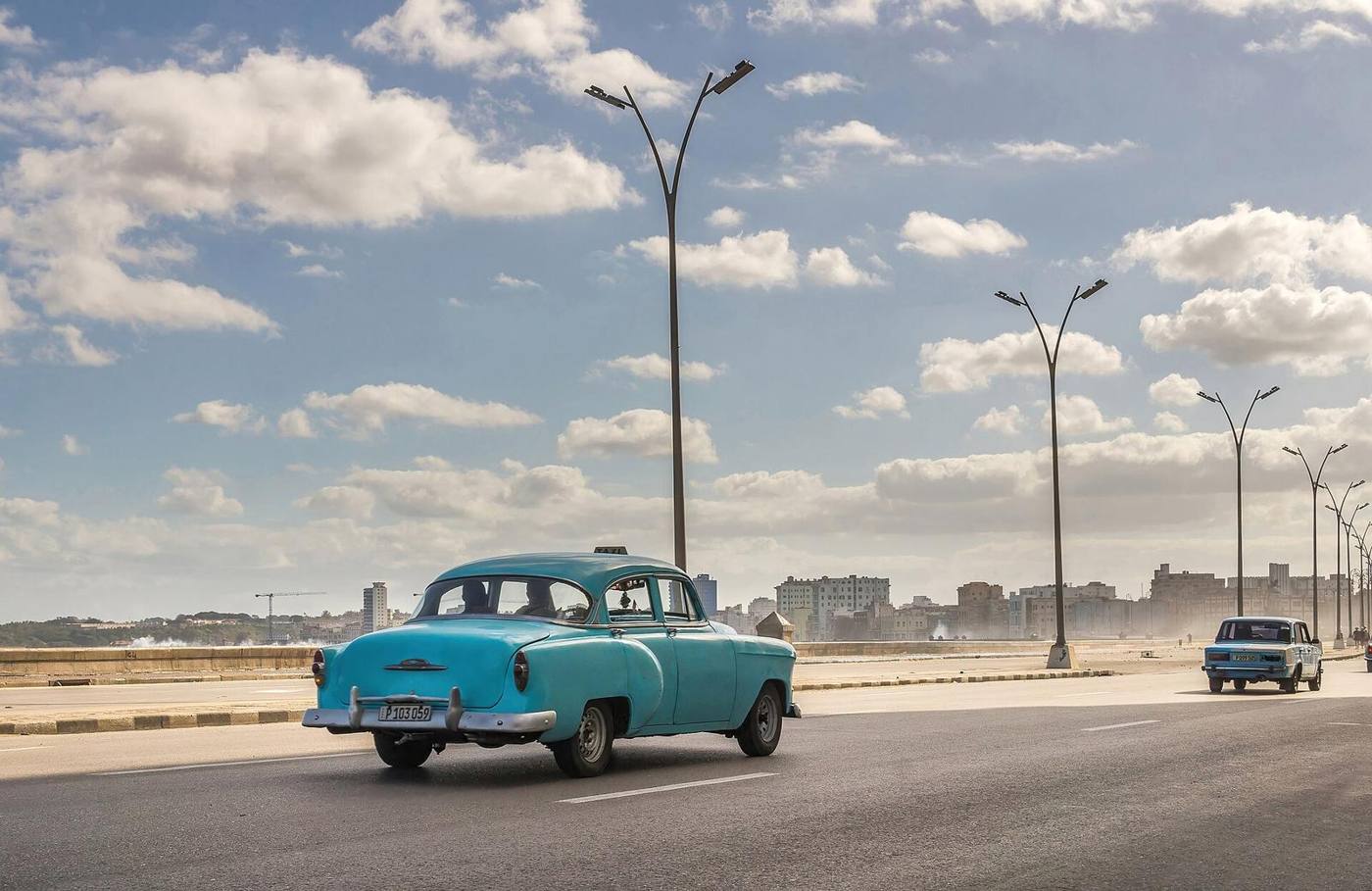
In the afternoon, take a vintage American car, one of the colourful convertibles from the 1950s, for a ride along the Malecón, the seafront, about eight kilometres long, which links the centre to Vedado. Agree the price and length of the ride before you get in. Stop at sunset and sit on the wall: the waves reach the road, and Cubans fish, chat and play music.
In the evening, go to a large art space in Vedado, set in an old factory, with exhibitions of contemporary art and photography, concerts and music until late. Check prices and times, because opening nights change and can be cancelled during power cuts. Before that, have an early dinner in one of the streets of the district, where there are many small family run places.
Vedado is big and it is dark at night: get around by taxi, not on foot.
Practical tip: for the vintage car, choose one with insurance and the official taxi sign, and ask to see the route before you set off.
- Day 4
The Callejón de Hamel and the Morro fortress
Today is a day for Afro-Cuban culture and fortresses. Around midday, go to the Callejón de Hamel, a small alley in the Centro Habana district transformed since the 1990s into an open air gallery. Painted walls, sculptures made from bathtubs and recycled objects, poetic phrases and symbols of Santería, the Afro-Cuban religion.
On Sundays at noon the alley fills up for the rumba: drums, songs and dances that come from the African tradition. If you are here on another day, ask when there are concerts or visits. Check times.
In the afternoon, cross the bay, by taxi through the tunnel or on the small ferry when it runs, to the Castillo de los Tres Reyes del Morro, the fortress that has guarded the harbour entrance since the late sixteenth century, with its lighthouse. From the walls you see all of Havana and the Malecón. Inside the fortress there are small rooms with cannons and stories of pirates and sieges.
Stay for the sunset, when the city turns golden. Nearby is the great fortress of La Cabaña: every evening at nine, soldiers dressed as in the eighteenth century fire the cañonazo, the cannon shot that once announced the closing of the city gates. Check prices and times.
Practical tip: agree the return trip from the fortress with your taxi too, because in the evening it is hard to find a car on the other side of the bay.
- Day 5
Matanzas, the city of bridges, and Varadero
Today you leave Havana heading east, along the Vía Blanca, the coast road, which runs close to the sea among hills, fields and small villages. After about an hour and a half, stop at the viewpoint of the Bacunayagua bridge, the highest in Cuba, above a green valley full of palms that runs down to the sea.
Soon afterwards you reach Matanzas, called the city of bridges because two rivers, the Yumurí and the San Juan, cross it before reaching the bay. It is also known as the Athens of Cuba, for the poets, musicians and writers born here. Matanzas is considered the cradle of the danzón and the rumba.
Stroll through the centre, around Parque de la Libertad. Visit the old pharmacy museum, a nineteenth century pharmacy with porcelain jars and wooden shelves, and look at the Sauto theatre, one of the most beautiful on the island. Check prices and times.
In the afternoon, continue to Varadero, about half an hour by road. The town covers the Hicacos peninsula, a long strip of land between the bay and the open sea, with a white sand beach about twenty kilometres long.
You arrive in time for your first swim at sunset. Sleep in Varadero, for three nights.
Practical tip: in Matanzas, eat something simple before setting off again, because there are few places open along the road.
- Day 6
Varadero and the beach
Today is a beach day. Varadero is the most famous seaside resort in Cuba: the sand is white and fine, the water is turquoise, shallow near the shore and usually calm. It is a sea suited even to children and weak swimmers.
In the morning, walk along the shore towards the less crowded stretches. In the part nearest the town the beach is livelier, with low houses, kiosks and Cubans on holiday, while towards the tip of the peninsula there are mainly large tourist resorts.
Near the end of the peninsula there is a small nature reserve, with low woodland of cactus and coastal trees, short trails and the Cueva de Ambrosio, a cave with ancient drawings left by the island's original inhabitants. Check prices and times.
In the hottest hours, rest in the shade of the palms and drink plenty of water. In the afternoon you can snorkel where there are rocks, rent a kayak or simply read on the sand.
Varadero is beautiful but very touristy. If you want to see Cuban life, walk in the evening through the old part of town, where families sit outside their houses and children play in the street.
Practical tip: Varadero is long and narrow, so to get from one end to the other use taxis or the small tourist bus, when it runs.
- Day 7
By catamaran to Cayo Blanco
Today you head out to sea. From the Varadero marina, catamaran trips leave for Cayo Blanco, a small islet with a white beach and shallow water, about an hour's sailing away.
The catamaran usually leaves in the morning. On the way you see the coast of the peninsula and the sea changing colour, from dark blue to turquoise. The first stop is on the coral reef, for snorkelling: with a mask and fins you see corals, sea fans and tropical fish of many colours. If you are not a strong swimmer, ask for a life jacket.
Then the boat stops at Cayo Blanco, where you can swim, walk on the sand and rest in the shade. The programme often includes a simple lunch of fish or chicken, music on board and a few drinks. Check prices and times and ask what is included, because programmes often change with the season and the fuel available.
In the afternoon you return to Varadero. Spend your last evening on the beach, watching the sunset over the sea.
If the sea is rough, the trip may be cancelled: in that case spend the day on the beach or take a walk in the nature reserve on the peninsula.
Practical tip: use water resistant sunscreen and wear a light T-shirt, because on the boat the wind keeps you cool and you do not notice how strong the sun is.
- Day 8
Departure
Today you leave Cuba. Varadero has an international airport about half an hour from town; if you are flying from Havana instead, allow about two and a half hours by road and leave well in advance. In the morning, if you have time, have a last swim in the calm water.
In these eight days you have seen the most accessible Cuba: the four squares of Old Havana, the Capitolio and calle Obispo, Vedado and the Malecón in a vintage car, the art of the Callejón de Hamel and the rumba, the Morro fortress at sunset, the bridges and theatre of Matanzas, the white beach of Varadero and the sea at Cayo Blanco.
Havana deserves at least three full nights. Varadero is beautiful but very touristy: if you want more authentic beaches, choose Playa Larga, on the Bay of Pigs, or the northern cays.
When to go: the best period runs from November to April, with dry weather and a calm sea. From June to November it is very hot, it often rains in the afternoon and it is hurricane season.
Before you leave, buy something to take home: coffee, rum, cigars with the official receipt for customs, or a work by a Havana artist.
Practical tip: keep some cash for the taxi and something to eat while you wait, because services at the airport may be limited.
The simplest Cuban week: city and sea with short transfers. Havana deserves at least three full nights. Varadero is beautiful but very touristy: for more genuine beaches, choose Playa Larga or the northern cayos.
Before you go
- Documents and visa
- Passport valid for at least six months after arrival. You need a tourist visa (the tourist card), now issued only in electronic form: apply online on the official eVisa platform, at a Cuban consulate or through an agency; it is valid for up to 90 days and can be extended in Cuba. After the visa, fill in the online D'Viajeros form within 72 hours before arrival and carry the printed QR code. You also need a return or onward ticket. Anyone who has been in Cuba on or after 12 January 2021 can no longer use ESTA for the United States and must apply for a US visa.
- Health and vaccines
- Health insurance covering medical costs in Cuba is compulsory on entry; it is best if it includes repatriation. Hospitals are struggling and often lack medicines and supplies: bring a stock of your own medicines and a first aid kit. Dengue, chikungunya and Oropouche are present: use repellent all day. Drink only bottled water, without ice. No vaccinations are compulsory: ask your doctor.
- Money and payments
- Cuban peso. Since 6 June 2026 Visa and Mastercard cards are no longer accepted and you cannot withdraw cash from ATMs with foreign cards; cards on US networks do not work either. Bring cash in euros or dollars for the whole trip and for emergencies, and change money only at Cadeca offices: changing on the street is illegal. Amounts over 5,000 dollars, or the equivalent, must be declared on arrival.
- Power sockets
- Types A, B, C and L, at 110 volts in most of the country and 220 volts in some newer hotels: bring an adaptor and check that your devices accept 110 volts.
- Time zone
- UTC-5, UTC-4 in summer.
- Safety
- Cuba is going through a severe crisis of fuel, electricity, water and medicines, with long power cuts across the country, cancelled flights and unreliable domestic transport; the UK advises against all but essential travel to the whole island. In the east, after Hurricane Melissa in October 2025, electricity and water remain severely limited. Theft and bag snatching are rising, especially in Havana: do not walk at night, use licensed taxis, do not change money on the street and stay only in registered accommodation. Bring a power bank and a torch. Official advice: GOV.UK.
Information checked in November 2026 for Italian and EU citizens. Rules change: always check before you travel.
Variations
In 5 days: three days in Havana and two in Varadero, with the stop in Matanzas on the way.
In 11 days: add three days in Viñales and Trinidad, or two nights at Playa Larga, on the Bay of Pigs, for diving.
Frequently asked questions
What documents do I need for Cuba?
Italian citizens enter with a passport valid for at least six months, the electronic tourist card, the online D'Viajeros form and compulsory health insurance. The rules change often: check them before you leave. Other nationalities should check their own rules.
How far is Varadero from Havana?
About two and a half hours by road along the coast. You can stop in Matanzas halfway. With the fuel shortage, confirm your car or transfer the day before.
When can you hear rumba at the Callejón de Hamel?
Usually on Sundays at noon, but times can change. Ask your accommodation before you go and keep an eye on bags and phones in the crowd.
Indicative itinerary written by World Atlas. Before booking, check timetables, seasonal openings, documents and safety.
 7 daysEasy
Havana, Viñales and Trinidad
The capital of vintage cars and music, the tobacco valley and the island's most beautiful colonial town.
 15 daysModerate
Cuba from west to east, to Santiago
The whole island: Havana, Viñales, the colonial towns of the centre, the Sierra Maestra, Santiago and a few days by the sea.
 11 daysEasy
Cuba express: Havana, Viñales and Trinidad
The heart of Cuba in under two weeks: colonial Havana, the tobacco valleys of Viñales, timeless Trinidad and the Bay of Pigs.