Beijing, Xi'an and Shanghai
A first trip to China: the Forbidden City and the Great Wall, the Terracotta Army of Xi'an, the gardens of Suzhou and the Shanghai skyline, linked by high-speed train.
- Beijing
- Mutianyu
- Xi'an
- Suzhou
- Shanghai
Day by day
- Day 1
Arrival in Beijing and a first evening in the hutong
Until 31 December 2026 Italian and many other European citizens can enter China without a visa for stays of up to 30 days for tourism; check before you go whether the scheme has been extended and whether it covers your nationality. Your passport must have at least six months' validity. Before leaving, install the Chinese payment apps, Alipay and WeChat, linking them to your card: in China almost everything is paid by QR code. Many Western websites and apps, such as Google and WhatsApp, are blocked; find out beforehand how to stay in touch.
Beijing Capital Airport is linked to the centre by an express train in about half an hour. To stay, choose Dongcheng, near the Forbidden City and the hutong, traditional lanes with courtyard houses.
In the afternoon, after the long flight, walk around Houhai Lake and the nearby hutong, such as Nanluoguxiang and the lanes around the Drum and Bell Towers, which once marked the city's hours. Many courtyard houses are still lived in: look discreetly.
In the evening try Peking duck, the city's signature dish, served sliced with thin pancakes, spring onion and sweet sauce. Practical tip: Beijing's metro is fast and clean, with signs in English too; you pay with the apps' QR code or tickets from machines. Always carry your passport, as it is often requested.
- Day 2
The Forbidden City and Tiananmen Square
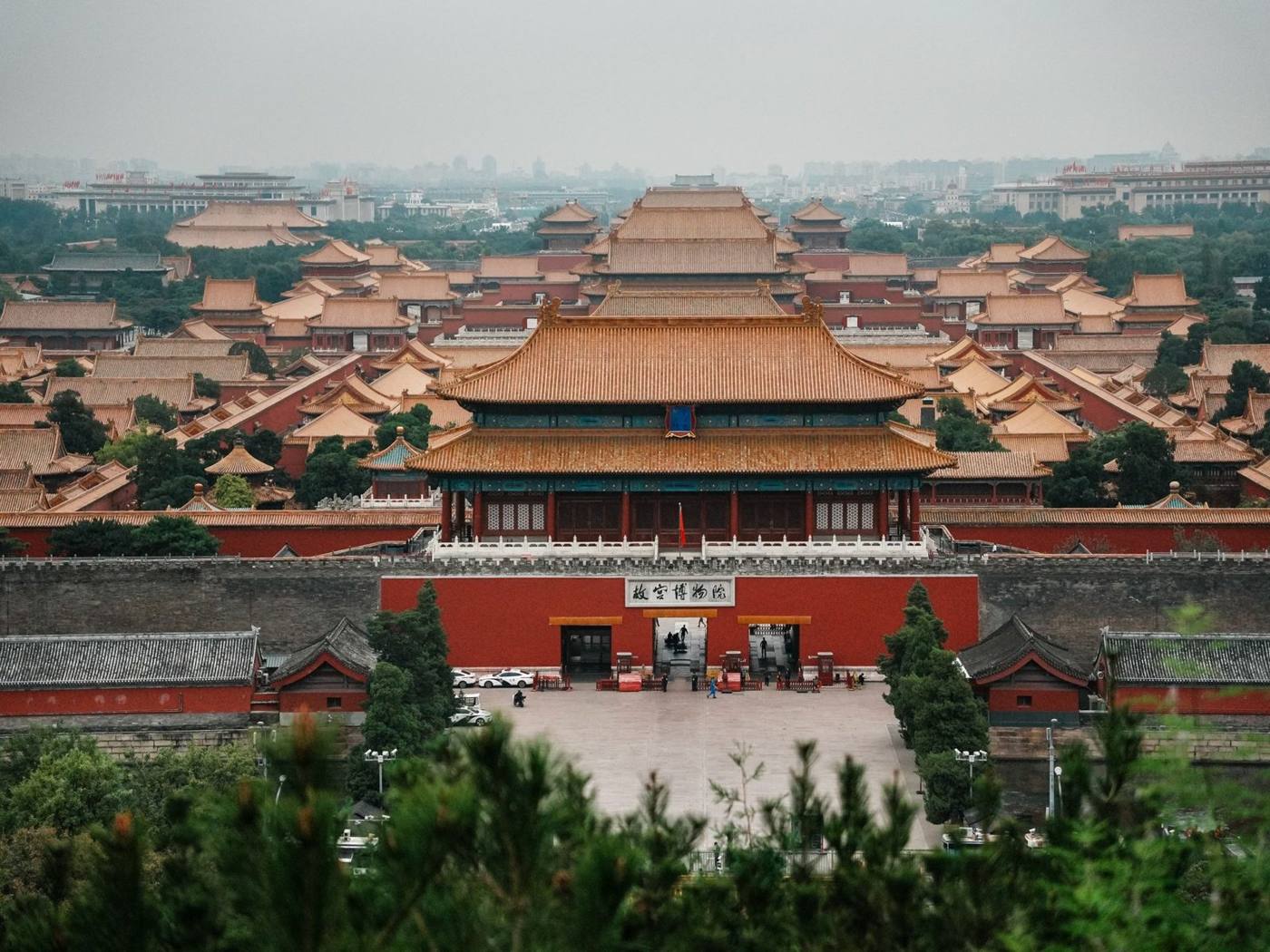
Today is the heart of imperial China. The Forbidden City, palace of the Ming and Qing emperors for almost five centuries, is the largest complex of ancient palaces in the world, a UNESCO World Heritage site. Tickets are sold online only, with your passport number, from seven days ahead; for busy dates they sell out in minutes. The ticket costs 60 yuan from April to October and 40 from November to March; the museum closes on Mondays. At the entrance you need the original passport used for the booking.
You enter from the Meridian Gate in the south and cross great courtyards to the three main halls, with yellow roofs reserved for the emperor. Side halls house the Treasure and Clock galleries, with small extra tickets. Allow at least three or four hours and comfortable shoes.
Leaving through the north gate, climb the hill in Jingshan Park: from the top you see the whole Forbidden City, a sea of golden roofs, especially beautiful in the late afternoon.
Tiananmen Square, south of the palace, is one of the largest squares in the world, with Mao's mausoleum and the great National Museum. Entering the square requires a separate booking with your passport, and there are security checks. Practical tip: do not let yourself be approached by people offering art exhibitions or tea ceremonies: they are common scams in the area.
- Day 3
The Temple of Heaven and the Summer Palace
Early in the morning go to the Temple of Heaven, where emperors prayed for a good harvest. The surrounding park is one of Beijing's liveliest places at dawn: hundreds of retirees practise tai chi, dance, sing, play cards and shuttlecock. It is everyday Beijing, welcoming and serene. The Hall of Prayer for Good Harvests, round with three blue roofs, is a masterpiece of wooden architecture built without nails.
In the afternoon take the metro to the Summer Palace in the north-west of the city, an immense imperial garden on Kunming Lake, a UNESCO World Heritage site, the court's summer residence. Walk along the Long Corridor, a covered gallery of more than seven hundred metres with thousands of paintings on its beams, to the Marble Boat built for Empress Cixi. Climb Longevity Hill for the view over the lake, or take a boat ride.
In spring and autumn the park's colours are beautiful; in winter the lake freezes and becomes a skating rink.
In the evening return to the centre and stroll along pedestrian Wangfujing street, with its department stores and lanes of street food. Practical tip: the Summer Palace is large; enter by the east gate and leave by the north gate so as not to walk the same way twice, and allow at least three hours.
- Day 4
The Great Wall at Mutianyu
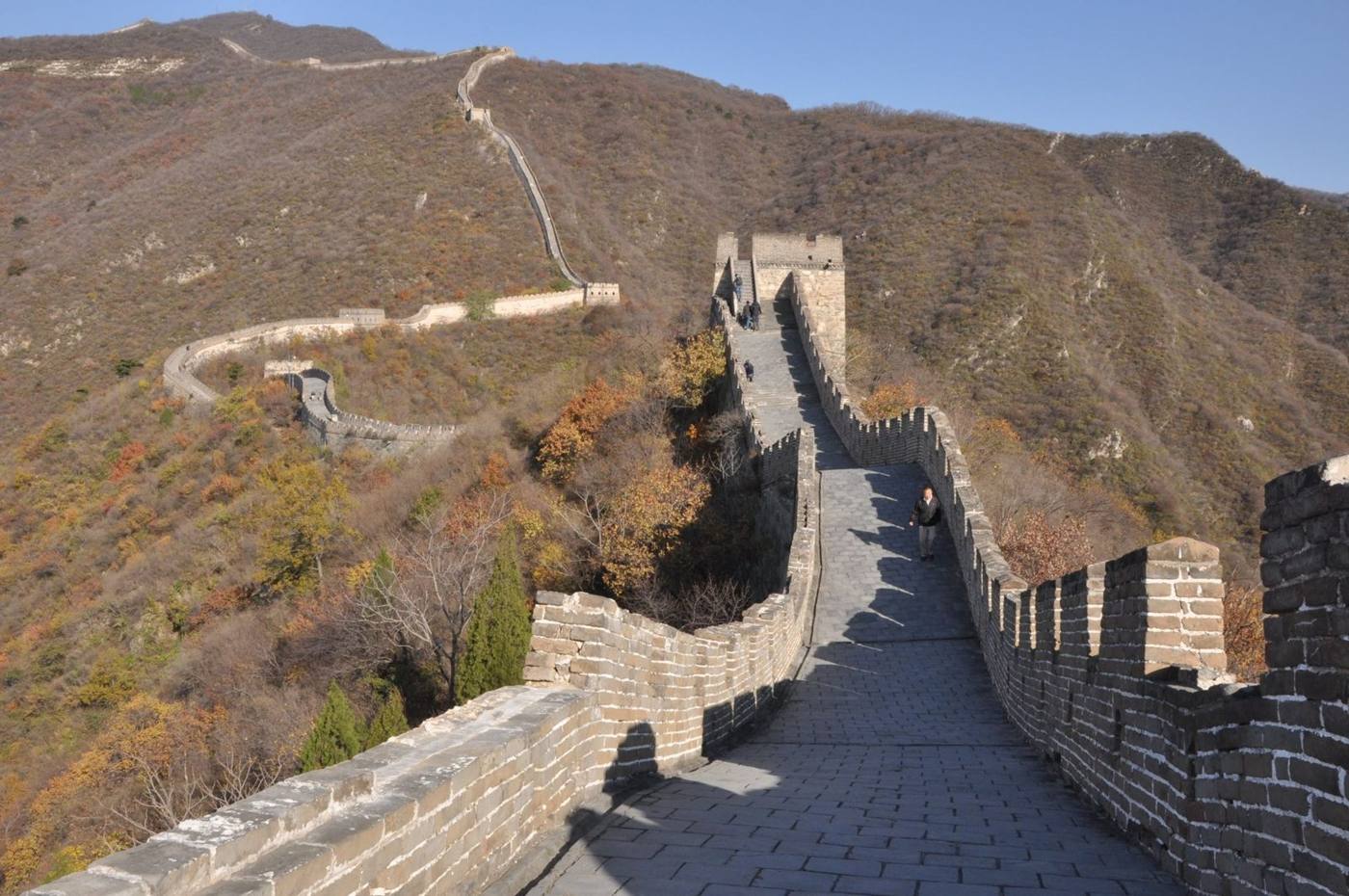
Today is the Great Wall. The Mutianyu section, about an hour and a half from central Beijing, is the most suitable for a day trip: restored but less crowded than Badaling, with twenty-three watchtowers along the crest of wooded mountains. You go up by cable car or chairlift, or on foot by a long staircase. Here too you book online with your passport.
On the Wall you walk between towers, with steep climbs and descents on uneven steps; the mountain views are spectacular in every season, especially in autumn with red leaves and in winter with snow. You come down by cable car or by toboggan, a kind of sledge on a track, great fun.
The Wall is not a single wall but a series of fortifications built and rebuilt over more than two thousand years; the sections we see today around Beijing are mainly from the Ming era, the fifteenth and sixteenth centuries.
To reach Mutianyu there are tourist buses from the centre, cars with drivers or organised tours. For a wilder experience you can walk the unrestored Jiankou section, only with an experienced guide: it is dangerous, with collapsed passages.
In the evening return to the city and rest. Practical tip: wear shoes with good soles and bring water and a hat; in summer it is hot with little shade, in winter the wind at the top is icy.
- Day 5
The high-speed train to Xi'an and the city walls
In the morning take the high-speed train from Beijing to Xi'an: about five hours across the plains of northern China at over three hundred kilometres an hour. Chinese trains are punctual and comfortable; tickets are bought with your passport on the official railway app or travel apps, and at the station you pass security checks. Arrive at least an hour early.
Xi'an was China's capital for thirteen dynasties and the starting point of the Silk Road towards Central Asia. To stay, choose the centre inside the walls, convenient for walking.
In the afternoon climb onto the city walls, the most complete and best preserved in China, from the fourteenth century: a rectangle of almost fourteen kilometres, as wide as a road. The best way to ride them is by bicycle, rented on the walls themselves, in about two hours. From above you see the old and new city, the monumental gates and the towers.
At sunset visit the Bell Tower and Drum Tower in the centre, lit up at night.
In the evening enter the Muslim Quarter, home to the Hui community for centuries, with streets full of stalls: lamb skewers, bread crumbled into lamb broth called paomo, hand-pulled noodles and rice sweets. Practical tip: the quarter is extremely crowded in the evening; keep an eye on your wallet and phone.
- Day 6
The Terracotta Army
Today is Xi'an's most famous visit: the Terracotta Army, about an hour from the city, discovered by chance in 1974 by farmers digging a well. It is part of the great funerary complex of Qin Shi Huang, the first emperor of unified China, from the third century BC, a UNESCO World Heritage site. The ticket costs 120 yuan and covers the museum and the mausoleum park, with a no-cost shuttle between them; book online with your passport.
In Pit One, covered by a huge hangar, thousands of life-size clay soldiers stand in battle formation: each has a different face, hairstyle and armour. In Pits Two and Three you see archers, horses and chariots, and archaeologists still at work. The museum displays two bronze chariots with horses and drivers, extraordinary in their detail.
A guide helps a great deal in understanding the story: there are licensed guides at the entrance, or an audio guide. Allow half a day.
To get there take a bus from Xi'an's east station or the metro to the nearest station, then a shuttle. On the way back, in the late afternoon, visit the Big Wild Goose Pagoda, from the seventh century, linked to the monk Xuanzang who brought Buddhist texts from India. Practical tip: do not buy tickets from sellers outside the site; use only the official website or reliable apps.
- Day 7
Xi'an in depth: museums and calligraphy
A quieter day to get to know Xi'an. In the morning visit the Shaanxi History Museum, one of China's richest museums, with objects from every dynasty, from ritual bronzes to Tang ceramics with colourful camels and horses. Main entry is at no cost but booked online with your passport, and places are limited; the section with Tang tomb murals has a separate ticket.
Alternatively visit the Forest of Steles, a museum in the old Confucian temple with thousands of stone slabs carved with classical texts and the calligraphy of great masters: the stone archive of Chinese culture. Outside, Shuyuanmen street is full of shops selling brushes, rice paper, ink and seals.
In the afternoon visit the Great Mosque in the Muslim Quarter, founded in the eighth century and rebuilt in the Ming era: a Chinese-style mosque, with courtyards, pavilions and gardens, without domes. You enter in respectful clothing outside prayer times.
In the evening watch a Tang-style music and dance show, or stroll around the Big Wild Goose Pagoda, where there is a musical fountain show. Practical tip: Chinese museums often close on Mondays and places sell out at weekends and on national holidays; book as soon as you have your dates.
- Day 8
The train to Suzhou and the classical gardens
In the morning take the high-speed train to Suzhou, about six hours across central China, from the Yellow River valley to the Yangtze. The landscape changes: fields, new cities, rivers and lakes.
Suzhou is called the Venice of the East for the canals crossing its old town, and has been famous for centuries for its classical gardens, created by retired officials and scholars, a UNESCO World Heritage site. Each garden is a small enclosed world, with rocks, ponds, pavilions, windows framing views and bent trees: a miniature landscape of mountains and water, designed for contemplation.
In the afternoon visit the Humble Administrator's Garden, the largest, with lakes covered in lotus flowers in summer, and the small Master of the Nets Garden, a masterpiece of proportion. Go early or late, as the gardens are very busy.
In the evening walk along Pingjiang Road, a canal with white houses, stone bridges and red lanterns, where you can hear pingtan, Suzhou's traditional storytelling song accompanied by the lute. You can sleep in Suzhou or continue in the evening to Shanghai, just thirty minutes by train. Practical tip: Suzhou is also famous for silk; buy only in reputable shops and beware of organised factory visits with pushy sales.
- Day 9
Shanghai, the Bund and Yu Garden
Arrival in Shanghai, China's largest and most cosmopolitan city. To stay, choose the Bund area, the French Concession or People's Square, all well served by the metro.
In the morning visit Yu Garden in the old town, a sixteenth-century classical garden with rocks, ponds and pavilions, surrounded by a bazaar of traditional-style buildings, always crowded. Next to it is the lakeside teahouse, with the zigzag bridge designed, according to tradition, to keep away evil spirits, which can only walk in straight lines.
In the afternoon walk along the Bund, the Huangpu riverfront lined with the buildings of foreign banks and companies from the 1920s and 1930s, in neoclassical and art deco style. Across the river rise the skyscrapers of Lujiazui, the symbol of modern China: the Oriental Pearl Tower, the Shanghai Tower, the second tallest in the world, and the Shanghai World Financial Center.
At sunset and in the evening return to the Bund: when the lights of the skyscrapers and historic buildings come on, it is one of the finest sights in Asia. Pedestrian Nanjing Road, with its department stores, links the Bund to People's Square. Practical tip: the skyscraper lights go off around ten in the evening; arrive before then.
- Day 10
The French Concession and the Shanghai Museum
In the morning visit the Shanghai Museum in People's Square, one of China's best museums, with collections of ancient bronzes, ceramics, painting, calligraphy, jade and Ming and Qing furniture. Entry is at no cost with a booking and passport; it is advisable to book ahead.
In the afternoon stroll through the former French Concession, the city's most pleasant district: avenues shaded by plane trees, 1930s villas, small shops, cafés and galleries. The lanes called lilong, with brick shikumen houses and stone gateways, are Shanghai's typical housing style. Tianzifang is a maze of shikumen lanes turned into shops and galleries, very touristy; Xintiandi is more elegant.
Also visit the site of the first congress of the Chinese Communist Party in Xintiandi, or the house of Sun Yat-sen, the father of modern China.
In the evening you can watch a Chinese acrobatics show, an ancient tradition, or take an evening cruise on the Huangpu river to see the Bund and Lujiazui lit up from the water. Practical tip: in Shanghai the metro is the fastest way around; taxis are called through apps, which show the address in Chinese to the driver, useful because few speak English. Always keep your accommodation address written in Chinese too.
- Day 11
Lujiazui and the water town of Zhujiajiao
In the morning go up the Shanghai Tower, 632 metres high, with one of the fastest lifts in the world and an observation deck on the 118th floor: on clear days you see the whole city, the rivers and the Yangtze estuary. Choose a day without smog by checking the air-quality forecast.
In the afternoon take a trip to Zhujiajiao, one of the ancient water towns around Shanghai, about an hour by metro. It is a village of canals, arched stone bridges, white houses with dark roofs and small temples, as life on the region's canals was for centuries. The five-arched Fangsheng bridge is one of the most beautiful. You can take a rowing boat along the canals. Mornings and late afternoons are quieter.
Alternatively you can visit Hangzhou, about an hour by high-speed train, with the famous West Lake, a UNESCO World Heritage site, pagodas and Longjing tea plantations on the hills: a longer trip that takes the whole day.
In the evening return to the centre for a last dinner: try xiaolongbao, steamed dumplings filled with broth, a Shanghai speciality, to be eaten carefully because the broth is scalding. Practical tip: in the water towns boat prices are often fixed and displayed; ask before boarding.
- Day 12
A last morning and departure
The last day depends on your flight time. Pudong International Airport is linked to the centre by the Maglev, the magnetic levitation train that reaches over three hundred kilometres an hour and covers about thirty kilometres in roughly eight minutes, to Longyang Road station, where you change to the metro. Alternatively there is a direct metro line and taxis, about an hour.
If you have a no-cost morning, stroll along the river in the new West Bund, with contemporary art museums and long walking and cycling paths, or take a last turn round the Yuyuan market for souvenirs. The Jade Buddha Temple, with two white jade Buddhas brought from Burma, is a peaceful place much visited by worshippers.
Things to take home: Chinese tea, such as Hangzhou's Longjing or pu'er, Suzhou silk, porcelain, brushes and ink for calligraphy, fans, and jade only if bought with a certificate.
Practical tip: on leaving China your passport and without a visa stay are checked; do not exceed the permitted days. Batteries and power banks go in hand luggage, and China has strict rules on their specifications. Reach the airport at least three hours before international flights, because check-in and security can take a long time.
The classic tour, easy to arrange independently thanks to the fast trains. It is hard without local apps: you need Alipay or WeChat Pay with a linked card, an eSIM with VPN for blocked Western services, and online booking for the sights, which often requires your passport days ahead. Avoid the national holidays in early May and early October. Check the visa rules before you go.
Before you go
- Documents and visa
- Passport with at least six months' validity. Until 31 December 2026 Italian and many other European citizens need no visa for tourism up to 30 days; check whether the scheme has been extended and covers you.
- Health and vaccines
- No compulsory vaccines arriving from Europe. In big cities check air quality. Emergencies: 110 police, 120 ambulance, 119 fire.
- Money and payments
- Renminbi yuan. Almost everything is paid with Alipay and WeChat QR codes, which can be linked to foreign cards; carry some cash.
- Power sockets
- Types A, C and I, 220 volts: a universal adapter is useful.
- Time zone
- UTC+8 all year: all of China uses Beijing time.
- Safety
- The United States rates China level 2 because of arbitrary enforcement of local laws. Always carry your passport. Many Western websites and apps are blocked. Official advice: GOV.UK.
Information checked in November 2026 for Italian and EU citizens. Rules change: always check before you travel.
Variations
In 8 days: three days in Beijing with the Wall, two in Xi'an with the Terracotta Army and three in Shanghai, skipping Suzhou and the water towns.
In 16 days: add Guilin and Yangshuo with the Li River between Xi'an and Shanghai, or Chengdu with the giant pandas.
Frequently asked questions
Do I need a visa for China?
Until 31 December 2026 Italian and many other European citizens can enter without a visa for stays of up to 30 days for tourism. Check before you go whether the scheme has been extended and covers your nationality.
How do I buy Forbidden City tickets?
Online only, with your passport number, from seven days ahead. They cost 60 yuan from April to October and 40 from November to March; the museum closes on Mondays.
How do I pay in China?
Almost everything is paid with the QR code of the Alipay and WeChat apps, which accept foreign cards. Still carry some cash in yuan for small purchases.
Indicative itinerary written by World Atlas. Before booking, check timetables, seasonal openings, documents and safety.
 5 daysModerate
The Great Wall on foot
Away from the restored sections: walks between Jiankou and Mutianyu and east from Jinshanling, with a night in a village below the towers.
 7 daysEasy
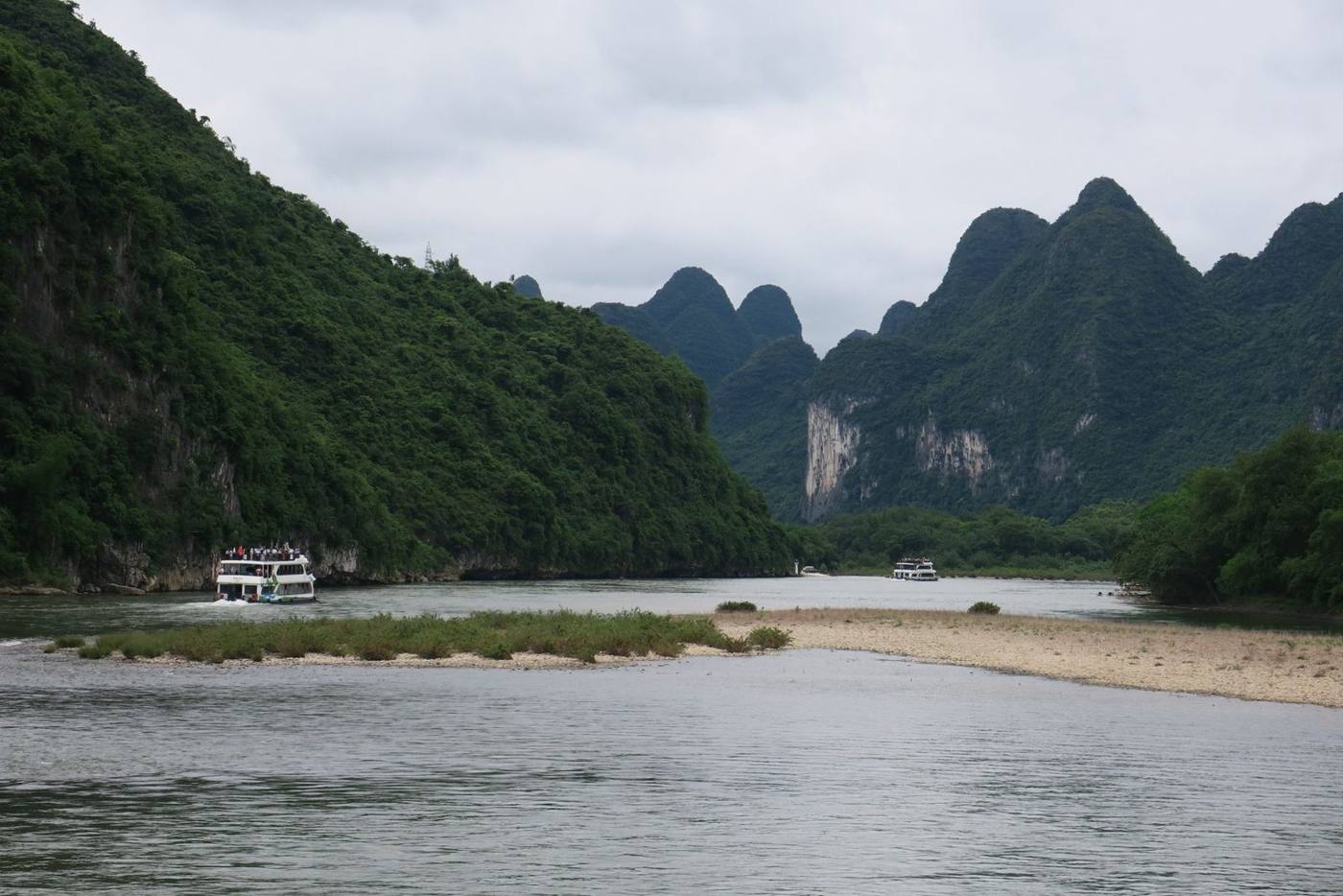
Guilin, Yangshuo and the Longji rice terraces
Karst peaks along the Li River by boat, Yangshuo by bike along the Yulong River and the rice terraces of the Zhuang and Yao villages.
 12 daysModerate
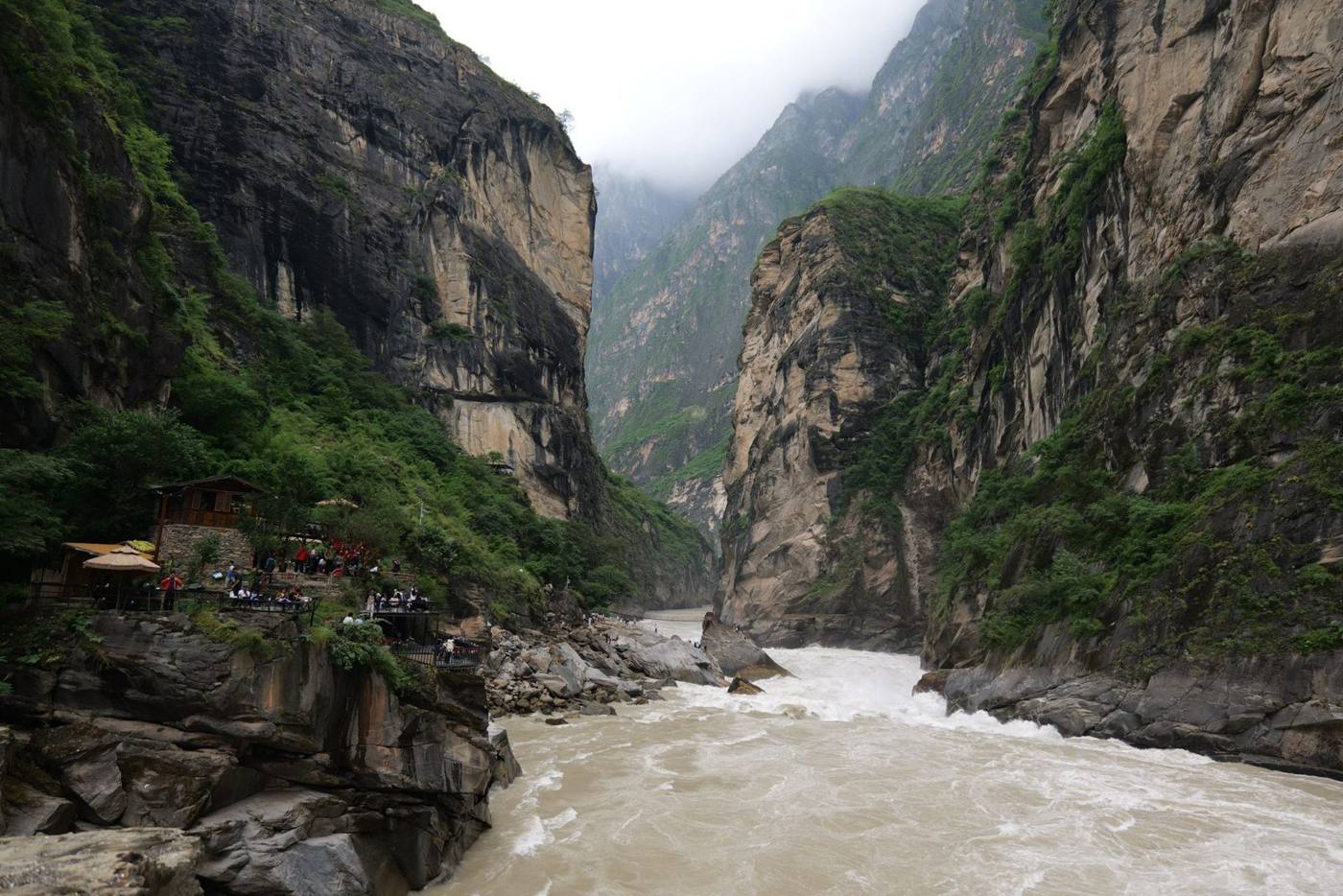
Yunnan from Dali to Shangri-La
Yunnan's minorities, Lake Erhai at Dali, the old town of Lijiang, the Tiger Leaping Gorge trek and the Tibetan monastery of Shangri-La.