Jordan and Oman
Two Arab countries in one trip: Jordan's Nabataean and Roman ruins, then the forts, wadis and dunes of Oman, linked by a direct flight.
- Amman
- Jerash
- Madaba
- Petra
- Wadi Rum
- Mascate
- Nizwa
- Jebel Shams
- Wahiba Sands
- Sur
Day by day
- Day 1
Arriving in Amman and the Citadel
This sixteen-day trip combines two very different Arab countries. In the first week you see the Jordan of Roman cities, mosaics, Petra and Wadi Rum; then a direct flight takes you to Oman, among mud forts, canyons, dunes and green-water wadis. You travel by hire car or with a driver; in Oman you need a four-wheel drive for the mountains and the desert.
Before you go: Italian citizens need a passport valid for at least six months from entry. For Jordan you need a visa, applied for online on the Jordanian Ministry of Interior website or on arrival at Queen Alia airport. The Jordan Pass, bought only on the official website jordanpass.jo before you leave, costs 70, 75 or 80 dinars for one, two or three consecutive days in Petra, includes Jerash, Wadi Rum and more than forty sites, and covers the visa fee if you stay at least two nights. In Oman you enter without a visa for stays of up to 14 days, with a return ticket, booked accommodation and health insurance; to stay longer you need an e-visa at evisa.rop.gov.om. Other nationalities should check their own rules.
Some areas on this trip are close to borders or places where the situation changes often: check your government's travel advice before booking and again before you leave.
In the afternoon climb to the Amman Citadel, with the columns of the Temple of Hercules and the Umayyad palace. From the top you see the Roman theatre and the city's white hills.
Practical tip: buy the Jordan Pass with two days in Petra, the right one for this trip.
- Day 2
Jerash, the Roman city
Today you head north, about an hour from Amman, to Jerash, one of the best-preserved Roman cities outside Italy.
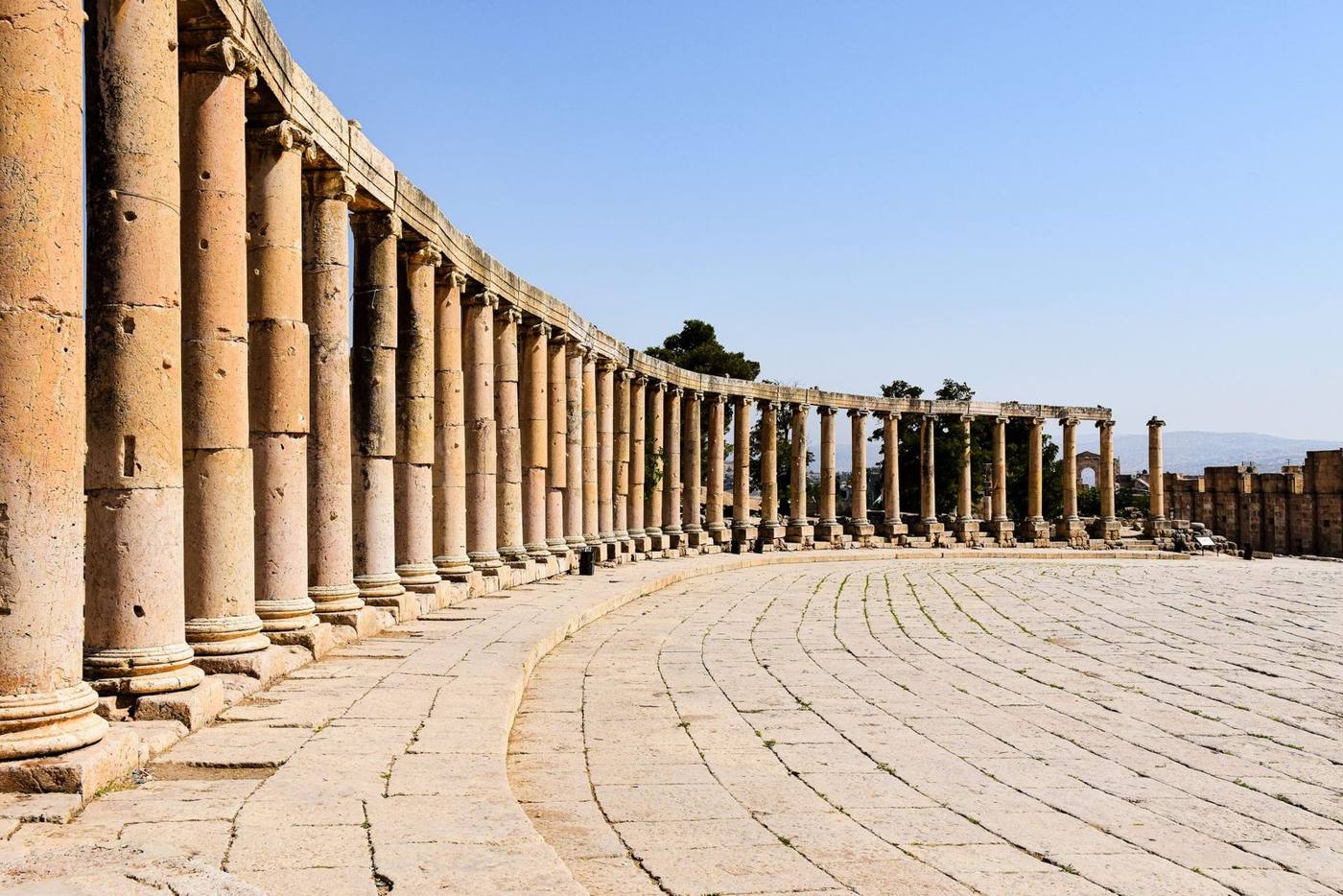
You enter through Hadrian's Arch, built for the emperor's visit, and pass the hippodrome. Then you reach the Oval Plaza, ringed by Ionic columns, one of the most famous images of Jordan. From here the cardo begins, the long colonnaded street, with its paving stones still marked by chariot wheels.
Walk slowly to the nymphaeum, the great decorated fountain, and climb to the Temple of Artemis, with its towering columns. Visit the South Theatre too, where the acoustics are still perfect: a bagpiper often shows how well you can hear from the centre of the stage. The site is included in the Jordan Pass.
To see everything you need at least three hours, and the site is large with little shade.
In the afternoon return to Amman and go down to the Balad, the old centre. Visit the Roman theatre, then walk among the stalls of the spice and gold souk.
In the evening try mansaf, the national dish of lamb cooked in dried yoghurt and served on rice, or pistachio sweets and warm knafeh.
Practical tip: arrive at Jerash when it opens, when the light is beautiful and the tour groups have not yet arrived.
- Day 3
Madaba, Mount Nebo and the King's Highway
Today you leave Amman and head south along the King's Highway, the ancient caravan route across the plateau.
The first stop is Madaba, the city of mosaics. In the Church of St George lies the map of the Holy Land, a sixth-century Byzantine mosaic showing Jerusalem, the Jordan and the Dead Sea. Then walk through the archaeological park, where more mosaics decorate the floors of old houses and churches.
A few kilometres away is Mount Nebo, where tradition says Moses saw the Promised Land. The memorial basilica has mosaics with hunting scenes and animals. From the terrace, on clear days, you see the Jordan Valley and the Dead Sea.
Then carry on south. The road crosses the canyon of Wadi Mujib with a long hairpin descent and a climb up the other side: stop at the viewpoint to look at the dam and the canyon walls.
You reach Wadi Musa, the town next to Petra, in the late afternoon. Sleep here for two nights.
The King's Highway is slow, with many bends and villages: drive calmly and do not travel at night, when speed bumps and animals on the road are hard to see.
Practical tip: in Madaba buy a small handmade mosaic from the workshops, and ask to see the craftsmen at work.
- Day 4
Petra, from the Siq to the Royal Tombs
Today you enter Petra, the city carved into pink rock by the Nabataeans, a UNESCO World Heritage Site.
Set off at opening time. From the visitor centre you walk for about a kilometre down the valley, then enter the Siq, the narrow, towering gorge that leads to the city. The walls close in, the light changes, and at the end the Treasury appears, the most famous facade, carved into the rock. It is a moment to take slowly.
Continue along the Street of Facades, with dozens of tombs, to the theatre cut into the mountain. Then climb to the Royal Tombs, on the right-hand cliff: the Urn Tomb, the Silk Tomb with its bands of colour and the Palace Tomb. From the terrace of the Urn Tomb the view over the valley is superb.
In the afternoon walk along the colonnaded street to the Great Temple and Qasr al-Bint, the most important temple of the Nabataean city.
In Petra you walk a lot, often on sand and steps. The animals offered for rides are not always well treated: if you want to save effort, choose the authorised carts on the first stretch or walk.
In the evening, if it is on, you can come back for Petra by Night, with the Siq and the Treasury lit by candles. Check prices and times.
Practical tip: carry at least two litres of water, a hat and shoes with a good sole.
- Day 5
Little Petra and the Monastery
Today you go back into Petra to climb to the Monastery, and you also visit Little Petra.
Go in early and walk straight to the far end of the city, beyond Qasr al-Bint. From here the climb to the Monastery, Ad Deir, begins: around eight hundred steps cut into the rock, with bends, shade and small tea stalls along the way. It takes about an hour, without rushing.
At the top the facade of the Monastery appears, even bigger than the Treasury, in an open space among the mountains. Sit and look at it, then climb to the nearby viewpoints to see the mountains stretching to the Araba valley.
Come down slowly and, if you still have energy, leave Petra by early afternoon. Then take the car to Little Petra, Siq al-Barid, a few kilometres north. It is a small canyon with facades, cisterns and banqueting halls, where caravans used to stop. In one hall you can still see traces of paintings with vines and birds. It is less crowded and takes about an hour.
At sunset return to Wadi Musa and rest your legs.
In the evening try zarb, meat and vegetables cooked under the sand in a Bedouin oven, if you find it in town.
Practical tip: climb to the Monastery in the morning, when the staircase is still in the shade.
- Day 6
Wadi Rum by jeep and a night in the desert
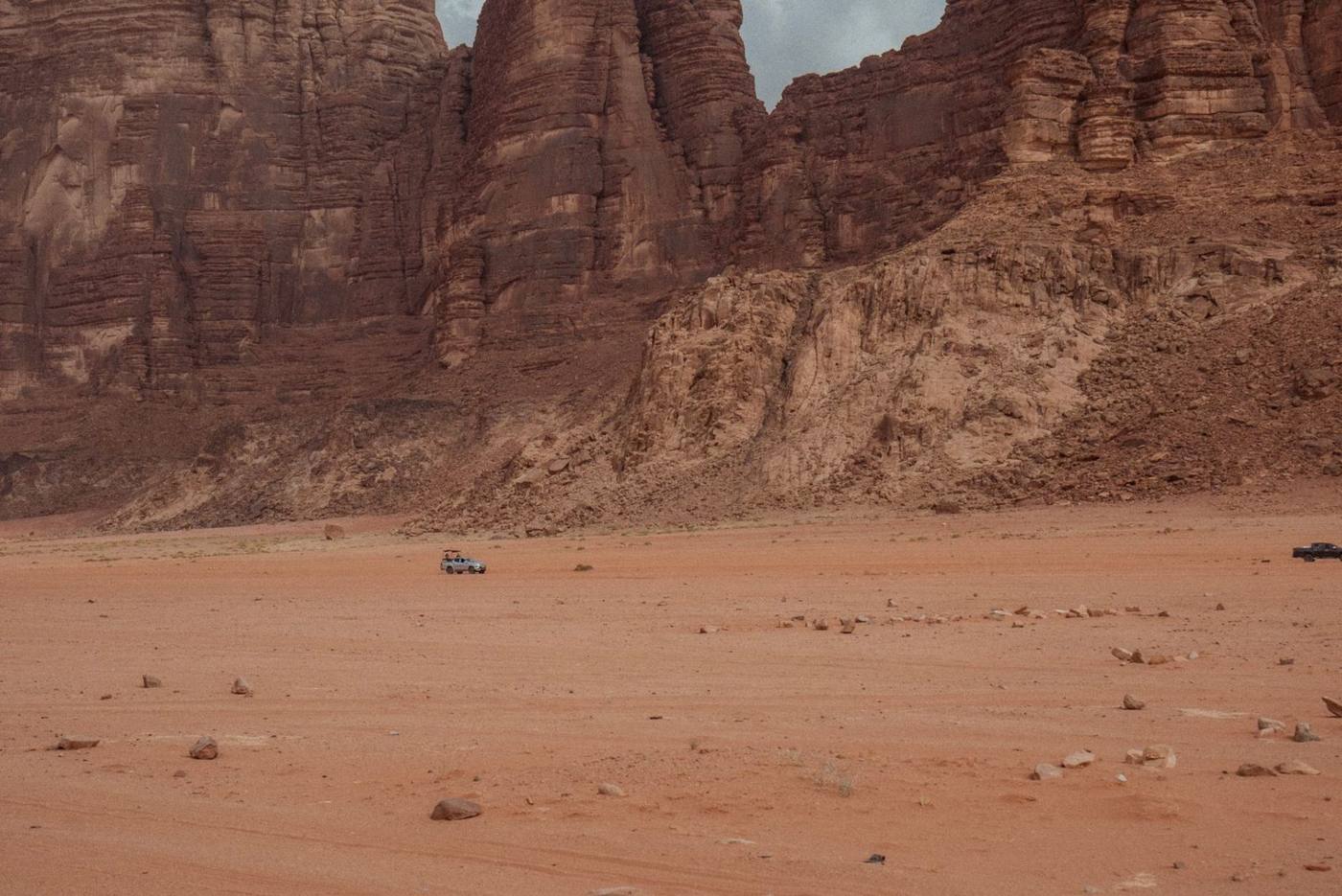
Today you head south to Wadi Rum, the desert of red sand and sandstone mountains that is a UNESCO World Heritage Site.
In a couple of hours you reach the visitor centre, included in the Jordan Pass. Here you leave the car and climb into a jeep driven by a local Bedouin. The tour lasts a few hours and stops at famous spots: the spring linked to Lawrence of Arabia, Khazali canyon with rock carvings by the Nabataeans and older peoples, red dunes to climb on foot, and natural rock arches.
The landscape changes at every bend: vertical walls, orange sand and small bushes. At the stops the Bedouin offer sage tea, sweet and fragrant, sitting on carpets in the shade of their tents.
At sunset the guide takes you up a rock to watch the sun go down between the mountains. Then you sleep in a desert camp, with dinner cooked under the sand and a sky full of stars.
Do not wander away from the camp on foot alone, especially at night, because it is easy to lose your bearings. At night it is cold even when the day was hot.
Practical tip: book a camp with the jeep transfer from the visitor centre included, so you do not have to drive on sand.
- Day 7
The Dead Sea and back to Amman
In the morning you wake up in the desert: step out of the tent for sunrise, when the mountains turn pink. After breakfast go back to the visitor centre and pick up the car.
Today you drive north to the Dead Sea. The road runs down the Araba valley and then alongside the lake, below sea level: this is the lowest point on dry land.
Stop at a beach with facilities and go into the water: it is so salty that you float without doing anything. Lie on your back, do not swim face down and keep the water out of your eyes. Then smear yourself with the dark mud, let it dry and rinse it off under the showers. Do not shave the day before, because the salt stings small cuts.
In the late afternoon drive up to Amman: the road climbs more than a thousand metres in under an hour. Sleep in Amman, near the airport if your flight is early.
If you have time, take a last evening walk around Rainbow Street, with its shops and cafés, to say goodbye to Jordan.
The Dead Sea road runs close to the border: stay on the main road, respect the checkpoints and keep your passport handy.
Practical tip: bring plastic sandals, because the Dead Sea shore has sharp salt crystals.
- Day 8
Flight to Muscat and the Muttrah corniche
Today you change country: a direct flight takes you from Amman to Muscat, the capital of Oman, in a few hours.
On arrival show your return ticket, accommodation booking and insurance, which you may be asked for at the border. Then pick up your hire four-wheel drive, or take a taxi into the city.
Muscat is a long, low city squeezed between dark mountains and the sea, with white houses and few tall buildings. In the afternoon, when the heat eases, go to Muttrah and walk along the corniche, the seafront that follows the bay. You will see the fishermen's wooden boats, the harbour with its ships and, on the rocks, small watchtowers.
At the fish market, early in the morning, the day's catch is sold; in the afternoon it is quieter.
At sunset climb to the watchtower above the corniche: from the top you see the whole bay lit up. Then have dinner with fish and spiced rice, or with shuwa, meat marinated in spices and slow-cooked for hours, the dish of the great Omani feasts.
Remember that in Oman clothing in public should cover shoulders and knees, even on the seafront.
Practical tip: change some Omani rials at the airport, useful for car parks, souks and villages.
- Day 9
The Grand Mosque, the souk and old Muscat
Today you discover the heart of Muscat.
Early in the morning go to the Sultan Qaboos Grand Mosque. For non-Muslims it is usually open only in the morning and not on Fridays. You enter the great courtyard of white marble and then the prayer hall, with a huge hand-made Persian carpet and a gigantic crystal chandelier. Women must cover hair, arms and legs; men arms and legs. Check prices and times.
Then visit the National Museum of Oman, which tells the country's story through seafaring, the frankincense trade, weapons and silver jewellery. Check prices and times.
In the afternoon go into the Muttrah souk, a covered maze of lanes. Here they sell frankincense and burners, silver, fabrics, pierced metal lamps and khanjar, the curved daggers. The scent of frankincense follows you everywhere. In the hottest hours many shops close and reopen in the late afternoon.
If you have time to spare, pass by the Royal Opera House, a pale stone building in Omani style with well-kept gardens, which you can see from outside and sometimes visit with a guide.
At sunset go to old Muscat, the historic part of the city, with its walls, gates and two Portuguese forts on the rocks above the bay, lit up in the evening.
Practical tip: in the souk always ask the price first and bargain politely, without pushing too hard.
- Day 10
Nizwa, the fort and the market
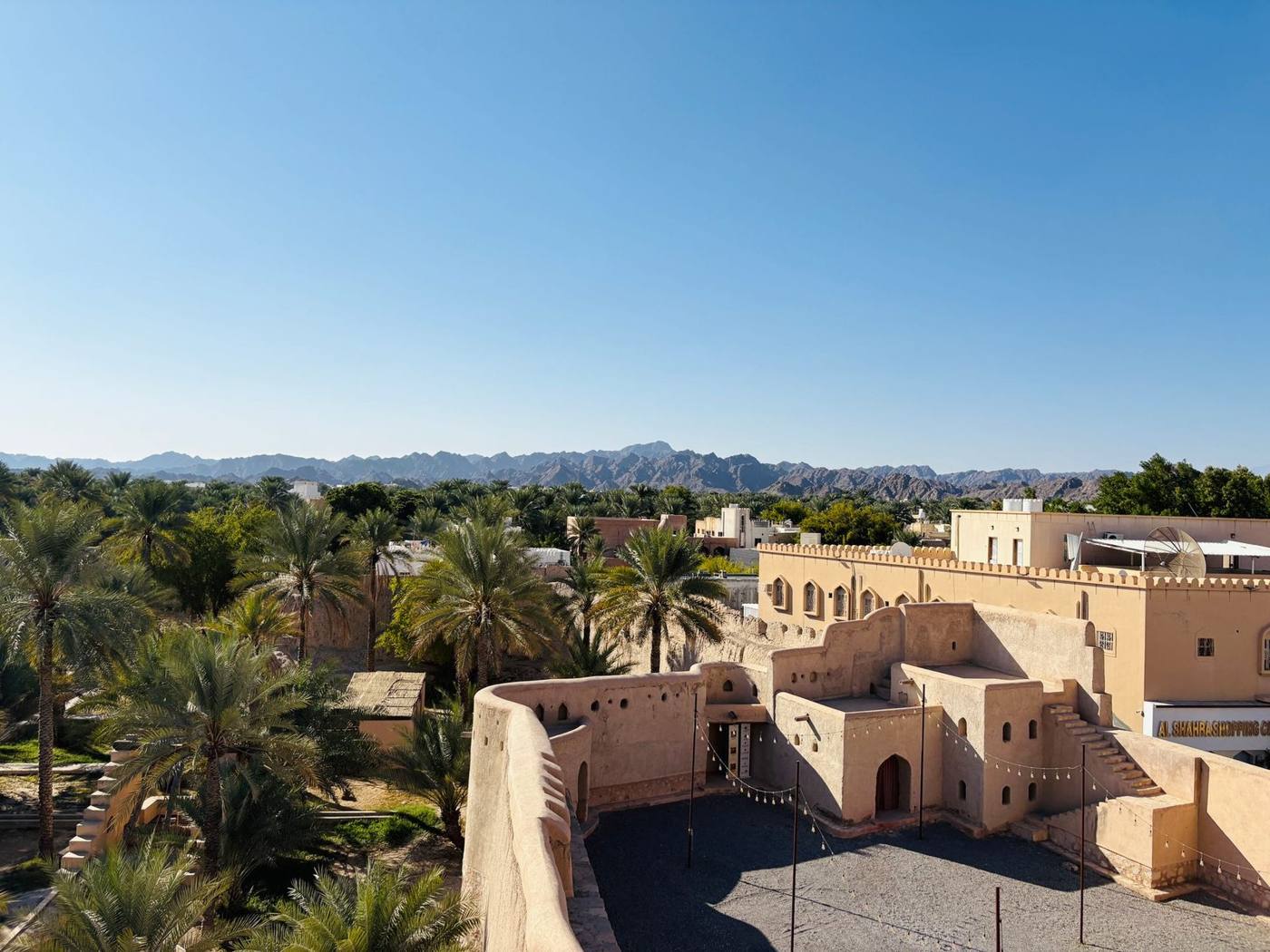
Today you climb inland into the Hajar mountains. In under two hours you reach Nizwa, the old capital of the interior, set among palm groves.
If it is Friday, leave at dawn for the livestock market: herders and buyers gather around a ring where goats are paraded, amid shouting and haggling. Watch from the edges and do not photograph people without asking. If today is not Friday, try to arrange your days so you are there tomorrow.
Then visit the seventeenth-century fort, dominated by an enormous round tower. Inside there are narrow stairs, traps for attackers and rooms that tell the story of the town. From the top you see the palm grove, the mosque dome and the mountains. Check prices and times.
Next door is the souk, with separate sections for dates, spices, pottery, silver and daggers. Accept a taste of halwa, the jelly-like sweet flavoured with cardamom and saffron.
In the afternoon walk among the old houses and along the falaj, the channel that carries water to the gardens. Sleep in Nizwa for two nights, in the centre or among the palm groves outside town.
Outside town goats and camels can appear on the roads: do not drive after sunset.
Practical tip: the stairs in the forts are steep and have no handrails, so wear closed shoes.
- Day 11
Al Hamra, Misfat and Jebel Shams
Today you explore mountain villages and the deepest canyon in Arabia.
In the morning head to Al Hamra, a village of old mud houses several storeys high, some abandoned and others restored. Walk along the lanes and look at the palm groves running down to the valley.
Then climb to Misfat al Abriyeen, a stone village built on the rock. Follow the falaj, the water channel that runs between the houses and irrigates terraces of palms, banana trees and pomegranates. Oman's irrigation channels are a UNESCO World Heritage Site. People live here: dress modestly, speak quietly and do not enter private spaces.
In the afternoon drive up Jebel Shams, the highest mountain in Oman. The last stretch is unpaved and you need the four-wheel drive. At the top you reach the rim of the Wadi Ghul canyon: the wall drops vertically for hundreds of metres. If you have time and energy, walk part of the Balcony Walk, which follows the canyon rim.
Keep away from the edge and bring water and a jacket: up there the wind is cool and in winter the evenings are cold.
Come down before dark and return to Nizwa, where you can have a relaxed dinner near the souk.
Practical tip: on the way down from Jebel Shams use low gears so the brakes do not overheat.
- Day 12
To the dunes of the Wahiba Sands
Today you leave the mountains and cross the interior to the great desert of the Wahiba Sands, also called the Sharqiya Sands.
The road runs down through gravel plains, villages with watchtowers and palm groves. In about three hours you reach Al Wasil or Bidiyah, on the edge of the desert. Here have your tyres deflated at a petrol station: without this the car gets stuck in the sand. If you have never driven on dunes, leave the car and have a local driver take you to the camp.
The dunes are long orange waves, tens of metres high, running from north to south. In the afternoon, as the sun goes down, climb a crest on foot: the sand is soft and warm, and from up there you see only waves of sand to the horizon.
You can take a short camel ride or a dune drive with a guide, but choose someone who drives carefully.
In the evening sleep in a tented camp among the dunes. Dinner is around the fire, with rice, meat, dates and cardamom coffee, under a sky full of stars.
At night do not wander away from the camp alone and do not drive among the dunes in the dark.
Practical tip: bring a scarf to protect your nose and mouth if the wind picks up.
- Day 13
Wadi Bani Khalid and its pools
At dawn climb a dune again: the morning light turns the sand red, and around you there is only silence and the tracks of small animals. After breakfast go back to the edge of the desert and have your tyres pumped up.
In under an hour on the road you reach Wadi Bani Khalid, a valley in the mountains where water flows all year round. From the car park you walk for a few minutes to the green pools, surrounded by palms, smooth boulders and pale rock walls.
You can swim here, but in a T-shirt and shorts, not swimwear, because many families come. If you walk further upstream, for about twenty minutes among the rocks, you find quieter pools and a small cave where the water comes out.
Have lunch in the shade of the palms and rest. In the afternoon continue to the coast and Sur, the sailors' town, where you sleep for two nights.
In the wadis the water level can rise very quickly if it rains in the mountains: check the forecast and do not go in if the sky is dark.
In the evening take a walk along the Sur corniche, with boats pulled up on the shore and white houses reflected in the lagoon.
Practical tip: bring water shoes, because the rocks in the pools are slippery.
- Day 14
Sur, the dhows and the turtles of Ras al Jinz
Today you discover Oman's seafaring tradition and, at night, the sea turtles.
In the morning visit the dhow yard, where for centuries the great wooden boats that sailed to East Africa and India have been built. The craftsmen still work by hand with planks and nails: ask before entering and before taking photos. Then cross the bridge to Ayjah, the district opposite, with white houses, decorated doors and a small lighthouse on the point.
In the afternoon drive for about an hour to Ras al Jinz, the easternmost point of the Arabian Peninsula. Here a reserve protects the beach where green turtles come to lay their eggs, mostly at night.
Visits are only with the reserve's guides, in groups and at set times, in the evening or before dawn: book ahead. Check prices and times. In the visitor centre a small exhibition explains the turtles' life cycle.
On the beach, in the dark, the guide leads you closer in silence. With a little luck you see a turtle digging its nest and laying eggs, or hatchlings running towards the waves. Do not use flash or torches and do not touch the animals.
After the visit drive back to Sur slowly.
Practical tip: drive slowly in the dark on the Ras al Jinz road, because there are goats and camels.
- Day 15
Wadi Shab and the coast road
Today you drive back up the coast towards Muscat, with one of the finest stops in Oman.
In under an hour you reach Wadi Shab. A small boat takes you across the stream, then you walk for about three quarters of an hour through a gorge between high walls, palms and little water channels. The path crosses boulders and slippery stretches.
At the end you find turquoise pools one after another. Leave your bag somewhere dry and swim: after a few pools you pass through a narrow crack in the rocks, and beyond it a cave with a waterfall opens up. Only go in if you are a strong swimmer. Wear a T-shirt and shorts for swimming, and do not go if it has rained.
In the afternoon continue north. Stop at the Bimmah sinkhole, a large hollow full of green water in the middle of a park, where you go down a staircase and swim among small fish.
The coast road runs between dark mountains and the sea, past fishing villages and long beaches. In the late afternoon you reach Muscat, for the last evening of the trip.
If you have time, have dinner with a sea view at Qurum or go back to the Muttrah corniche.
Practical tip: keep your phone in a waterproof pouch, because in Wadi Shab the last stretch can only be done swimming.
- Day 16
Flying home from Muscat
Today is your travel day home.
If your flight is in the afternoon, take a last walk through the Muttrah souk in the morning to buy frankincense, dates, cardamom coffee or a small clay burner. Muscat airport is about half an hour from the centre. Return the four-wheel drive with a full tank and clean of sand.
Trip summary: in sixteen days you have crossed two worlds. In Jordan you saw the Amman Citadel and the columns of Jerash, the mosaics of Madaba and the view from Mount Nebo, the Siq and the Treasury of Petra, the Monastery and Little Petra, the red mountains of Wadi Rum with a night in the desert, and floating in the Dead Sea. In Oman you visited the Grand Mosque and the Muttrah souk, Nizwa fort, the villages of Al Hamra and Misfat, the Jebel Shams canyon, the Wahiba dunes, the pools of Wadi Bani Khalid, the dhows of Sur, the turtles of Ras al Jinz and the cave of Wadi Shab.
When to go: from October to March, the only season when Oman is pleasant too. In Jordan the best months are October, November and March; between December and February Amman and Petra can be cold, with rain and sometimes snow, while the desert is freezing at night. In Oman the winter is warm by day and cool at night.
Practical tip: check your flight status before leaving for the airport, because schedules can change.
It makes sense for those with sixteen winter days who want two very different countries without changing continent: Jordan for history, Oman for landscape and calm order. The drawback is that both are compressed, and in Jordan you give up Dana and the desert castles. Oman is noticeably more expensive for lodging and four-wheel-drive hire; check current travel advice for both countries.
Before you go
- Documents and visa
- Passport valid for at least six months from entry and a tourist visa, applied for online on the Jordanian Ministry of Interior website or on arrival at Queen Alia airport in Amman, paid in dinars. The Jordan Pass, bought only on the official website jordanpass.jo before arrival, covers the visa fee if you stay in Jordan for at least three nights and includes Petra, Jerash, Wadi Rum and more than forty sites.
- Health and vaccines
- No compulsory vaccinations: ask your doctor about recommended ones at least eight weeks before. Protect yourself from the sun and drink plenty of water, above all in the desert and the canyons. Outside Amman and Aqaba medical facilities are basic: you need insurance with medical costs and repatriation. Emergencies: 911.
- Money and payments
- Jordanian dinar. Cards work in cities and hotels; keep cash for villages, the desert and tips.
- Power sockets
- Mixed sockets for type A and C plugs, often also F and G, 230 volts: bring a universal adapter.
- Time zone
- UTC+3 all year.
- Safety
- With regional tensions and the missile and drone attacks of 2026, the United States rates Jordan level 3 and the UK advises against all travel within 3 km of the Syrian border. Do not go near the borders with Syria and Iraq, the refugee camps, Zarqa or Rusayfah; avoid the city of Ma'an. Flights and airspace can close without notice. In the canyons there is a risk of flash floods: follow the reserves' closures. Official advice: GOV.UK.
Information checked in November 2026 for Italian and EU citizens. Rules change: always check before you travel.
Variations
Shorter version: in twelve days drop the Dead Sea and the Sur coast, returning to Muscat after the dunes.
Longer version: add two days in Jordan for the Dana reserve and the desert castles.
Frequently asked questions
Is the Jordan Pass worth it on this trip?
Yes: with at least two nights in Jordan it covers the visa fee and includes Petra, Jerash and Wadi Rum. Choose the one with two days in Petra and buy it only on jordanpass.jo.
Do you need a visa for Oman?
Italian citizens do not, for stays of up to 14 days, with a return ticket, booked accommodation and health insurance. To stay longer you apply for an e-visa on the official website.
How do you get from Jordan to Oman?
On a direct flight from Amman to Muscat, lasting a few hours. Check the flight days before fixing the itinerary.
Indicative itinerary written by World Atlas. Before booking, check timetables, seasonal openings, documents and safety.
 15 daysModerate
From Petra to AlUla: Jordan and Saudi Arabia
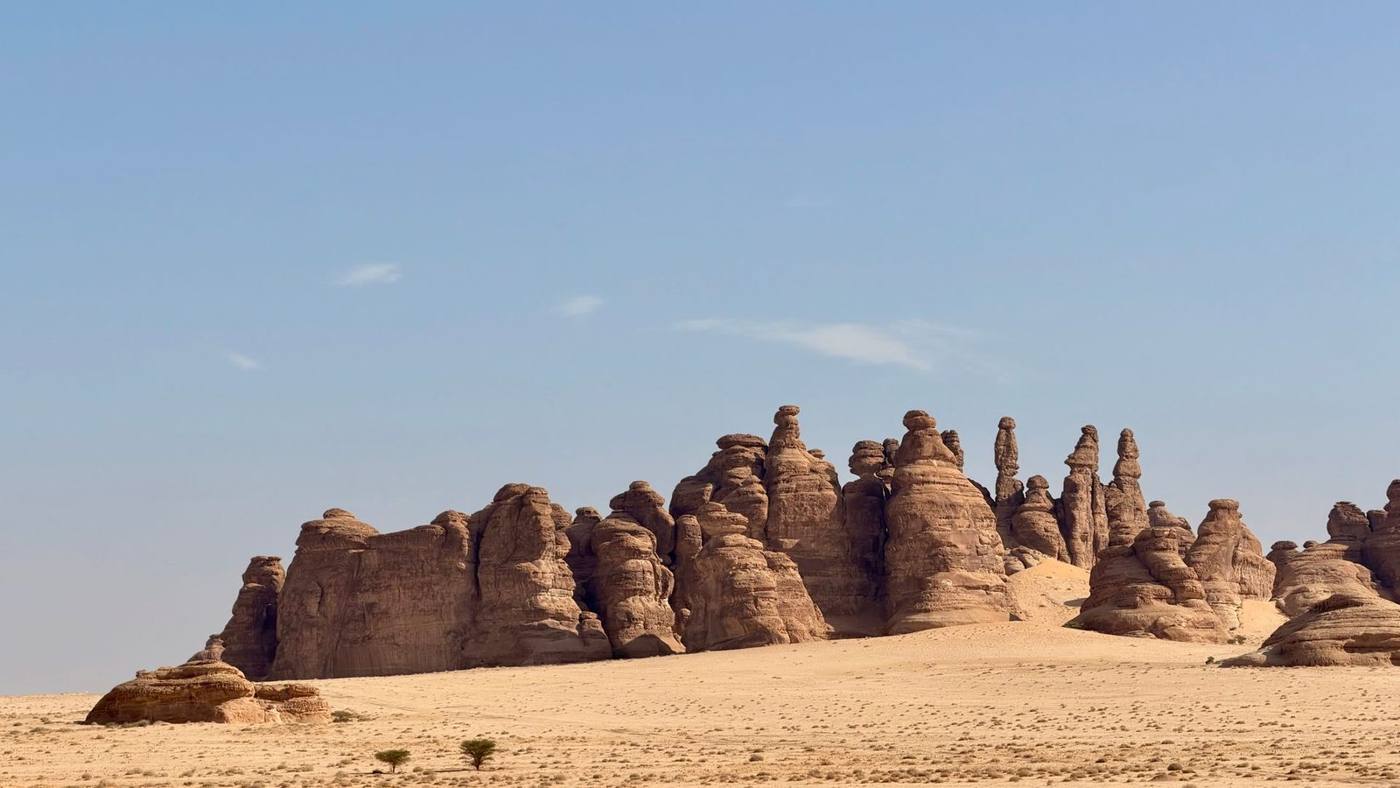
Following the Nabataeans from one capital to the other: Petra in Jordan, then overland across the border to the tombs of Hegra and the canyons of AlUla.
 15 daysEasy
The Whole of Jordan, from Amman to Aqaba
Two unhurried weeks: the Umayyad desert castles, the Jordan Valley, Dana, Petra, a night in Wadi Rum and the Red Sea to finish.
 9 daysEasy
Jerash, Madaba and the King's Highway
Classic Jordan in nine days, with the Roman city of Jerash, Byzantine mosaics, the Crusader castle of Shobak and the Wadi Mujib canyon in season.