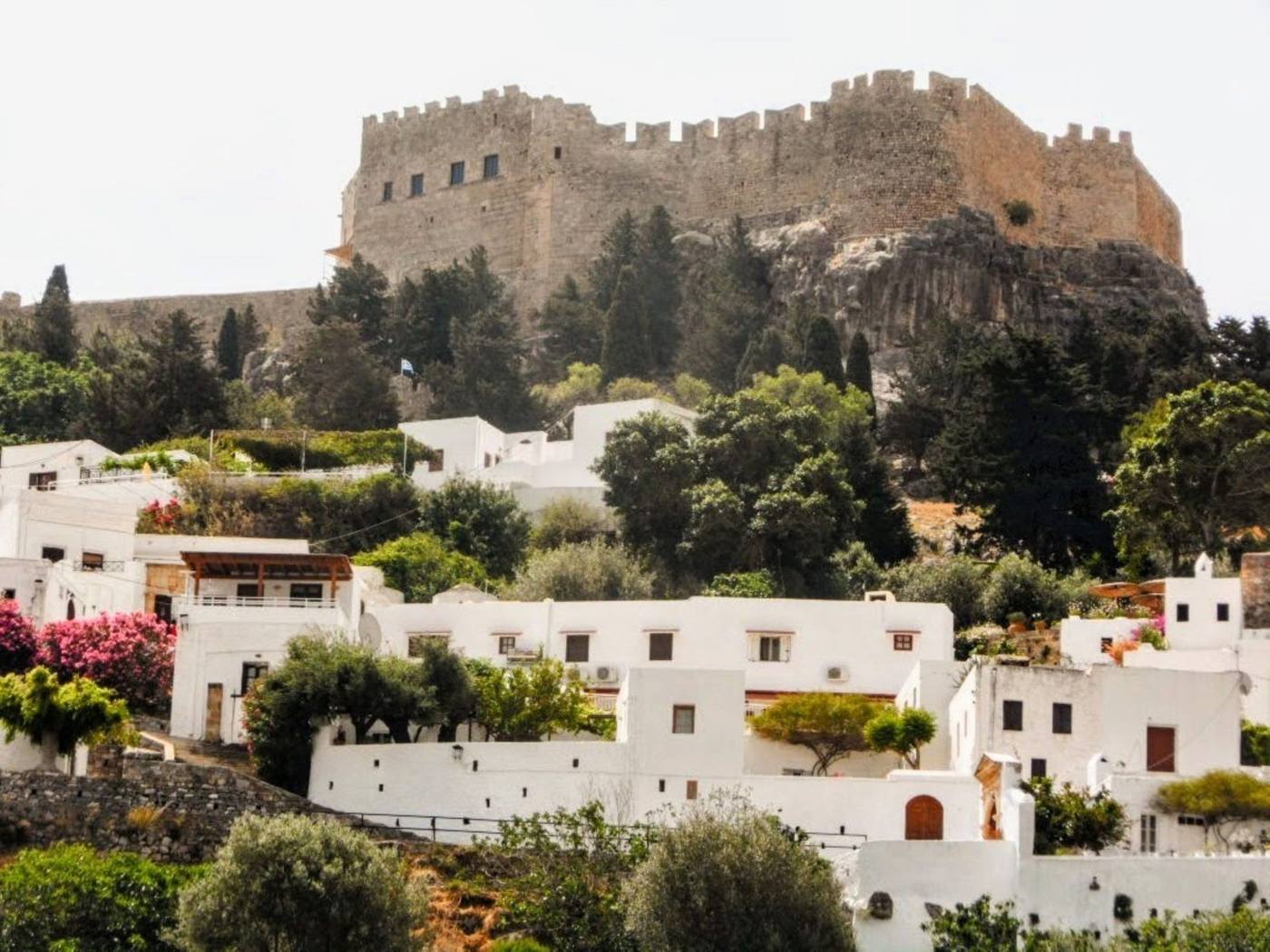
Rhodes by Car: Lindos, Kameiros and the South
One island explored at an easy pace, from the city of the Knights to the inland villages, with a hire car as the base.
- Rhodes Town
- Filerimos
- Lindos
- Petaloudes
- Kameiros
- Monolithos
- Lahania
- Prasonisi
Day by day
- Day 1
Arrival in Rhodes and a first evening in town
This trip goes round Rhodes by car, the largest island of the Dodecanese, close to the Turkish coast: the medieval city of the Knights, a UNESCO site, the acropolis of Lindos above the sea, the ancient cities of Ialysos and Kameiros, the inland villages and the wild south down to Prasonisi, where two seas meet.
Before you leave: Greece is part of the Schengen area and European Union citizens only need an identity card. Accommodation charges a nightly tax that varies by category and season: ask for the amount when you book.
You land at Rhodes airport, on the west coast, about half an hour from town. Collect your hire car: you need one for this trip, because buses inland and in the south are few. A small car is easier in villages and car parks.
Stay in town, ideally outside the walls or on their edge, because cars cannot enter most of the medieval city.
In the evening take a first walk in the old town, which is beautiful in the evening light: squares with fountains, cobbled lanes, stone arches and minarets from the Ottoman period. Have dinner with Dodecanese dishes, such as pitaroudia, chickpea and tomato fritters, or the catch of the day.
Sleep in Rhodes town.
Practical tip: the best time is May to June and September to October. July and August are hot and crowded.
- Day 2
The medieval city: the Knights, the palace and the walls
Today you explore the medieval city of Rhodes on foot, one of the best preserved in Europe. It was the seat of the Knights of Saint John, a religious and military order that ruled the island from 1309 to 1522, when the city fell after a long siege by the Ottoman army of Suleiman the Magnificent.
In the morning walk up the Street of the Knights, lined with the inns where the knights lived, grouped by language: France, Italy, Spain, England and others. At the top stands the Palace of the Grand Master, a great fortress. It was destroyed by an explosion in the nineteenth century and rebuilt by the Italians in the 1930s, when the island was Italian: inside are ancient mosaics brought from Kos and furnished rooms.
Then visit the archaeological museum, in the Knights' old hospital, with a courtyard full of statues and sculptures from the island's ancient cities.
In the afternoon walk along the moat or on the walls, if the route is open: check the days and times. Then go down to the lower town, with the mosque of Suleiman, the old Turkish bath and the shopping streets.
At sunset go to Mandraki harbour, with the deer statues at its entrance, where legend places the Colossus of Rhodes, and the windmills on the pier.
Sleep in Rhodes town.
Practical tip: the cobbled streets are slippery. Wear comfortable shoes with a good sole.
- Day 3
Filerimos hill and the ruins of Ialysos
In the morning drive south west to Filerimos hill, about twenty minutes from Rhodes town. On the top are the remains of ancient Ialysos, one of the island's three Dorian cities along with Lindos and Kameiros. You see the foundations of the temple of Athena and Zeus, a Doric fountain cut into the hill, a small underground Byzantine church with frescoes and the monastery of Our Lady of Filerimos, rebuilt by the Italians, with a quiet cloister. Peacocks stroll among the trees.
From the monastery an avenue with the Stations of the Cross leads to a large cross on the edge of the hill. You can climb inside the cross: from the top you see the west coast, the sea and, on clear days, Turkey.
In the afternoon head back to the east coast and stop at the Kallithea springs, south of Rhodes town: a spa complex built by the Italians in the 1920s, with domes, columns and mosaics among the palms, in a small rocky cove where you can swim. Check the opening hours and entry.
In the evening return to town or move to the east coast, which will be your base for the next few days.
Sleep in Rhodes town or on the east coast.
Practical tip: at Filerimos the pines give cool shade. It is a good place for a break with a sandwich during the hot hours.
- Day 4
Lindos: the white village and the acropolis
Today you go to Lindos, on the east coast, about an hour from Rhodes town. Leave very early: arrive when the acropolis opens, before the cruise ship coaches and before the heat.
Lindos is a village of white houses at the foot of a rock high above the sea. You leave the car in the car parks above the village and walk up through the lanes in about twenty minutes. Many people offer donkey rides: it is better to walk, as the animals work hard in the heat.
At the top is the acropolis of Lindos, one of the most spectacular in Greece. You enter through the walls of the Knights' castle, pass a relief of a Greek ship carved into the rock and climb the great staircase to the Hellenistic porticoes and the temple of Athena Lindia, on the edge of the cliff. From here you see Lindos bay and the small bay of Saint Paul, almost closed by rocks, where according to tradition the apostle landed. Check the opening hours and ticket.
Then walk down into the village and visit the church of the Panagia, with its frescoes, and the old captains' houses, with courtyards decorated with black and white pebbles.
In the afternoon swim in Saint Paul's bay or at the main beach.
Sleep in or near Lindos.
Practical tip: bring water and a hat. There is no shade on the acropolis.
- Day 5
The valley of the butterflies and ancient Kameiros
Today you cross the island from east to west. In the morning go to Petaloudes, the valley of the butterflies, inland west of the airport. It is a cool green gorge with a stream, small waterfalls, wooden bridges and sweetgum trees, which produce a fragrant resin.
From June to September thousands of tiger moths, which everyone here calls butterflies, gather on the trunks and rocks to rest through the summer. At rest their wings are brown and white; in flight they show red. Do not clap or make noise to make them fly: every flight uses up their energy and many die. Out of season the valley is still a lovely shaded walk. Check the opening hours and ticket.
In the afternoon drive to the west coast and Kameiros, another of the three ancient Dorian cities. Kameiros had no walls and does not look like a fortress: it is a town on a hillside sloping down to the sea, with streets, houses, cisterns, a large stoa at the top and a temple at the bottom. It was abandoned and then covered by earth, which is why its plan is so clear. The light at sunset is very beautiful.
On the way back stop in one of the fishing villages on the west coast for a fish dinner.
Sleep on the west coast or return to the east coast.
Practical tip: the west coast is windier than the east. The sea is often rough: swim with care.
- Day 6
Asklipio, its castle and Haraki bay
Today you stay in the central part of the east coast. In the morning go up to the village of Asklipio, inland south of Lindos, a quiet village of white houses with a ruined Knights' castle on the hill, from where you see the whole countryside down to the sea.
In the village there is a small Byzantine church dedicated to the Dormition of the Virgin, entirely covered in frescoes telling stories from the Old and New Testaments: it is one of the most beautiful on the island. Go in with shoulders and legs covered and leave a donation. Next to it is a small museum of rural life.
In the afternoon head north to Haraki bay, a small fishing village with a pebble beach and calm water, below the castle of Feraklos, one of the Knights' fortresses, on a hill above the sea. You walk up in a quarter of an hour to see the walls and the view over the nearby bays. Not far away is Agathi beach, with golden sand, one of the finest on the east coast.
In the evening have dinner in Haraki, watching the boats in the bay.
Sleep on the east coast, between Lindos and Haraki.
Practical tip: many village churches are open only at certain hours. If you find the door closed, ask at the village café: someone often has the key.
- Day 7
The south west: the castles of Kritinia and Monolithos
Today you head south west, the highest and greenest part of the island. The road passes below Attavyros, the highest mountain on Rhodes, at over twelve hundred metres.
The first stop is the castle of Kritinia, built by the Knights on a hill above the sea, with a long view over the coast and the nearby islands. Then go up to Embonas, the wine village on the slopes of Attavyros, where vineyards grow and local wines and spirits are made. Many cellars offer tastings: ask first whether they charge. If you are driving, just take a sip.
Pass through Siana, a village known for its thyme honey and for souma, a local spirit, with a church with a tall bell tower.
In the afternoon you reach Monolithos, where the Knights' castle, built at the end of the fifteenth century, rises on an isolated rock spur more than two hundred metres above the sea and the pines. You climb a stone stairway and inside the walls there is only a small white chapel. It is one of the most spectacular places on Rhodes, especially at sunset.
Below the castle, a narrow road leads down to Fourni beach, with small pebble coves and caves cut into the rock.
Sleep in Monolithos or a nearby village.
Practical tip: there are few petrol stations in the south. Fill up before you set off.
- Day 8
The empty south: Lahania and Prasonisi
Today you explore the south of Rhodes, the least populated part, with scrub covered hills, quiet villages and long empty beaches.
In the morning go to Lahania, a village on the south east coast, with white houses, flowery lanes and a square with a fountain and a large plane tree. Many houses have been carefully restored. It is a calm place to drink a Greek coffee in the shade.
Then drive down to the tip of Prasonisi, the southern end of the island. Here a strip of sand joins Rhodes to a small islet with a lighthouse. On one side is the Aegean, often whipped up by the wind, on the other the Mediterranean, with calm water: you see the two seas side by side. Prasonisi is one of the best places in Europe for windsurfing and kitesurfing, especially in summer, when the meltemi blows. In winter and spring the water can cover the sandbar.
Walk across the sand to the islet and climb up to the lighthouse. Bring water and sun protection: there is very little shade.
In the afternoon, on the way back, stop at one of the long beaches of the south coast, such as Plimmiri or Gennadi, almost empty even in summer.
In the evening drive back towards Rhodes town, about an hour and a half.
Sleep in Rhodes town.
Practical tip: the last kilometres of the road to Prasonisi are sandy. Drive slowly and stay on the track.
- Day 9
Return
On the last day, if your flight leaves in the afternoon, you still have a few hours in Rhodes town.
You can go back to the old town to see what you missed, such as the Kahal Shalom synagogue, the oldest in Greece, with a small museum about the Jewish community of Rhodes, almost entirely deported in 1944. It is a short but important visit.
Alternatively go to the aquarium at the northern tip of the town, in a 1930s building, or have a last swim at Elli beach, near the centre, where the sea is calmer.
Before you leave buy something local: thyme honey from the villages, olive oil, wines from Embonas, or rugs and painted ceramics from Lindos.
The airport is about half an hour from town. Return the car with a full tank and check for damage together with the agency. In summer the airport is crowded: arrive in good time.
This trip shows that Rhodes is not just beaches and resorts: in a few days you go from an intact medieval city to ancient acropolises, castles on rocks, frescoed churches and an empty, wild south where two seas meet.
Practical tip: keep your identity card with you, even at the beach and in the car. Checks can happen in Greece.
Suits those who want a single base and a week without ferries, with plenty of medieval history and the sea when needed. The old town of Rhodes is one of the best preserved in the Mediterranean. The drawback is mass tourism on the east coast, best avoided in August; the south and the interior reward those willing to drive a little further.
Before you go
- Documents and visa
- EU citizens need a valid identity card or passport, including on ferries, where ID may be checked at boarding. Other nationalities should check the Schengen rules.
- Health and vaccines
- No vaccines required. EU citizens should bring their EHIC; in summer protect yourself from the sun and drink plenty. Emergencies: 112.
- Money and payments
- Euro. Cards are accepted almost everywhere; every accommodation charges a fee per room per night, often paid on departure.
- Power sockets
- Types C and F, 230 volts.
- Time zone
- Eastern European Time (UTC+2), summer time (UTC+3) from late March to late October.
- Safety
- A safe country. In summer watch for wildfires and 112 alerts; in Athens, for pickpockets on the metro. Official advice: GOV.UK.
Information checked in November 2026 for Italian and EU citizens. Rules change: always check before you travel.
Variations
In 5 days: Rhodes town, Filerimos and Lindos, without the south.
In 12 days: add a ferry trip to Symi and a few days by the sea.
Frequently asked questions
What documents do I need?
Greece is part of the Schengen area: European Union citizens only need a valid identity card.
Do I need a car?
Yes. In town you walk, but buses inland and in the south are few. A small car is the best choice.
When is the best time to go?
May to June and September to October. July and August are hot and Lindos is crowded; the Petaloudes moths are seen from June to September.
Indicative itinerary written by World Atlas. Before booking, check timetables, seasonal openings, documents and safety.
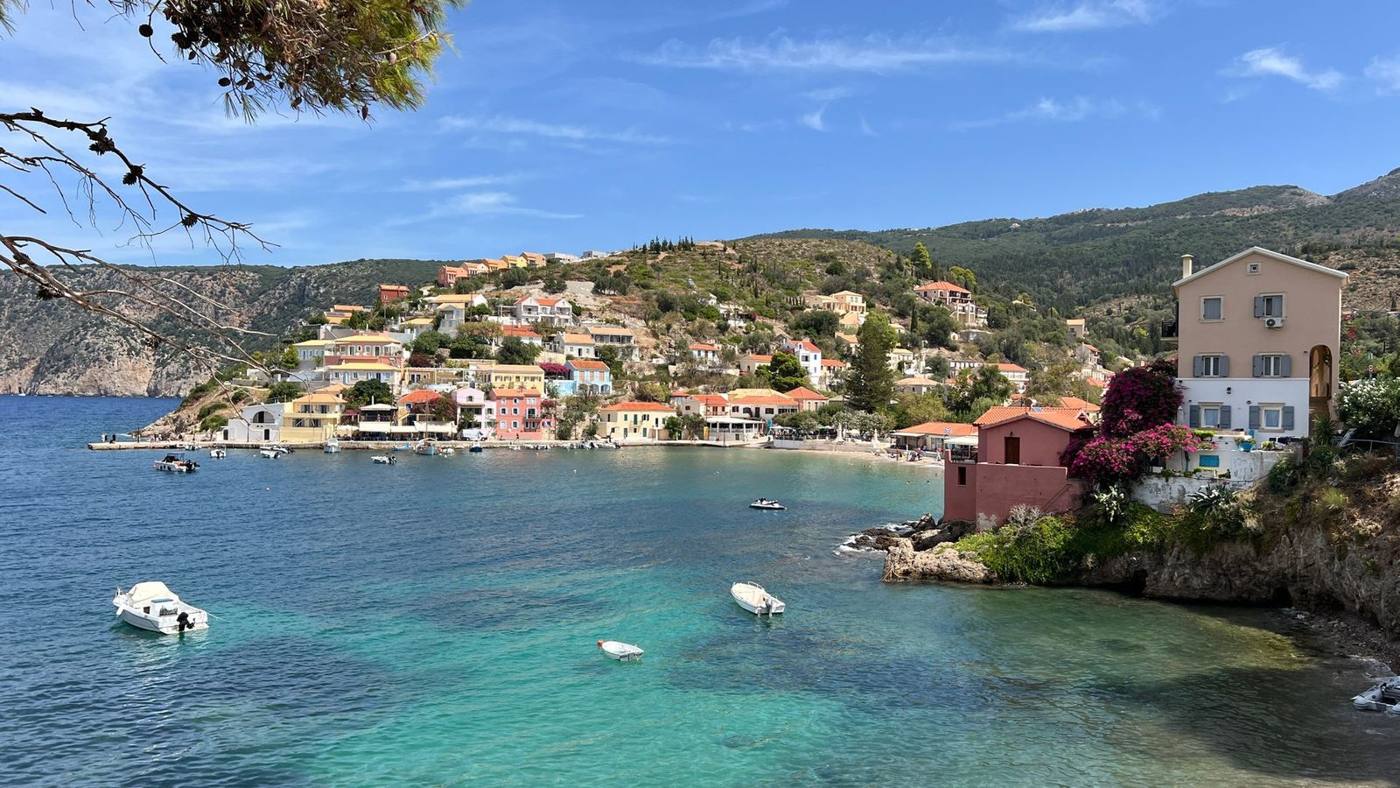 10 daysEasy
Kefalonia and Ithaca, Odysseus's Sea
Ten days in the Ionian islands among cliffs, karst caves and Venetian villages, with a crossing to the island Homer gave to Odysseus.
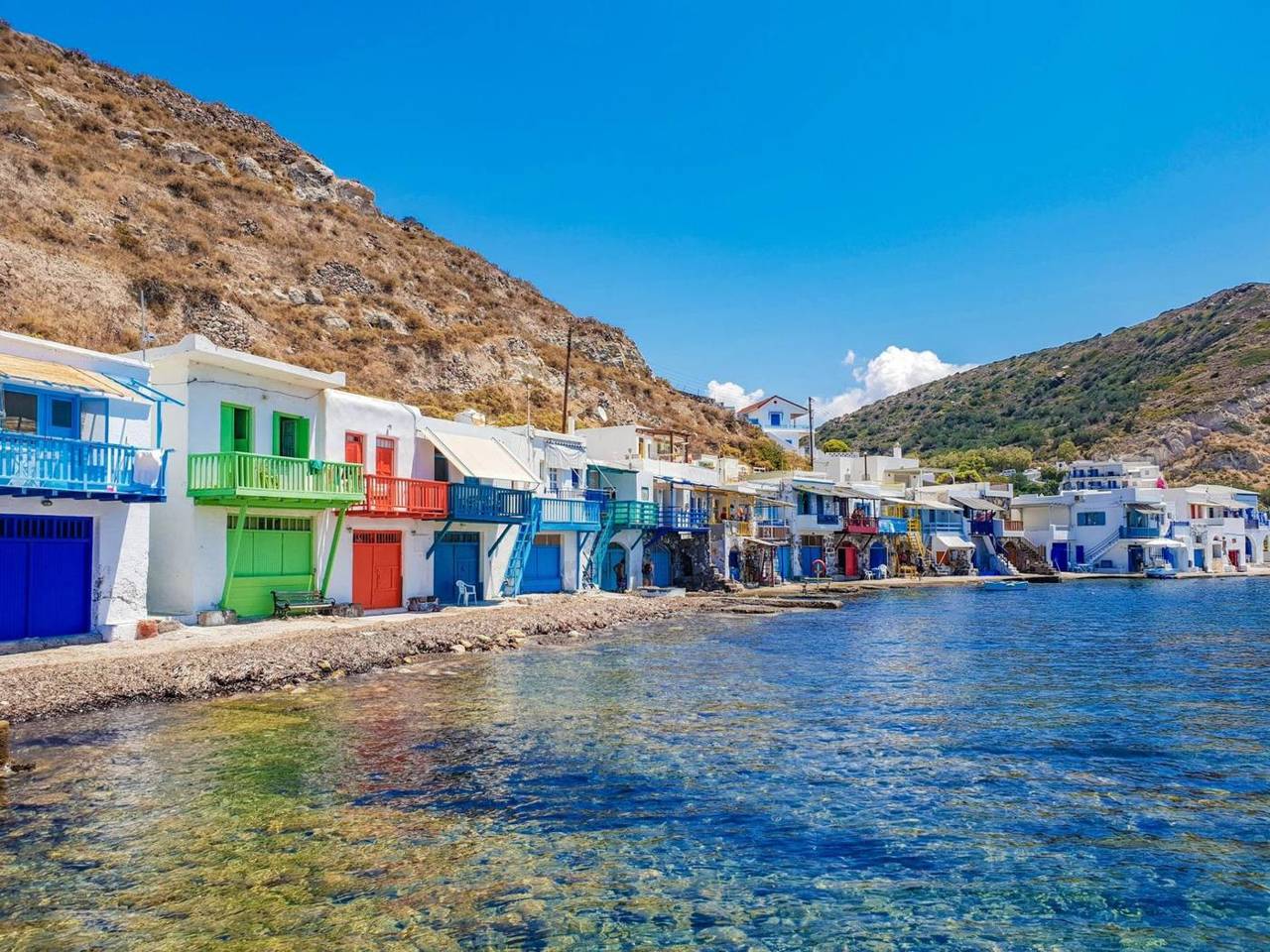 16 daysModerate
The Lesser Cyclades: Sifnos, Milos, Folegandros, Amorgos and Paros
Two weeks of ferries through the less trodden Cyclades, leaving Mykonos and Santorini aside, with three nights on the islands that deserve it.
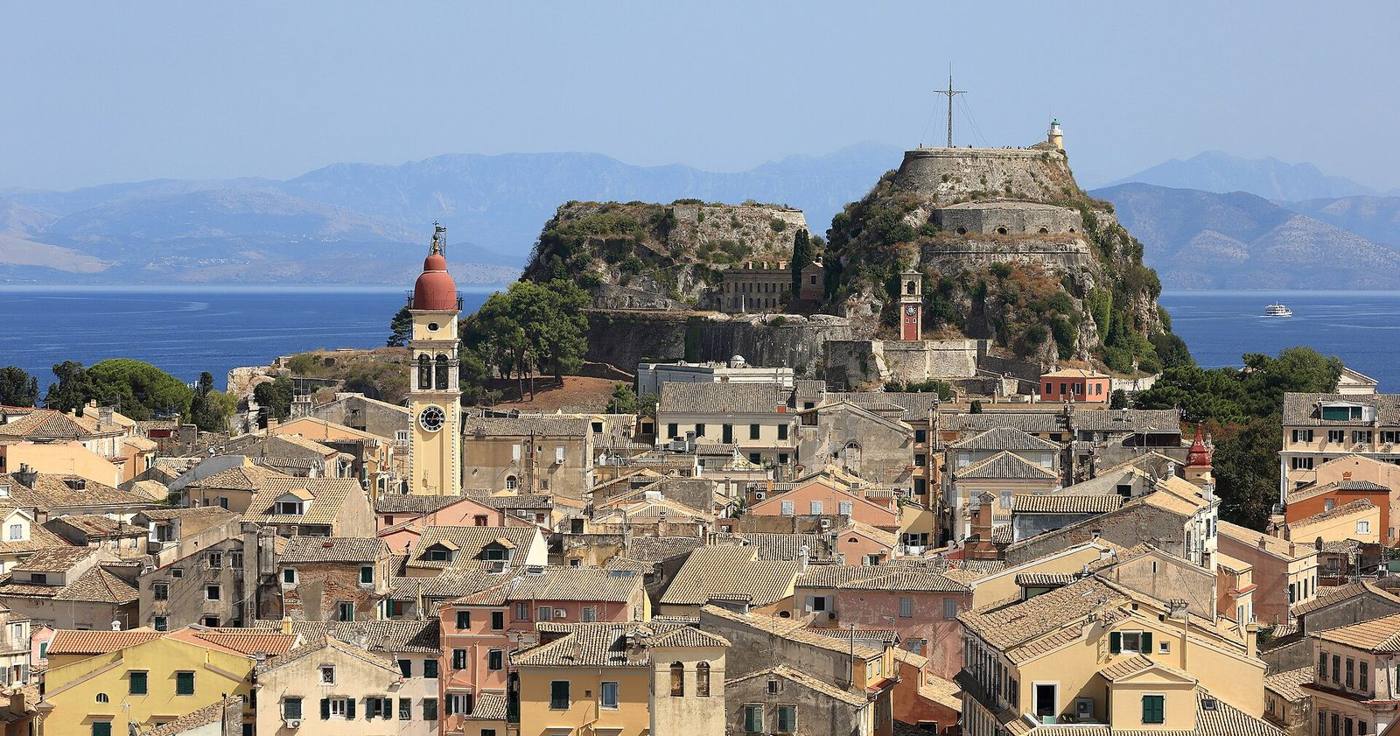 6 daysEasy
Corfu and Paxos
The greenest Ionian islands: Corfu old town (UNESCO) with its two Venetian fortresses and the Liston, the Achilleion palace, the bays of Paleokastritsa, the north-east coast up to Kassiopi, then Paxos with its olive groves and the white beaches of Antipaxos.