Easter Island
Five days on the world's most remote inhabited island, among the moai of Ahu Tongariki, the Rano Raraku quarry and the ceremonial village of Orongo.
- Santiago
- Hanga Roa
- Ahu Tongariki
- Rano Raraku
- Anakena
- Orongo
Day by day
- Day 1
The flight from Santiago to Hanga Roa and sunset at Ahu Tahai
Easter Island, Rapa Nui in the language of its people, is one of the most isolated inhabited places on Earth: a triangle of volcanic land in the middle of the Pacific, thousands of kilometres off the coast of Chile, to which it belongs. It is famous for the moai, the great stone statues carved by the ancient Polynesian islanders to represent their ancestors. Much of the island is a national park and a UNESCO World Heritage Site. In seven days you see the main sites, hike on the volcanoes and swim in crystal clear sea.
You fly from Santiago in about five hours. The island's only town is Hanga Roa, where almost all the accommodation is.
The first afternoon is for settling in and getting your bearings. Walk around Hanga Roa: the little harbour, the church with wooden carvings that blend Christian and Rapa Nui symbols, the craft market.
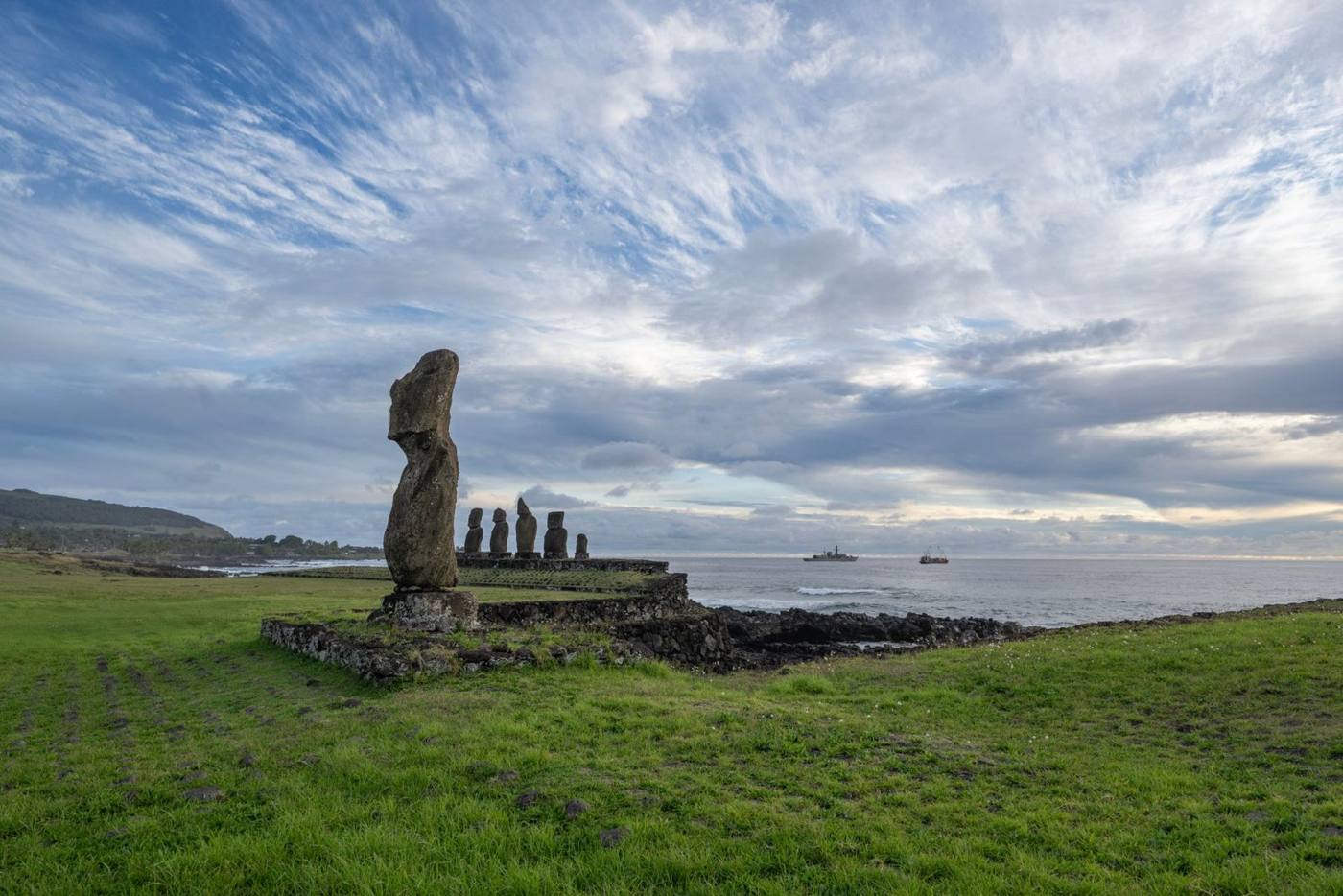
At sunset walk to Ahu Tahai, a few minutes from town. Here there are several ceremonial platforms, the ahu, with standing moai. One of them, Ahu Ko Te Riku, has white coral eyes and a red stone topknot, and is the only one showing how the complete statues must have looked. The sun sets behind them over the sea.
Spend the night in Hanga Roa.
Practical tip: Italians and most Europeans do not need a visa for Chile for up to 90 days. Easter Island has special rules, though: the maximum stay is 30 days, and you need an entry form completed online before the flight, a return ticket and an accommodation booking. Check the current rules before you go.
- Day 2
Sunrise at Ahu Tongariki and the Rano Raraku quarry
Get up very early to watch sunrise at Ahu Tongariki, on the south east coast, about half an hour's drive from Hanga Roa. It is the largest platform on the island, with fifteen moai in a row, tall and different from one another, their backs to the sea. They had been toppled in past centuries and then swept away by a tsunami in the twentieth century; they were stood up again in the 1990s. As the sun rises behind the statues, their silhouettes stand out against the orange sky.
Nearby is Rano Raraku, the volcano that supplied the stone for almost all the moai. It was the island's great quarry: sculptors carved the volcanic rock directly on the crater's slopes, then moved the statues all over the island, in a way still being studied today.
On the slope you see dozens of half finished moai, some buried up to the neck with only the head above ground, others still attached to the rock. One, never finished, is more than twenty metres long. The path climbs among the statues to a view over the crater lake and Tongariki.
In 2022 a fire damaged some of the quarry's moai. Some areas may be closed, and the visit follows a set route.
In the afternoon return to Hanga Roa and rest.
Practical tip: a national park ticket is required; check the price. Rano Raraku and Orongo can each be visited only once on the same ticket. Many sites require you to be accompanied by an authorised guide: check the rules and book ahead.
- Day 3
Anakena beach and the north coast
Today you cross the island to the north coast, home to Anakena, the most famous beach on Rapa Nui. It is a bay of white coral sand with coconut palms and turquoise water, very different from the black rocky shores elsewhere on the island.
According to tradition, this is where Hotu Matu'a landed, the king who led the first Polynesian settlers to the island. Above the beach stands Ahu Nau Nau, a platform with seven moai, some with red stone topknots. Long buried in sand, they have kept the carved details of their backs and hands well. Nearby is another lone moai, Ahu Ature Huki, the first to be stood up again in the twentieth century.
Spend the morning on the beach, swim and have lunch at one of the small kiosks.
In the afternoon, on the way back, stop at Te Pito Kura, where the largest moai ever moved to a platform lies on the ground, alongside a large smooth round stone that tradition calls the navel of the world. Not far away, at Papa Vaka, there are rock carvings of canoes, fish, turtles and other sea symbols.
In the evening return to Hanga Roa.
Practical tip: the moai and ahu are sacred to the islanders. It is forbidden to climb on the platforms, touch the statues or walk on the carvings. Fines are high and checks frequent.
- Day 4
Rano Kau volcano and the village of Orongo
Today you go to the south west tip of the island, to Rano Kau volcano, a few kilometres from Hanga Roa. Its crater, more than a kilometre wide, holds a lake partly covered by floating islands of totora reeds. The view from the rim is spectacular: the green and blue lake below, the crater walls and, on one side, the rim breaking open to the ocean.
You can drive up or walk from Hanga Roa on a trail of an hour and a half to two hours through grass and shrubs, with views over the town and the coast.
On the crater rim, high above the sea, lies Orongo, a ceremonial village of low stone houses. This was the site of the birdman rite, the Tangata Manu. Each year young competitors climbed down the cliff, swam through the waves to the islet of Motu Nui and waited to find the first sooty tern egg. The first to return with the egg intact made his chief the birdman for a year. The rocks are covered in carvings of figures that are half man and half bird.
In the afternoon visit the cave of Ana Kai Tangata, on the coast near Hanga Roa, with ancient bird paintings on its ceiling, if it is open.
Spend the night in Hanga Roa.
Practical tip: at Orongo the route is marked and supervised by wardens. The wind on the crater rim can be extremely strong: hold on to your hat and phone and keep away from the cliff edge.
- Day 5
Snorkelling or diving and a day in Hanga Roa
Today is a quieter day devoted to the sea. The water around Rapa Nui is among the clearest in the Pacific: far from rivers and big cities, it lets you see for tens of metres. The seabed is volcanic, with caves, rock arches and coral, and tropical fish found only in these waters.
Snorkelling and diving trips with the town's dive centres leave from Hanga Roa harbour, for beginners and experienced divers alike. In some spots you see sea turtles, which often come close to the little harbour too. Do not touch or feed them.
If you do not like going underwater, swim in the natural rock pools near town or at the small Pea beach next to the harbour.
In the afternoon visit the anthropological museum, a few minutes' walk from Ahu Tahai. It tells the island's story, from the arrival of the Polynesians to the crisis of the ancient society, from the slave raids of the nineteenth century to annexation by Chile. You see tools, wooden carvings and an explanation of rongorongo, an ancient script still undeciphered.
In the evening, if there is one, watch a show of Rapa Nui dance and song.
Spend the night in Hanga Roa.
Practical tip: in February the island holds the Tapati, its great festival, with traditional contests, dancing and singing. If you visit then, book flights and accommodation many months ahead.
- Day 6
Climbing Terevaka and the seven moai of Ahu Akivi
Today you climb Terevaka, the island's highest volcano, just over five hundred metres above the sea. The easiest trail starts near Ahu Akivi in the interior and climbs steadily through grassland and open fields where horses roam no-cost. The round trip takes a few hours.
The view from the top is unique: you see the whole island, with its craters, coasts and sea in every direction, with no land on the horizon. You truly understand how isolated Rapa Nui is.
On the way back visit Ahu Akivi. It is one of the few platforms built inland, with seven identical moai. They are also the only ones that face the sea, while almost all the others turn their backs to the ocean to watch over the villages. Tradition links them to the seven explorers sent by the king before the landing. They are also said to be precisely aligned with the sun at the equinoxes.
If you still have energy, stop at the Puna Pau quarry, where the red stone for the moai topknots, called pukao, was cut.
In the evening, for your last night, go back to Ahu Tahai for sunset, or watch the starry sky outside town, away from the lights.
Spend the night in Hanga Roa.
Practical tip: there is no shade or water on Terevaka. Carry at least two litres of water, a hat and sunscreen, and set off early. The horses roam no-cost: do not approach them from behind.
- Day 7
A last morning and the flight to Santiago
Take your last morning slowly. If your flight leaves in the afternoon, you can go back to Tongariki for sunrise or take a final walk along the coast near town, where waves break on the black rock.
Alternatively visit the Hanga Roa craft market, where artisans sell small moai carved in wood and stone, shell necklaces and objects with birdman symbols. Buy directly from people who work on the island. Small shops in town also sell books and maps on the history and sites of Rapa Nui, a good way to remember what you have seen.
Remember that taking stones, sand or pieces of rock off the island is forbidden and punished: every part of the landscape belongs to the protected heritage.
The airport is a few minutes from the centre. At departure, following a much loved tradition, islanders place shell necklaces around visitors' necks to say goodbye.
The flight to Santiago takes about five hours. If you are flying on to Europe, it is best to spend a night in Santiago before the intercontinental flight.
Practical tip: flights between Santiago and the island are few and often full. Book early and leave a day of margin before an international flight, because if a flight is cancelled the next one may be days later.
A unique place, but remote and expensive: the flight from Santiago takes almost six hours. The park fee is paid on arrival and many sites can only be visited with a licensed local guide. Five full days are enough to see everything without rushing.
Before you go
- Documents and visa
- Valid passport; no visa for tourism up to 90 days for EU citizens. On arrival you receive the PDI electronic slip, to be kept until you leave.
- Health and vaccines
- No compulsory vaccines arriving from Europe. In the Atacama Desert and the Andes beware of altitude sickness. Emergencies: 131 ambulance, 132 fire, 133 police.
- Money and payments
- Chilean peso. Cards are accepted almost everywhere; carry some cash in parks and villages.
- Power sockets
- Types C and L, 220 volts: European two-pin plugs almost always fit.
- Time zone
- UTC-4 in the southern winter and UTC-3 from September to April. The Magallanes region stays on UTC-3 all year.
- Safety
- The United States rates Chile level 2 for crime and civil unrest, with protests in the Araucanía region. In Santiago and Valparaíso watch out for pickpockets. Official advice: GOV.UK.
Information checked in November 2026 for Italian and EU citizens. Rules change: always check before you travel.
Variations
In 5 days: the main sites without the Terevaka climb or the day at sea.
In 12 days: add Santiago and Valparaíso, or the Atacama Desert, before or after the island.
Frequently asked questions
When is the best time to go?
December to March is warmer with the best sea. February is Tapati month and very busy. Winter is cooler and wetter, but with fewer visitors.
Do I need a guide?
For many national park sites, yes: the rules require an authorised guide. It is best to book one before you travel.
How do I get around the island?
By hire car or scooter, by bike or on organised tours. Distances are short, but inland roads are not always paved.
Indicative itinerary written by World Atlas. Before booking, check timetables, seasonal openings, documents and safety.
 10 daysEasy
Lakes and volcanoes: Pucón and Chiloé
Chile's green south: Villarrica volcano, hot springs in the forest, Lake Todos los Santos and the wooden churches of Chiloé.
 18 daysModerate
Chile in full, from the Atacama to Patagonia
The world's longest country in one trip: desert, Santiago, the southern lakes and volcanoes and a grand finale in Torres del Paine.
 8 daysModerate
Tierra del Fuego and king penguins
The Strait of Magellan, the penguin colony of Isla Magdalena, the king penguins of Bahía Inútil and the steppes of Tierra del Fuego.