Milne Bay and Tufi
Some of the planet's most biodiverse diving in Milne Bay, the fjords of Tufi and villages welcoming visitors with dances and canoes.
- Port Moresby
- Alotau
- Milne Bay
- Tufi
Day by day
- Day 1
Port Moresby and the flight to Alotau
This trip takes you to coastal Papua New Guinea: the diving of Milne Bay, among the richest in marine life on the planet, then the fjords of Tufi and the villages that welcome visitors with dances and canoes. You travel by domestic flights and boats, and Port Moresby is only a stopover.
Before you go: Italian citizens need a passport, with at least six months' validity, and a tourist visa, to apply for before travelling through the official website of Papua New Guinea's immigration authority or the embassy; check there whether your passport qualifies for a visa on arrival. Have your return ticket ready and fill in the digital arrival card online in the 72 hours before your flight. Other nationalities should check their own rules. Some areas on this trip are close to borders or places where the situation changes often: check your government's travel advice before booking and again before you leave. Ask your doctor about malaria prevention.
You land at Port Moresby airport and stay in the airport area until the domestic flight to Alotau, just over an hour. Crime is high in Port Moresby: do not go out on foot, do not change money in the street and do not take taxis or minibuses found on the spot.
Alotau is a quiet small town on the shore of Milne Bay, a deep bay surrounded by green mountains. Here, in August and September 1942, Australian troops stopped a Japanese landing: it was Japan's first land defeat in the Pacific war. A small memorial on the waterfront remembers it.
Sleep in Alotau or along the bay, for four nights.
Practical tip: book all transfers before you leave with the place where you are staying and have them pick you up at the airport.
- Day 2
First dives in Milne Bay
Today you start diving in Milne Bay, one of the areas with the most marine species in the world, in the heart of the so-called Coral Triangle.
In the morning board the boat with the dive guides and make a first check dive, to test your equipment and get used to the warm, clear water. Then you go down onto reefs covered in hard and soft corals, gorgonian fans, giant sponges and clouds of colourful fish: butterflyfish, angelfish, orange anthias and schools of fusiliers.
Milne Bay is also famous for muck diving, diving over dark sand and rubble that look empty but hide small and strange animals. It is said that the name itself was born here. With sharp eyes you see frogfish, ghost pipefish, mimic octopuses that imitate other animals, pygmy seahorses and nudibranchs in incredible colours.
Between dives rest on the boat, looking at the forest-covered mountains that run down to the sea and the fishermen's canoes going by.
In the evening, back on land, write up your dive log and have dinner with fish, taro and sweet potatoes cooked in coconut milk.
Sleep in Alotau or along the bay.
Practical tip: bring a dive torch even by day, because on dark sand the colours of small animals only show up with a light.
- Day 3
Reefs and muck diving
Today you keep diving, alternating open reefs and sandy bottoms.
In the morning the boat heads for one of the furthest points of the bay, where coral walls drop into the blue. Here visibility is often very good and you meet bigger fish: trevallies, barracuda, turtles, sometimes reef sharks cruising calmly past. With luck, at certain times of year you may also see manta rays.
In the afternoon you return inshore for a slow dive over sand, near the villages. This is the time for patience: move slowly, stay close to the bottom without touching it and follow the guide, who knows where the animals hide. A piece of wood can be a scorpionfish, a leaf can be a leaf fish.
If you like, do a night dive: with torches you see crustaceans coming out of their holes, octopuses hunting and corals opening their small tentacles.
Between trips ask to stop at a village on the coast. People welcome you kindly, children run along the beach and the elders tell the story of the place.
In the evening eat tropical fruit, cooked bananas and grilled fish.
Practical tip: make no more than three dives a day, drink plenty of water and leave at least twenty-four hours between your last dive and your flight.
- Day 4
The last day in Milne Bay
Today is your last day in Milne Bay: you can do a couple more dives in the morning and then rest.
Choose with the guide the sites you liked best, or try a dive on a wreck or a new site. Many divers return to the same muck diving site several times, because different animals appear each time.
In the afternoon, on land, visit Alotau with a local companion. The market on the waterfront is full of betel nuts, bananas, sweet potatoes, fish and fruit. Women also sell woven baskets and bags. Remember that betel nut, chewed with lime and leaves, is very common: the red stains on the ground are its spit.
If you are here in November, ask about the Alotau canoe and drum festival, when the big decorated war canoes arrive from the nearby islands, with dances and songs. Check the dates, because they change every year.
In the evening pack your bags and dry your equipment well: tomorrow you fly to Tufi.
Remember that you do not fly straight after diving: that is why the last dives are in the morning and the departure is the next day.
Practical tip: at the market always ask before photographing people and carry small kina notes in cash, because cards do not work here.
- Day 5
The flight to Tufi and the fjords
Today you fly from Milne Bay to Tufi, on the coast of Oro province.
The journey is made on small planes, usually via Port Moresby; flights and transfers are often arranged by the place where you stay. Domestic flights are often delayed or rescheduled: leave a margin. In Port Moresby stay in the airport area.
From the air you see the Tufi fjords for the first time: long, narrow, deep arms of sea cutting into the coast of Cape Nelson, between green walls covered in forest. They were formed by ancient volcanic eruptions and valleys flooded by the sea. Tufi is one of the few tropical places in the world with a landscape like this.
You land on the small Tufi airstrip, above the sea, and settle in. In the afternoon take a boat or canoe trip into one of the fjords: the water is calm and dark, the walls rise steeply, and from afar you hear forest birds and village children.
In the evening watch the sunset over the fjords, with the fishermen's outrigger canoes coming home.
Sleep in Tufi, for three nights.
Practical tip: bring insect repellent, long sleeves for the evening and a mosquito net if one is not provided, because malaria is common here too.
- Day 6
The villages of the fjords
Today you spend the day in the villages of Tufi, where communities welcome visitors.
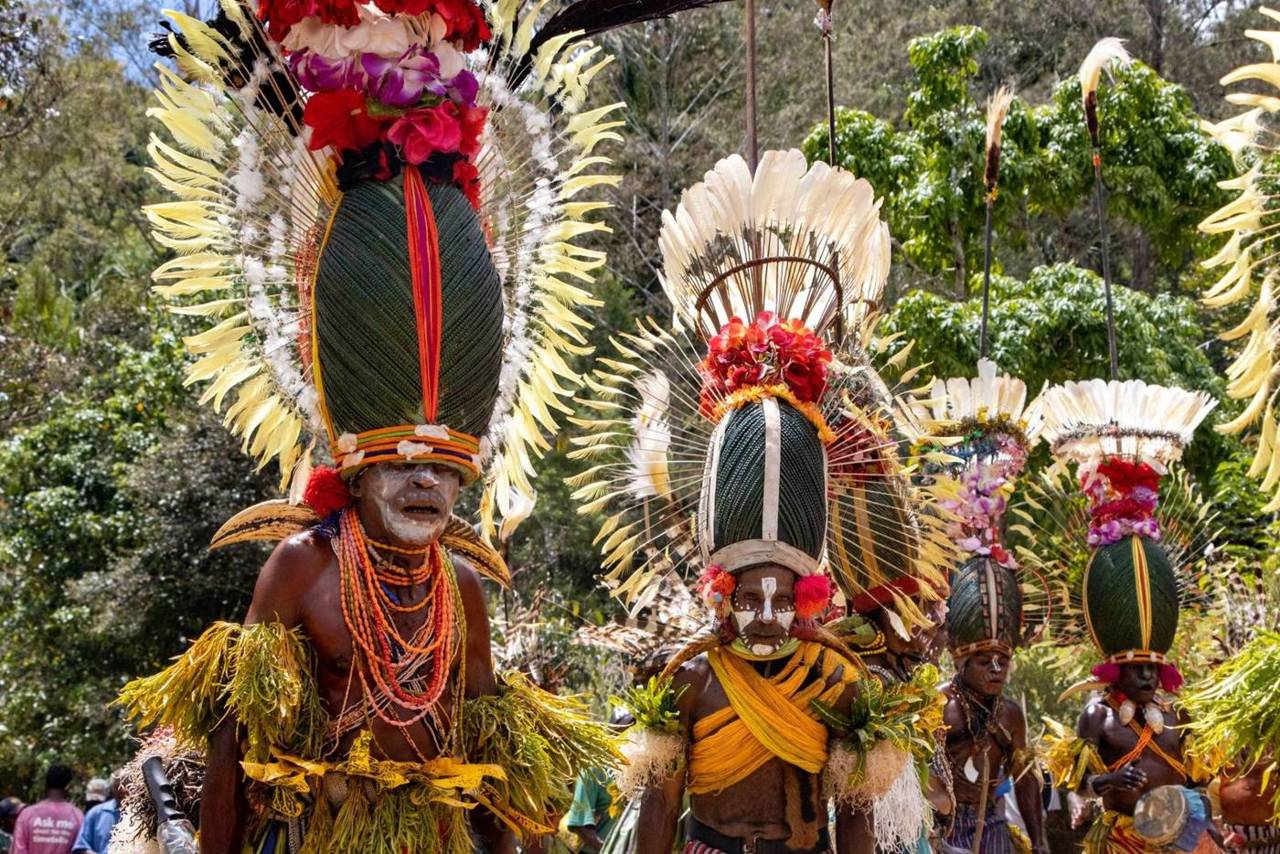
In the morning a canoe or boat takes you to the end of a fjord, where a forest trail leads to a village. You are welcomed with traditional dances: men and women in fibre skirts, feathers, shell necklaces and kundu drums beating the rhythm. It is an encounter prepared for visitors, but done with pride and a wish to show their culture.
Then the women show you how tapa is made, the cloth made from tree bark, beaten for a long time and painted with natural colours and ancient designs. In this area many older women still have traditional facial tattoos, a sign of identity and of coming of age.
For lunch you taste a dish cooked in the village: taro, sweet potatoes, greens and fish or chicken cooked in coconut milk.
In the afternoon return by canoe, swim in the calm water of the fjord and rest.
In the evening listen to the guide's stories about clans, land and the ties between villages. More than eight hundred languages are spoken in Papua New Guinea, and often each group of villages has its own.
Practical tip: always ask permission before taking photos, dress modestly in the villages and buy tapa directly from the women who make it.
- Day 7
Diving and snorkelling in Tufi
Today you go back underwater, this time on the reefs outside the Tufi fjords.
In the morning the boat leaves the fjord for the open sea. The reefs here are far from towns and big ports, and the corals are in good condition. On your dives you see walls full of soft corals, gorgonians, Napoleon wrasse, turtles and schools of fish. With luck you meet dolphins on the boat ride.
Inside the fjords too the water hides surprises: on the bottom near the walls live small, rare animals, similar to those of Milne Bay, and it is an excellent place for macro photography.
If you do not dive, snorkelling on the shallow reefs near the coast is very good: a mask is enough to see clownfish in anemones and blue starfish.
In the afternoon make your last dive or rest, because tomorrow you fly. Remember the rule of twenty-four hours between your last dive and the flight.
In the evening watch the last sunset over the fjords and say goodbye to the people you met in the villages.
In these days in Tufi you have seen a place where village life is still tied to the sea, the forest and tradition.
Practical tip: sort out your equipment and let it dry well in the sun, because on small planes baggage weight is limited and carefully checked.
- Day 8
Back to Port Moresby and departure
Today you leave Tufi and fly to Port Moresby for your international flight.
In the morning look down from the plane, one last time, at the fjords and the green mountains of the coast. Then you land in Port Moresby and stay at the airport or nearby until departure. If you must spend a night in the city, choose a place near the airport with a transfer included and do not go out on foot, especially after dark.
In these eight days you have seen a Papua New Guinea different from the one in the news: the seabed of Milne Bay, with muck diving and coral reefs, the history of the 1942 battle, the fjords of Tufi, the villages with their dances, tapa and tattoos, and a sea among the richest on the planet.
When to go: the best months are October to December, when the sea is often calm and underwater visibility is good. From November to May, however, it is also the rainy and cyclone season: check the forecast before you leave.
Medical facilities are very limited: you need insurance with air evacuation, useful also for any diving accidents. Emergencies: 112 for the police, 111 for an ambulance.
Practical tip: carry only small amounts of cash, use the cash machines inside the airport and do not show your phone, camera or jewellery in the city.
An extraordinary but difficult country: Port Moresby and the highlands have high crime and violence. This trip stays in calmer coastal areas, organised with lodges and lodge transfers. Follow your government's advice and never go out alone in town.
Before you go
- Documents and visa
- Passport valid for at least six months from the date of arrival. You need a tourist visa, to apply for before travelling through the official website of Papua New Guinea's immigration authority or the embassy; check there whether your passport qualifies for a visa on arrival. You may be asked for a return ticket. All travellers must complete the digital arrival card online in the 72 hours before arrival.
- Health and vaccines
- Malaria and dengue are widespread: ask your doctor about prevention and protect yourself from mosquitoes. A yellow fever certificate is needed only if you arrive from a country at risk. Medical facilities are very limited: you need insurance with air evacuation, usually to Australia. Emergencies: 112 police, 111 ambulance.
- Money and payments
- Kina. Cards work only in the larger places in towns; in villages you need cash in small notes. Use cash machines inside banks, airports or shopping centres and carry only small amounts.
- Power sockets
- Type I, 240 volts: you need an adapter for European plugs.
- Time zone
- UTC+10 all year.
- Safety
- Crime is high in Port Moresby, Lae and Mount Hagen, including armed robbery: do not walk alone or at night, use only booked transfers and do not show valuables. The UK advises against all but essential travel to Hela and Southern Highlands provinces and most of Enga, because of tribal fighting. Domestic flights are often delayed or cancelled. Earthquakes, active volcanoes and, from November to May, rain and cyclones. Official advice: GOV.UK.
Information checked in November 2026 for Italian and EU citizens. Rules change: always check before you travel.
Variations
In 6 days: Milne Bay only, with four days of diving from Alotau and the return to Port Moresby.
In 11 days: add three days on a dive cruise among the islands of Milne Bay, arranged before you leave.
Frequently asked questions
Is Papua New Guinea dangerous?
Crime is high in Port Moresby and the highlands. This trip stays on quieter coasts. Use only booked transfers, do not walk around the city and check your government's travel advice before booking and again before you leave.
What documents do you need?
A passport valid for six months and a tourist visa, to apply for before travelling through the immigration authority or the embassy. You also need the digital arrival card. Other nationalities should check their own rules.
Do you need to be an experienced diver?
No, many sites suit divers with their first certificate and the snorkelling is good. For deep walls and currents you need more experience.
Indicative itinerary written by World Atlas. Before booking, check timetables, seasonal openings, documents and safety.