Granada, Ometepe and León
Colonial Granada on the lake, Ometepe island with its two volcanoes, Masaya volcano with visible lava and León with ash-boarding on Cerro Negro.
- Granada
- Masaya
- Ometepe
- León
- Cerro Negro
Day by day
- Day 1
Granada, the colonial city on the lake
This eight-day trip crosses the Nicaragua of volcanoes and colonial cities: Granada on the great lake, Masaya volcano with its visible lava, the island of Ometepe with its two cones, and León, with its white cathedral and Cerro Negro.
Before you go: Italian citizens enter without a visa for tourism for up to 90 days, with a passport valid for at least six months. On arrival you pay 10 dollars in cash for the tourist card and may be asked for a ticket out of the country; you are advised to fill in the Interior Ministry's online entry form beforehand. The authorities can refuse entry without giving reasons. Drones are banned and are seized at customs; professional photo and video equipment and binoculars can also be seized, and birdwatching needs a permit from the Environment Ministry. Bring a simple camera and do not photograph soldiers, police or public buildings. Other nationalities should check their own rules. Some areas on this trip are close to borders or places where the situation changes often: check your government's travel advice before booking and again before you leave.
From Managua airport to Granada takes about an hour or a little more by car. In the afternoon walk around the centre: the main square with the yellow cathedral, the low houses with inner courtyards, and the Calzada, the pedestrian street that runs down to the lake. Climb the bell tower of La Merced church to see the tiled roofs and Mombacho volcano. Check prices and times.
In the evening try vigorón, Granada's typical dish, with cassava, cabbage salad and crispy pork crackling on a banana leaf.
Practical tip: avoid political discussions and comments about the government, including on social media; do not join demonstrations or rallies.
- Day 2
The lake islets and Masaya volcano by night
Today you alternate water and fire: in the morning by boat among the islets of Lake Nicaragua, in the evening on the rim of an active crater.
The Granada islets are hundreds of small islands born from an ancient eruption of Mombacho volcano. A motorboat leaves from the harbour near the centre and glides through calm channels. Some islands have just a few trees and a fisherman's house, others villas and gardens. You see herons, cormorants, kingfishers and, in the branches, small monkeys. You also pass the old fort of San Pablo, built to defend the city from pirates. Check prices and times with the boatman before getting on board.
In the afternoon rest in the shade, then towards sunset leave for Masaya Volcano National Park, less than an hour away. A paved road climbs to the rim of Santiago crater. When conditions allow, from the viewpoint you see the lava lake bubbling at the bottom of the crater, lighting the smoke red. The sight is strongest in the dark.
Visits are short and controlled by rangers, and the park can close suddenly because of gas or small tremors, which are frequent here. Always follow instructions and do not cross the barriers. Check prices and times before you go.
Back in Granada have a late dinner of gallo pinto, rice and red beans fried together, with fried fresh cheese.
Practical tip: if you have asthma or breathing problems, stay only briefly at the viewpoint and keep upwind, because the crater gases irritate the throat and eyes.
- Day 3
To Ometepe and Ojo de Agua
Today you reach Ometepe, the island formed by two volcanoes in Lake Nicaragua. From Granada drive to the port of San Jorge, near Rivas, in about an hour and a half. From here the ferry to Moyogalpa takes about an hour.
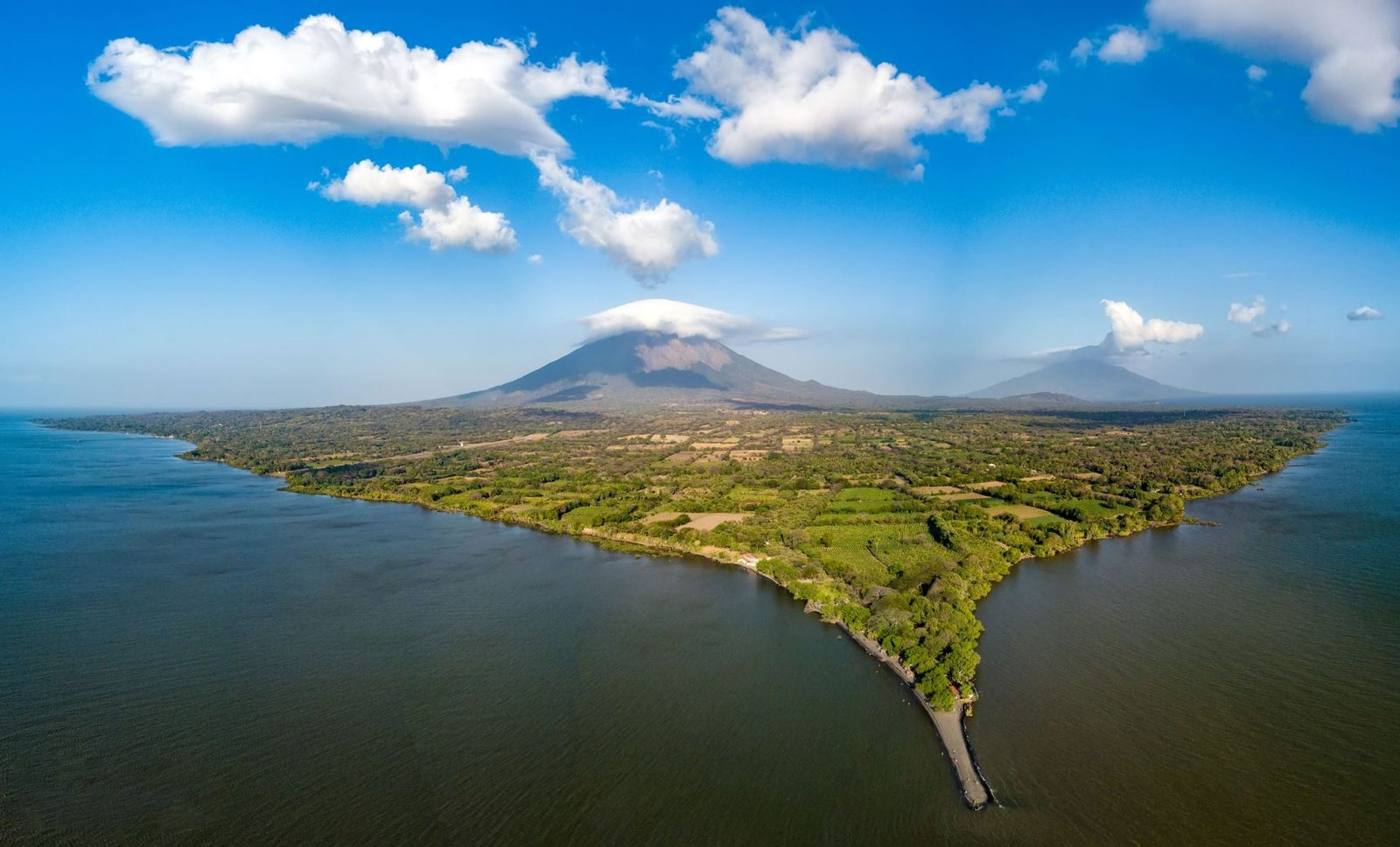
During the crossing look towards the island: the perfect cone of Concepción, 1,610 metres high and still active, and next to it Maderas, lower and covered in forest. The two mountains are joined by a narrow strip of land, the Istián isthmus.
In Moyogalpa hire a car with a driver or, if you are experienced, a scooter, and drive east on the road that circles Concepción. You pass banana fields and plantain plantations, quiet villages and cows walking on the road.
In the afternoon stop at Ojo de Agua, a natural pool fed by a spring under the trees. The water is clear and cool, perfect after the heat of the journey. Check prices and times at the entrance.
At sunset go to Santo Domingo beach, on the isthmus, where you see the two volcanoes turn orange. Sleep in this area, which is handy for reaching both Concepción and Maderas.
In the evening try fish from the lake, guapote or mojarra, fried whole with rice and salad.
Practical tip: there is little shade on the ferries; get to the pier early, keep your bags close and ask for confirmation of the departure time, which can change in strong wind.
- Day 4
Concepción or Maderas volcano
Today you choose Ometepe's great excursion: climbing one of the two volcanoes. Both climbs are done with a local guide, who is required and knows the route and the weather.
Concepción is the harder choice. It is an active cone, and reaching the rim depends on conditions: guides often stop before the summit because of gas or wind. You leave before dawn and walk for many hours, first through woodland and then over steep rocks and ash, with no shade. In return the view over the lake and the island is immense. You need to be very fit.
Maderas is lower but not easy. The trail climbs through tropical forest and then cloud forest, through mud, roots and coffee plantations. You will hear howler monkeys and see butterflies and colourful birds. At the top, if the clouds allow, there is a small lagoon inside the crater. The route is long and very slippery, so plan for the whole day.
If you do not want such a demanding climb, choose a shorter walk to San Ramón waterfall, on the side of Maderas, which falls from a high rock wall in the forest. Check prices and times.
In the evening rest your legs and eat early. On Ometepe nightlife is quiet and you go to bed to the sound of crickets.
Practical tip: carry at least three litres of water, salty snacks, a light jacket and hiking boots with a sturdy sole; the wind is strong at the top and the descent on ash tests your knees.
- Day 5
Around the island by scooter or car
Today you tour Ometepe at a gentle pace, stopping in the villages and the quietest places on the island.
Leave in the morning for Altagracia, on the north side of Concepción. Here people live from fishing and farming, and around the church there are pre-Columbian stone statues. The island also has many petroglyphs, rocks carved with spirals, animals and human figures by ancient peoples. Ask your guide to show you a site with carvings.
Continue to Charco Verde, a reserve on the southern shore of Concepción, with a green lagoon and an easy forest trail. It is easy to see monkeys, iguanas and many birds. Then reach Punta Jesús María, a long tongue of sand running into the lake: at sunset the light is beautiful and Concepción is reflected in the water.
If you hire a scooter, ride carefully. Some roads are paved, others are dirt tracks, with potholes, stones and animals. Wear a helmet and do not ride after sunset, when the roads are unlit. If you are not experienced, take a car with a driver.
In the evening try nacatamal, a parcel of maize dough with pork, rice and vegetables cooked in a banana leaf, which families make mostly at the weekend.
Practical tip: on Ometepe cash machines are few and sometimes empty; carry US dollars in new notes and enough córdobas for all your days on the island.
- Day 6
León and the cathedral with the white roof
Today you leave Ometepe on the ferry to San Jorge and cross the country northwards to León. The drive, passing near Managua, takes several hours: leave early and arrive in daylight.
León is a university city, hot and lively, with colonial churches and walls covered in murals. Its symbol is the Cathedral of the Assumption, the largest in Central America, listed by UNESCO as a World Heritage Site. Inside, in the half-light, lies the tomb of Rubén Darío, the country's most famous poet, the father of modernism in Spanish-language poetry.
The best moment is the climb onto the roof. Take off your shoes and walk barefoot on the domes painted white, which shine in the sun. From here you see the whole city, the bell towers of the other churches and, on the horizon, the chain of volcanoes. At sunset the colours turn golden. Check prices and times.
After the cathedral visit the Rubén Darío house museum, a few blocks away, with furniture, books and objects from his life. Then sit in the square, where in the evening families and students chat under the trees.
Try quesillo, a warm maize tortilla with soft cheese, pickled onion and cream, sold along the roads in this area.
Practical tip: on the cathedral roof the white surface reflects the sun strongly; wear sunglasses and go early in the morning or late in the afternoon.
- Day 7
Cerro Negro, boarding down the ash
Today you live León's most famous adventure: sliding down the ash of Cerro Negro on a board. It is one of the youngest volcanoes in Central America, born in 1850 in a maize field, and its black ash contrasts with the green fields around it.
You leave the city in the morning with a group and a guide, and in about an hour you reach the entrance of the protected area. Here you start climbing on foot with the board on your shoulders. The path is steep, over volcanic stones and gravel, and the sun is strong, but the climb takes less than an hour. From the top you see the chain of volcanoes, the fields and, on clear days, the Pacific.
At the top the guide gives you overalls, goggles and gloves. You sit on the board, or stand on it if you are experienced, and slide down the side of the volcano over the black gravel. The descent lasts a few minutes, but leaves dust everywhere and a big smile. Listen carefully to the instructions on how to brake with your feet.
In the afternoon, if you still have energy, cool off on the nearby coast at Las Peñitas, where you can eat fish by the sea. Waves and currents are strong: swim only where local people swim.
Practical tip: wear long trousers and closed shoes, and carry at least two litres of water; the ash on the volcano gets very hot and the stones cut easily.
- Day 8
Departure from Managua and summary
Today you leave León and head for Managua airport. By car it takes about two hours, but traffic near the capital can make the journey longer: leave with plenty of time.
If you have time, stop in a village along the way to buy fruit or one last quesillo. Do not visit the outlying districts of Managua or its large markets without a guide: go straight to the airport.
At the airport keep your passport and ticket ready. The air departure tax is usually already included in the price of the flight, but keep a few dollars just in case.
In eight days you have seen Granada with its colourful houses and the lake islets, the lava lake of Masaya volcano by night, the island of Ometepe with Concepción and Maderas, Ojo de Agua and Punta Jesús María, and finally León with the white cathedral where Rubén Darío rests and the slide down the ash of Cerro Negro. It is a trip of volcanic landscapes and colonial cities, with lower prices than many neighbouring countries.
When to go: from December to April, in the dry season, the trails are dry and the sky is clearer; March and April are the hottest months, especially in León. From May to November it often rains in the afternoon, the vegetation is green and there are fewer visitors.
Practical tip: before your flight check again that your bag contains no banned items, such as e-cigarettes, which are prohibited in Nicaragua and can be confiscated.
Extraordinary volcanic scenery and low prices. The political climate has been tense since 2018: some foreigners have been refused entry, especially journalists. Check your government's travel advice and avoid demonstrations.
Before you go
- Documents and visa
- Passport valid for at least six months; no visa is needed for tourism for up to 90 days, but on arrival you pay 10 dollars in cash for the tourist card and may be asked for an onward ticket. You are advised to fill in the Interior Ministry's online entry form beforehand. The authorities can refuse entry without giving a reason. Drones are banned and are seized at customs; professional photo and video equipment and binoculars can also be seized, and birdwatching needs a permit from the Environment Ministry. E-cigarettes are banned. Do not photograph soldiers, police or public buildings. Nicaragua, El Salvador, Guatemala and Honduras share a single 90-day period.
- Health and vaccines
- There is dengue, chikungunya and Zika: use repellent during the day too. Ask your doctor whether you need malaria prevention for the areas you visit. A yellow fever certificate is needed only if you arrive from a country at risk. Drink bottled water. Private hospitals in Managua are good, elsewhere facilities are limited: you need insurance covering medical costs and repatriation. Emergencies: police 118, Red Cross 128, fire brigade 115.
- Money and payments
- Córdoba. The US dollar is accepted almost everywhere, but change often comes in córdobas and worn or marked notes are refused. Cards and cash machines work in towns; change money only at banks and carry cash for Ometepe and the Corn Islands.
- Power sockets
- Types A and B, with flat pins as in the United States, 120 volts: you need an adapter, and check the voltage of your devices.
- Time zone
- UTC-6 all year.
- Safety
- The political situation is tense and laws can be applied unpredictably: avoid demonstrations, political discussions and comments, including on social media. In the evening do not walk alone and use only official taxis; do not drive at night outside towns. On the Pacific the currents are strong, and the boat between the two Corn Islands is dangerous in rough seas. Official advice: GOV.UK.
Information checked in November 2026 for Italian and EU citizens. Rules change: always check before you travel.
Variations
Shorter version: in five days visit Granada with Masaya and León with Cerro Negro, without going to Ometepe.
Longer version: add three days on Ometepe to climb both volcanoes, or two days on the Pacific coast south of Rivas.
Frequently asked questions
Can I bring a drone to Nicaragua?
No. Drones are banned and are seized at customs. Professional photo equipment and binoculars can also be seized: travel with a simple camera and check with the embassy before leaving.
Do I need a guide to climb the Ometepe volcanoes?
Yes, a local guide is needed for Concepción and Maderas. They know the trails, the weather and the state of the volcano, and decide when it is best to turn back.
How much does it cost to enter Nicaragua?
On arrival you pay 10 dollars in cash for the tourist card. Bring new notes in small denominations, because worn ones are often refused.
Indicative itinerary written by World Atlas. Before booking, check timetables, seasonal openings, documents and safety.