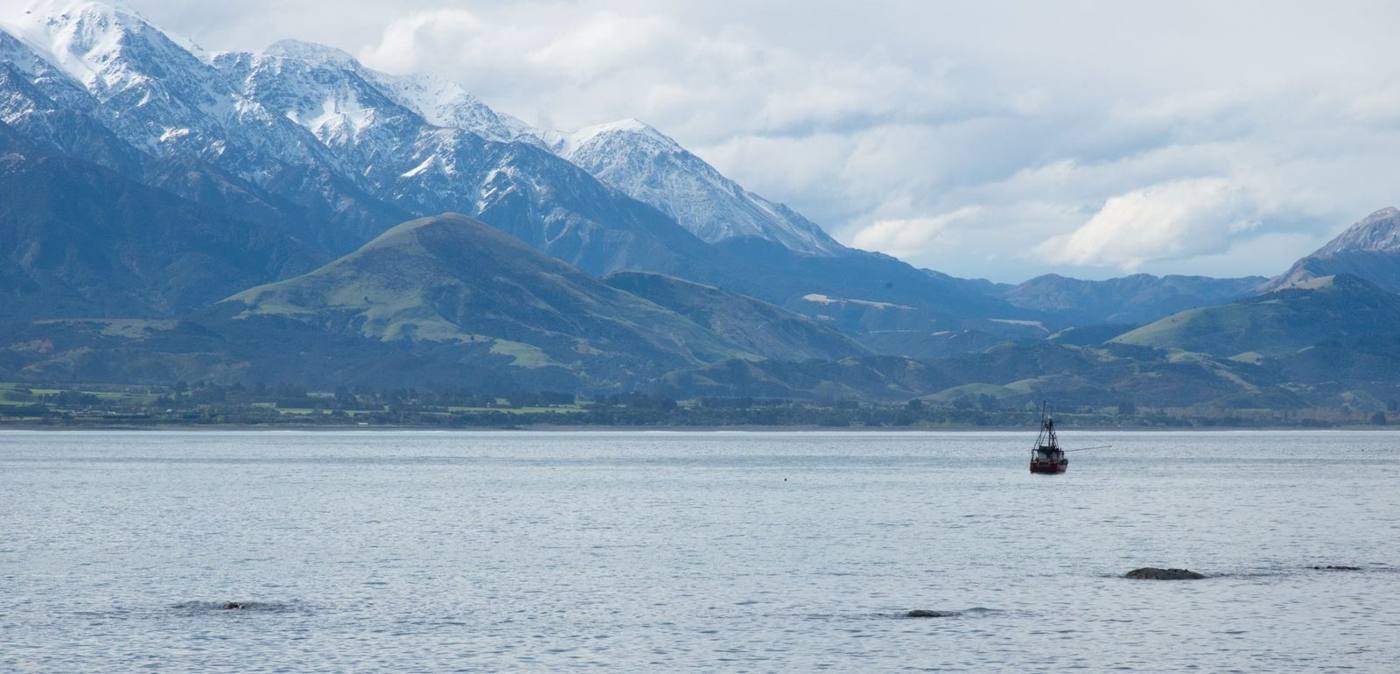
Kaikoura and Akaroa: whales and dolphins
Sperm whales all year at Kaikoura, fur seal colonies and albatrosses, then Banks Peninsula with the tiny Hector's dolphins.
- Christchurch
- Kaikoura
- Ohau Point
- Akaroa
- Christchurch
Day by day
- Day 1
From Christchurch to Kaikoura along the coast
The east coast of the South Island, between Christchurch and Kaikoura, is one of the best places in the world to see marine mammals up close. Off Kaikoura the seabed drops quickly into an underwater canyon more than a thousand metres deep, and the cold, nutrient-rich water draws sperm whales, dolphins, fur seals and albatrosses all year round. Further south, Banks Peninsula hides Akaroa, a village of French origin, and Hector's dolphins, among the smallest and rarest in the world. In five days you see both.
You arrive in Christchurch, the South Island's main city, rebuilt after the 2011 earthquake. If you have a few hours, walk along the Avon river, through the botanic gardens and to the cardboard cathedral, the temporary church built with large cardboard tubes after the old cathedral collapsed.
Then take the car and drive north on State Highway 1, in about two and a half hours. The road crosses the Canterbury plains, then the hills, and finally reaches the sea, where it runs between the mountains and the rocky coast. This stretch was badly damaged by the 2016 Kaikoura earthquake, magnitude 7.8, which lifted the seabed by several metres; the road has been reopened and rebuilt.
You reach Kaikoura in the afternoon. The town lies on a peninsula, with the Seaward Kaikoura Range behind it, snow-covered for much of the year.
In the evening, try crayfish, which gives the town its name: in Māori, kai means food and koura crayfish.
Practical tip: book the boat trips for the following days in advance, especially in summer.
- Day 2
By boat with sperm whales and the seal peninsula
Early in the morning, head out by boat to see sperm whales. Trips last about two and a half hours and leave several times a day when the sea allows. Male sperm whales live here all year round, drawn by the giant squid and fish of the canyon. The skipper locates them with a hydrophone that listens to their sounds underwater.
A sperm whale stays at the surface for about ten minutes to breathe, its blowhole sending up a slanting spout, then dives, raising its great tail, and goes deep for almost an hour. You often also see dolphins, fur seals and, depending on the season, humpback whales or passing orcas.
The sea can be rough: if you suffer from seasickness, take a remedy before you go. Trips are cancelled when the waves are too high, and part of the ticket is often refunded if no whale is seen: check the conditions when you book.
In the afternoon, walk the Kaikoura Peninsula Walkway, a hike of about three hours that follows the coast and the clifftops. At the Point Kean car park, fur seals sleep on the rocks a few metres away. From the path you see the rock platform lifted by the 2016 earthquake, now out of the water, with dried seaweed.
In the evening, watch the sunset over the mountains from the pebble beach.
Practical tip: stay at least ten metres from the seals, never get between them and the sea, and do not approach the pups. They can bite.
- Day 3
Albatrosses, dolphins and Ohau Point
Today choose between two sea trips, or do both.
The first is the seabird trip: a small boat heads offshore and attracts the birds. You can see several species of albatross up close, including the wandering albatross, with a wingspan of more than three metres, along with petrels, shearwaters and prions. It is a rare experience even for those who are not keen birdwatchers.
The second is swimming with dusky dolphins, which live off Kaikoura in large pods, sometimes of hundreds of animals. Wearing a wetsuit and mask, you get into the water when the pod passes nearby, and the curious dolphins circle the swimmers and leap out of the water. For those who do not want to swim there is also a watching-only trip. The water is cold all year.
In the afternoon, drive north for about half an hour to Ohau Point, a coastal lookout where a large fur seal colony lives. In winter and spring you see many pups playing among the rocks.
Return to Kaikoura for the evening. If you like walking, Mount Fyffe, behind the town, offers a long climb with views over the whole peninsula.
Practical tip: swimming with dolphins depends on the sea and the animals, and places are limited. Book for your first no-cost day, so you can try again if the trip is cancelled.
- Day 4
Akaroa and Hector's dolphins
In the morning, head south, pass through Christchurch again and continue onto Banks Peninsula, about three and a half hours in all. The peninsula is formed by two large extinct volcanoes, and their craters, flooded by the sea, have become natural harbours surrounded by green hills. The road climbs to the crater rim and then descends to Akaroa, on the shore of the harbour.
Akaroa has an unusual history: in 1840 a group of French settlers arrived to found a colony, only to find that New Zealand had just become British with the Treaty of Waitangi. The French stayed anyway, and the village still keeps French street names, nineteenth-century wooden houses with flowering gardens, a small lighthouse and a museum that tells this story.
In the afternoon, take a boat out in Akaroa Harbour to see Hector's dolphins, which live only in New Zealand. They are small, just over a metre long, grey, white and black, with a rounded dorsal fin that recalls Mickey Mouse's ears. The boat crosses the harbour to its mouth towards the open sea, among volcanic cliffs where shags nest and little blue penguins live.
In summer you can also swim with Hector's dolphins with licensed operators.
In the evening, try smoked salmon and the peninsula's cheeses, and walk along the waterfront at sunset.
Practical tip: the road to Akaroa has many bends. Take your time and stop at the Hilltop lookout.
- Day 5
Back to Christchurch and departure
On your last morning, if you have time, take a walk on one of the trails above Akaroa, through pastures and bush, with views over the harbour, or rent a kayak on the calm waters of the bay.
Then return to Christchurch, in about an hour and a half. If your flight leaves in the afternoon, you can spend a few hours in the city. Canterbury Museum, next to the botanic gardens, tells the story of the region, of Antarctic exploration and of Māori culture. The centre, rebuilt after the earthquake, has new squares, the cultural centre, the covered market and the walk along the Avon river, where you can take a punt, as in Cambridge.
Alternatively, ride the gondola up Mount Cavendish, above Lyttelton harbour, to see the city, the plains and the Southern Alps on the horizon from above.
Christchurch has flights to other New Zealand cities and to Australia. This trip combines well with the rest of the South Island: Lake Tekapo and Aoraki/Mount Cook to the south-west, the Marlborough region and Abel Tasman park to the north, or the TranzAlpine train to the West Coast.
Practical tip: to enter New Zealand, Italian citizens need the NZeTA, the electronic travel authority, and must pay the international visitor levy, the IVL, of 100 New Zealand dollars. Both are requested online before departure.
One of the most reliable places in the world to see sperm whales, because the ocean trench comes very close to the coast. Trips are often cancelled in rough seas, so spend at least two nights in Kaikoura. Hector's dolphin is one of the smallest and rarest in the world. Short and easy, it fits well into a South Island tour.
Before you go
- Documents and visa
- Valid passport and an NZeTA, requested online before leaving, with the IVL levy of 100 New Zealand dollars. The NZeTA costs 17 dollars through the official app and 23 through the website.
- Health and vaccines
- No vaccines required. Biosecurity checks on arrival are very strict: declare food, plants and hiking boots. Emergencies: 111.
- Money and payments
- New Zealand dollar. Cards are accepted almost everywhere, even in small towns.
- Power sockets
- Type I, 230 volts: you need an adapter for the angled flat-pin Australian-style plugs.
- Time zone
- UTC+12, UTC+13 with daylight saving time from late September to early April.
- Safety
- A very safe country. The main risks are natural: changeable mountain weather, strong sea currents, earthquakes and active volcanoes. Driving is on the left. Official advice: GOV.UK.
Information checked in November 2026 for Italian and EU citizens. Rules change: always check before you travel.
Variations
In 3 days: Kaikoura only, with the sperm whales, the peninsula and the dolphins.
In 9 days: add Lake Tekapo and Aoraki/Mount Cook, south-west of Christchurch.
Frequently asked questions
When can you see sperm whales?
All year round, because the males live permanently off Kaikoura. Trips do depend on the sea, though.
Do I need a car?
It is the most convenient way. There are also buses and a summer scenic train between Christchurch and Kaikoura, but for Akaroa a car is almost essential.
What documents do I need?
A passport, the NZeTA and the international visitor levy of 100 New Zealand dollars, both requested online before you leave.
Indicative itinerary written by World Atlas. Before booking, check timetables, seasonal openings, documents and safety.
 7 daysModerate
Queenstown and Fiordland
The adventure capital and the surroundings of Glenorchy, then Fiordland with Milford and the more remote Doubtful Sound and a section of the Routeburn Track.
 21 daysModerate
The complete New Zealand
Three weeks from Auckland to Christchurch: Rotorua and Tongariro, Wellington, Abel Tasman, the West Coast, Queenstown, Milford Sound and Mount Cook.
 6 daysEasy
Bay of Islands and Northland
Waitangi, where modern New Zealand was born, the 144 islands of the bay, the forest of giant kauri trees and Cape Reinga.