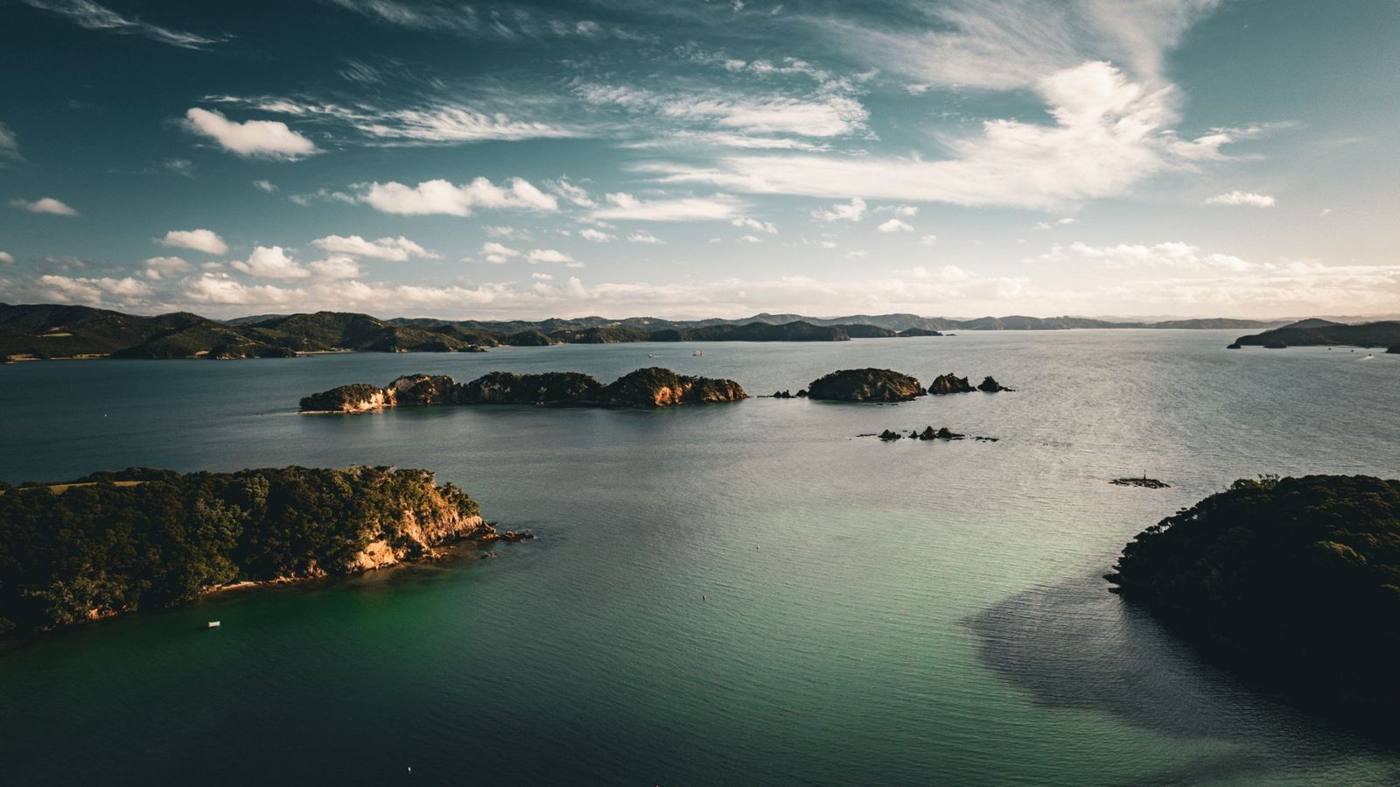
Bay of Islands and Northland
Waitangi, where modern New Zealand was born, the 144 islands of the bay, the forest of giant kauri trees and Cape Reinga.
- Auckland
- Paihia
- Waitangi
- Russell
- Cape Reinga
- Waipoua
- Auckland
Day by day
- Day 1
From Auckland to Paihia
Northland is the long subtropical peninsula stretching north from Auckland to the northern tip of New Zealand, with calm bays, golden beaches, sand dunes and the last great forests of kauri, the country's giant trees. It is also where modern New Zealand was born, with the treaty signed in 1840 between the British Crown and Māori chiefs. In six days you see the Bay of Islands, Cape Reinga and Waipoua Forest.
You arrive at Auckland international airport. Hire a car and drive north to Paihia, on the Bay of Islands, in about three and a half hours, on a road through green hills, pastures and woods.
On the way, stop in Whangārei, Northland's main town, at Whangārei Falls, which drop about twenty metres into a pool surrounded by forest, a few minutes from the centre. If you like art, at Kawakawa, just before Paihia, there are the public toilets designed by the Austrian artist Friedensreich Hundertwasser, who lived in the area: a small, colourful building full of ceramics, glass bottles and crooked columns.
In the afternoon you arrive in Paihia, the main town on the bay, with its waterfront, pier and boats.
In the evening, walk along the beach at sunset.
In the evening, sleep in Paihia.
Practical tip: to enter New Zealand, Italian citizens must apply online for an NZeTA and pay the visitor levy, the IVL, of 100 New Zealand dollars. Do it on the official app or website before you travel.
- Day 2
The Waitangi Treaty Grounds and the ferry to Russell
In the morning, visit the Waitangi Treaty Grounds, a few minutes' walk from Paihia, the most important historic site in New Zealand. Here, on 6 February 1840, representatives of the British Crown and many Māori chiefs signed the Treaty of Waitangi, the country's founding document. The two versions of the treaty, in English and Māori, said different things, and their differences remain central to New Zealand's history and politics today.
Visit the two museums, which tell the story of the treaty and of Māori history, and the Treaty House, the white wooden home of the British representative, with its lawn sloping down to the sea. Next to it is the Māori meeting house, with carvings from all the tribes.
See the great ceremonial war canoe, the waka, more than thirty metres long, carved from three kauri trunks, which is launched every year on 6 February for the celebrations. Watch a Māori cultural performance, with songs and the haka.
In the afternoon, take the ferry to Russell, across the bay, in a quarter of an hour. Russell was New Zealand's first European settlement, then called Kororāreka, a whalers' port. Today it is a quiet town of wooden houses with the country's oldest church.
In the evening, sleep in Paihia or Russell.
Practical tip: the Waitangi Treaty Grounds ticket is usually valid for two consecutive days and includes the guided tour and the performance. Check current times and prices.
- Day 3
By boat among the islands to the Hole in the Rock, with dolphins
The Bay of Islands has more than one hundred and forty islands, sheltered bays and turquoise water, and it is one of the finest places in New Zealand for sailing and life on the water.
In the morning, leave Paihia on a boat trip around the bay. You pass between forest-covered islands and headlands to Cape Brett, at the entrance to the bay, with its white lighthouse on the cliffs. Here is the Hole in the Rock, a large natural arch carved by the sea through Motukōkako island: when the sea is calm, boats pass through the hole.
Along the way, look for dolphins, which live in the bay all year round, especially bottlenose dolphins, and sometimes orcas and whales. On some trips you can swim with the dolphins, but only when the rules allow and conditions are suitable.
In the afternoon, stop on Urupukapuka Island, the largest in the bay, with white sand beaches, trails over the hills and the remains of ancient Māori villages. Walk to a viewpoint over the islands and swim in the calm bays.
In the evening, return to Paihia and taste fish and oysters from the bay.
In the evening, sleep in Paihia.
Practical tip: dolphin swimming trips are regulated and suspended at certain times to protect them. Choose licensed operators and check the current rules.
- Day 4
Cape Reinga and the Te Paki dunes
Today is a long day towards the northern tip of New Zealand. Early in the morning, drive north for about three hours along the Aupōuri peninsula, narrowing all the time, past swamps, avocado orchards and hills.
You reach Cape Reinga, Te Rerenga Wairua, one of the most sacred places for Māori. According to tradition, from here the spirits of the dead leave on their last journey to Hawaiki, the Māori homeland, descending the roots of an ancient pōhutukawa tree clinging to the cliff. Out of respect, people do not eat or drink near the lighthouse.
Walk to the white lighthouse on the headland and watch the place where the Tasman Sea, to the west, meets the Pacific Ocean, to the east: the waves collide and form a line of foam visible from above.
In the afternoon, stop at the Te Paki dunes, huge golden sand dunes tens of metres high near the west coast. Hire a board and slide down the dunes on your stomach, as you would on snow.
Along the west coast runs Ninety Mile Beach, a very long beach, actually about eighty-eight kilometres.
In the evening, sleep in Kaitāia or around Doubtless Bay.
Practical tip: you can drive on Ninety Mile Beach, but hire cars are usually not insured on sand. Leave the driving to organised buses and check the tide times.
- Day 5
Waipoua Forest and Tāne Mahuta, the largest kauri
In the morning, drive south along the west coast, through the Hokianga, a long estuary surrounded by hills, with huge golden sand dunes on the north shore and the small villages of Ōpononi and Ōmāpere. Stop at the viewpoint over the dunes at the mouth of the estuary.
Then enter Waipoua Forest, the last great kauri forest in New Zealand. Kauri are enormous trees that can live more than two thousand years. In the nineteenth century almost all of them were felled for timber and gum, and today only a small part remains.
Walk the short path to Tāne Mahuta, the lord of the forest, the largest living kauri: more than fifty metres tall, with a trunk about fourteen metres round, it may be two thousand years old. For Māori, Tāne is the god of the forest, who separated sky and earth.
Further south, another path leads to Te Matua Ngahere, the father of the forest, the kauri with the widest trunk, and to the Four Sisters, four kauri grown together.
In the evening, if possible, join a guided night walk in the forest with Māori guides, to look for kiwi and listen to the stories of the forest.
In the evening, sleep around Waipoua or the Hokianga.
Practical tip: kauri are threatened by a disease spread by soil on shoes. Always clean your shoes at the stations at the start of the trails and stay on the boardwalks.
- Day 6
Return to Auckland and departure
In the morning, drive south for about three and a half hours to Auckland, through the Northland hills and the Kaipara region, with its great natural harbour.
On the way, stop at Matakohe, at the Kauri Museum, which tells the story of the felling of the forests, of gum digging, the resin used for varnish and flooring, and of the lives of the pioneers and gum diggers who came from Dalmatia. The museum has a large collection of objects carved from kauri gum, which looks like amber.
If you have time before your flight, in Auckland go up the Sky Tower for the view over the city, built on a field of extinct volcanoes, the harbour and the Hauraki Gulf, or climb Maungawhau, Mount Eden, the crater of an extinct volcano in the middle of the city, with a 360-degree view.
Alternatively, walk along the Viaduct Harbour and the Wynyard Quarter, with bars and sailing boats.
Then leave from Auckland airport.
This trip combines well with the Coromandel peninsula, Rotorua and the volcanoes of the North Island, or with the South Island, with Queenstown and the fiords.
Practical tip: in New Zealand you drive on the left, and Northland roads are narrow and winding. Allow more time than navigation apps suggest and stop often.
The subtropical north, with seas warm by New Zealand standards and the country's history. Less spectacular than the South Island but more relaxed. Ninety Mile Beach cannot be driven in a hire car, which is not insured on sand: take a tour. In the kauri forests shoes are cleaned to protect the trees from disease.
Before you go
- Documents and visa
- Valid passport and an NZeTA, requested online before leaving, with the IVL levy of 100 New Zealand dollars. The NZeTA costs 17 dollars through the official app and 23 through the website.
- Health and vaccines
- No vaccines required. Biosecurity checks on arrival are very strict: declare food, plants and hiking boots. Emergencies: 111.
- Money and payments
- New Zealand dollar. Cards are accepted almost everywhere, even in small towns.
- Power sockets
- Type I, 230 volts: you need an adapter for the angled flat-pin Australian-style plugs.
- Time zone
- UTC+12, UTC+13 with daylight saving time from late September to early April.
- Safety
- A very safe country. The main risks are natural: changeable mountain weather, strong sea currents, earthquakes and active volcanoes. Driving is on the left. Official advice: GOV.UK.
Information checked in November 2026 for Italian and EU citizens. Rules change: always check before you travel.
Variations
In 4 days: Paihia, Waitangi and the island cruise, then Waipoua.
In 10 days: add Coromandel and Rotorua.
Frequently asked questions
When is the best time to go?
From November to April, the southern summer, with warm sea and long days. Northland is mild even in winter, but wetter.
Do I need a car?
Yes, it is the easiest way to get around Northland. For Cape Reinga there are also bus tours from Paihia.
Can you see kiwi?
They are hard to see in the wild. Guided night walks in Waipoua and the Bay of Islands give a better chance, but it is not guaranteed.
Indicative itinerary written by World Atlas. Before booking, check timetables, seasonal openings, documents and safety.
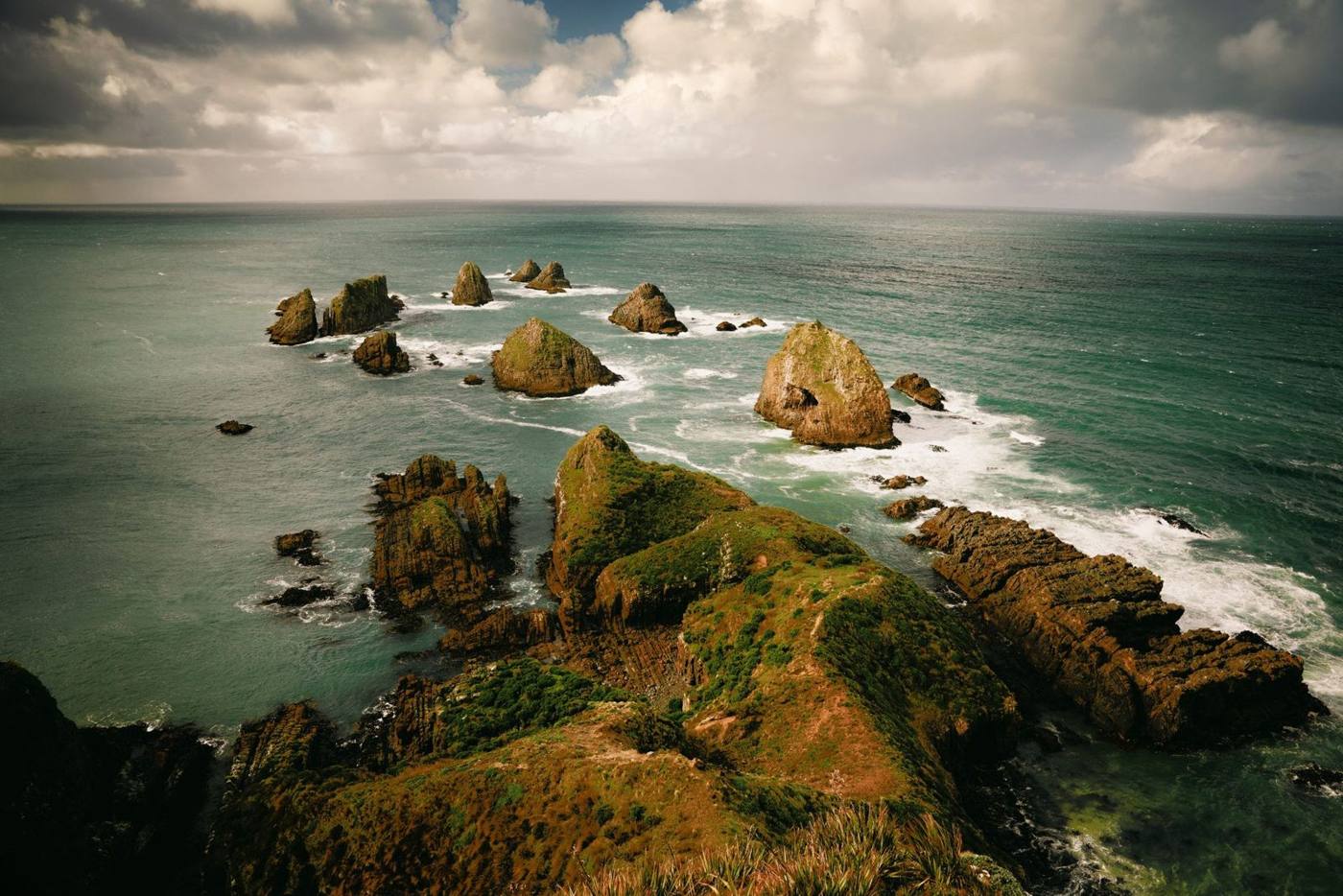 6 daysEasy
The Catlins and Stewart Island
The deep south: Dunedin and the Otago Peninsula with albatrosses and yellow-eyed penguins, the Catlins waterfalls and the wild kiwi of Stewart Island.
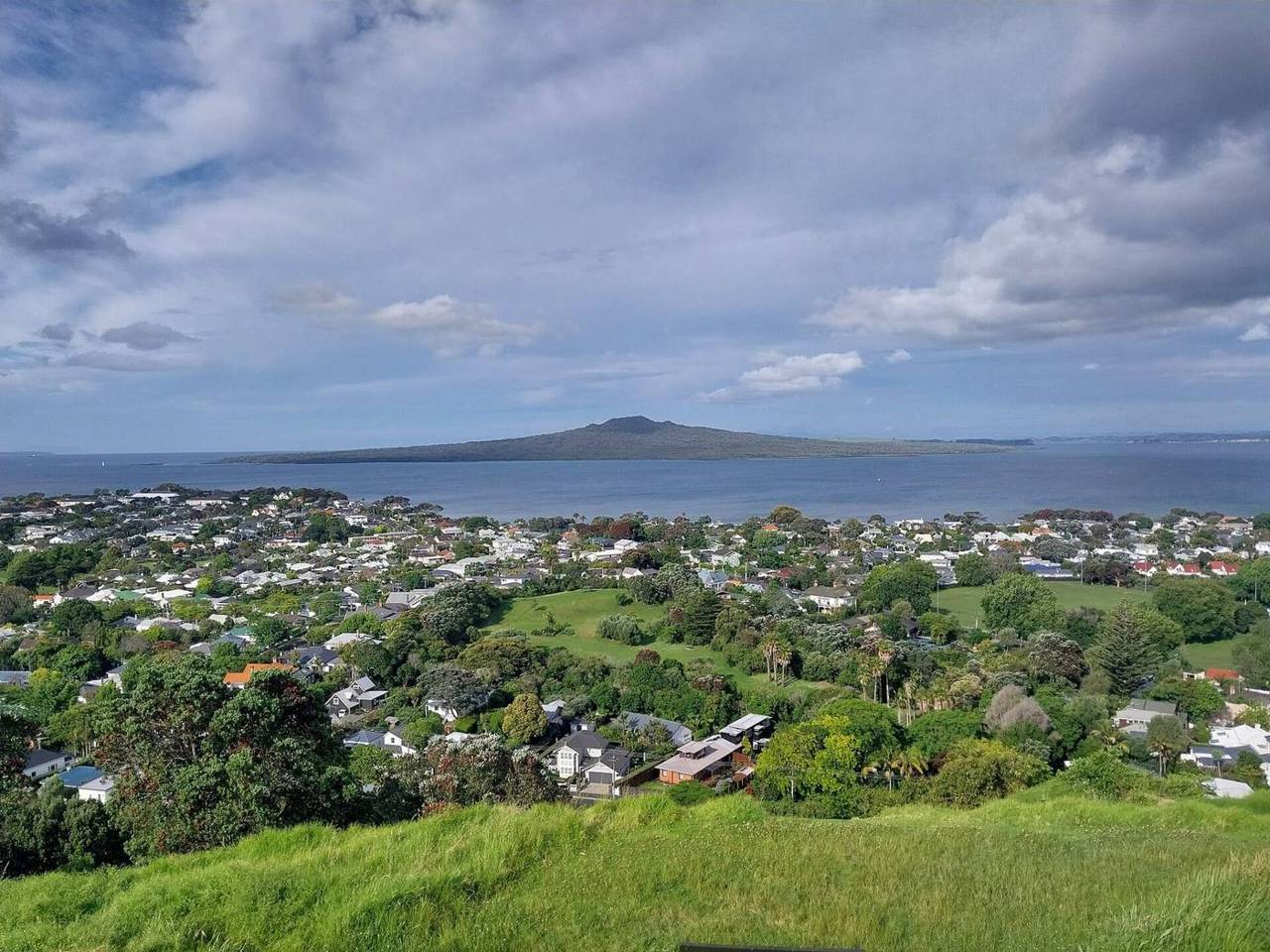 4 daysEasy
Auckland and the Hauraki Gulf
The city of volcanoes and sails: the harbour and the Auckland Museum, the view from the extinct Maungawhau volcano, the ferry to Rangitoto volcano, the beaches and vineyards of Waiheke Island and the bird sanctuary of Tiritiri Matangi, with rare species that have vanished elsewhere.
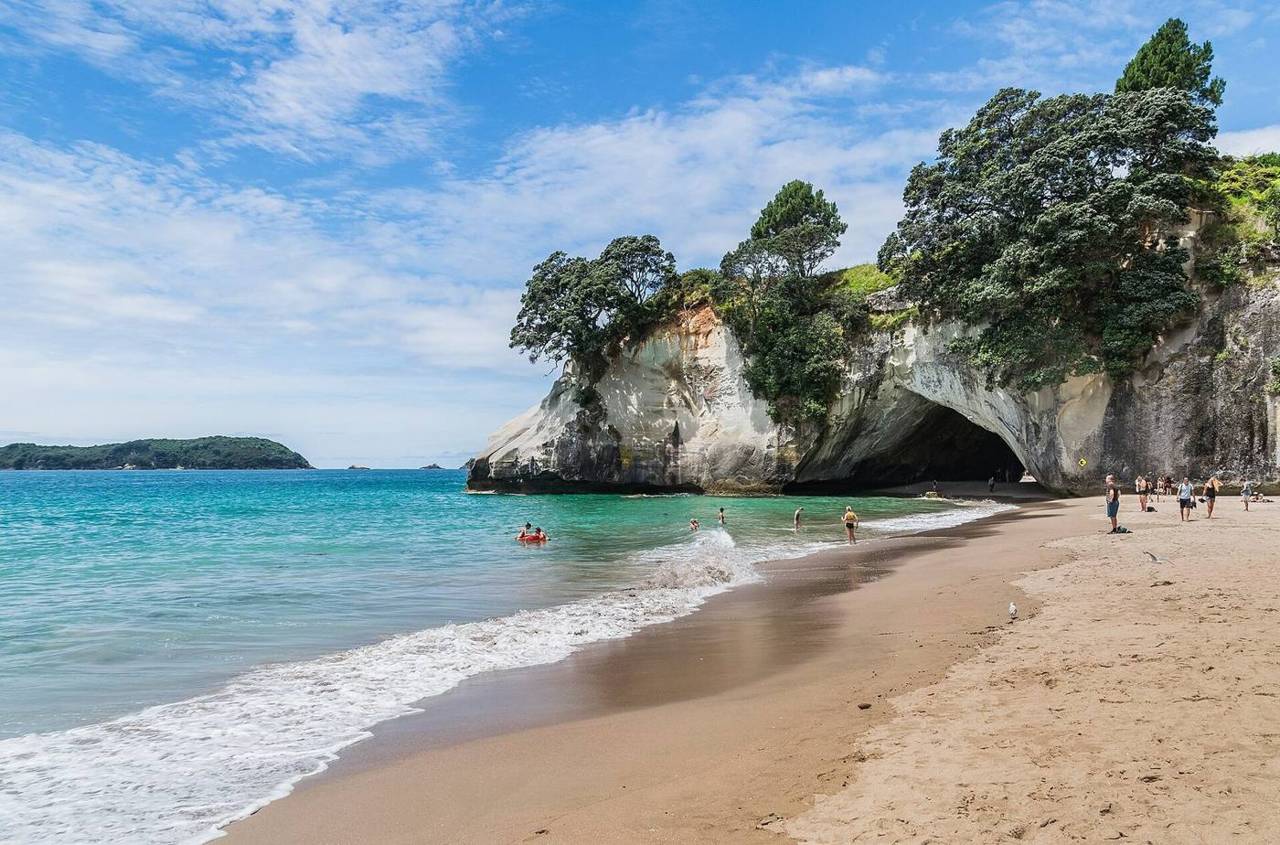 4 daysEasy
The Coromandel Peninsula
The North Island's finest beaches two hours from Auckland: the rock arch of Cathedral Cove, Te Whanganui-A-Hei marine reserve by kayak, Hot Water Beach, where you dig a warm pool in the sand, kauri forests and the coast road to Coromandel Town.