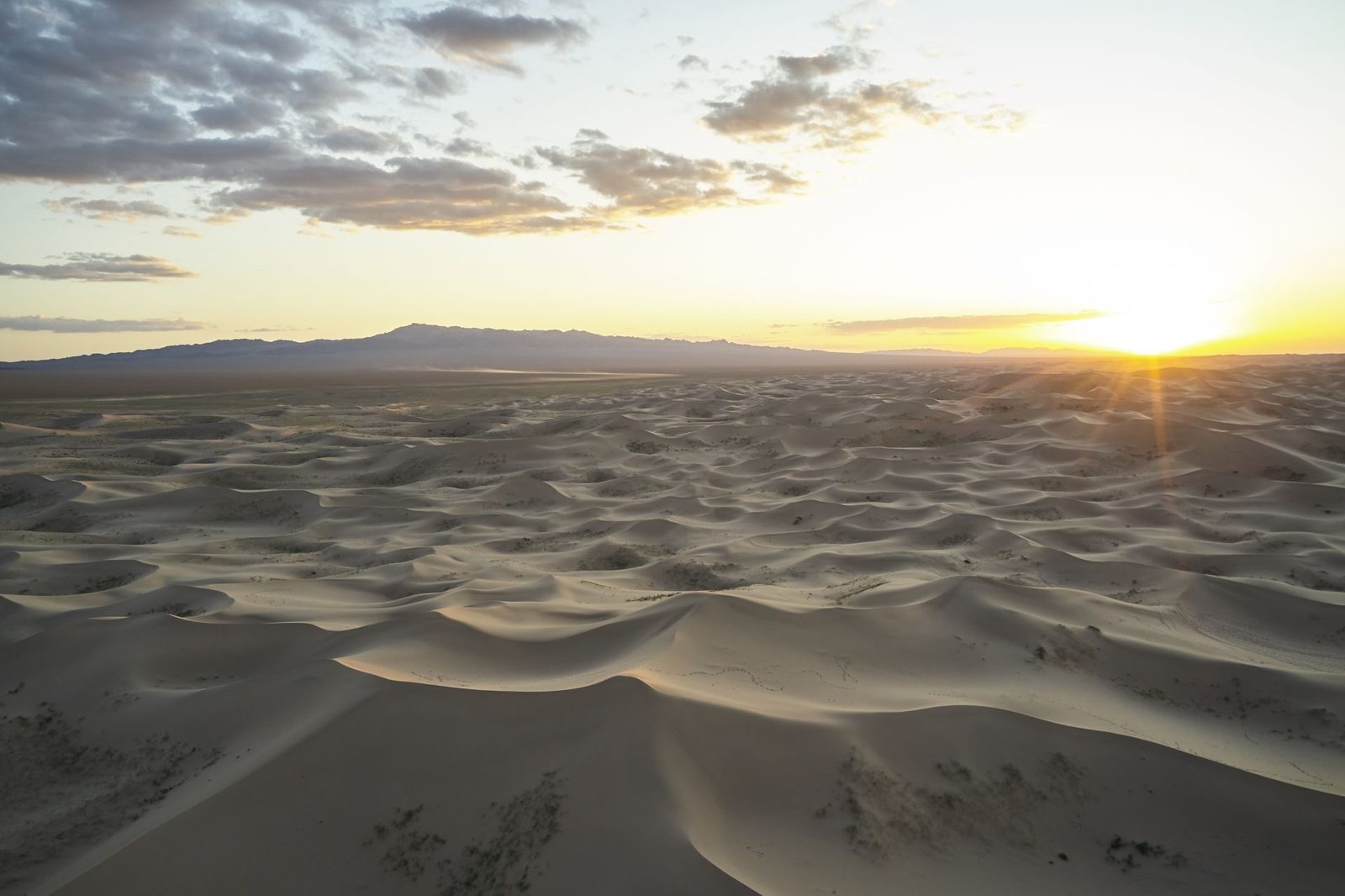
The Gobi
The red Flaming Cliffs of Bayanzag, the singing dunes of Khongoryn Els, the ice canyon of Yolyn Am and the formations of Tsagaan Suvarga, by 4x4 and ger.
- Ulan Bator
- Tsagaan Suvarga
- Yolyn Am
- Khongoryn Els
- Bayanzag
- Ongi
Day by day
- Day 1
Ulaanbaatar, Gandan and the National Museum
This eight-day trip takes you into the Gobi desert, Mongolia's great south: the cliffs of Tsagaan Suvarga, the Yolyn Am canyon, the dunes of Khongoryn Els, the red cliffs of Bayanzag and the ruins of Ongi monastery. You will travel by four-wheel drive on tracks, with a driver and often a cook, and sleep in gers.
Before you go: Italian citizens enter Mongolia with a passport valid for at least six months. The visa exemption for tourism of up to 30 days runs until the end of 2026: for later trips check whether it has been renewed, otherwise apply for a visa at the Mongolian embassy. Other nationalities should check their own rules. Mongolia is a safe country; in Ulaanbaatar watch out for pickpockets in crowded places. In 2026 there have been fuel shortages: allow extra time.
In the morning visit Gandan monastery, the country's most important Buddhist centre. Go into the main temple, home to the great golden statue of Avalokiteshvara, more than twenty metres high, and listen to the monks praying in the temples around it. Check prices and times.
In the afternoon go to the National Museum of Mongolia, which tells the country's story from prehistory to the empire of Genghis Khan and the life of the nomads, with costumes, jewellery and a complete ger. Check prices and times. Then stroll in Sükhbaatar Square, the heart of the capital.
Practical tip: meet your driver in the evening and go through the plan, the water supply and the first aid kit together.
- Day 2
The long road to Tsagaan Suvarga
Today you leave early heading south. After the last houses of the capital the steppe begins, green at first and then drier and drier. The paved road soon gives way to tracks: your driver knows the way even where there are no signs. It is a long stage, with many hours in the car, but you learn to see the Gobi: not just sand, but mostly gravel plains, shrubs and low hills.
On the way you stop for lunch in a village, the centre of a district, with a shop, a petrol station and a small teahouse. If your driver knows a herding family along the road, stop for tea.
In the afternoon you reach Tsagaan Suvarga, the «white stupa»: a long cliff of eroded rock that rises suddenly from the plain. Its layers of white, pink, orange and red tell of millions of years, when this was the bottom of a sea. Walk along the edge and go down carefully into the gullies, but keep away from the brink, which can crumble.
The best light is at sunset, when the rock glows with warm colours. In the evening sleep in a ger nearby.
Practical tip: in the four-wheel drive keep water, sunglasses, a scarf against the dust and something to eat within reach.
- Day 3
Yolyn Am, the ice canyon
Today you continue south-west to Gobi Gurvansaikhan National Park, where mountains rise out of the desert. There is an entry fee: check prices and times. On the way you pass close to Dalanzadgad, the capital of the South Gobi province, where you can refuel.
The afternoon is for Yolyn Am, the «valley of the vultures», a narrow gorge between high rock walls. The name comes from the lammergeier, the great bearded vulture that lives in these mountains. The path follows the floor of the canyon and grows narrower and narrower, between meadows, streams and rocks. You walk for a couple of hours, there and back, on easy ground.
At the end of the gorge, in the shade, a thick layer of ice stays for many months, and it used to last into the summer. In recent years it melts earlier, and in July and August there is often little or none left. Even without the ice the place is beautiful and cool.
Look up: ibex and argali, the great wild sheep, live on the cliffs, and the meadows are full of pikas, small tailless rodents.
In the evening sleep in a ger in the park area. The nights here are cool even in summer, because you are in the mountains.
Practical tip: take a light jacket into the canyon, because in the shade the temperature is much lower than outside.
- Day 4
Towards the dunes of Khongoryn Els
Today you head west, along the mountains, to the dunes of Khongoryn Els. The landscape is one of the finest in the Gobi: gravel plains, black hills and then, on the horizon, a long golden line of sand that grows higher and higher as you approach.
The dunes of Khongoryn Els stretch for many kilometres at the foot of the mountains and some are very high. They are called the «singing dunes», because when the sand slides down from the crest, in the wind or under your feet, it makes a low, deep sound, like the distant noise of an aircraft.
In the afternoon you reach your camp and rest in the ger during the hottest hours. Near the dunes a small river creates a green oasis, where camels, horses and goats graze: a surprising contrast with the sand.
Towards evening visit a family of camel breeders. They will offer you milky tea, perhaps camel's milk yoghurt and dried curd. Watch how they milk the camels and work the wool, which is very warm and soft. If you like, take a short camel ride with them.
At night the desert sky is a spectacle: if there is no moon you see thousands of stars.
Practical tip: in the desert the temperature changes a lot between day and night, so dress in layers and keep a fleece for the evening.
- Day 5
Climbing the dunes and a day with nomads
In the morning get up early to climb the dunes before the heat. With your guide choose the most suitable dune: the climb is hard, because at every step the sand slips back, and on the last stretch you climb almost on all fours. Stop often to catch your breath.
At the top the view is magnificent: on one side the sea of dunes disappearing to the west, on the other the green plain of the oasis and the mountains. Sit on the crest and then run or slide down: this is when you hear the sand «sing» best.
After lunch rest in the ger during the hottest hours. In the afternoon, if you like, take a longer camel ride towards the foot of the dunes, with a camel herder from the family. The two-humped camel is calm but tall: follow the instructions for getting on and off, when the animal kneels.
In the evening go back to the dunes for sunset, when the shadows draw the crests and the sand turns red. Then have a relaxed dinner: the cook often makes tsuivan, fried noodles with meat and vegetables. Before you sleep shake out your shoes and clothes well, because the sand gets everywhere.
Practical tip: to climb the dunes bring water, a hat and light closed shoes, because at midday the sand is burning hot.
- Day 6
Bayanzag, the dinosaur cliffs
Today you travel north-east to Bayanzag, which travellers also call the «Flaming Cliffs». They are cliffs and hills of red and orange sandstone that glow with colour at sunset. On the way you cross areas of saxaul, small twisted desert trees that families use as firewood.
Bayanzag is world-famous for its fossils. Here, in the 1920s, an American expedition found the first dinosaur eggs recognised by science, together with skeletons of many species, such as Protoceratops and Velociraptor. Excavations continue to this day. There is an entry fee: check prices and times.
Walk along the edge of the cliffs and into the gullies with your guide. Do not pick up stones or fragments of bone you find on the ground: fossils are protected by law and it is forbidden to take them out of the country. At the foot of the cliffs there are sometimes souvenir sellers: do not buy real fossils.
Stay until sunset, the finest moment, when the rock turns deep red and the shadows lengthen over the plain. In the evening sleep in a ger nearby. Over dinner ask your guide about the excavations and the expeditions: they are adventurous stories, with motor cars and camel caravans in the desert of the 1920s.
Practical tip: the edge of the cliffs is crumbly, so walk a few metres back from the brink, especially in the wind.
- Day 7
The ruins of Ongi monastery
Today you continue north, gradually leaving the desert. The landscape turns back into steppe, with more grass, herds and gers. In the afternoon you reach the banks of the Ongi river, where the ruins of Ongi monastery stand.
It was once one of the largest monasteries in Mongolia, with many temples and hundreds of monks, on both banks of the river. In 1939, during the religious repression, it was destroyed and many monks were killed. Today you see the ruined walls, the foundations of the temples and a small rebuilt temple, where some monks have returned to pray. There is also a small museum. Check prices and times.
Walk among the ruins slowly and quietly, because for Mongolians it is a place of memory. Then climb the nearby hill to see the whole complex from above, with the river and the steppe around it.
In the late afternoon take a walk along the river, where local families' animals come to drink in the evening. It is the last night in a ger on this trip: enjoy the silence, the fire in the stove and the starry sky. If your driver and cook agree, it is a good evening to have dinner all together and thank them.
Practical tip: ask your guide to tell you the history of the monastery before the visit, so you understand better what you see.
- Day 8
Back to Ulaanbaatar
The last day is a long stage north to Ulaanbaatar. The tracks gradually become paved road and the landscape turns green again. On the way stop for lunch and, if there is time, at an ovoo, a sacred pile of stones on top of a pass: walk round it three times clockwise and add a stone, as Mongolians do for a good journey.
You arrive in the capital in the afternoon or evening, depending on the road and the traffic. Say goodbye to your driver and cook and leave them a tip, which is much appreciated after so many days together.
In eight days you have seen Gandan monastery and the National Museum, the colourful cliffs of Tsagaan Suvarga, the Yolyn Am canyon, the singing dunes of Khongoryn Els with their camels and nomadic families, the dinosaur cliffs of Bayanzag and the ruins of Ongi monastery.
When to go: from June to September. In June and September temperatures are more pleasant; in July and August it can be very hot during the day and there are sometimes sandstorms and sudden thunderstorms. In spring the wind is strong and brings dust, while in winter the Gobi is freezing and many camps are closed.
Practical tip: keep a spare day in Ulaanbaatar before your international flight, because the tracks and fuel supplies can cause delays.
An experience of endless space and nomadic life, with many hours of 4x4 on tracks. Ger camps are simple, with shared bathrooms. It is organised through local agencies in Ulaanbaatar: driver and cook are usually included.
Before you go
- Documents and visa
- Passport valid for at least six months. Italian citizens can enter for tourism without a visa for up to 30 days, but the current exemption runs until the end of 2026: for later trips check whether it has been renewed, otherwise apply for a visa at the Mongolian embassy. Anyone staying more than 30 days must register with the immigration office in Ulaanbaatar within seven days of arrival.
- Health and vaccines
- No vaccinations are compulsory; ask your doctor about hepatitis A and B and tetanus. Drink bottled water, avoid undercooked meat and never eat marmot, because of the risk of plague. Outside the capital medical facilities are limited: bring your own medicines and insurance covering medical costs and repatriation. Emergencies: police 102, ambulance 103, fire service 101.
- Money and payments
- Mongolian tugrik (MNT). By law payments inside the country are made in local currency. Cards work mainly in Ulaanbaatar; carry cash in the steppe.
- Power sockets
- Types C and E, 230 volts: you need an adapter for British plugs.
- Time zone
- UTC+8 all year.
- Safety
- Generally a safe country. In Ulaanbaatar pickpockets work in markets, at bus stops and in crowded places; avoid arguments with drunk people. In 2026 there have been fuel shortages that can affect flights and road travel: allow extra time. Official advice: GOV.UK.
Information checked in November 2026 for Italian and EU citizens. Rules change: always check before you travel.
Variations
In six days: Tsagaan Suvarga, Yolyn Am, Khongoryn Els and Bayanzag, then straight back to Ulaanbaatar.
In eleven days: after Ongi continue to Kharkhorin and the Orkhon valley before returning to the capital.
Frequently asked questions
How many hours on the road are there in the Gobi?
Many: on some days you spend six hours or more in a four-wheel drive on tracks. The driver stops regularly, but you need patience. Always allow extra time.
What are the ger camps like?
Simple: beds, a stove and shared bathrooms, often with showers at limited times. Bring a towel, a torch and wet wipes.
Can I take fossils home?
No. Fossils are protected by Mongolian law and it is forbidden to collect or export them. Never buy real fossils from sellers.
Indicative itinerary written by World Atlas. Before booking, check timetables, seasonal openings, documents and safety.
 7 daysEasy
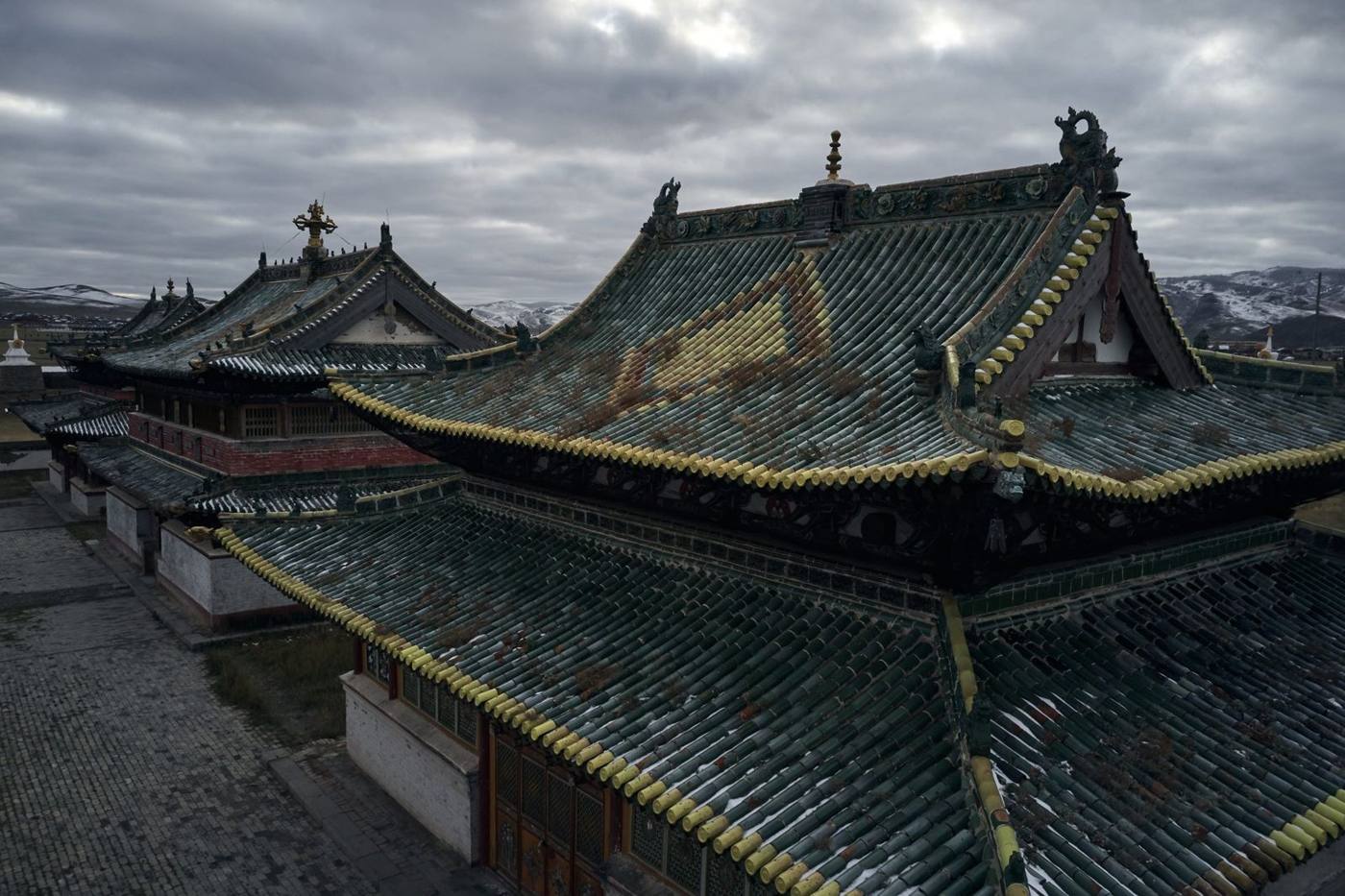
The Orkhon Valley and Karakorum
The Elsen Tasarkhai dunes, Erdene Zuu monastery on Genghis Khan's old capital, the Orkhon waterfall and the Tsenkher hot springs.
 6 daysModerate
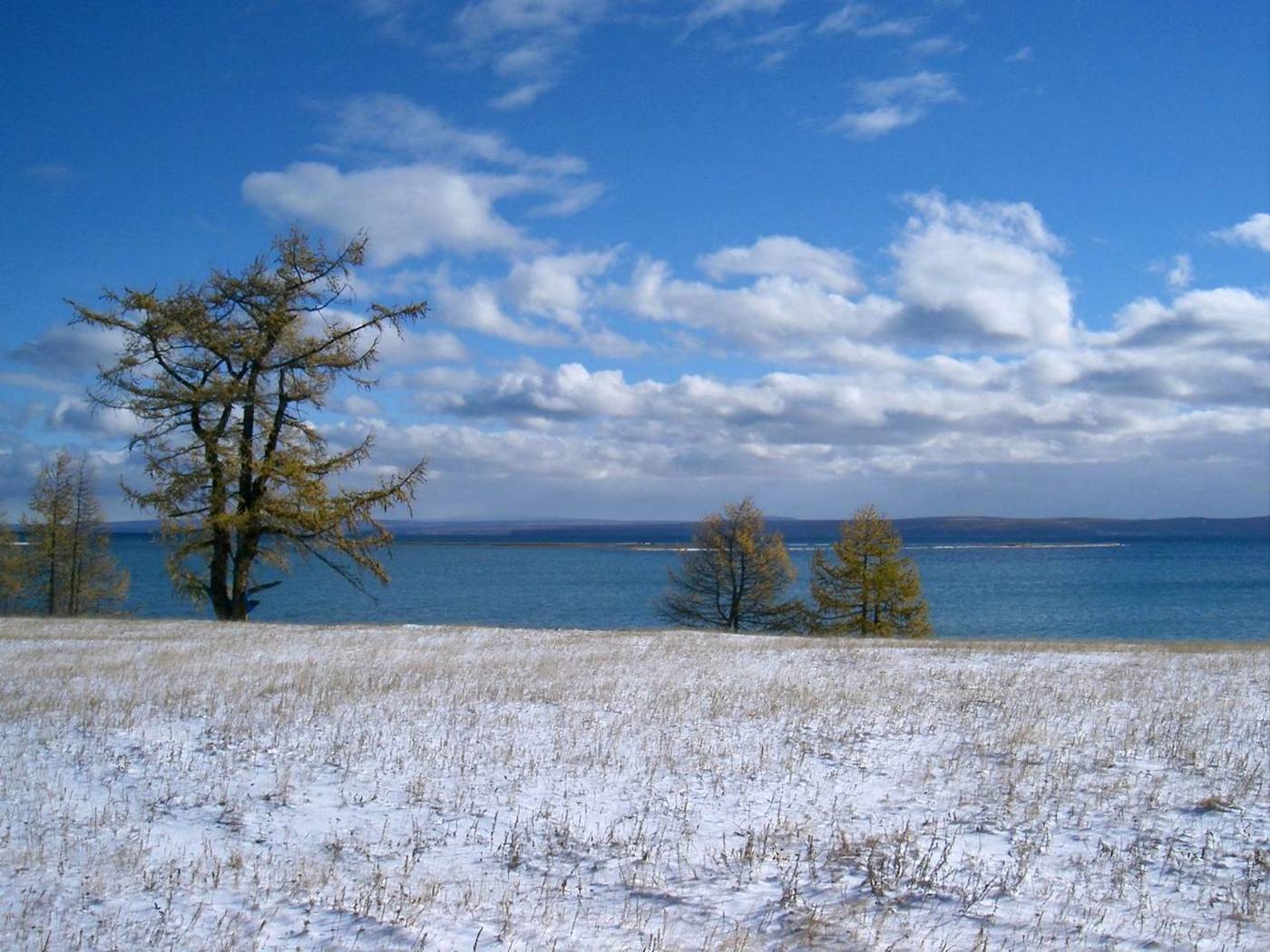
Lake Khövsgöl
The great freshwater lake of the north, larch forests, rides along the shore and the Tsaatan reindeer herders.
 4 daysEasy
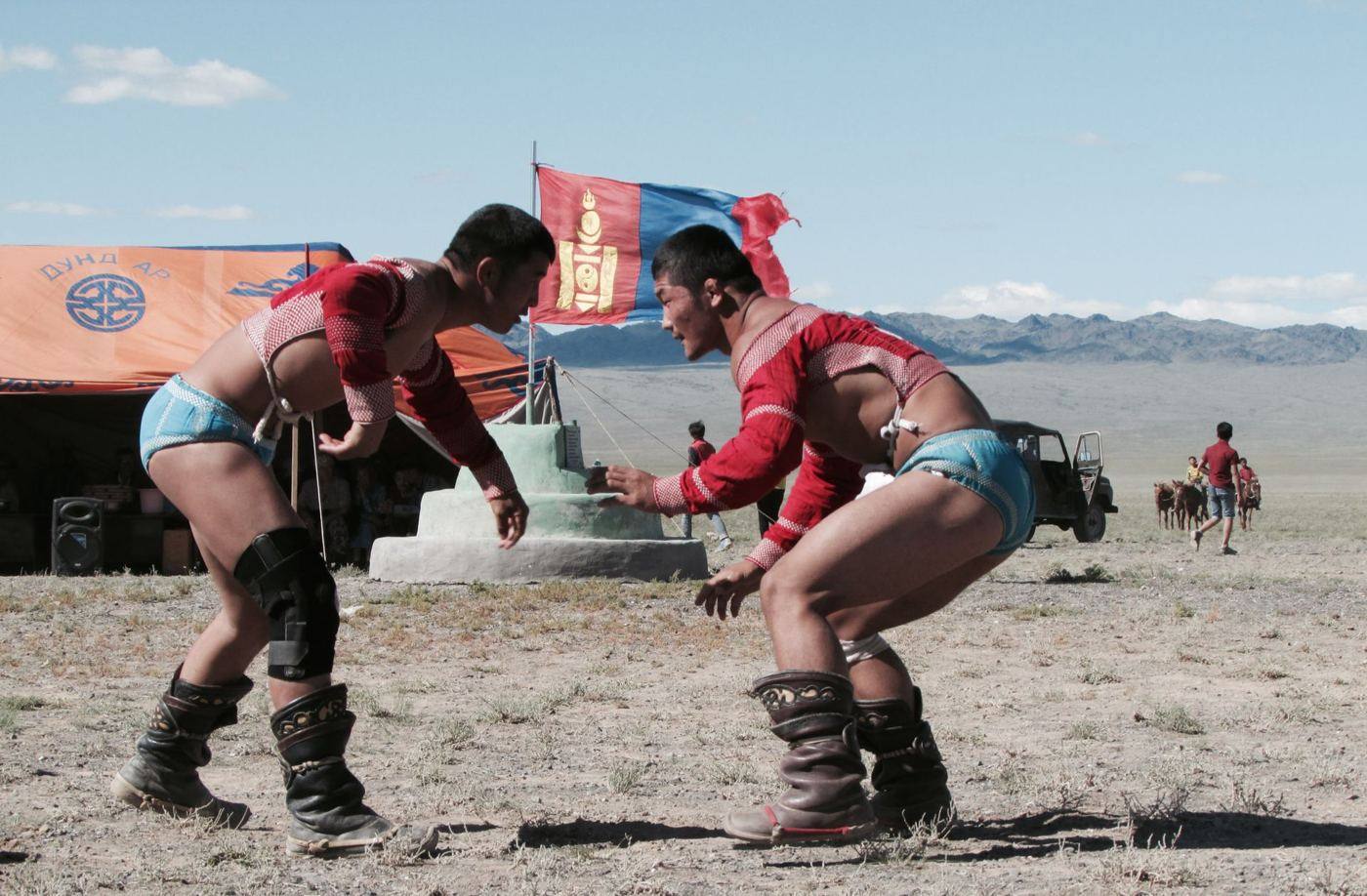
Naadam
The great national festival in July in Ulaanbaatar: the opening ceremony, wrestling, archery and horse races ridden by child jockeys across the steppe.