The Dolomites
Val Gardena and the Alpe di Siusi, Seceda, the Tre Cime di Lavaredo, Lake Braies and Cortina, among mountain huts and Dolomite passes.
- Bolzano
- Ortisei
- Alpe di Siusi
- Seceda
- Passo Giau
- Cortina
- Tre Cime
- Braies
Day by day
- Day 1
Bolzano, Ötzi and the road to Ortisei
Arrive in Bolzano by train or car: the Brenner motorway exit is a few minutes from the centre. The city is where Italy meets the German-speaking world, and you notice it at once in the arcades of Via dei Portici, the bilingual names and the market in Piazza delle Erbe, good for fruit, speck and rye bread. The main visit is the South Tyrol Museum of Archaeology, home to Ötzi, the man who lived over five thousand years ago and was found in the ice of the Val Senales in 1991, with his clothes and tools. Allow about an hour and a half; at busy times there is a queue and it is worth arriving at opening time. The museum closes on Mondays for part of the year: check the calendar.
In the early afternoon take the Renon cable car, which leaves from the centre and climbs to the plateau in twelve minutes: a narrow-gauge train runs towards the earth pyramids, clay columns topped by a boulder. It is an ideal first easy walk.
In the evening drive to Val Gardena, about an hour: Ortisei is the most convenient base for the next days, with wood-carving shops and plenty of accommodation. For dinner try canederli, bread dumplings with speck or cheese, and schlutzkrapfen, half-moon pasta filled with spinach. Practical tip: many places to stay in South Tyrol give guests a pass for local public transport; ask on arrival.
- Day 2
The Alpe di Siusi on foot or by bike
The Alpe di Siusi is Europe's largest high-altitude alpine meadow, a green, rolling plateau beneath the Sassolungo and the Sciliar. During the day the road from Siusi is closed to private cars for anyone not staying on the plateau, so you go up by lift: from Ortisei the gondola reaches Monte Seuc, and from Siusi the gondola goes to Compaccio. In high season go early, before nine, to avoid queues at the lifts.
From Compaccio or Monte Seuc almost level trails lead past huts, haylofts and meadows that flower in June and July. A classic loop heads towards Saltria and the area below the Sassolungo in three or four hours, with stops at mountain huts serving simple food. Those wanting more climbing can go up to the Rifugio Bolzano on the Sciliar, a full day with about 600 metres of ascent. E-bikes can also be hired on the plateau.
On the way down in the afternoon stop at Castelrotto, a village with an onion-domed bell tower and painted houses. In the evening return to Ortisei. Mountain hut food in South Tyrol means alpine cheeses, polenta, Kaiserschmarrn, a shredded sweet pancake with lingonberry jam, and strudel. Tip: weather changes quickly at altitude; always carry a waterproof jacket and check for afternoon thunderstorms, frequent in summer.
- Day 3
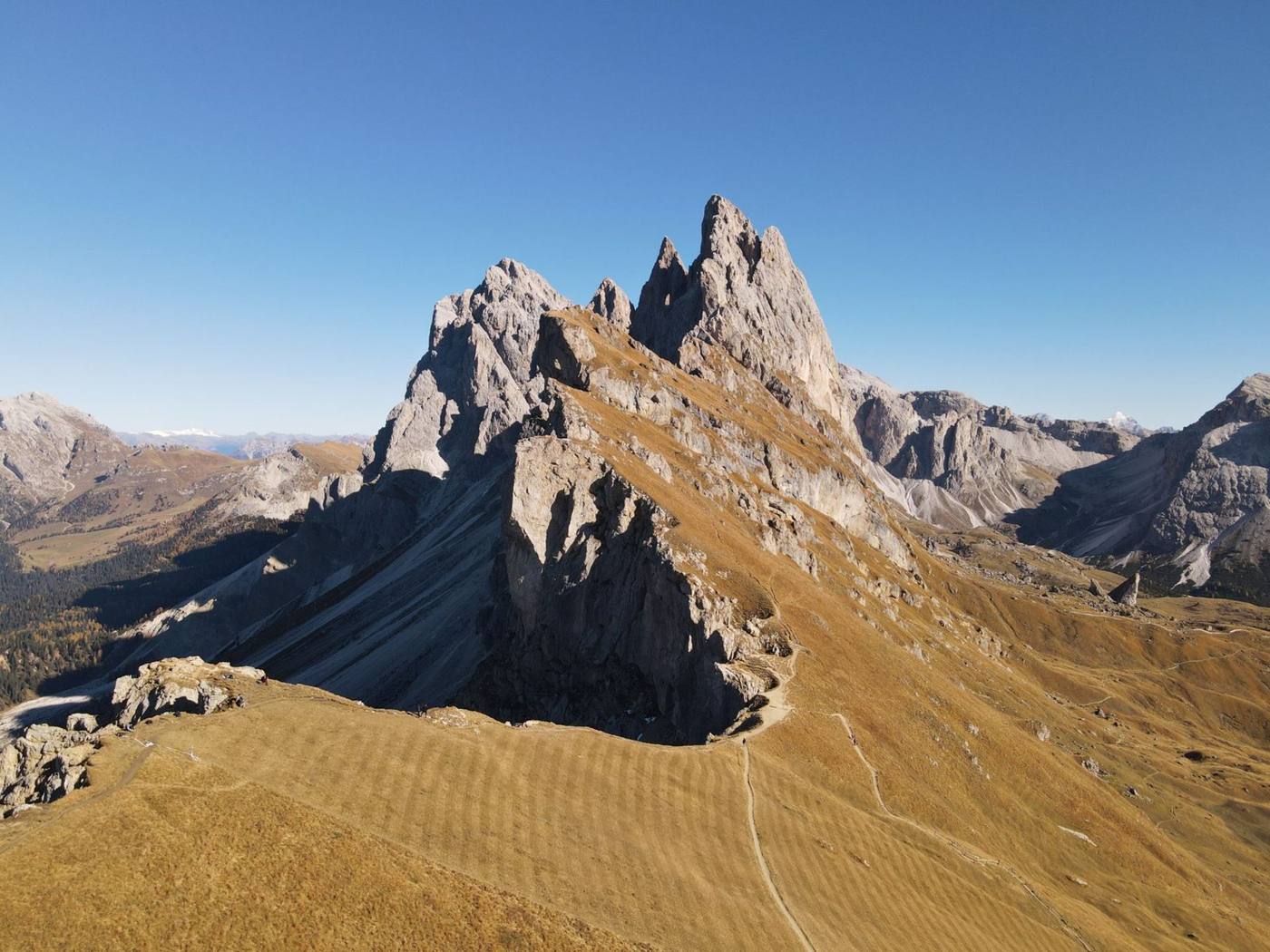
The Seceda and the Odle ridge
The Seceda is the mountain of the Dolomites' most famous photos: a sloping meadow that ends against the vertical spires of the Odle. From Ortisei you go up by gondola to Furnes and then by cable car to about 2,500 metres. Since 22 May 2026 access to the Seceda lifts requires online booking with a time slot, and the return ticket costs 74 euros: book as soon as you have your dates. On the most photographed path, which crosses private pastures, the landowners charge a 5-euro toll; the rock balcony beyond the fence is off limits.
From the top station you can follow the ridge and walk down towards the Rifugio Firenze and Val Gardena, a three- to four-hour route mostly downhill, or do a shorter loop to the huts of Pieralongia. Walking down avoids the queue for the cable car at peak times.
In the afternoon, in Ortisei, visit the Val Gardena museum for the history of wood carving, or rest. In the evening, Val Gardena has small villages such as Santa Cristina and Selva, where Ladin is still spoken and written. Tip: the first lifts of the morning give the best light and fewer people; if the ridge is in fog, postpone the trip, because the view is everything.
- Day 4
Passo Gardena, Passo Giau, the Cinque Torri and Cortina
Today you cross the Dolomites by car from west to east, with short and frequent stops. From Selva climb to the Passo Gardena, at 2,121 metres, between the walls of the Sella and the Cir; then drop to Corvara and the Val Badia, Ladin country, and climb again to the Passo Falzarego. From here a detour leads to the Passo Giau, at 2,236 metres, with a wide view of the Nuvolau and the Marmolada: one of the most beautiful passes and quiet early in the morning.
Around midday take the Cinque Torri chairlift: at the top there is an open-air First World War museum, with reconstructed trenches and posts among the rock towers, which takes an hour and a half. Fit walkers can climb on foot to the Rifugio Nuvolau, above the Passo Giau, in about an hour and a half from the top station.
In the afternoon descend to Cortina d'Ampezzo, in its basin ringed by the Tofane, Cristallo and Sorapiss. Corso Italia is the street for strolling; the church of Santi Filippo e Giacomo has a bell tower over sixty metres high. Stay in Cortina or in nearby villages such as Dobbiaco or San Vito, often cheaper. Dish to try: casunziei, Ampezzo ravioli filled with beetroot, served with butter and poppy seeds. Tip: the passes have tight bends and many motorcyclists at summer weekends; set off early.
- Day 5
The Tre Cime di Lavaredo circuit
The Tre Cime circuit is the most famous walk in the Dolomites: about ten kilometres round the three vertical walls, in three to four hours with little climbing. It starts at the Rifugio Auronzo, at 2,333 metres. The panoramic road up from Lake Antorno is tolled, and since 23 May 2026 driving up and parking require online booking. Alternatively, from 31 May to 11 October 2026 a shuttle bus runs from Dobbiaco to the Rifugio Auronzo, also only with online booking, both ways.
Walk anticlockwise: pass the Rifugio Lavaredo, climb to the Forcella Lavaredo and you get the view of the north faces, the one in the photographs. The Rifugio Locatelli, below Monte Paterno, is a good lunch stop; from there you return to Auronzo along the west side. Those wanting more can descend to the Val Fiscalina and return by shuttle, a five- to six-hour traverse.
In the evening stay in the Val Pusteria, between Dobbiaco and San Candido: from here Lake Braies is close for tomorrow. San Candido has the most important Romanesque collegiate church in the eastern Alps. Tip: even in August the morning temperature at altitude can be close to freezing and the wind is strong; bring warm layers, hiking boots and water, as there are few springs along the circuit.
- Day 6
Lake Braies at dawn and the Val di Funes
Lake Braies is an emerald lake beneath the Croda del Becco, with wooden boats at the jetty. From 1 July to 15 September 2026, between 9 a.m. and 4 p.m., the Braies valley can be reached by car only with an online booking or a transit permit; otherwise take buses 439 and 442, which must also be booked and paid online, or come on foot or by bike. The best option is to arrive at dawn, before nine, when the lake is almost empty and the water still. Walking round the lake takes about an hour and a half.
By mid-morning drive west along the Val Pusteria and then to Bressanone, a bishop's town with a cathedral and frescoed cloister, good for lunch, about an hour and a quarter from Braies.
In the afternoon go up the Val di Funes, a quiet side valley beneath the Odle, seen from the opposite side to the Seceda. At Santa Maddalena the church tower with the mountains behind is one of South Tyrol's signature images; the little church of San Giovanni in Ranui, nearby, is photographed from a viewpoint behind a 4-euro turnstile. An easy path, the Odle trail, runs below the walls. Stay in Funes or Bressanone. Tip: respect the no-entry signs on private meadows; many photographers trample them.
- Day 7
Back to Bolzano or Venice and departure
From the Val di Funes to Bolzano takes about fifty minutes by motorway; to Venice, for those flying from Marco Polo airport, about three hours via Belluno or via the Brenner motorway and Verona. If your flight is in the afternoon, use the morning for a stop.
On the way to Bolzano, stop at Neustift Abbey, near Bressanone: an Augustinian monastery with a baroque library, a cloister and a winery producing the whites of the Isarco valley, such as Sylvaner and Kerner. The guided visit takes about an hour. Alternatively, those heading to Venice can pass Lake Misurina and Cortina, or break the journey in Belluno, a Venetian town with Piazza dei Martiri and a fine view of the Belluno Dolomites.
If you leave Bolzano by train, the station is central and has direct links to Verona and Munich; Bolzano airport has few flights, so many travellers choose Verona, Innsbruck or Venice. Practical tip: return the car with a full tank and allow extra time on mountain roads, which are always slower than maps suggest. Before leaving, buy South Tyrolean speck and alpine cheeses in village shops, vacuum-packed for the journey. In spring and autumn some lifts and huts are closed: check opening dates if you travel out of season.
Among the most beautiful mountains in the world, accessible even to non-climbers thanks to lifts and well-kept trails. In July and August the famous spots are overrun: the road to the Tre Cime is tolled and Lake Braies requires an access booking in high season. For a real trek there is the Alta Via 1, taking 8-10 days.
Before you go
- Documents and visa
- EU citizens only need a valid identity card or passport; hotels and guesthouses must register it on arrival. Other nationalities should check the visa rules for the Schengen area.
- Health and vaccines
- No vaccines required. EU citizens should bring their European Health Insurance Card (EHIC). Emergency number: 112.
- Money and payments
- Euro. Cards are accepted almost everywhere; many cities charge a tourist tax per night, paid directly at your accommodation.
- Power sockets
- Types C, F and L, 230 volts.
- Time zone
- Central European Time (UTC+1), summer time (UTC+2) from the last Sunday of March to the last Sunday of October.
- Safety
- A safe country. In big cities and on crowded public transport watch out for pickpockets. Emergencies: 112. Official advice: GOV.UK.
Information checked in November 2026 for Italian and EU citizens. Rules change: always check before you travel.
Variations
In 5 days: Ortisei and the Alpe di Siusi on day one, the Seceda on day two, the passes and Cortina on day three, the Tre Cime on day four, Braies at dawn and departure on day five. You skip Bolzano and the Val di Funes.
In 10 days: add the Val di Fassa with the Catinaccio and Lake Carezza, the Marmolada with the Punta Rocca cable car, and two days of hut-to-hut trekking on the Alta Via 1, for example from Braies to the Rifugio Fanes.
Frequently asked questions
Do I need to book anything before going?
Yes, in summer. In 2026 online booking was needed for the Seceda lifts, for driving up the Tre Cime road and for the shuttle from Dobbiaco, and for driving into the Braies valley between 9 a.m. and 4 p.m. from 1 July to 15 September. The rules change every year: check the official websites before you go.
Do I need to be fit?
No. Every walk on this trip has an easy version thanks to the lifts. Hiking boots and some habit of walking three or four hours are enough. Via ferratas and the Alta Via, on the other hand, require experience or a mountain guide.
When is the best time?
From mid-June to the end of September, when lifts and huts are open. July and August are the busiest months, with more afternoon storms; September brings clear skies and fewer people. At the end of June the meadows are in flower.
Indicative itinerary written by World Atlas. Before booking, check timetables, seasonal openings, documents and safety.
 8 daysEasy
Naples, Pompeii and the Amalfi Coast
Naples and its pizza, the excavations of Pompeii and Herculaneum, Vesuvius, Positano and Amalfi, the Path of the Gods and the island of Capri.
 8 daysEasy
Eastern Sicily
Catania and Etna, Taormina, Syracuse and Ortigia, the baroque of Noto, Modica and Ragusa, the Vendicari reserve.
 9 daysEasy
Puglia and Matera
Old Bari, the trulli of Alberobello, the Itria Valley, the Sassi of Matera, the baroque of Lecce and the sea of Salento.